
Torus Foundry is the newest answer to the AI industry’s most expensive problem: power. Torus, a Salt Lake City energy-storage company, announced on November 11, 2026 that it has raised $500 million in growth capital to launch Foundry, a prefabricated AI data center that plugs into power the grid already has — no new plants, no new transmission lines, no years-long wait.
The pitch is simple. Most AI companies bring power to the chips, which means building a giant campus and waiting years for a grid connection. Torus does the opposite. It puts the chips where spare power already sits: factories, warehouses and commercial sites with unused capacity at their transformers. A Foundry site goes from signed contract to running AI workloads in 12 to 16 weeks.
What Torus just announced
Torus launched Foundry on November 11, 2026 alongside the $500 million raise, led by Magnetar with ICONIQ, Origin Ventures, Ridgeline Partners and Trinity Capital participating. Bloomberg, which first reported the round, describes it as a Series C. Torus did not disclose its valuation.
Foundry is modular AI inference compute. Training is how a model learns; inference is the model doing its job every time someone uses AI. Inference is where demand is growing fastest, and it does not need one giant campus. It needs smaller blocks of compute in many places at once — which is exactly what a container-sized unit delivers.
“Inference doesn’t have to wait. We’ve spent years learning how to make the grid more affordable, flexible, resilient, and intelligent, and Foundry applies that to compute: capacity in weeks, with power that’s already available. Most providers are bringing power to the chips. Foundry brings the chips to power.” — Nate Walkingshaw, Founder and CEO of Torus, November 11, 2026
Foundry by the numbers
The launch materials give Foundry hard numbers, not vague promises. The table below comes from Torus’s own announcement, with the per-unit GPU count attributed to Bloomberg’s reporting of the round.
Torus Foundry: the launch facts
| Funding | $500 million in growth capital, led by Magnetar; ICONIQ, Origin Ventures, Ridgeline Partners, Trinity Capital |
| Capacity per site | 1 to 20 megawatts of inference compute; smallest unit roughly the size of a small cargo van |
| Time to running AI | 12 to 16 weeks from contract to token; site prep about a week, install one to two days |
| GPUs per unit | 576 Nvidia HGX B300 GPUs in about 577 square feet, running on 1.2 megawatts (Bloomberg) |
| GPUs deployed | Thousands running today; more than 47,000 planned by the end of 2027 |
| First customers | Hydra Host and a second, unnamed AI cloud provider |
| Factory | GigaOne, Salt Lake City: 545,000 sq ft; a new production line every 21 days in 2026; Foundry line rated at 500 MW of IT load, expanding to 1 GW |
| Water use | Closed-loop cooling is waterless: 95% less water than evaporative coolers |
Sources: Torus: Torus Launches Modular AI Infrastructure, Foundry, Torus: Introducing Torus Foundry.
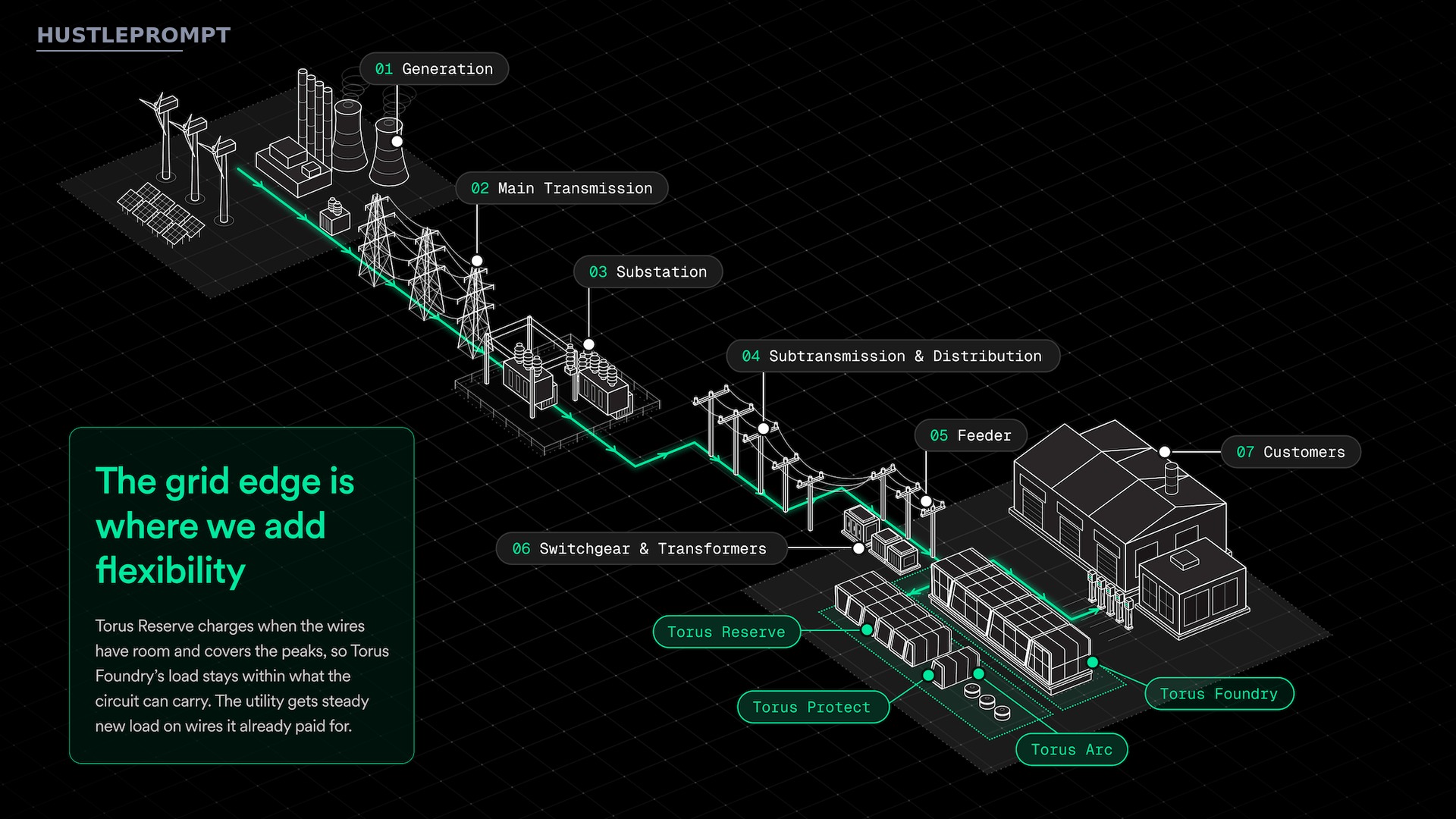
Every Foundry unit pairs with Torus Reserve, the company’s energy storage and management system. AI inference load hits the grid in spikes, like a heartbeat on a monitor. Reserve — flywheel plus battery storage — smooths those spikes into steady load, so the grid sees a well-behaved customer instead of a problem. It also covers demand peaks so more compute fits on the same connection, and provides backup power during outages.
Torus explains why it built Foundry in “Why we built Torus Foundry | Modular inference compute” (Torus on YouTube).
Why the grid is the real AI bottleneck
The AI buildout has a power problem that money alone cannot fix quickly. A traditional hyperscale campus needs new generation, new transmission and a place in an interconnection queue that can run for years. Torus argues the grid is not out of power — it is congested. Unused capacity sits between substations and existing commercial and industrial buildings, and Foundry is designed to use it.
The demand shift behind Foundry is from training to inference. McKinsey projects data center demand for AI inference will grow 35% a year through 2030, compared with 22% for training, according to Torus’s launch release. Inference runs continuously, serves users in real time, and works better distributed close to demand — which favors many small sites over one mega-campus.

Foundry vs. a traditional hyperscale campus
| Time to online | Foundry: 12–16 weeks from contract. Traditional campus: years, including a years-long interconnection queue. |
| Power source | Foundry: spare capacity at existing transformers, behind the meter. Traditional: new generation and transmission buildout. |
| Construction | Foundry: prefabricated, no building construction; install takes a day or two. Traditional: full campus construction on site. |
| Cooling | Foundry: closed-loop, waterless, 95% less water than evaporative coolers. Traditional: evaporative cooling at data-center scale. |
| Scale | Foundry: 1–20 MW per site, distributed. Traditional: hundreds of MW in one place. |
| Control | Foundry: single-tenant Direct model gives one customer exclusive hardware. Traditional: shared tenancy is the norm. |
Source: Torus launch release, November 11, 2026. Timelines and contrasts are Torus’s own framing.
Three ways to buy Foundry
Torus is selling Foundry in three models, which matters if you run a business that needs AI compute but cannot wait for a data center:
- Strategic: a powered shell with power and enclosure, without GPUs. You bring your own hardware.
- Partner: a turnkey bare-metal unit with power, enclosure and GPUs included.
- Direct: sovereign inference capacity sold straight to an enterprise. Single-tenant hardware is allocated exclusively to that company’s workload.
Torus vertically integrates the whole stack — Reserve for load shaping and redundancy, Foundry for inference compute, and Torus Protect for networking and security — and provides ongoing operations and maintenance. The company has nearly 400 employees at GigaOne, and each Foundry system also donates GPU time to medical research through Folding@home.
How to profit from the inference buildout
Torus is private, so there is no ticker to buy. The money angle is the shift it represents: inference is moving out of mega-campuses and into distributed sites, and that creates work for people who can serve it.
- Sell to the bottleneck. If you do electrical, site prep or facilities work, modular sites need local crews: a week of site prep and a one-to-two-day install per unit, repeated at hundreds of sites. Foundry’s own timeline is the sales pitch.
- Rent inference, don’t build it. If your product burns GPU hours — AI agents, video generation, voice apps — a distributed inference supplier that comes online in weeks is leverage in your next vendor negotiation. Ask your provider what their lead time is, then compare it with 12 to 16 weeks.
- Watch the suppliers, not just the labs. Magnetar led this round, and ICONIQ, Origin Ventures, Ridgeline and Trinity Capital joined. When that group of investors backs the same infrastructure twice — Magnetar pledged $200 million to Torus in September 2025 — the direction of travel is worth tracking in your own portfolio research.
- Price the power story. Inference demand growing 35% a year means the winners are whoever can deliver compute where power already exists. Any AI service you sell gets cheaper when its compute stops waiting on the grid.
Torus identifies sites with unused headroom at their transformer — factories, warehouses, commercial buildings.
The Foundry unit is prefabricated in Salt Lake City with power, storage, cooling, networking and compute inside.
Site prep takes about a week; installation and commissioning take one to two days. No building construction.
Reserve smooths the load, the site runs AI workloads, and the contract-to-token clock stops at 12 to 16 weeks.
Frequently asked questions
What is Torus Foundry?
Foundry is modular AI inference compute from Torus, launched November 11, 2026. It packages power, storage, cooling, networking and compute into one prefabricated unit that runs on electricity a site already has, delivering 1 to 20 megawatts per site.
How much did Torus raise?
$500 million in growth capital, led by Magnetar, with ICONIQ, Origin Ventures, Ridgeline Partners and Trinity Capital participating. Bloomberg, which first reported the round, describes it as a Series C. Torus will use the money to expand its GigaOne factory in Salt Lake City and deploy Foundry and Reserve systems across the United States.
How fast can a Foundry site go live?
12 to 16 weeks from contract to running AI workloads, according to Torus. Site preparation takes about a week, and installation and commissioning take one to two days. A traditional hyperscale campus can take years, largely because of grid interconnection queues.
How many GPUs does one Foundry unit hold?
Bloomberg reported that each Foundry container holds 576 Nvidia HGX B300 GPUs in about 577 square feet and runs on 1.2 megawatts. Torus says thousands of GPUs are already deployed in Foundry units, with a target of more than 47,000 by the end of 2027.
Who are Foundry’s first customers?
Hydra Host, an AI infrastructure company, and a second AI cloud provider that Torus has not named.
Is Torus a public company?
No. Torus is a private company headquartered in Salt Lake City, Utah, founded in 2021. It has earned a TIME Best Invention award, a 2025 R&D 100 Award, a 2026 Energy Storage award from Reuters, Fast Company’s Next Big Things in Tech 2026, and the 2026 Battery Manufacturer of the Year award from The Battery Show.