
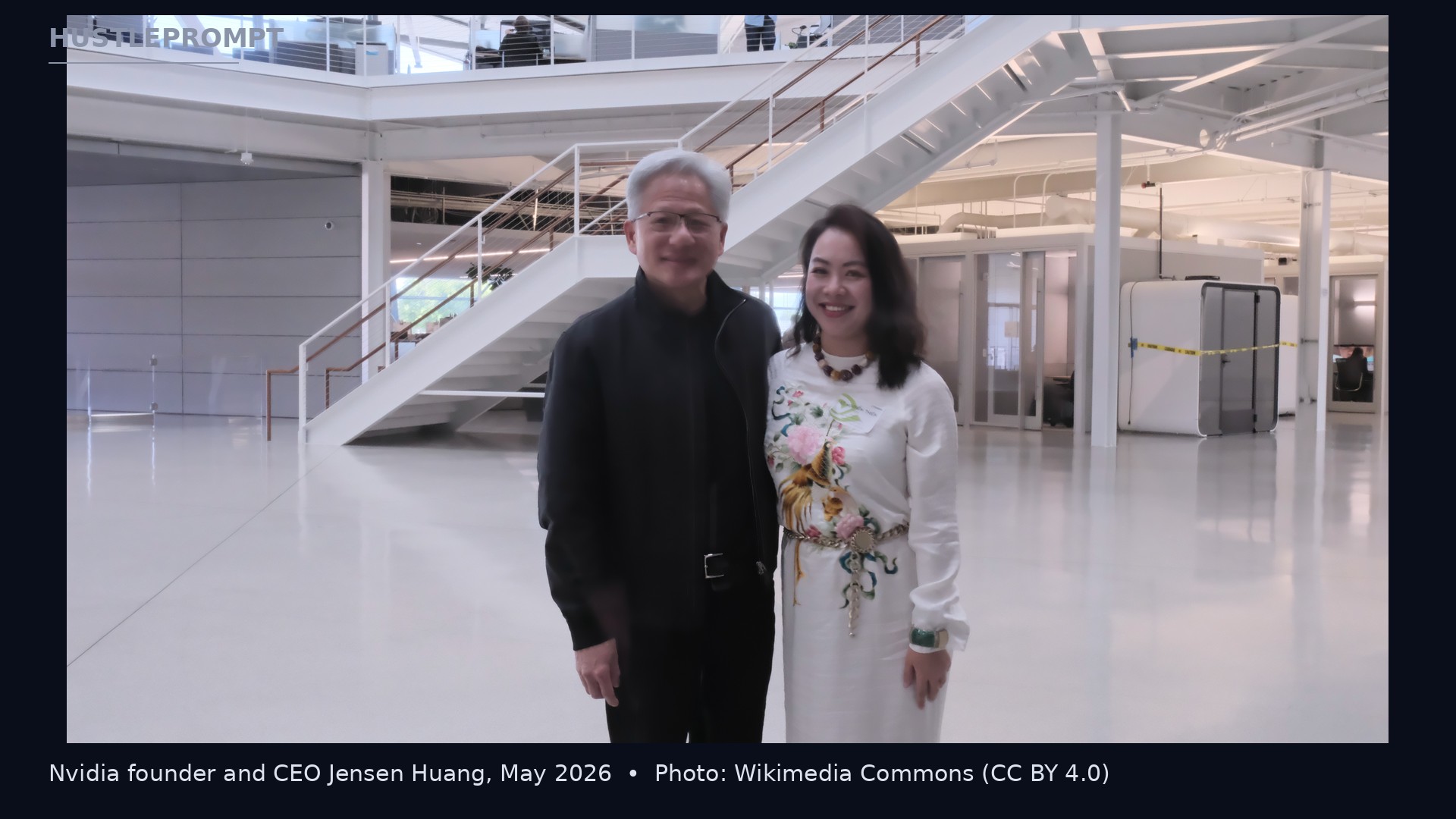
Nvidia Jensen Huang ouster talk turned real on Wednesday night. The Wall Street Journal reported that Nvidia’s board is preparing to remove Huang as chief executive — the only CEO the company has had since he co-founded it in 1993. Shares fell about 8% in after-hours trading, on top of a week that has already wiped roughly $600 billion off Nvidia’s market value.
The report landed minutes after The New York Times said Huang had a relationship with Kimberly Powell, Nvidia’s vice president of healthcare — an executive who reports directly to him. The Times cited five people who have worked at Nvidia. Powell joined the company in 2008 and has led its healthcare work since 2017.
What happened on Wednesday night
Two reports, minutes apart, changed the question facing Nvidia’s board. It is no longer only whether Huang was targeted by a foreign intelligence operation. It is whether he keeps his job.
- The New York Times reported that Huang had a relationship with Powell, and that the two were seen being affectionate at a hotel in San Jose during a company conference in March.
- The Wall Street Journal reported at 22:44 UTC that the board is preparing to oust Huang and could meet as soon as Wednesday to decide his future, citing people familiar with the matter.
- Nvidia declined to comment. As of early Thursday, no decision had been announced and no interim chief executive had been named.
- Shares dropped to about $160 in after-hours trading, roughly 8% below Wednesday’s close of $173.73.
Huang told staff in a memo on November 8 that he had been unfaithful to his wife, without naming anyone. It is not known whether the relationship he referred to is the one the Times described, or a separate one.
The week NVDA lost about $600 billion
The market had already been punishing Nvidia all week — before either Wednesday report landed.
The week in NVDA
| Monday, Nov 9 | Shares fell 4.3% as the scandal widened |
| Tuesday, Nov 10 | Shares fell 5.5% as the board hired outside counsel |
| Wednesday, Nov 11 | Shares closed at $173.73, up 2.9%, in regular trading |
| Wednesday after hours | Shares fell to about $160, roughly 8% below the close |
| Week total | About $600 billion in market value gone this week |
Sources: Reuters: Nvidia is preparing to oust CEO Jensen Huang, WSJ reports. After-hours prices are indicative and move fast.
Nvidia is worth roughly $4 trillion, which makes it the world’s most valuable company by market value. A drop of this size in a single week is rare for a stock of that scale. It shows how much of Nvidia’s value investors tie to one person — and how fast that premium can vanish when the board itself loses confidence.
How we got here
The crisis started with a relationship outside the company. It escalated when a second one, inside it, was reported.
- Late October: first reports said Huang had a relationship with Alice Huang, an executive at Singapore-based Megaspeed. US intelligence believes she was recruited by China’s Ministry of State Security, according to the reports. She has not been charged, and China denies the allegation.
- Sunday, Nov 8: Huang told employees in a memo that he had been unfaithful to his wife. The same day, Nvidia’s board opened an independent investigation into whether he had been targeted by a foreign intelligence operation.
- Monday, Nov 9: a shareholder filed a proposed class action, Kistenmacher v. Nvidia Corp., in federal court in California.
- Tuesday, Nov 10: the board’s independent directors hired former acting US Attorney Joon H. Kim and the law firm Wachtell, Lipton, Rosen & Katz to run the investigation.
- Wednesday, Nov 11: the Times reported the Powell relationship. The Journal reported the board is preparing to remove Huang.
“While the Board has no reason to believe that either national security or NVIDIA secrets were compromised, the Board’s inquiry will examine all available information.” — Nvidia board statement, November 8, 2026
“The Board has confidence in Jensen and his leadership team.” — Nvidia board statement, November 8, 2026
Read those two lines again. On Sunday, the board publicly backed Huang. Three days later, it was reportedly preparing to remove him. The Powell report is the difference: a relationship with a direct report raises a different kind of question than a relationship with an outsider — and it is one the board can judge for itself.
The Justice Department has reportedly taken over the federal investigation into Megaspeed. And three Republican House committee chairs asked Huang to attend a closed-door briefing on November 18 — or face a subpoena. Representative Brian Mast, who chairs the House Foreign Affairs Committee, said he would issue one “absolutely” if Huang does not respond. Huang had until Wednesday to answer. By Wednesday evening, neither he nor Nvidia had replied publicly.
The succession problem
Removing Huang would be easy to announce and hard to execute. Nvidia has no obvious successor.
- Huang co-founded Nvidia in 1993 and has been its chief executive ever since. He is the only one of its 11 directors who is not independent, and he sits on none of the board’s committees.
- The company’s 2026 proxy statement says nothing about succession planning for the chief executive. Its latest annual report warns investors directly: “Failure to ensure effective succession planning, transfer of knowledge, and smooth transitions involving executives and key employees could hinder our strategic planning, execution, and long-term success.”
- Huang owns about 3.6% of Nvidia’s stock, including shares held by his foundation. BlackRock holds 7.43% and Vanguard 7.31%. Each share carries one vote — Huang holds no shares with extra voting rights.
- Semafor reported that some directors favor naming chief financial officer Colette Kress as interim chief executive. Bloomberg reported the board is working with an outside firm to identify replacements.
“Huang being removed immediately could be challenging for Nvidia since it does not have a succession plan in place… If Mr. Huang broke the law or violated company policies, the board is likely to act as soon as they have proof.” — Gil Luria, D.A. Davidson
Patrick Moorhead of Moor Insights & Strategy said there is “no planned successor” — but added that Nvidia’s product plans are already set for years, which limits the short-term risk of a change at the top.
Other boards have moved fast in similar cases. Intel’s Brian Krzanich resigned in 2018 after a past relationship with an employee. Norfolk Southern fired Alan Shaw in 2024. Nestlé dismissed Laurent Freixe in 2025 over an undisclosed relationship with a direct subordinate. None of those chief executives founded the company they ran — and none of the cases involved a national security allegation.
Baird downgraded Nvidia shares to Neutral on Wednesday morning, before the two reports, with analyst Tristan Gerra saying he would wait until uncertainties around the CEO’s tenure clear.
Confirmed vs. reported
| Board opened an independent investigation | Confirmed — Nvidia board statement, Nov 8 |
| Wachtell Lipton and Joon H. Kim hired | Confirmed — independent directors’ statement, Nov 10 |
| Huang admitted unfaithfulness to staff | Confirmed — Huang memo, Nov 8 |
| Shareholder class action filed | Confirmed — court filing, Nov 9 |
| Board preparing to oust Huang | Reported — Wall Street Journal, Nov 11 |
| Relationship with Kimberly Powell | Reported — New York Times, Nov 11 |
| Colette Kress as possible interim CEO | Reported — Semafor |
| DOJ took over Megaspeed investigation | Reported — press reports |
Sources: Nvidia: Statement From NVIDIA Board of Directors, November 8, 2026, Reuters.
Huang admits unfaithfulness to staff. The board opens an independent investigation and publicly backs him.
Independent directors hire Joon H. Kim and Wachtell, Lipton, Rosen & Katz to run the investigation.
The Times reports the Powell relationship. The Journal reports the board is preparing to oust Huang.
Directors meet to decide Huang’s future. Shares fell about 8% after hours. No decision announced yet.
Nvidia reports Q3 results on Nov 17. The House briefing Huang was asked to attend is Nov 18.
What AI investors should watch next
Nvidia reports third-quarter results on November 17 — the day before the House briefing Huang was asked to attend. Those are the next hard dates. Here is what to watch:
- Any board announcement. The decision, the interim name, and the wording on why. A removal “for cause” versus a resignation would mean very different things for Huang’s exit package and for the shareholder lawsuit.
- The interim name. If Colette Kress takes over, watch whether the board signals a permanent search or a long interim stretch.
- Earnings on Nov 17. Guidance on AI chip demand matters more than the governance story for the stock’s long-term direction — but expect every analyst question to be about the CEO.
- The Nov 18 briefing. If Huang is subpoenaed, the national security angle stays in the headlines whatever the board decides.
- Roadmap signals. Analysts say Nvidia’s product plans are set for years, so a CEO change should not delay chips in the near term. Any slip in Blackwell or Vera Rubin timelines would be the real red flag.
This article reports the news as it stands. It is not investment advice, and no decision has been announced yet. The story is moving fast — the board could speak at any moment.
Frequently asked questions
Is Jensen Huang still Nvidia’s CEO?
Yes. As of early Thursday, November 12, no decision had been announced and Huang remained chief executive. The Wall Street Journal reported the board is preparing to remove him, but Nvidia has not confirmed the report.
Why would the board remove Huang?
According to the Journal’s report, the board is preparing to oust him after reports of two extramarital affairs — one with a woman US intelligence believes was recruited by China, and one with Kimberly Powell, an Nvidia vice president who reports to him. No finding has been made that Huang broke the law or any company policy.
How far has Nvidia stock fallen?
Shares fell 4.3% on Monday and 5.5% on Tuesday, recovered 2.9% to close at $173.73 on Wednesday, then dropped about 8% to roughly $160 in after-hours trading. About $600 billion in market value has been lost this week.
Who would replace Huang?
No successor has been named, and Nvidia’s 2026 proxy statement says nothing about CEO succession planning. Semafor reported that some directors favor chief financial officer Colette Kress as interim chief executive, and Bloomberg reported the board is working with an outside firm to identify replacements.
Will this affect Nvidia’s AI chips?
Not in the near term, according to analysts. Patrick Moorhead of Moor Insights & Strategy said Nvidia’s product plans are already set for years. The risk is governance and execution over time — not a sudden delay to chips already on the roadmap.
What happens next?
Three dates matter: the board’s decision, which could come at any moment; Nvidia’s third-quarter results on November 17; and the House briefing on November 18, which Huang was asked to attend or face a subpoena.
Keep Reading
- NVIDIA Board Probes CEO Huang Over Spy Reports — the November 8 investigation that started this crisis, and what the board said then.
- NVIDIA Invests $3B in Meta as Muse Deal Expands — the $3 billion bet Nvidia placed on Meta’s AI just weeks before the scandal broke.
- NVIDIA OpenShell: The Safe-Agent Stack for Businesses — Nvidia’s open-source security runtime for autonomous agents, and why it matters for AI deployment.
Sources: Reuters: Nvidia is preparing to oust CEO Jensen Huang, WSJ reports; Nvidia: Statement From NVIDIA Board of Directors, November 8, 2026; reporting from The Wall Street Journal, The New York Times, Semafor and Bloomberg.