
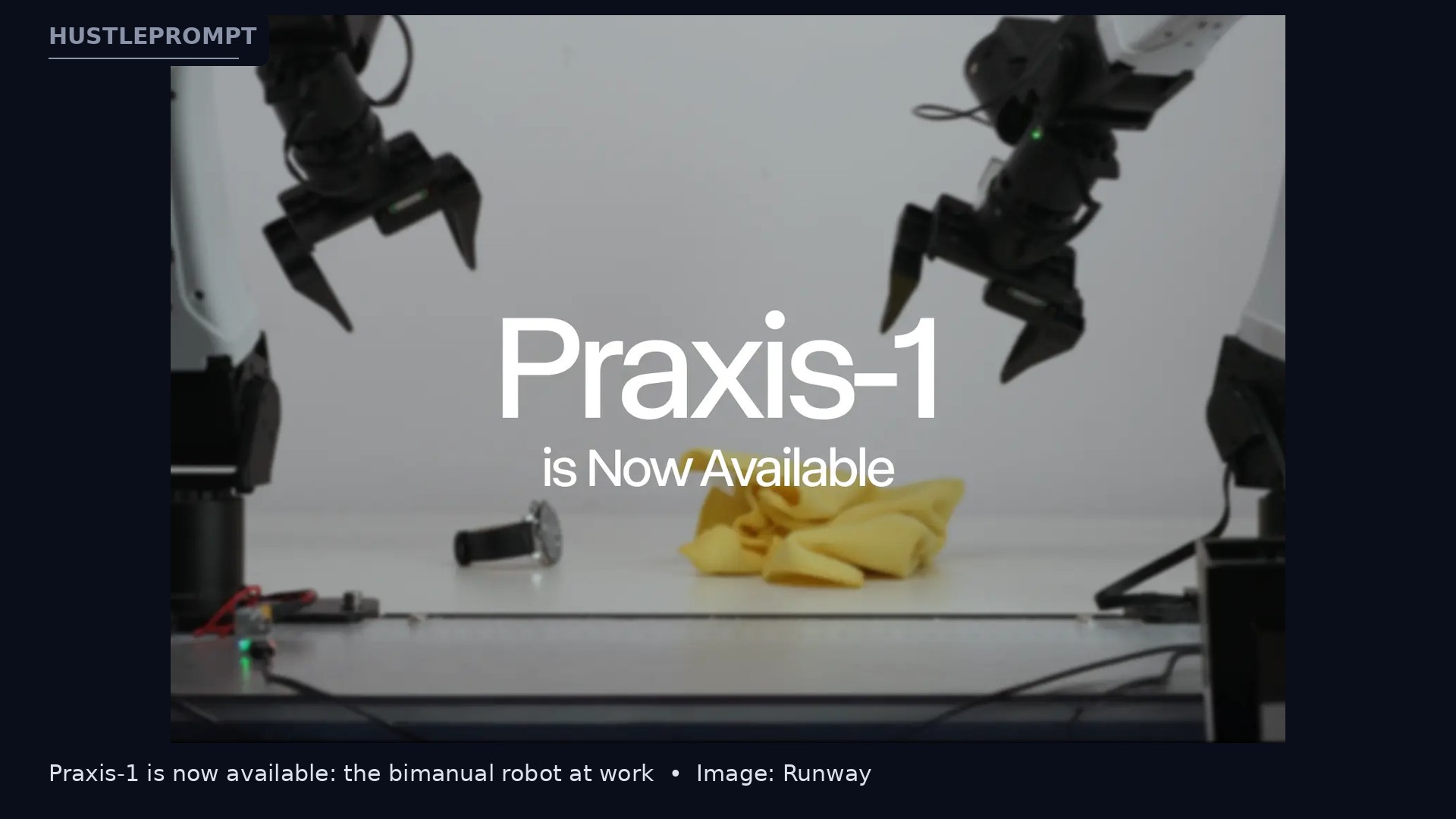
Runway Praxis-1 is now free for anyone to download, run, and sell with. Runway released the open weights of its 27-billion-parameter world action model on November 11, under the Apache 2.0 license — including for commercial use. It is the top-performing world action model on NVIDIA’s RoboLab-120 leaderboard, finishing 1,200 robot tasks with a 46.2% success rate.
Runway first introduced Praxis-1 on September 30, as a model that learns to control robots mostly by watching video. Yesterday’s release turns that promise into something developers can actually download: the weights, the inference code, and the fine-tuning code are now on GitHub and Hugging Face, with hosted inference on Reactor. No license fee. No waitlist. No closed beta.
What Praxis-1 actually does
Most robot models map what a camera sees straight to motor commands. Praxis-1 works differently. It is a world action model: it first predicts a short video clip of what should happen next, then reads that imagined future to decide which motion will get there.
That matters because video is everywhere and robot demonstration data is not. Runway built Praxis-1 on the same large-scale video pretraining behind its general world models, then fine-tuned it on robot data. Its own research found that a policy trained mostly on general web video placed objects with 16.1 cm of error — essentially matching the 16.0 cm of a policy trained on hand-recorded robot demonstrations. The slow, expensive part of building robot software just got a shortcut.
Each call to the model produces 1.6 seconds of motion — 24 action rows at 15 Hz — in roughly half a second on a single H100 GPU, according to Runway’s technical write-up. That speed is what makes the model usable for real-time control instead of offline planning.
The numbers that matter
Runway’s headline number comes from RoboLab-120, NVIDIA’s simulated benchmark of 120 tabletop manipulation tasks with 10 trials each. Here is where Praxis-1 stands.
RoboLab-120 leaderboard (November 2026)
| Praxis-1 (Runway) | 46.2% — 555 of 1,200 episodes |
| FLUX 3 Action | 42.9% |
| Cosmos 3 Nano | 36.8% |
| π0.5 | 28.0% |
Source: Runway: Praxis-1 Is Now Available. Success rate across 1,200 episodes; data as of November 2026.
Two caveats belong next to that number. First, every figure so far is Runway’s own — no independent lab has reproduced the leaderboard result yet. Second, 46.2% is a first-place finish that still means failing more than half the time, on simulated tabletop tasks, not a factory floor. Runway is ahead of the open field. It is not done.
Praxis-1 at a glance
| Architecture | 27B-parameter mixture-of-experts diffusion transformer |
| License | Apache 2.0, including commercial use |
| Model size | 54.4 GB in bfloat16; 17.5 GB in 4-bit NVFP4 |
| Hardware | One 80 GB GPU (H100/B200), RTX 5090, RTX PRO 6000, or Jetson Thor on the robot |
| Checkpoints | Base mid-trained model, DROID fine-tuned, bimanual YAM fine-tuned |
| Speed | 1.6 seconds of motion per call, in about 0.5 seconds on one H100 |
| Unseen robot test | 80.0% on SimplerEnv with Google’s RT-1, vs. 52.4% for the original RT-1 policy |
| Where to get it | GitHub, Hugging Face (native LeRobot support), vLLM-Omni; hosted inference on Reactor |
Sources: Runway: Praxis-1 Is Now Available; AI Frontier Post: Runway open-sources Praxis-1.
“Praxis-1, our state-of-the-art world action model, is now available to everyone with open weights under the Apache 2.0 license.” — Runway, November 11, 2026
“When we announced Praxis-1, we committed to shipping it as an open model. U.S. leadership in physical AI will depend on investment in both hardware and software, and on a level of openness from American models that physical use cases don’t have yet.” — Runway
How Praxis-1 turns video into motion
The “world action” idea sounds abstract until you break it into steps. Here is the loop the model runs, over and over, while a robot works.
Praxis-1 starts from large-scale video pretraining, so it already knows how objects move, fall, slide, and get picked up.
Given a task, the model predicts a short video clip of what the scene should look like next.
A 16-layer action expert reads the imagined future and derives the motor commands that would produce it.
Each call outputs 24 action rows — 1.6 seconds of motion at 15 Hz — and the loop starts again.
Three launch partners have already run Praxis-1 on real machines: Noble Machines on a legged humanoid, Standard Bots on a six-axis industrial arm, and Ultra on a dual-arm warehouse robot. Runway says a single checkpoint adapted to each of those embodiments with light fine-tuning, and that LoRA fine-tuning can adapt it to your own embodiment, cameras, and tasks without retraining the full model.
Runway’s introduction to Praxis-1, from its September 30 unveiling (Runway on YouTube).

Why open weights change the robotics business
Praxis-1 does not arrive in a vacuum. It lands in the middle of a crowded week for robot models. NVIDIA opened its GR00T 2 model days earlier, and Google’s Gemini Robotics 2.5 is already running on a Mercedes-Benz factory line. Runway’s entry is the most permissive of the three: full weights, fine-tuning code, and a license that allows commercial use.
That permissiveness is the business story. A closed robot model is a vendor relationship. An open-weight model is a building material. Anyone with a robot and a GPU can now start from the best open world action model on the leaderboard, instead of starting from zero — or paying a lab for API access to a model they cannot inspect, adapt, or run on their own hardware.
- The training-data bottleneck moves. Robot demos are slow and expensive to record. Video is not. Praxis-1’s bet is that the bottleneck shifts from “how much robot data can you collect” to “how much general video can you learn from” — and Runway already did the video part.
- Simulation becomes a sales tool. Runway reports a 0.95 correlation between policies tested inside its simulated world and their real-world outcomes. If that holds up, a robotics vendor can prove a policy works in simulation before risking a real machine — and show the customer the evidence.
- Hardware choice stays open. The same model runs on a data-center H100, a workstation RTX 5090, or a Jetson Thor computer inside the robot itself. A buyer is not locked into one vendor’s cloud.
- America’s open stack is forming. Runway is a founding member of the Cosmos Coalition, and says it is working with NVIDIA to open frontier technology stacks for physical AI. Open weights from American labs are becoming a deliberate strategy, not a side effect.
How to profit from an open robot brain
A free frontier model is only valuable if someone turns it into a working system. That is where the money is. Here is how to move on it this week.
- Sell integration, not the model. Download Praxis-1, pick a robot your local market already uses — a Standard Bots arm, a Franka, a warehouse platform — and offer a paid pilot: one task, one cell, one month. The model is free. The setup, the fine-tuning, and the safety testing are the product.
- Fine-tune with LoRA for one customer. Praxis-1 ships with full and LoRA fine-tuning code. A LoRA adapter trained on a customer’s parts, bins, and lighting is a deliverable you can charge for — and it stays small enough to ship and update cheaply.
- Run sim-first demos. Use the 0.95 sim-to-real correlation as your pitch: test the policy in simulation, show the customer the simulated result, then deploy. Fewer crashed prototypes, faster sign-off, lower risk for everyone.
- Target the dull, repetitive jobs first. Pick-and-place, kitting, packing gift bags, closing drawers — the manipulation tasks Praxis-1 was benchmarked on. Warehouses and small manufacturers pay for reliability on boring tasks, not for demos of hard ones.
- Offer hosted inference for buyers without GPUs. Not every customer owns an 80 GB GPU. Runway offers hosted inference on Reactor; wrapping that into a managed service — robot plus brain plus support — is a recurring-revenue business.
- Move before the field catches up. GR00T 2, Cosmos 3 Nano, and Gemini Robotics 2.5 are all in play. The window for “we can deploy the best open robot model” is open right now. It will not stay open long.
What to watch next
Open weights do not automatically produce safe robot motion. A model that predicts plausible actions can still crush, drop, or misjudge. The release includes the weights and the code — not a safety certification. Anyone deploying Praxis-1 on a real machine owns the testing.
Watch for three things. First, independent reproduction of the RoboLab-120 result — the number is Runway’s own until another lab confirms it. Second, real deployments beyond the three launch partners, especially in warehouses where a failure costs money. Third, what NVIDIA and Google do next: the open-weight race in robotics is now a three-way contest, and the next release could change the leaderboard in a week.
Frequently asked questions
What is Runway Praxis-1?
Praxis-1 is Runway’s world action model for robotics: a 27-billion-parameter model that predicts video and robot actions together, turning large-scale video pretraining into control for real robots. Runway introduced it on September 30, 2026 and released the open weights on November 11, 2026.
Is Praxis-1 really free for commercial use?
Yes. Runway released the weights, inference code, and fine-tuning code under the Apache 2.0 license, which allows commercial use. That covers the base model and the DROID and bimanual YAM fine-tuned checkpoints.
What hardware do I need to run Praxis-1?
The full model is 54.4 GB in bfloat16 and needs a single 80 GB GPU, such as an NVIDIA H100 or B200. A 4-bit NVFP4 quantized version shrinks it to 17.5 GB. Runway says it also runs on workstation GPUs like the RTX 5090 and RTX PRO 6000, and on the Jetson Thor computer inside the robot itself.
How good is Praxis-1 compared with other robot models?
On NVIDIA’s RoboLab-120 benchmark, Praxis-1 reached 46.2% success across 1,200 episodes — ahead of FLUX 3 Action at 42.9%, Cosmos 3 Nano at 36.8%, and π0.5 at 28.0%. Runway calls it the top-performing world action model on the leaderboard and says it outperforms every open-weight VLA. The figures are Runway’s own and have not been independently reproduced yet.
How is a world action model different from a VLA?
A vision-language-action (VLA) model usually maps what it sees straight to motor commands. A world action model first imagines a short video of what should happen next, then derives the actions from that imagined future. The video prediction step is what lets Praxis-1 learn mostly from general video instead of robot demonstrations.
Where do I download Praxis-1?
From GitHub and Hugging Face, with native LeRobot support, and in vLLM-Omni. Runway also offers hosted inference on Reactor. The download links are in Runway’s announcement post.
Keep Reading
- Robots Just Clocked In: Physical AI’s First Paychecks — the paid work physical AI is already doing, from Mercedes factory lines to warehouse robots.
- Google’s Gemini Robotics 2.5 Puts Robots to Work — the closed model Praxis-1 is now competing with, already running on a factory floor.
- AI Labs Pay Experts $400 an Hour to Train AI — the expert data-labor market behind models like Praxis-1, and what it pays.
Sources: Runway: Praxis-1 Is Now Available; AI Frontier Post: Runway open-sources Praxis-1.