
Gemini Decisions API is Google’s strangest launch of the year: a model that refuses to write. Announced on November 11, 2026, the new endpoint — powered by a model called Gemini Decision 1 — answers up to 1,000 yes/no, multiple-choice, and rubric questions about a single document, photo, video, or PDF in one pass, and returns numbers instead of sentences. The price: $0.10 per million input tokens, with zero output tokens billed.
That pricing is the story. A generative model charges you for every word it writes. Gemini Decision 1 writes nothing, so there is nothing to bill on the way out — and Google says the whole call lands in 150 to 250 milliseconds. For anyone running AI agents at scale, that turns the thousands of tiny judgments an agent makes every hour into a line item that costs almost nothing.
What Google just launched
The Decisions API is a new endpoint for fast, closed-set decisions, built by Google DeepMind. The model behind it is Gemini Decision 1 (model code gemini-decision-1), and it is available now through the Gemini API in Google AI Studio on the v1beta endpoint, with the google-genai SDK 3.2 or later. A no-cost tier exists for prototyping, and Google says support in Google Cloud is coming soon.
You send one shared multimodal input — text, images, audio, video, and PDFs, up to 256K tokens — plus up to 1,000 independent questions about it. Instead of generating answer text token by token, the model scores your candidate options in a single forward pass and returns probabilities and confidence scores, so your code can branch on the numbers directly.
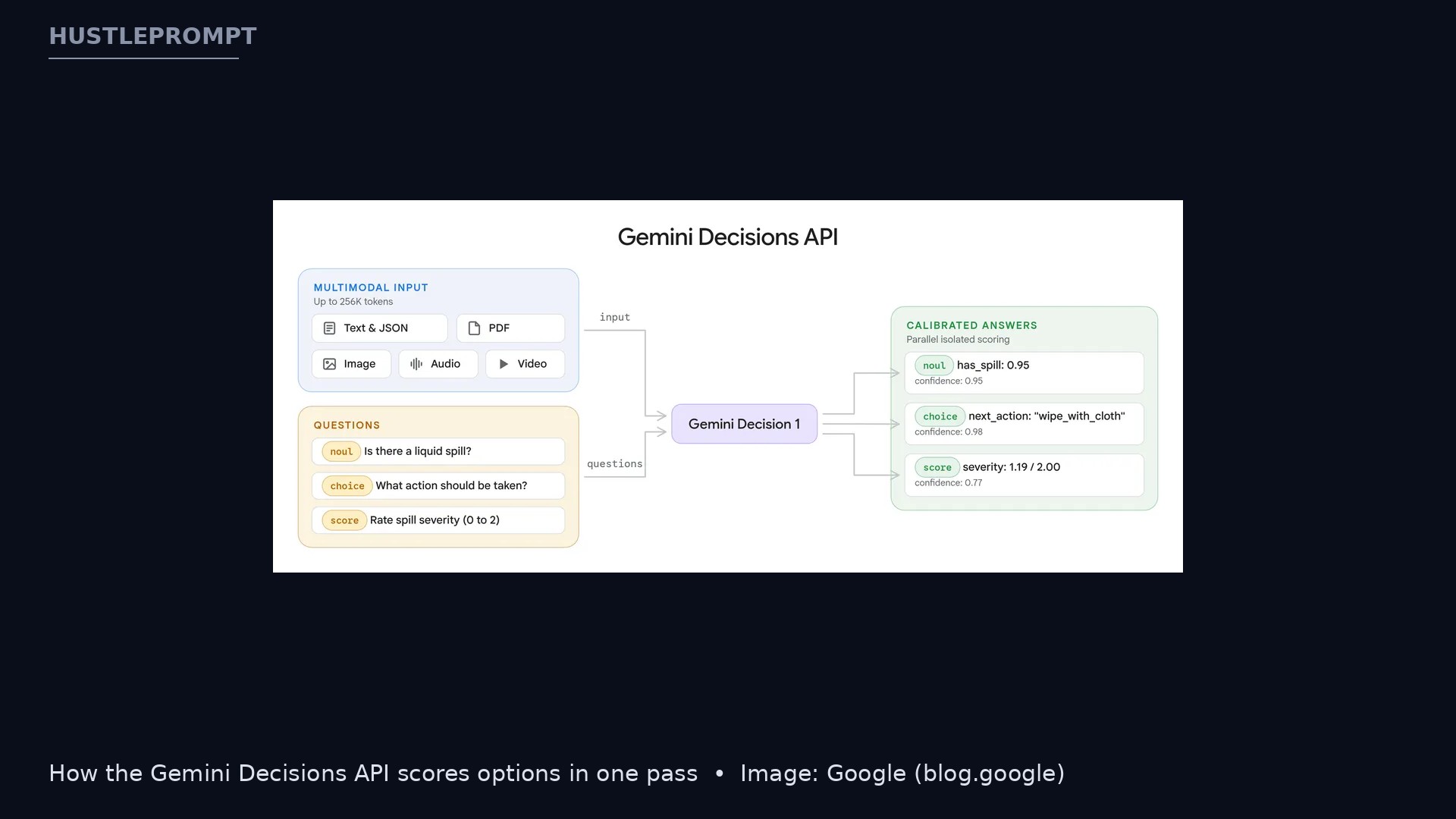
Three question types, one forward pass
Every question you ask is one of three types, and you can mix all three in a single request:
- noul (yes/no): estimates the probability that a yes/no condition holds, with optional true and false description criteria.
- choice (multiple choice): picks from 2 to 255 options, returning the winner and normalized probabilities for every candidate.
- score (ordered rubric): grades an input across an ordered rubric starting at 0, returning a continuous weighted score and the probability of each grade.
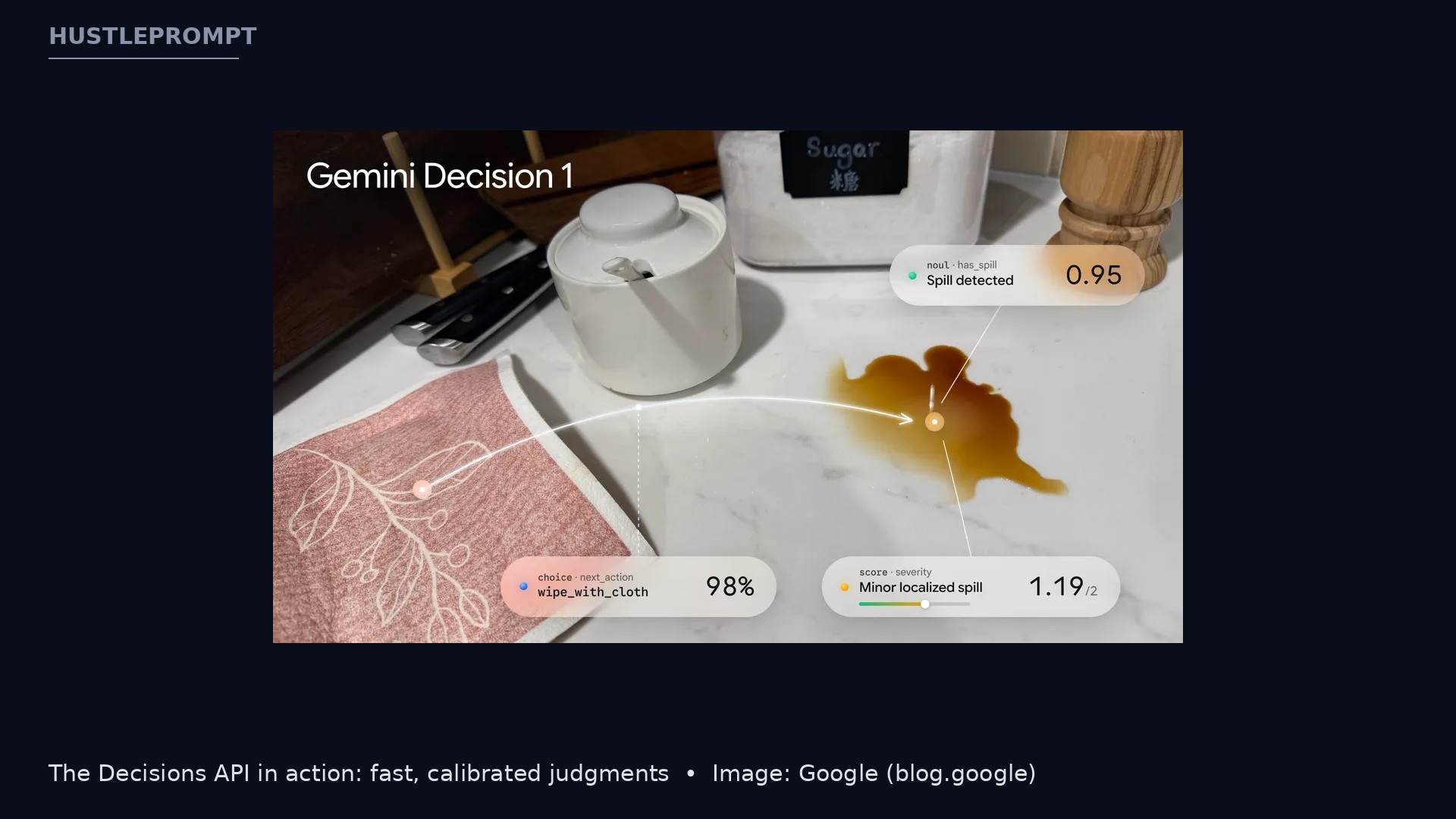
Google’s own example makes the idea concrete. Send a photo of a breakroom counter plus a short note, and one request checks all three at once: is there an uncleaned spill (0.95 confidence), what should happen next (wipe with a cloth, 98%), and how bad is the mess (1.19 out of 2.00). Every answer carries a confidence score from 0 to 1, so your code can route ambiguous cases to a fallback or a human reviewer.
Gemini Decisions API: the evidence
| Model | Gemini Decision 1 (gemini-decision-1) |
| Endpoint | Gemini API, v1beta, in Google AI Studio; Google Cloud support coming soon |
| Input per request | One multimodal input, up to 256K tokens (text, images, audio, video, PDFs) |
| Questions per request | Up to 1,000 independent questions, three types mixed freely |
| Latency | 150\u2013250 ms end-to-end; 50\u2013100 ms median model compute (up to 16K tokens) |
| Price | $0.10 per 1M input tokens; $0 output tokens; shared input billed once per request |
| Free tier | No-cost tier in Google AI Studio; VentureBeat reports limits of 200 requests and 50,000 input tokens per minute |
| Demo apps | Doorstep Parcels, Speed Sketch, and Find the Zoo Keeper ship with the launch |
Source: Google: Gemini Decisions API: Fast multimodal decisions, November 11, 2026. Free-tier limits via VentureBeat.
The benchmarks: 7 wins out of 9 — and two losses
Google’s own comparison table puts Gemini Decision 1 against OpenAI’s GPT-6 Luna, the classification-focused TypeSafe Jev 1.14, and its own Gemini 3.5 Flash-Lite. Decision 1 wins 7 of the 9 benchmarks, including JevBench (92.2%), Amazon ESCI (58.7%), and Video-MME (69.1%). It also posts the lowest calibration error in the comparison: a Top-1 expected calibration error of 0.0250, against 0.0494 for Jev, 0.0721 for GPT-6 Luna, and 0.2104 for Flash-Lite.
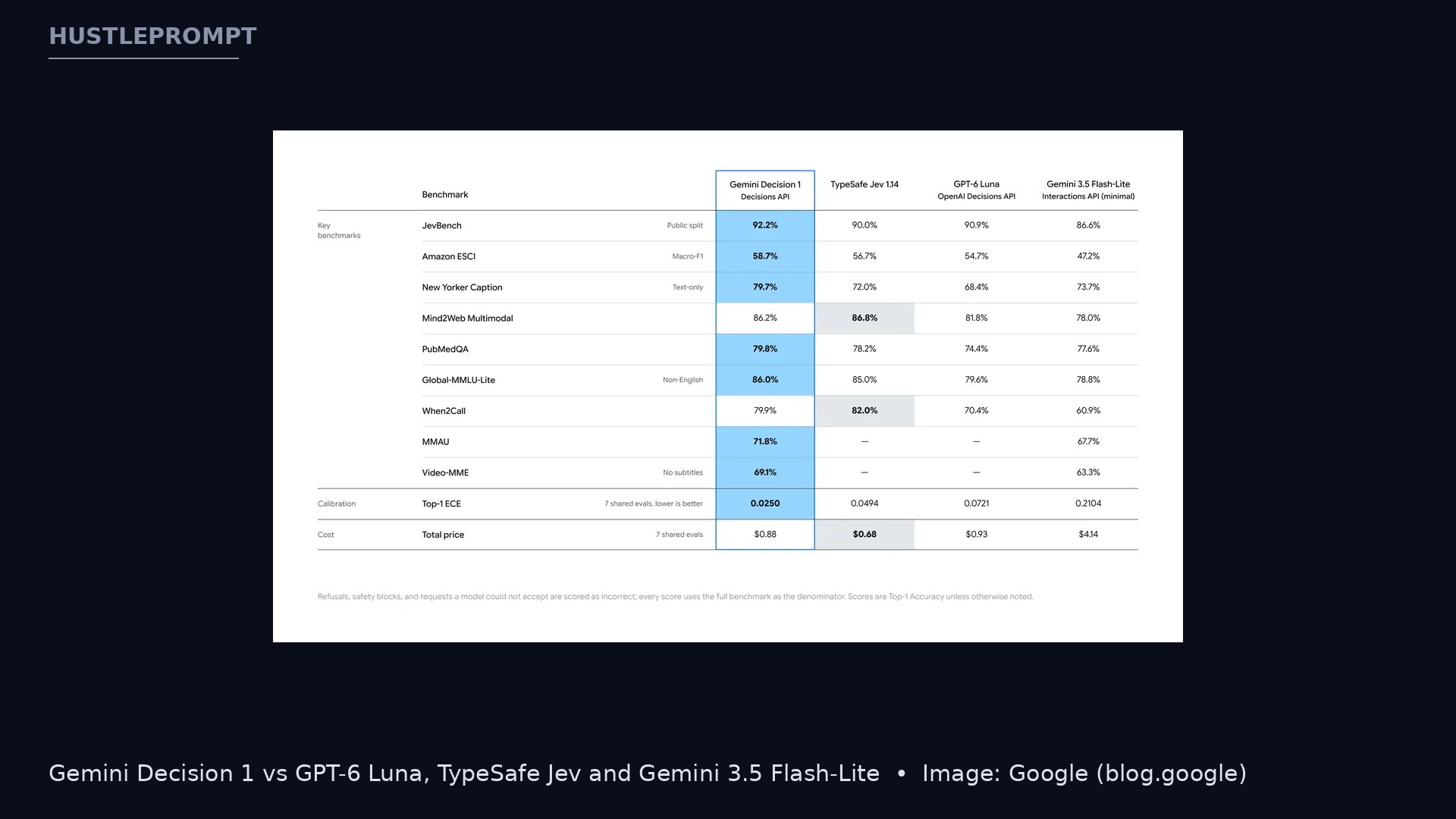
The two losses matter. TypeSafe Jev 1.14 wins Mind2Web Multimodal (86.8% vs 86.2%) and When2Call (82.0% vs 79.9%) — and Jev is cheaper on the same seven shared evaluations: $0.68 total against $0.88 for Decision 1. Google’s “nearly 5x cheaper” claim is measured against Flash-Lite, which costs $4.14 on the same suite. Artificial Analysis is cooler: it scores Decision 1 at 66, with a median latency of 211 ms and about $345 per million tasks, ranking it 9th of 18 decision models.
What a decision costs
| Gemini Decision 1 | $0.10 per 1M input tokens, $0 output; $0.88 total on Google’s 7 shared evals |
| Gemini 3.5 Flash-Lite (Interactions API) | $4.14 total on the same 7 evals — about 4.7x the Decision 1 cost, per Google |
| GPT-6 Luna (OpenAI Decisions API) | $0.10 per 1M input tokens, $0 output, per VentureBeat; $0.93 total on the 7 evals |
| TypeSafe Jev 1.14 | $0.68 total on the same 7 evals — cheaper than Decision 1, and wins 2 of 9 benchmarks |
| Independent check | Artificial Analysis: score 66, median 211 ms, ~$345 per 1M tasks, ranked 9th of 18 decision models |
Sources: Google’s benchmark table in the launch post; VentureBeat; Artificial Analysis Decision Index via KuCoin. Google’s figures are its own tests.
“Rather than generating answer text token by token, Gemini Decision 1 scores your candidate options in a single forward pass, returning probabilities and confidence scores in 150-250 ms end-to-end latency at $0.10 per 1M input tokens with zero output tokens billed.” — Google DeepMind, November 11, 2026
How Google already uses it
Google is not asking developers to trust a demo. Four of its own products already run on the Decisions API:
- Gemini Notebook uses it as a real-time router, sending each query to the best model tier and reasoning level. Google says everyday queries now serve with up to 40% lower latency, while deep reasoning models stay reserved for complex tasks.
- Stitch uses it in a rapid canvas experiment to generate playable wireframes of a product flow in seconds, and to apply voice or tap edits almost instantly.
- CC from Google Labs uses it to pick the right emoji reaction from a palette of more than 200 options in a fraction of a second.
- Google Search uses it as a safety layer for MCP tools, detecting adversarial behavior and content against adversarial evals within the latency envelope.
How to profit from a model that only decides
The money angle is simple: every agent you run makes hundreds of small judgments per task — which tool to call, whether a document passes a policy check, which model tier handles the next step. Today those judgments usually go through a full generative call, and you pay output tokens for an answer you could have expressed as a number. A decision API turns that into a $0.10-per-million-tokens check.
Write down every fixed-choice judgment your app makes: routing, tool selection, policy checks, grading, triage.
Pass the document, image, or transcript once, with up to 1,000 questions attached. The input is billed once, no matter how many questions you ask.
Use the probabilities and confidence scores directly in code. High confidence goes through; low confidence goes to a fallback or a human.
Replace generative calls with decision calls wherever the answer is a fixed choice, and prototype free on the no-cost tier in AI Studio first.
The fastest wins are the ones Google already ships: model routing, content moderation at scale, lead scoring, support triage, and grading piles of documents or call recordings. Day-one integrations cover OpenRouter, LangChain, Vercel, LiteLLM, Pydantic AI, Pipecat, LiveKit, and OpenCode, so most agent stacks can try it without changing frameworks.
The catch
First, the latency numbers come with a footnote. Google’s 150–250 ms figures cover inputs up to 16K tokens and up to 100 questions — the full 256K-token context with 1,000 questions is a different workload, and Google does not promise the same speed there. Test your own heaviest case first.
Second, this model cannot do most of what you expect from an AI model. It cannot write text, reason through multi-step problems, call tools, or return structured JSON — and it cannot explain a decision. If your workflow needs any of that, Google’s own guide points you to its Interactions API instead.
Third, it is early. The API is v1beta only, Google Cloud support is still coming soon, and batch processing, caching, Flex, and Priority tiers are unavailable. Google has not disclosed the model’s parameters, training data, or architecture either, so the benchmark wins are Google’s own tests until independent evaluators run the same suite.
Frequently asked questions
What is the Gemini Decisions API?
A new Google endpoint, launched November 11, 2026, that scores up to 1,000 fixed-choice questions about one shared input — text, images, audio, video, or PDFs up to 256K tokens — in a single forward pass. It returns probabilities and confidence scores instead of generated text.
How much does Gemini Decision 1 cost?
$0.10 per million input tokens, with $0 charged for output tokens, because the model produces none. The shared input is billed once per request no matter how many questions you evaluate, and there is a no-cost tier in Google AI Studio for prototyping.
How is it different from a normal Gemini model?
A normal Gemini model generates text token by token. Gemini Decision 1 never generates text: you give it a fixed list of candidate answers and it scores them, returning a winner and a confidence score for each. That makes it fast and cheap, but useless for anything that needs prose, reasoning, or tool calls.
What can I build with it?
Model routing, tool selection, policy and safety checks, content grading, lead scoring, support triage, and document review. Google already uses it for routing in Gemini Notebook, design iteration in Stitch, emoji selection in CC, and safety screening in Search.
Is there a free tier?
Yes. Google offers a no-cost tier in Google AI Studio for prototyping. VentureBeat reports free-tier limits of 200 requests and 50,000 input tokens per minute.
What are the limits?
No text generation, no multi-step reasoning, no tool calls, and no structured JSON output. Latency of 150–250 ms is measured on inputs up to 16K tokens, not the full 256K context. It is v1beta only, with Google Cloud support still coming soon, and Google has not disclosed the model’s size or training data.