
Only 87.2% of marketing emails reached the inbox in 2025, according to Validity’s 2026 Email Deliverability Benchmark Report — and at Microsoft mailboxes the figure fell to 77.4%. That means roughly one email in eight never arrives. For a small business, the missing mail is lost revenue. This tutorial shows you how to sell an AI email deliverability audit: a one-off service that finds why a business’s emails land in spam — and fixes it. This is a deliverability audit — diagnose and fix — not cold-email outreach, not a newsletter service, and not a win-back flow.
Transparency note: this article uses the standard HustlePrompt block that embeds a third-party video tutorial. Where the tutorial text cites earnings examples or ranges, they are always presented as illustrative references — never as promises of income.
What the service is, exactly
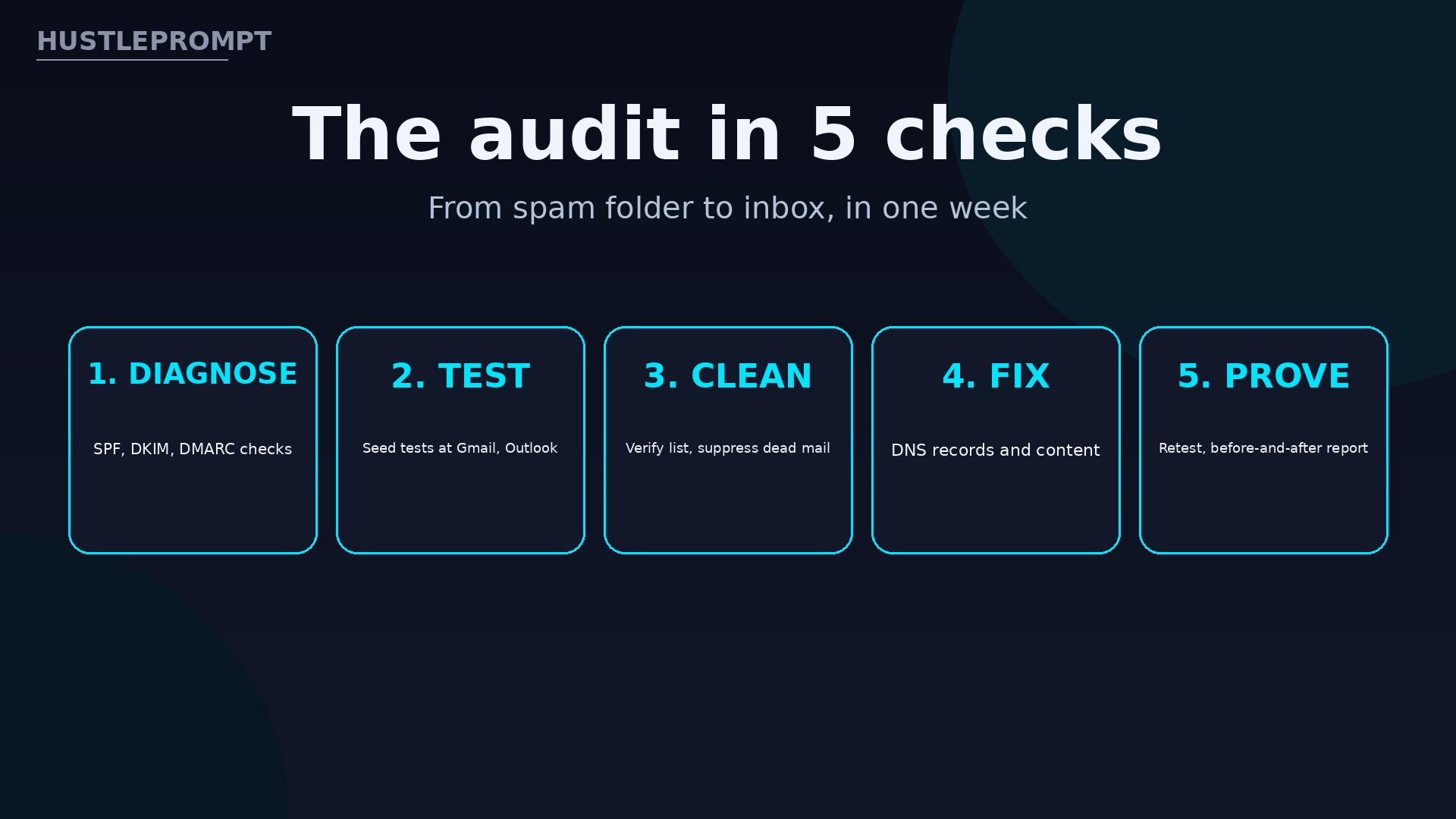
You run a one-off audit for one small business:
- Diagnose: check SPF, DKIM, and DMARC records, domain reputation, and spam rate.
- Test: run seed inbox tests across Gmail, Outlook, and Yahoo first.
- Clean: verify the list, suppress dead addresses, and flag spam traps.
- Fix: correct the DNS records, split marketing from transactional mail, and rewrite risky content.
- Prove: retest and deliver a before-and-after report the owner reads in five minutes.
The AI speeds up the checks and drafts the report. You decide what gets fixed and make the DNS changes yourself.
SPF, DKIM, DMARC.
Seed tests at Gmail, Outlook.
Verify list, suppress dead mail.
DNS records and content.
Retest and report.
The evidence: one email in eight never arrives
Validity’s 2026 Email Deliverability Benchmark Report measured 87.2% average inbox placement in 2025, with 6.1% in spam and 6.6% missing. The gap by provider is wide: Gmail placed 89.8%, Yahoo 87.3%, Apple 82.0%, and Microsoft only 77.4%. An Outlook-heavy business loses nearly a quarter of its mail.
| Provider | Inbox (2025) | Spam |
|---|---|---|
| Gmail | 89.8% | Lowest share |
| Yahoo | 87.3% | Near average |
| Apple Mail | 82.0% | Below Gmail |
| Microsoft (Outlook/Hotmail) | 77.4% | 15.1% in spam |
| Global average | 87.2% | 6.1% / 6.6% |
Google draws a hard line: bulk senders must keep the spam rate below 0.3%, and Google recommends under 0.1%. Validity’s network averaged 0.06% in 2025. Above 0.3%, Google has withdrawn mitigation support since June 2024 — no help until the rate stays below 0.3% for seven straight days.
The rules have teeth. Gmail and Yahoo have enforced sender requirements since February 2024, ramping up again in November 2025. Since May 5, 2025, Microsoft rejects high-volume mail that fails SPF, DKIM, or DMARC with error 550 5.7.515. A missing DMARC record is a rejection, not a warning.
Your costs: what the tools actually charge
| Tool | Price (checked 2026-11-13) | What you get |
|---|---|---|
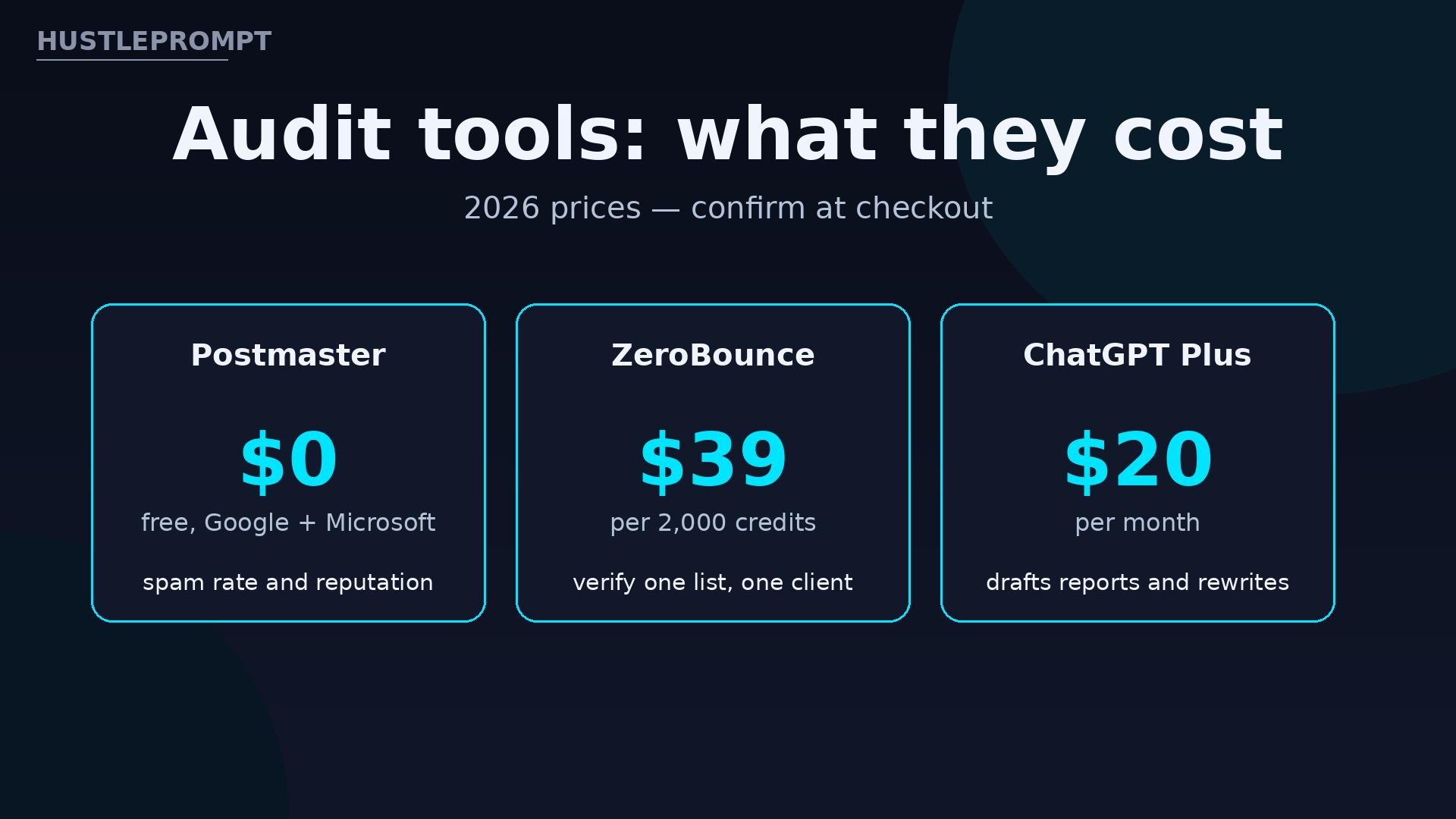
| Google Postmaster Tools | $0 | Spam rate and reputation |
| Microsoft SNDS | $0 | IP reputation data |
| Mailtrap | $0 free; $15/month Basic | 4,000 free; 10,000 on Basic |
| Mailgun Basic | $15/month | 10,000 emails; validation |
| Postmark Basic | $15/month | 10,000 emails; $1.80/1,000 over |
| ZeroBounce pay-as-you-go | $39 for 2,000 credits | 1 credit = 1 address |
| ChatGPT Plus | $20/month | Drafts reports, rewrites content |
Prices change, so confirm each at checkout. Start with the two free postmaster tools plus one $20 AI plan.
Step 1: pick one niche and learn its mail
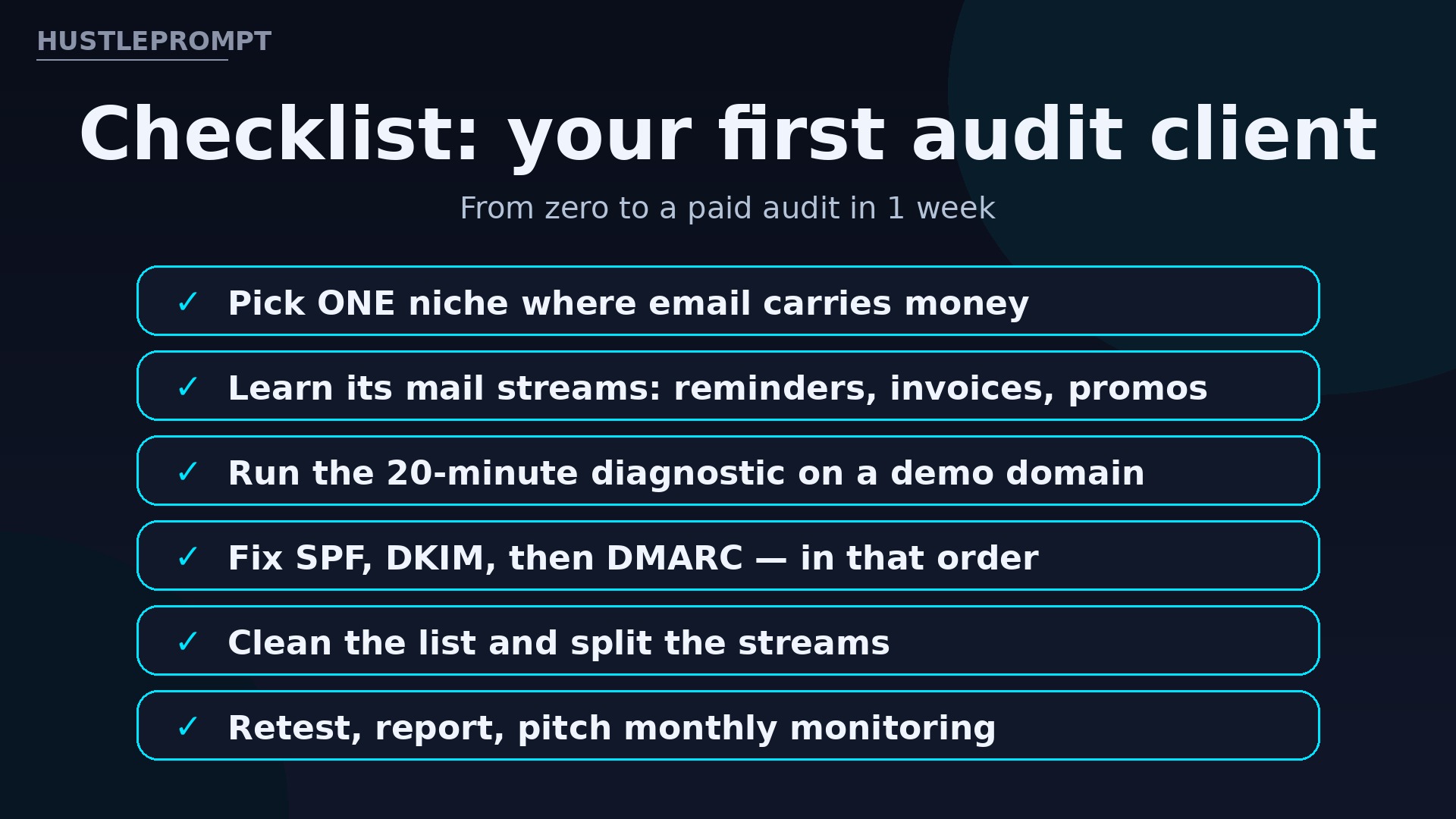
Do not audit “any small business.” Pick one niche where email carries money — dental clinics, gyms, salons, or local e-commerce stores. One niche means one set of patterns, one list of mistakes, and referrals inside the same trade community. Study how that niche sends mail first: reminders, invoices, promotions, receipts. Each stream needs its own checks.
Step 2: run the 20-minute diagnostic
Ask the owner for read-only access to their sending platform and DNS. Then run five checks and record every result before changing anything:
- Authentication: does the domain pass SPF and DKIM, and does DMARC exist?
- Alignment: does the From domain match SPF or DKIM, as Google requires?
- Reputation: what do Postmaster Tools and SNDS say about the domain and IP?
- Complaints: is the spam rate below 0.1%, or above the 0.3% line?
- Placement: seed-test Gmail, Outlook, Yahoo, Apple; record results.
Use the AI to turn results into plain English: one sentence and one severity rating per finding. The diagnostic is the product.
Step 3: fix authentication first, in this order
Fix SPF first, then DKIM, then DMARC — never in reverse. SPF is one TXT record listing every service allowed to send for the domain; there must be exactly one per domain. DKIM adds a cryptographic signature: generate the key in the sending platform, publish the public key in DNS, and use a 2048-bit key when possible. DMARC goes last at p=none; read the reports for two weeks before tightening to quarantine.
Google treats a sender as a bulk sender at close to 5,000 messages a day to personal Gmail accounts, and that status is permanent. A business planning a big launch needs the full setup first. Add one-click unsubscribe and honor opt-outs within two days.
Step 4: clean the list and split the streams
Authentication means nothing if the list is dirty. Verify every address — ZeroBounce charges $39 for 2,000 credits — and suppress hard bounces and anyone unopened in six months. Then split the mail: transactional (receipts, reminders, resets) on one stream, marketing on another. One bad promotion must never drag down the invoice stream.
Rewrite content triggers last: cut ALL-CAPS subject lines and “FREE!!!” spam words. The AI flags risky phrases; you make the final call.
Step 5: retest, report, and pitch monitoring
After 48 hours, rerun the same seed test. The report is one page: before-and-after placement per provider, the spam rate, the three records fixed, and the list size before and after cleaning. Close with the monitoring offer — a monthly check of spam rate, blacklist status, and DMARC reports — which turns a one-off audit into a retainer.
What to charge: an illustrative framework
There is no official price list for this service, so treat this as a framework to validate against your market. The audit is a one-off fee; monitoring is a small monthly fee on top.
| Package | Illustrative price | What it includes |
|---|---|---|
| Deliverability audit (one-off) | $300–$600 | Diagnostic, DNS fixes, list clean, retest |
| Monthly monitoring | $75–$150/month | Spam rate, blacklist, DMARC |
The mistakes that kill this business
- No baseline before DNS changes. No proof the fix worked without a before-test.
- Two SPF records. One SPF record per domain; a second breaks validation.
- Straight to DMARC reject. Start at p=none, read reports, then tighten.
- Cleaning the list once. Lists rot monthly; monitoring is the product.
- Mixing receipts with promotions. One promo complaint can sink the invoice stream.
- Promising a placement rate. Guarantee the work, never a percentage.
Frequently Asked Questions
What is an AI email deliverability audit?
It is a one-off diagnostic: you check SPF, DKIM, and DMARC records, sender reputation, spam rate, and inbox placement, then fix what is broken and retest. AI speeds up the checks and drafts the report, but you verify every finding.
How is an audit different from a newsletter service?
A newsletter service writes and sends mail every week. An audit is a one-time diagnosis and fix of why mail lands in spam. It can lead to a monthly monitoring retainer, but it never writes the client’s campaigns.
What is a good inbox placement rate?
Validity’s 2026 benchmark put the global average at 87.2% in 2025, with Gmail at 89.8% and Microsoft at 77.4%. A healthy result lands above 90% at the providers the client’s customers actually use, judged per provider.
Do small senders need SPF, DKIM, and DMARC too?
Yes. Every sender to Gmail needs SPF or DKIM, valid reverse DNS, and TLS, plus a spam rate below 0.3%. The full bulk-sender list applies near 5,000 messages a day, but authentication protects small senders at any volume.
How long does an audit take?
The diagnostic takes about 20 minutes. DNS changes need up to 48 hours to propagate, and DMARC reports need about two weeks before you tighten the policy. Promise the report in one week, not one day.
What does the audit cost the business?
The tool cost is small: Postmaster Tools and SNDS are free, and verification runs about $39 per 2,000 addresses. Your fee is separate — the illustrative range here is $300 to $600 for the audit.
Keep Reading
- Sell AI Customer Win-Back Services to E-Commerce Stores — the AI email playbook for stores with lapsed buyers.
- Sell AI Email Newsletter Services to Local Gyms — the weekly service for a clean, authenticated domain.
Sources: Validity 2026 Benchmark Report (2025 data) via dreamlit.ai; Google sender guidelines FAQ — support.google.com; Gmail/Yahoo sender requirements — mailercloud.com; Mailgun and Postmark pricing, October 2026 — duoplus.net; ZeroBounce pricing, October 31, 2026 — salesopstools.com; Microsoft sender enforcement, May 5, 2025 — sendpulse.com.