
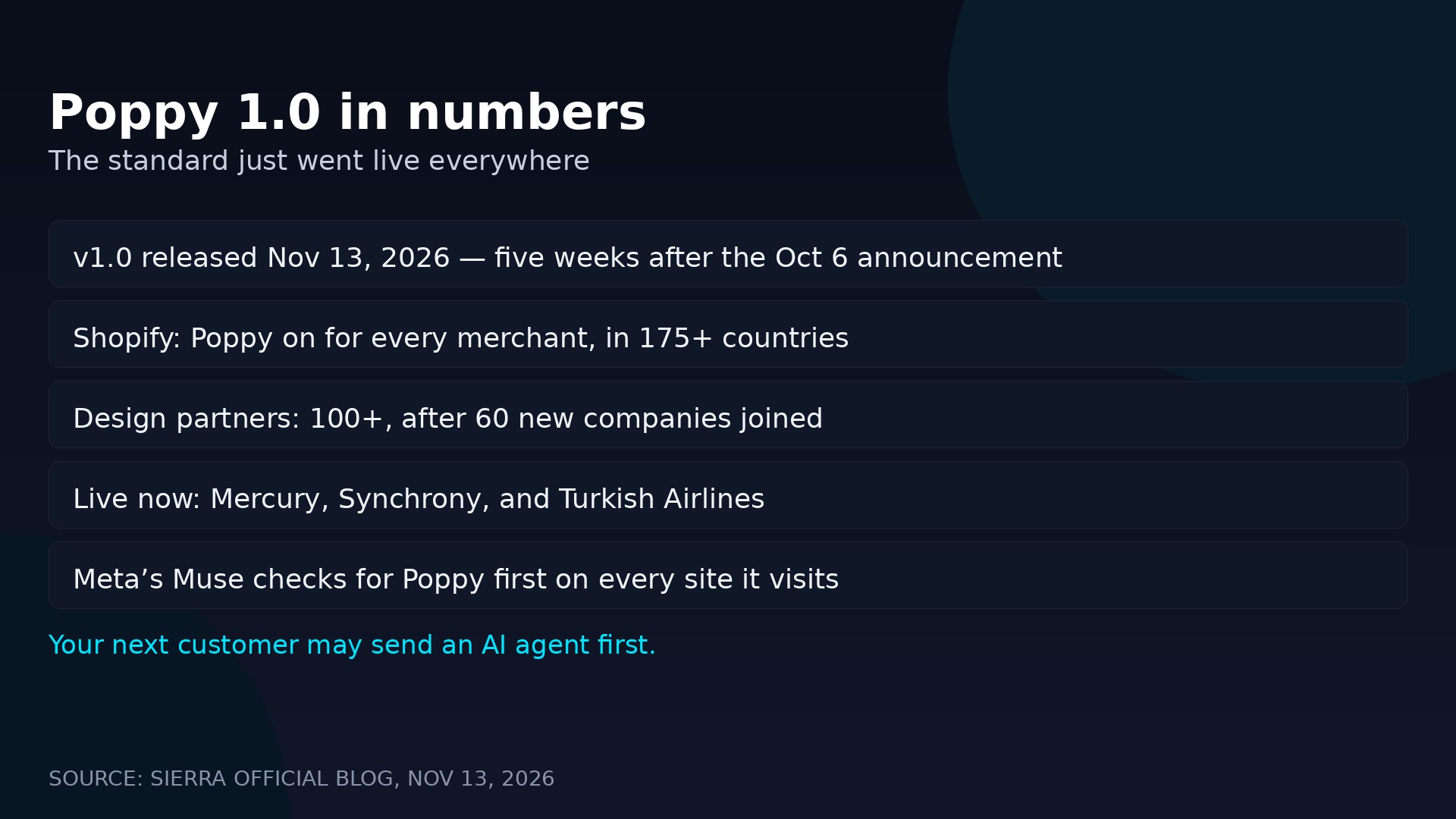
Poppy 1.0 is live, and it quietly changes who your next customer is. On November 13, Sierra and Meta released version 1.0 of the Personal Agent Protocol — nicknamed Poppy — the open standard that lets a personal AI agent walk into a business, identify itself, and get to work on your behalf. Shopify switched it on the same day for every merchant on its platform, in more than 175 countries. Meta’s Muse, the company’s AI agent, now looks for Poppy first on every site it visits.
That is the sentence that matters for anyone who sells anything online. Your next customer may not be a person browsing your store. It may be their agent, arriving with a task, a budget, and permission to spend. As of November 13, every Shopify store in the world is ready to receive it — and the store owner did not have to do anything.
Poppy 1.0, at a glance
| What it is | Personal Agent Protocol (Poppy), an open standard from Sierra and Meta for how a personal AI agent works with a business on a user’s behalf |
| Released | Version 1.0 on November 13, 2026 — five weeks after the October 6 announcement |
| Shopify | Enabled for every merchant automatically; every Shopify store now publishes a Poppy file, in 175+ countries, with no merchant setup |
| Meta’s Muse | Poppy is on for everyone who uses Muse; the agent automatically looks for Poppy first on every site it visits |
| Partners | 100+ design partners after 60 new companies joined, including Cisco, Delta Air Lines, Intuit, Salesforce, Twilio and Zoom |
| Live now | Mercury, Synchrony and Turkish Airlines are going live with Poppy, alongside Shopify and Muse |
| Commerce link | Shopify co-authored the commerce extension that connects Poppy to the Universal Commerce Protocol (UCP) for carts and checkout |
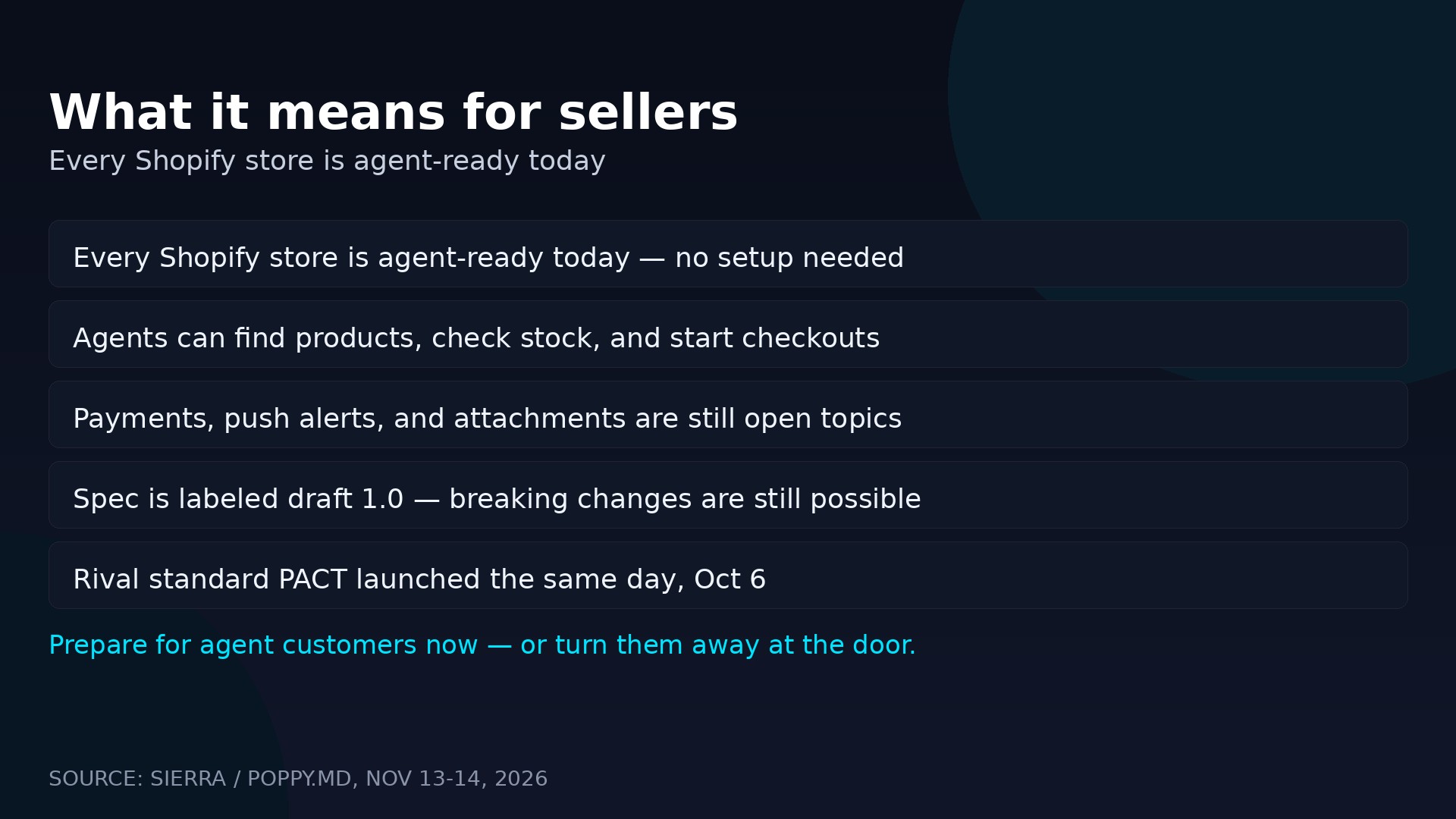
| Caveat | The specification labels v1.0 as draft 1.0 and warns of possible breaking changes — the rules can still move |
Source: Sierra — Releasing Personal Agent Protocol 1.0, November 13, 2026; Unite.AI — Sierra Releases Poppy 1.0 With Shopify and Meta Muse Support, November 13, 2026.
What Poppy actually does
Until now, a personal agent that wanted to do something for you at a business had two bad options: pretend to be you in a browser, or get blocked at the door. Companies could not tell a legitimate agent acting with your permission from a scraper, a bot, or an attacker. Their rational answer was to block everything, which is why so many sites fight agents today.
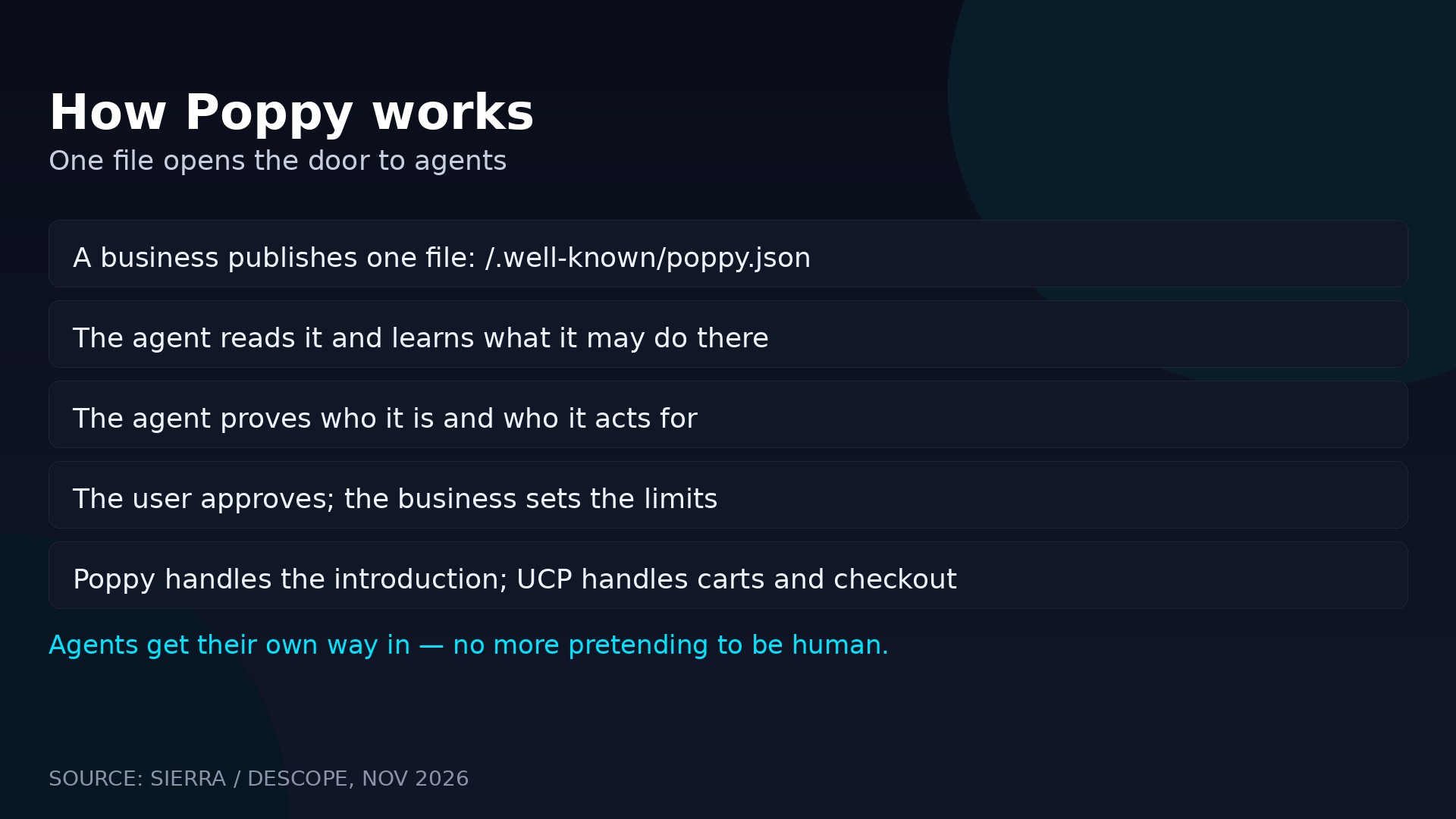
Poppy gives the agent its own way in. A company publishes one discovery file — poppy.json — at a standard address on its website, /.well-known/poppy.json, over HTTPS. When your agent arrives, it reads that file and learns how the business wants to be approached: what the agent may do, whether it should use the website, the company’s APIs, or the company’s own AI agent, and how to identify itself. The agent proves three things with cryptography: which assistant is knocking, which user it represents, and what level of permission it has. The business decides the limits. The user approves the access.
Poppy only handles the introduction. It does not handle the purchase. That job belongs to the Universal Commerce Protocol (UCP), which covers product discovery, carts, and checkout — and every Shopify store already supports UCP by default. Shopify co-authored the commerce extension that links the two protocols, so an agent can shop as a guest or as the signed-in user while the cart and checkout run over UCP. Payments, push notifications, and attachments are still open topics at release, which is an honest reminder that the standard is young.
How an agent visit works under Poppy 1.0
Flow per Sierra’s announcement and Descope’s Poppy guide, November 2026. The specification labels v1.0 as draft 1.0.
Why Shopify changes everything
Standards live or die on distribution, and Poppy just got the biggest distribution in e-commerce. Shopify powers businesses in more than 175 countries, and every one of those stores now automatically publishes a Poppy file. Shop owners do not have to do anything, install anything, or even know the protocol exists. The agent-ready storefront is now the default, not the exception.
That matters because the alternative was a slow, opt-in rollout where only the biggest brands bothered. Instead, the long tail of commerce — the millions of small stores that make up most of Shopify — is agent-ready on day one. When Meta’s Muse visits any of those stores, it checks for Poppy first. The same applies to any personal agent that adopts the standard. The first time a customer sends an agent to buy something, the store will already know how to answer.
The partner list tells the same story at the enterprise end. Sixty additional companies joined as design partners with the 1.0 release, bringing the total past 100. The new names include Cisco, Delta Air Lines, Intuit, Salesforce, Twilio, and Zoom, alongside the launch group of Genesys, Instinct, Rocket, Shopify, Stripe, and Walmart, plus OpenAI, Visa, Mastercard, and United Airlines. Multiple design partners are already going live, including Mercury, Synchrony, and Turkish Airlines — a bank, a lender, and an airline, which shows the standard is not only about shopping. It is about any business a personal agent might need to deal with on your behalf.
Muse is already looking
The other half of the launch is Meta’s side. Poppy is now on for everyone who uses Muse, Meta’s AI agent, which automatically looks for Poppy first on every site it visits. That is the demand side of the standard arriving at the same moment as the supply side. Sierra and Meta co-developed Poppy, and Meta described it on its October 21 earnings call as an open standard across Muse and Meta Business Agents.
The timing is not a coincidence. On the very same day, November 13, OpenAI introduced ChatGPT Wallet, which lets its assistant make purchases on a user’s behalf. The two launches solve the two halves of the same problem on the same day: Poppy solves how an assistant gets inside a business, and the Wallet solves how it pays once it is there. Whether the two will connect — a Muse or ChatGPT agent entering a Shopify store through Poppy and paying through a wallet — has not been clarified. But the pieces are now on the table, from the two companies that matter most in consumer AI.
There is also a rival to watch. On October 6, the same day Sierra and Meta announced Poppy, Decagon and Instinct open-sourced PACT, the Personal Agent Consent and Trust Protocol, built on Agent2Agent and OAuth 2.0. Two standards for the same problem, launched the same day, is how protocol wars start. Poppy has the distribution — Shopify and Muse — and PACT has the open-source head start. The 1.0 release is Poppy’s bid to settle the question before it becomes a fight.
Poppy vs the alternatives: a quick comparison
Businesses have three ways to handle an agent that shows up today. The comparison is the decision every store owner and every platform team is now making.
Three ways to handle an AI agent at your door
| Poppy 1.0 | Open standard from Sierra and Meta; agent identifies itself with proof; business sets limits; Shopify-wide; Muse checks first everywhere |
| PACT (rival) | Open-sourced by Decagon and Instinct on Oct 6; consent and trust protocol on Agent2Agent + OAuth 2.0; same problem, different camp |
| Block everything | What many sites do today: no agents allowed. Simple, but it turns away customers whose agents do their shopping |
| Let agents pretend | Agents browse as if they were humans. Works until it doesn’t — no identity, no limits, no accountability |
| Poppy’s edge | Distribution: every Shopify store plus Muse’s built-in lookup. A standard only wins if both sides show up, and both sides just did |
Sources: Sierra, November 13, 2026; Descope — What Is Personal Agent Protocol (Poppy)?, November 2026; Poppy.md — Personal Agent Protocol Partners, checked November 14, 2026.
How to profit: sell the agent-ready store
The money in Poppy is not in the protocol — it is open and free. The money is in what businesses need to do now that agents are coming. Here is the play, step by step:
- Sell Poppy readiness audits to Shopify stores. Every Shopify store has a Poppy file now, but most owners do not know what their file says or what agents can do there. Offer a $500-to-$2,000 audit: read the store’s poppy.json, check what it exposes, tighten the permissions, and write the agent-facing product and policy pages in plain words. The pitch is one line: your next customer may send an agent first.
- Build agent-facing storefronts. Agents read pages, not designs. Offer a $2,000-to-$5,000 package that makes a store genuinely agent-friendly: clear product data, stock and returns policies in words an agent can act on, and a tested poppy.json that exposes the right APIs. Early movers will win the first wave of agent-driven orders.
- Sell agent-observability to brands. Once agents start arriving, brands will want to know which agents came, what they asked for, and what they bought. Build or resell the dashboard that answers those questions — the analytics layer for the agent economy. Price it at $200 to $1,000 a month per brand.
- Target the 100-plus design partners. Cisco, Delta, Intuit, Salesforce, Twilio, Zoom, Mercury, Synchrony, Turkish Airlines — these companies are implementing Poppy now and hiring for it. Offer implementation help, validator runs, and integration testing. The validator needs Node 22.18 or later, and a test environment is recommended — that sentence alone is a service business.
- Teach it before the crowd. A short course or workshop — “Your Store in the Agent Economy” — for Shopify sellers and small-business owners will sell while the topic is new. Price it at $99 to $299, and build it this week, while Poppy 1.0 is still news.
The market signal is the distribution. A protocol that reaches every Shopify store on day one and is checked first by Meta’s agent does not need to win an argument — it has already won the shelf. The businesses that prepare for agent customers now will take the orders that everyone else turns away at the door.
The honest limits
Five things to keep straight before you build on this story:
- It is labeled draft 1.0. Sierra calls the release v1.0, but the specification and the implementation kit label it draft 1.0, and the official guide warns of possible breaking changes. Rules can still move in ways that break early implementations. Build with that in mind.
- Being a design partner does not mean shipping. The 100-plus figure counts companies that agreed to help design the standard. Nobody has reported a production deployment yet beyond the named live partners — Mercury, Synchrony, Turkish Airlines, Shopify, and Muse. Treat the partner count as intent, not adoption.
- Payments are still an open topic. Poppy handles the introduction, not the purchase. Payment handling outside UCP is still unresolved, as are push notifications and attachments. The checkout half of the story depends on UCP and on wallets like ChatGPT Wallet, and the two have not been shown working together.
- There is a rival standard. PACT, from Decagon and Instinct, launched the same day and solves the same problem. Poppy has the distribution advantage today, but a standards fight is still possible, and backing the wrong one has costs.
- Agents are still early. The whole premise — customers sending agents to shop — is growing fast but still small. The infrastructure is arriving before the behavior. That is exactly the right time to prepare, and exactly the wrong time to bet the business on it.
Frequently asked questions
What is Poppy 1.0?
Poppy is the nickname for the Personal Agent Protocol, an open standard from Sierra and Meta that defines how a personal AI agent works with a business on a user’s behalf. Version 1.0 was released on November 13, 2026, after five weeks of design partners testing the drafts against real websites, APIs, and agents. A business publishes a poppy.json file at /.well-known/poppy.json, and an agent reads it to learn how it may connect and what it is allowed to do.
Why does Poppy 1.0 matter for Shopify stores?
Because Shopify enabled it for every merchant automatically. Every Shopify store — in more than 175 countries — now publishes a Poppy file, with no setup needed from the store owner. When Meta’s Muse, or any agent that adopts the standard, visits a Shopify store, it checks for Poppy first. The agent-ready storefront is now the default for millions of small businesses.
How does Poppy work with Meta’s Muse?
Poppy is on for everyone who uses Muse, Meta’s AI agent. Muse automatically looks for Poppy first on every site it visits, reads the business’s poppy.json file, and follows the rules the business published there. Sierra and Meta co-developed the protocol, and Meta described it on its October 21 earnings call as an open standard across Muse and Meta Business Agents.
Does Poppy handle payments?
No. Poppy handles the introduction — how the agent identifies itself, proves who it acts for, and learns what it may do. The purchase runs through the Universal Commerce Protocol (UCP), which covers product discovery, carts, and checkout. Shopify co-authored the commerce extension that connects Poppy to UCP, and every Shopify store already supports UCP by default. Payment handling outside UCP is still an open topic.
What is the difference between Poppy and PACT?
Both are open standards for the same problem, launched on the same day, October 6, 2026. Poppy comes from Sierra and Meta and is built on OAuth, with Shopify-wide distribution and Muse checking for it everywhere. PACT, the Personal Agent Consent and Trust Protocol, comes from Decagon and Instinct and is built on Agent2Agent plus OAuth 2.0. Poppy has the distribution edge today; a standards fight is still possible.
Is Poppy 1.0 finished?
Not quite. Sierra calls the release v1.0, but the specification labels it draft 1.0 and warns of possible breaking changes, so the rules may still move. Payments, push notifications, and attachments are still open topics. The core — discovery, identity, and permission — is stable enough to build on, but early implementers should expect updates.
How can a small business prepare for agent customers?
Start with three steps. First, check what your store already exposes: if you are on Shopify, your poppy.json file is already live. Second, put your key facts in plain words on the page — products, prices, stock, shipping, and returns — because agents read words, not designs. Third, decide what agents may do and tighten the permissions in your Poppy file. An audit of those three steps is the service businesses will pay for this month.
Keep Reading
- Meta, OpenAI, Visa Back Standard for AI Shopping Agents — Where Poppy started: the October launch of the standard, with Meta, OpenAI, and Visa behind it — the announcement that set up the 1.0 release.
- ChatGPT Wallet: Your AI Agent Can Now Buy Things for You — The other half of the story, launched the same day: Poppy gets the agent inside, the Wallet lets it pay. The two halves of agent commerce, side by side.
- Meta’s Muse AI Agent Just Moved Into Your Chrome Browser — The agent that checks for Poppy first now lives in your browser: Muse’s move into Chrome and what it means for every site you visit.
Sources: Sierra — Releasing Personal Agent Protocol 1.0, November 13, 2026; Unite.AI — Sierra Releases Poppy 1.0 With Shopify and Meta Muse Support, November 13, 2026; Descope — What Is Personal Agent Protocol (Poppy)?, November 2026; Poppy.md — Personal Agent Protocol Partners, checked November 14, 2026. The specification labels v1.0 as draft 1.0 with possible breaking changes. Suggested service prices in the “How to profit” section are illustrative packages, not Sierra or Shopify prices. No official Sierra or Meta video for Poppy 1.0 exists, so this article has no video embed.