
Perplexity just placed its biggest bet yet on AI doing science by itself. Perplexity Frontier Research, launched today, November 16, 2026, is a new lab with one job: build an automated researcher — a system that can ask unanswered questions, gather evidence, form hypotheses, run experiments, and update its own conclusions. The company is backing the effort with more than 10,000 GPUs and a promise to publish its work in the open. For subscribers, the payoff is closer than it sounds: Perplexity says the lab’s results will land directly in the product millions of people already use.
The announcement came from Perplexity’s official blog and its research site on November 16, followed by posts from the company’s X account and from CEO Aravind Srinivas. This article sticks to what Perplexity actually said — and labels clearly what it did not say. The announcement names no GPU model, no interconnect, no cost figure, and no timeline for the first results. Those gaps matter, because 10,000 GPUs can mean very different things depending on the hardware behind the number.
What Perplexity Frontier Research is
Perplexity describes the goal in plain terms: an automatic research scientist, an AI system that can conduct research on its own. Research, in Perplexity’s framing, is a loop — asking the right questions, hypothesizing, designing experiments, analyzing results, navigating ambiguity, and updating beliefs. The point is not another chatbot that answers faster. It is a system that produces new, interpretable knowledge, the kind of understanding that lets you predict things you have not seen before, rather than black-box predictions in narrowly defined settings.
That framing is a deliberate break from how most AI labs talk about progress. Perplexity’s own research page puts it bluntly: the field has advanced in making black-box predictions but has “barely scratched the surface of autonomous scientific discovery.” The lab’s answer is to run the research loop inside software, for anyone — not just inside a handful of institutions, at the speed of a few people.
The work is organized around six tracks, each covering a different part of the proposed system:
- Multi-agent orchestration: asking, gathering, collaborating — coordinating agents that search wide, go deep, propose experiments, critique, and hypothesize.
- Pre-training: architectures that make every token count.
- Continual learning: finding the edge of the known — models that keep learning after release.
- Reinforcement learning: hypothesize, test — models that generate their own training signal.
- Systems: inference, training, environments, and security — coordinating across devices and datacenters as one system.
- Frontier evaluations: measuring discovery, not recall — tests that disambiguate reasoning from memorization.
Perplexity’s stated goal for that orchestration is output “on the Pareto frontier of quality for any cost the user wishes to spend” — for example, the best quality LLM service available at the lowest cost. In other words, the lab is not only chasing smarter answers; it is chasing smarter answers at whatever price a user is willing to pay.
The six tracks of Frontier Research — official agenda
| Track | What it does | Why it matters for the automated researcher |
|---|---|---|
| Multi-agent orchestration | Asking, gathering, collaborating | Agents that search wide, go deep, propose experiments, and critique — combined into a whole greater than the sum of its parts |
| Pre-training | Architectures that make every token count | More efficient models mean more research per GPU |
| Continual learning | Finding the edge of the known | Models that keep learning after release instead of freezing at training time |
| Reinforcement learning | Hypothesize, test | Models that generate their own training signal and improve in a self-improving loop |
| Systems | Inference, training, environments, security | Coordinating across devices and datacenters as one system |
| Frontier evaluations | Measuring discovery | Tests for discovery, not recall — separating reasoning from memorization |
Sources: Perplexity, “Introducing Perplexity Frontier Research,” November 16, 2026; Perplexity Frontier Research site (research.perplexity.ai). Perplexity says it will be “particularly focused on pre-training, continual learning, and reinforcement learning,” unified by multi-agent orchestration.

10,000 GPUs — and what Perplexity did not say
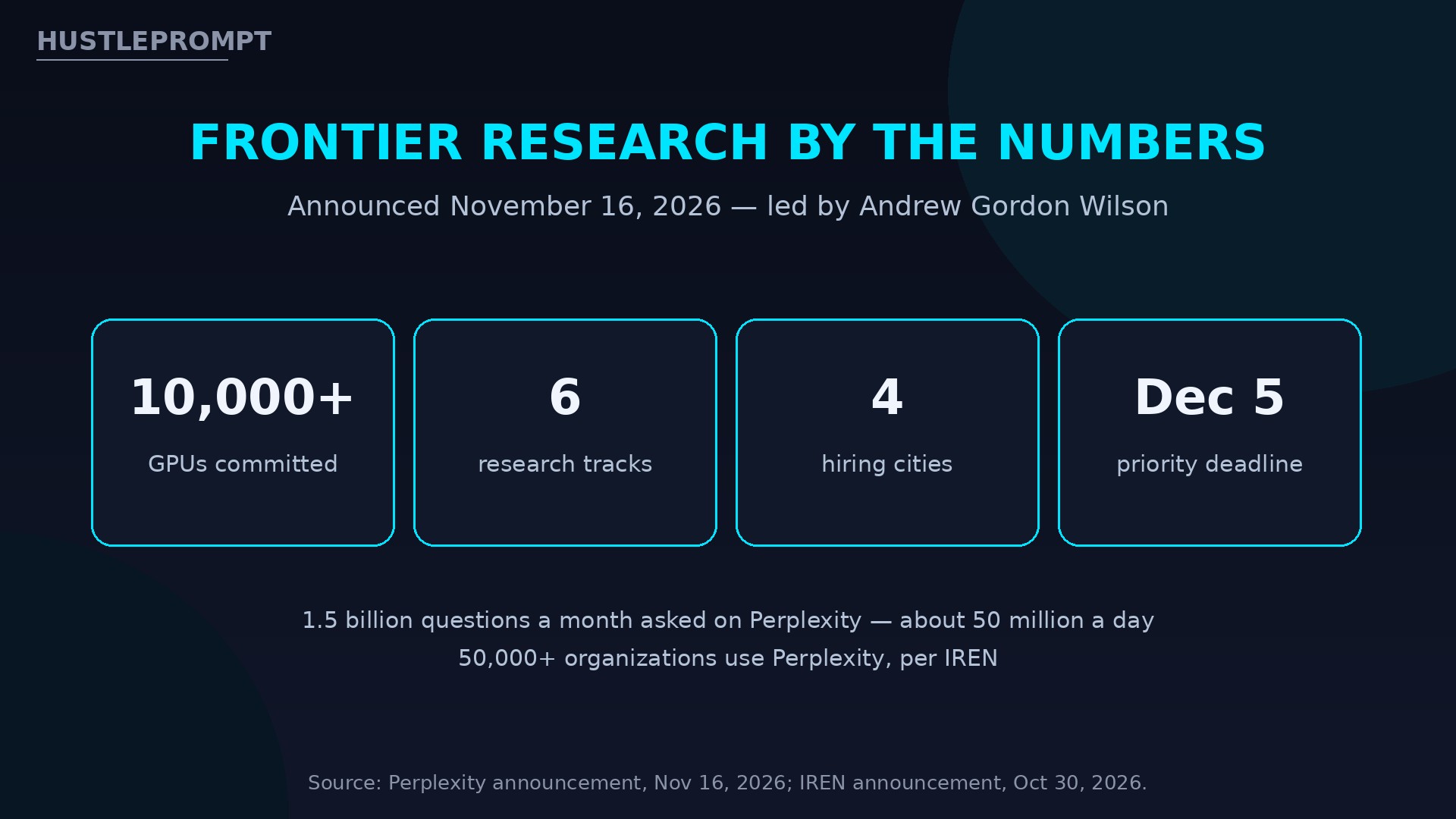
The headline number is the compute: more than 10,000 GPUs, in the words of Perplexity’s research site, or “in excess of 10,000 GPUs,” in the words of the blog post. CEO Aravind Srinivas put it as “at least 10,000 GPUs.” The commitment is meant to support large-scale experiments across pre-training, reinforcement learning, and continual learning — the three areas where compute is the binding constraint.
What the announcement does not specify matters just as much. It names no GPU model, no interconnect, no cluster allocation, and no cost. Ten thousand of one accelerator is not ten thousand of another, and a shared pool is not a dedicated cluster. Perplexity also gave no date for the first papers, models, or benchmarks, and no headcount target for the lab. Treat the 10,000 figure as a floor on ambition, not a specification — and watch the first published artifacts for the real signal.
There is one concrete clue about where the capacity comes from. On October 30, 2026, IREN announced a multi-year agreement giving Perplexity access to NVIDIA Blackwell Ultra GPUs at an IREN data-center campus, to run the models and agents behind Perplexity Computer. IREN disclosed no value, term, GPU count, or campus location for that deal, so it cannot be tied directly to the 10,000-GPU figure — but it is the only public GPU supply deal Perplexity has announced, and it shows the company was lining up serious accelerator capacity weeks before launching the lab.
Frontier Research at a glance — verified facts
| Fact | What Perplexity announced | Source |
|---|---|---|
| Announced | November 16, 2026 | Perplexity blog; @perplexity_ai on X |
| Goal | An automated researcher / automatic research scientist | Perplexity blog; research site |
| Compute | More than 10,000 GPUs (“in excess of 10,000”) | Perplexity blog; research site; CEO on X |
| Research lead | Andrew Gordon Wilson | Reported by Crypto Briefing, TokenPost, AlphaSignal |
| Six tracks | Multi-agent orchestration, pre-training, continual learning, reinforcement learning, systems, evaluations | Perplexity blog; research site |
| Open commitment | Papers, blog posts, data, models, code, benchmarks — released openly | Perplexity blog; research site |
| Hiring | Researchers and engineers in San Francisco, Palo Alto, New York, London; competitive salary and equity | Research site; @perplexity_ai on X |
| Priority deadline | December 5, 2026 | Research site |
| GPU supply context | IREN multi-year deal, Oct 30, 2026: NVIDIA Blackwell Ultra GPUs at an IREN campus for Perplexity Computer workloads | IREN announcement, Oct 30, 2026 |
Sources: Perplexity blog post and research site (November 16, 2026); Crypto Briefing, TokenPost, AlphaSignal coverage of the announcement (November 16, 2026); IREN announcement (October 30, 2026). GPU models, interconnects, allocation, and cost were not specified in the announcement.
Who is running it
The initiative is led by Andrew Gordon Wilson, according to coverage of the announcement from Crypto Briefing, TokenPost, and AlphaSignal, which all name him as research lead. Wilson previously taught machine learning at New York University and has published research on Bayesian deep learning, model generalization, and uncertainty — a background that fits the lab’s stated focus on estimating uncertainty and producing interpretable knowledge rather than black-box predictions. Perplexity’s own pages do not name Wilson, so this article attributes his leadership to the three independent reports, not to Perplexity directly.
Perplexity is hiring researchers and engineers for the lab in San Francisco, Palo Alto, New York, and London, with “competitive salary and equity” and a priority deadline of December 5, 2026 — 19 days after the announcement. A separate Perplexity Research Fellowship offers predoctoral and postdoctoral tracks for early-career researchers, including work aligned with the initiative. The hiring signal is part of the story: a lab that needs talent in four cities at once is a lab that intends to grow fast, and the December 5 deadline shows Perplexity wants applications now, not next quarter.
How the automated researcher is supposed to work
What this means for Perplexity subscribers
The lab is not a side project. Perplexity says its results “end up in a product used by millions of curious people, the most challenging test of all.” That is the money angle for subscribers: research breakthroughs from Frontier Research are meant to land in Perplexity’s products, not sit in papers. The most likely landing spots are the features Perplexity already sells — Deep Research, which digs into questions across dozens of sources, and Computer and Teammates, the agent products that take on ongoing work.
Teammates is the clearest precedent. Launched November 5, 2026 — eleven days before Frontier Research — Teammates are AI agents that take ongoing responsibility for specific work, and they are available as a research preview to subscribers on the $200-a-month Max plan. Perplexity’s CEO said the company created about 10,000 Teammates in 30 days, 20 times its human workforce. A better automated researcher makes Teammates better at the exact thing they are sold to do: sustained, multi-step work without constant supervision.
The pricing context matters for anyone weighing a subscription. Perplexity Pro costs $20 a month and Max costs $200 a month. If Frontier Research delivers even part of its promise — research agents that ask better questions, check their own uncertainty, and remember what they learn — the value of the Max tier, where the agent features live, goes up. The open-release commitment also means some of the lab’s models and evaluations will be public, so the benefits are not locked behind a paywall alone.
Scale is on Perplexity’s side here. IREN says more than 50,000 organizations use Perplexity, and Perplexity users ask more than 1.5 billion questions a month — about 50 million a day. Every one of those questions is a test case for the lab’s systems, and every answer is a chance to measure whether the new research methods actually work. No other research lab has a live product with that volume of real research questions flowing through it every day.
How to profit from the automated-researcher race
A research lab announcement is not a product launch, and this is not financial advice. But four concrete moves follow from what Perplexity actually announced — and from what it did not.
- Use the research tools you already pay for, harder: if you are on Perplexity Pro ($20/month) or Max ($200/month), Deep Research and Teammates are the closest thing to an automated researcher you can buy today. Run your real research questions through them now, and keep notes on where they fail — asking the wrong question, missing a gap, overstating confidence. Those failure modes are exactly what Frontier Research is trying to fix, and your notes become the benchmark for whether the new features are worth the upgrade later.
- Apply before December 5 if you qualify: the priority deadline is December 5, 2026, for full-time roles in San Francisco, Palo Alto, New York, and London, plus a predoctoral and postdoctoral fellowship. One application covers all six research areas. Research labs at this scale pay competitive salaries with equity, and joining at launch — rather than after the first papers — is the fastest way into frontier AI research without a PhD from a top lab.
- Watch the open releases, not the press release: Perplexity promised papers, models, data, benchmarks, and open repositories. The first real test is whether those artifacts arrive, and whether they are reproducible. Bookmark the Frontier Research site and the Perplexity blog, and check what ships in the next 90 days. An open model or evaluation from this lab is a free tool for your own research business — and early expertise with it is a sellable skill.
- Sell research as a service, with better tools coming: if you sell market research, literature reviews, or due diligence to small businesses, your margins depend on how fast you can turn a question into a sourced, checked report. An automated researcher that estimates its own uncertainty and remembers what it learns would cut the verification time that eats your margin today. Build the service now on Deep Research and Teammates; the Frontier Research pipeline is your upgrade path, not your starting point.
The catches
Three things temper the story. First, an automated researcher is a research objective, not a product. Perplexity has announced a lab, a compute commitment, and a hiring drive — not a single paper, model, or benchmark. The near-term evidence will come from reproducible releases and measured system performance, and until those arrive, the 10,000-GPU number is a promise, not proof. Second, the compute figure is underspecified: no GPU model, no interconnect, no allocation, no cost. A lab with 10,000 older accelerators shared with product workloads is a different thing from a dedicated cluster of the latest hardware, and Perplexity has not said which it is. Third, the competition is not standing still. Meta has outlined a frontier AI team of 50 to 100 researchers, per TokenPost’s coverage, and OpenAI, Google, and Anthropic all run research labs at far larger scale. Perplexity’s edge is its live product and its open-release promise — but an edge is not a lead, and the lab has to ship to keep it. The honest move is the boring one: watch what Frontier Research publishes in the next 90 days, and judge the lab by its artifacts, not its announcement.

FAQ
What is Perplexity Frontier Research?
Perplexity Frontier Research is a new research lab launched by Perplexity on November 16, 2026. Its goal is to build an automated researcher — an AI system that can perform autonomous scientific research: asking unanswered questions, gathering evidence, finding gaps, forming hypotheses, running experiments, estimating uncertainty, and updating its conclusions.
How many GPUs is Perplexity committing to Frontier Research?
More than 10,000 GPUs, according to Perplexity’s research site and blog post; CEO Aravind Srinivas put it as “at least 10,000 GPUs.” The announcement does not specify GPU models, interconnects, allocation, or cost.
Who leads Perplexity Frontier Research?
Andrew Gordon Wilson, according to coverage of the announcement from Crypto Briefing, TokenPost, and AlphaSignal. Wilson previously taught machine learning at New York University and has published research on Bayesian deep learning, model generalization, and uncertainty. Perplexity’s own announcement pages do not name him.
What are the six research tracks?
Multi-agent orchestration, pre-training, continual learning, reinforcement learning, systems, and frontier evaluations. Perplexity says it will focus particularly on pre-training, continual learning, and reinforcement learning, unified by multi-agent orchestration.
Will Frontier Research publish its work openly?
Yes. Perplexity says it will publish papers, models, data, and benchmarks, and release algorithms, models, and evaluations openly, tested in Perplexity products. The research site says results ship as papers, blog posts, model weights, and open repositories.
Is Perplexity hiring for Frontier Research?
Yes. Perplexity is hiring researchers and engineers in San Francisco, Palo Alto, New York, and London, with competitive salary and equity. The priority application deadline is December 5, 2026. A separate Perplexity Research Fellowship offers predoctoral and postdoctoral tracks.
How does Frontier Research affect Perplexity Pro and Max subscribers?
Perplexity says the lab’s results will land in the product used by millions of people. The most likely beneficiaries are Deep Research, Computer, and Teammates — the agent features available to Max subscribers at $200 a month. Pro costs $20 a month. The lab’s open-release commitment also means some models and evaluations will be public.
Sources
- Perplexity: Introducing Perplexity Frontier Research — official blog post, November 16, 2026 (goal, six pillars, 10,000+ GPUs, open releases)
- Perplexity Frontier Research — official research site (six tracks, hiring cities, December 5 deadline, fellowship)
- Crypto Briefing: Perplexity launches Frontier Research team to build an automated researcher — November 16, 2026 (Wilson as lead, hiring cities)
- TokenPost: Perplexity Launches Frontier Research With At Least 10,000 GPUs — November 16, 2026 (Wilson as lead, six tracks)
- AlphaSignal: Perplexity Builds an Automated Scientist Backed by 10,000 GPUs — November 16, 2026 (Wilson background, GPU context)
- AI Brief: Perplexity Signs Multi-Year Deal for Blackwell Ultra GPUs on IREN AI Cloud — October 30, 2026 (IREN deal context)
Keep Reading
- Perplexity Teammates Hit Mac: AI Coworkers for $200 a Month — the agent product Frontier Research will make smarter
- Perplexity Teammates: AI Coworkers That Never Clock Out — what the November 5 launch added
- Perplexity Decider v1.3 Finds the Exact Words for 2 Cents — open research tools from Perplexity’s lab