
Tencent Hy4 open weights are live — and the download is 1.55 terabytes. Tencent published the full weights of its 770-billion-parameter flagship on November 20, 2026, on Hugging Face, ModelScope, and GitCode. The instruct model, an FP8 version, and the pre-trained base model are all there.
That is the headline. The real story is the license. Hy4 does not ship under Apache 2.0. It ships under a new Tencent Hy License v1.0, and Section 10 says any company selling Hy4 as a service needs Tencent’s written permission once its revenue passes $50 million a year or its product passes 100 million monthly users.
What Tencent published on November 20
Tencent’s Hy team published three checkpoints. The main one is Hy4, the instruction-tuned flagship that launched as a paid API on November 4. Next to it sits Hy4-FP8, the same model compressed to 8-bit precision, and Hy4 base, the pre-trained model for teams that want to fine-tune from scratch.
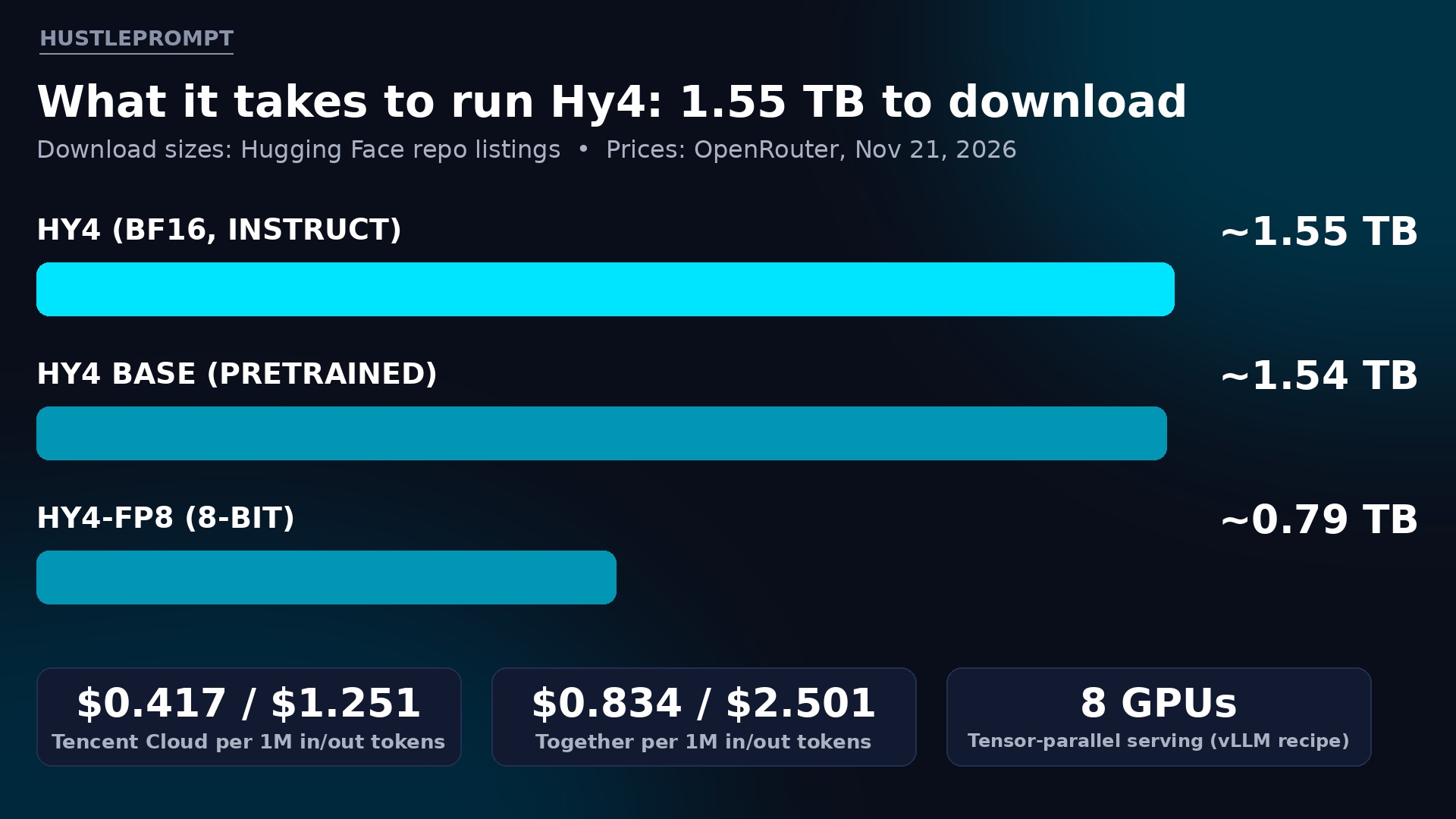
The files are enormous: the instruct model runs about 1.55 TB, the base model about 1.54 TB, and the FP8 version about 0.79 TB. Tencent’s deployment recipes assume eight GPUs working in parallel.
Do not confuse this release with Hy4 flash, the smaller sibling we covered on November 16. Hy4 flash has 224 billion total parameters with 12 billion active per token, and its weights went up on November 17-18. The full Hy4 is a different machine: 770 billion total parameters and 49 billion active per token.
The evidence: Hy4 by the numbers
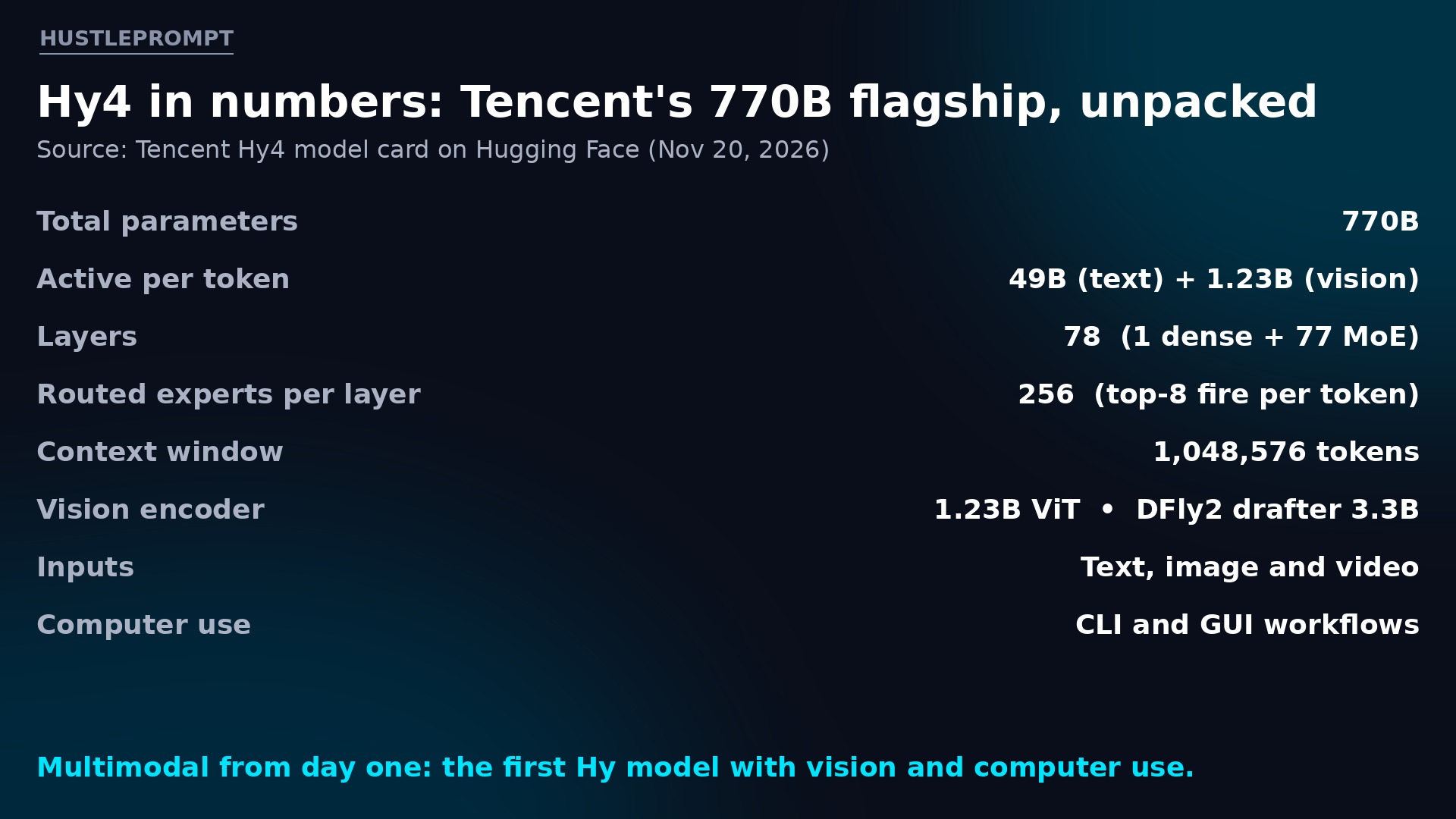
Every figure below comes from Tencent’s own Hy4 model card on Hugging Face. The 770B figure excludes the vision encoder and the speculative-decoding drafter:
| Spec | Hy4 |
|---|---|
| Total parameters | 770B (language backbone) |
| Active per token | 49B text + 1.23B vision |
| Layers | 78 — 1 dense layer, 77 MoE layers |
| Experts | 256 routed + 1 shared per MoE layer; top-8 fire |
| Context window | 1,048,576 tokens |
| Vision encoder | 1.23B ViT — text, image, and video input |
| Speculative decoding | DFly2 drafter, 3.3B parameters, reuses the KV cache |
| Download size | ~1.55 TB (BF16) / ~0.79 TB (FP8) / ~1.54 TB (base) |
“Hy4 is one of the strongest open-weight models available today.” — Tencent Hy Team, Hy4 model card, November 2026
Hy4 is also the first Hy model with vision and computer use: it reads images and video, and it can operate software through command-line and graphical interfaces, including Blender, CAD, Unreal Engine, Unity, and Godot.
The license is the real story
Open weights are not open source, and Hy4 proves it. The license file on Hugging Face warns that the Tencent Hy License v1.0 is derived from Apache 2.0, but it is not Apache 2.0. The August preview shipped under plain Apache 2.0; the final model does not.
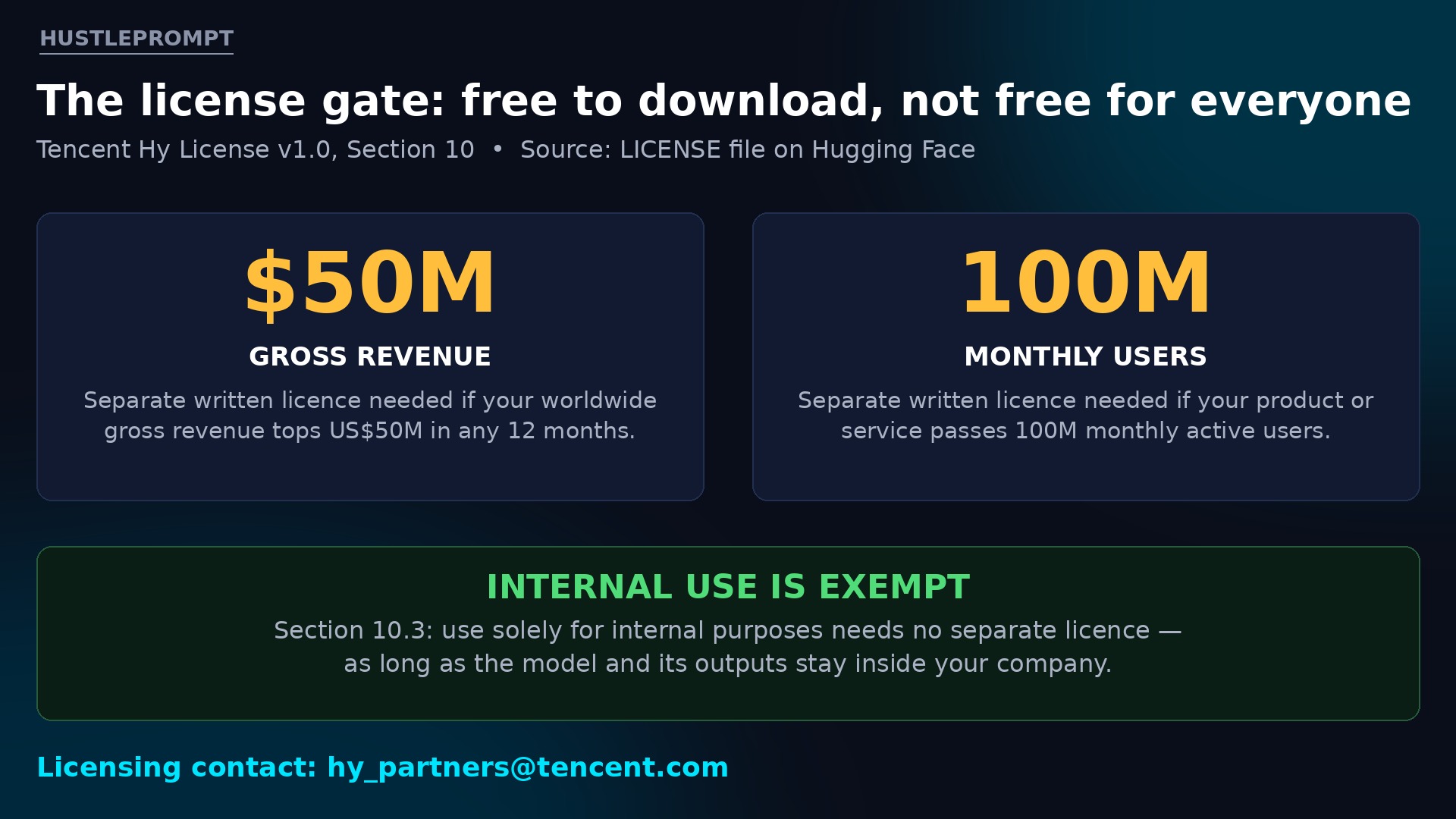
Section 10 is where the difference lives. It defines model-as-a-service — giving third parties remote access to model inference or fine-tuning, for example through an API — and requires a separate written license from Tencent above either threshold: more than $50 million in worldwide gross revenue in any 12 months, or more than 100 million monthly active users.
There are two carve-outs. First, Section 10.3 exempts internal use entirely: run Hy4 only inside your own company, never share the model or its outputs with third parties, and the thresholds do not apply. Second, the definition excludes end-user products where the model’s capabilities are confined to specific features. Internal use is free, while selling Hy4 inference at scale needs a talk with Tencent first.
Pull Hy4, Hy4-FP8, or Hy4 base from Hugging Face, ModelScope, or GitCode. Budget ~1.55 TB for the full model.
Read Section 10 of the Tencent Hy License. Internal use is exempt; selling inference above the thresholds needs a separate licence.
Serve it with the official vLLM or SGLang images across 8 GPUs, or call the hosted API instead.
Fine-tune, quantize, or distill — the license covers derivatives. Just mind Section 10 before you sell access.
What it costs: rent it or run it
If 1.55 TB and eight GPUs sound like too much, the hosted API is the cheaper door in. OpenRouter lists two providers for the same model, and the gap between them explains the conflicting prices this week. Tencent Cloud charges $0.417 per million input tokens and $1.251 per million output tokens (marked 50% off); Together charges the full list price of $0.834 and $2.501.
Self-hosting flips the math. The weights are free, so the cost becomes hardware: eight GPUs, storage for roughly 1.5 TB, and the engineering time to keep a 770B model serving. The FP8 version halves the storage to about 0.79 TB and runs on Tencent’s official vLLM image, vllm/vllm-openai:hy4, or the SGLang image, lmsysorg/sglang:hy4.
The evidence: benchmarks — Tencent’s own tests
All scores below are from Tencent’s own evaluations, published on the Hy4 model card. No independent benchmark of the open weights exists yet, so treat these as the vendor’s numbers:
| Benchmark (Hy4 Base, few-shot) | Score |
|---|---|
| MMLU | 91.6 |
| MMLU-Pro | 73.9 |
| SuperGPQA | 62.7 |
| C-Eval | 95.0 |
| SimpleQA | 57.2 |
| GPQA Diamond (OpenRouter listing) | 83.2% |
The finance numbers are the most concrete. Across 579 real-world financial tasks judged by 213 finance professionals, Hy4 averaged 3.04 out of 4 — ahead of DeepSeek-V4.1-Flash at 2.97 and GLM-5.3 at 2.68. Tencent also reports cutting the hallucination rate from 15.76% on Hy4 preview to 5.45%.
How to profit from a 770B model you can download
Free weights plus a license gate create a set of openings. Most small businesses will never touch the $50 million threshold, so the model is effectively free for them — while big API sellers face a negotiation. Here is how to turn that into income:
- Sell internal AI, not API access. Offer companies a private Hy4 deployment that automates their own documents, research, and coding. Internal use is exempt from Section 10, so the client gets a flagship model with no per-token bill and no license negotiation.
- Build finance and office agents. Hy4’s strongest reported results are in financial workflows — fund research, equity analysis, tax accounting — with a hallucination rate Tencent says fell to 5.45%. Package that as a service for accounting firms and small funds.
- Offer fine-tuning on the base model. Hy4 base is the pre-trained checkpoint, built for further training. Fine-tune it on a client’s data and sell the tuned model as part of a project, not as a public API.
- Run the API arbitrage, carefully. The Tencent Cloud rate on OpenRouter is half the Together rate for the same model. If you build products on the API, route through the cheaper provider and keep the margin — but check the rate before you quote a client, because the 50%-off price can change.
One rule covers all four: read the license before you sell anything. If your plan involves giving third parties general-purpose access to Hy4 inference, get legal advice on Section 10 first.
How to run it yourself
Running Hy4 takes a server, not a laptop. Tencent’s vLLM recipe uses the official image vllm/vllm-openai:hy4 with tensor parallelism across eight GPUs. The SGLang route uses lmsysorg/sglang:hy4 with the same eight-way split.
Before you commit, check three things: storage for roughly 1.5 TB (or 0.79 TB for FP8), eight GPUs with enough memory for a 770B model, and your use case against Section 10. If all three check out, the download is free and the model is yours to run.
The honest limits
Tencent is unusually frank about where Hy4 falls short. The model card states that a notable gap remains between Hy4 and top proprietary models, particularly on research-level mathematics, long-horizon coding, model self-improvement, and advanced visual question answering.
There is also a practical limit: almost nobody can run this model at home. A 1.55 TB download and an eight-GPU server put Hy4 out of reach for individuals and small teams, which is why the API price matters more.
Frequently asked questions
What is Tencent Hy4?
Hy4 is Tencent’s flagship AI model: a 770-billion-parameter mixture-of-experts model with 49 billion active parameters per token, a 1,048,576-token context window, and text, image, and video understanding plus computer use. It launched as a paid API on November 4, 2026, and its full weights were published on November 20, 2026.
Are the Tencent Hy4 weights really free to download?
Yes. The instruct model, the FP8 version, and the pre-trained base model are published on Hugging Face, ModelScope, and GitCode with no gate. The files are about 1.55 TB, 0.79 TB, and 1.54 TB. Downloading is free, but you need a multi-GPU server to run the model.
Is Hy4 open source under Apache 2.0?
No. Hy4 uses the Tencent Hy License v1.0, which is derived from Apache 2.0 but explicitly states it is not Apache 2.0. The key difference is Section 10: model-as-a-service operators above $50 million in annual revenue or 100 million monthly active users need a separate written license from Tencent. Internal use is exempt. Licensing questions go to hy_partners@tencent.com.
What does the $50 million license threshold mean for me?
Almost certainly nothing. The threshold applies only if you operate a model-as-a-service business — selling third parties remote access to Hy4 inference or fine-tuning — and your worldwide gross revenue exceeds $50 million in any 12 months, or your product passes 100 million monthly active users. The revenue test counts all of your revenue, not just revenue from Hy4. Running Hy4 inside your own company is exempt under Section 10.3.
How much does the Hy4 API cost?
On OpenRouter, Tencent Cloud lists $0.417 per million input tokens and $1.251 per million output tokens (marked 50% off), while Together lists $0.834 input and $2.501 output. Cache reads cost $0.021 on Tencent Cloud and $0.042 on Together. Check the live listing before you build, because the discounted rate can change.
What is the difference between Hy4 and Hy4 flash?
Hy4 is the 770B flagship with 49B active parameters per token; Hy4 flash is a smaller, cheaper sibling with 224B total parameters and 12B active per token, built for low cost and high speed. Flash costs about $0.07 per million input tokens on Tencent Cloud, roughly one-twelfth of full Hy4’s list price. Flash weights were published on November 17-18, two days before the full Hy4 weights.
Can I run Hy4 on my own hardware?
Only on serious hardware. Tencent’s deployment recipes use eight GPUs in parallel with the official vLLM or SGLang images. The FP8 version needs about 0.79 TB of storage; the full BF16 model needs about 1.55 TB. Both serving stacks expose an OpenAI-compatible API, so existing tools can point at your server with a one-line URL change. For most people, the hosted API is the practical way to use Hy4.
Sources: Tencent Hy4 model card on Hugging Face; Tencent Hy License v1.0 (full text); Hy4 pricing and benchmarks on OpenRouter.