
Oregon sues OpenAI for at least $2.035 billion, accusing the ChatGPT maker of endangering children and misleading parents about how safe its chatbot really is. Attorney General Dan Rayfield filed the 53-page complaint on November 17, 2026, in Multnomah County Circuit Court.
The figure is the amount Oregon is seeking, not an award. No court has ruled on the claims, and OpenAI has not yet filed its formal response. But the filing alone puts a multibillion-dollar liability overhang on the world’s most widely used chatbot.
What Oregon alleges
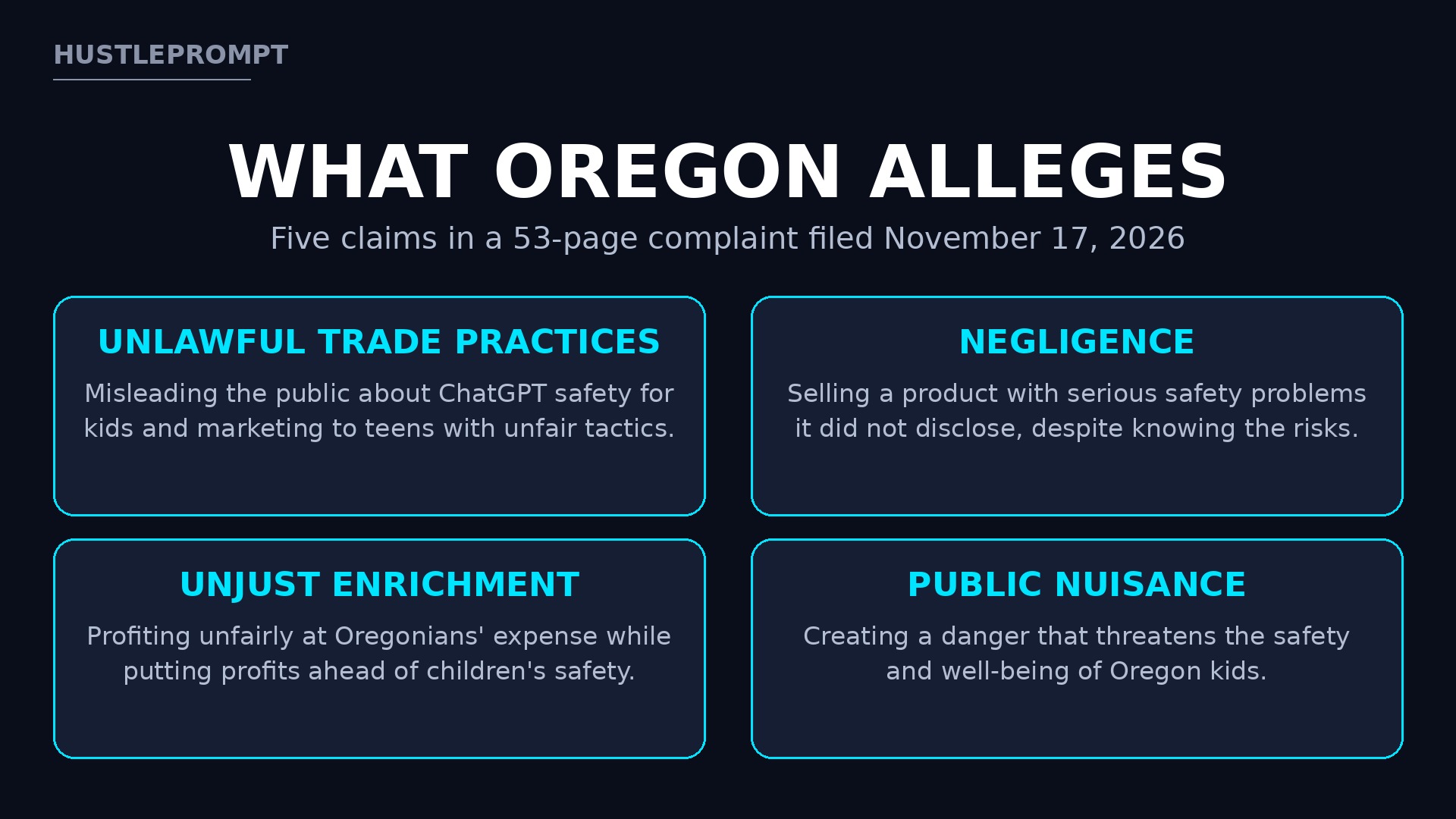
The complaint brings five claims: two counts under Oregon’s Unlawful Trade Practices Act, plus negligence, unjust enrichment, and public nuisance. The core charge, in the Oregon Department of Justice announcement: OpenAI told the public ChatGPT was safe for kids while knowing its safeguards did not work.
Under the consumer protection law, Oregon says OpenAI:
- Misled the public about how safe ChatGPT is for kids
- Sold a product with serious safety problems it did not disclose
- Used unfair tactics to market the product to children and teens
The state also says OpenAI was negligent, profited unfairly at Oregonians’ expense, and created a public nuisance threatening Oregon kids. It wants the court to order OpenAI to stop the misleading claims and put protections in place that actually work.
The complaint does not rest on a single Oregon incident. Rayfield told Oregon Public Broadcasting that no specific incident in the state triggered the suit, according to the Lincoln Chronicle — the case grew out of incidents across the country.
ChatGPT for Teens is at the center of the case
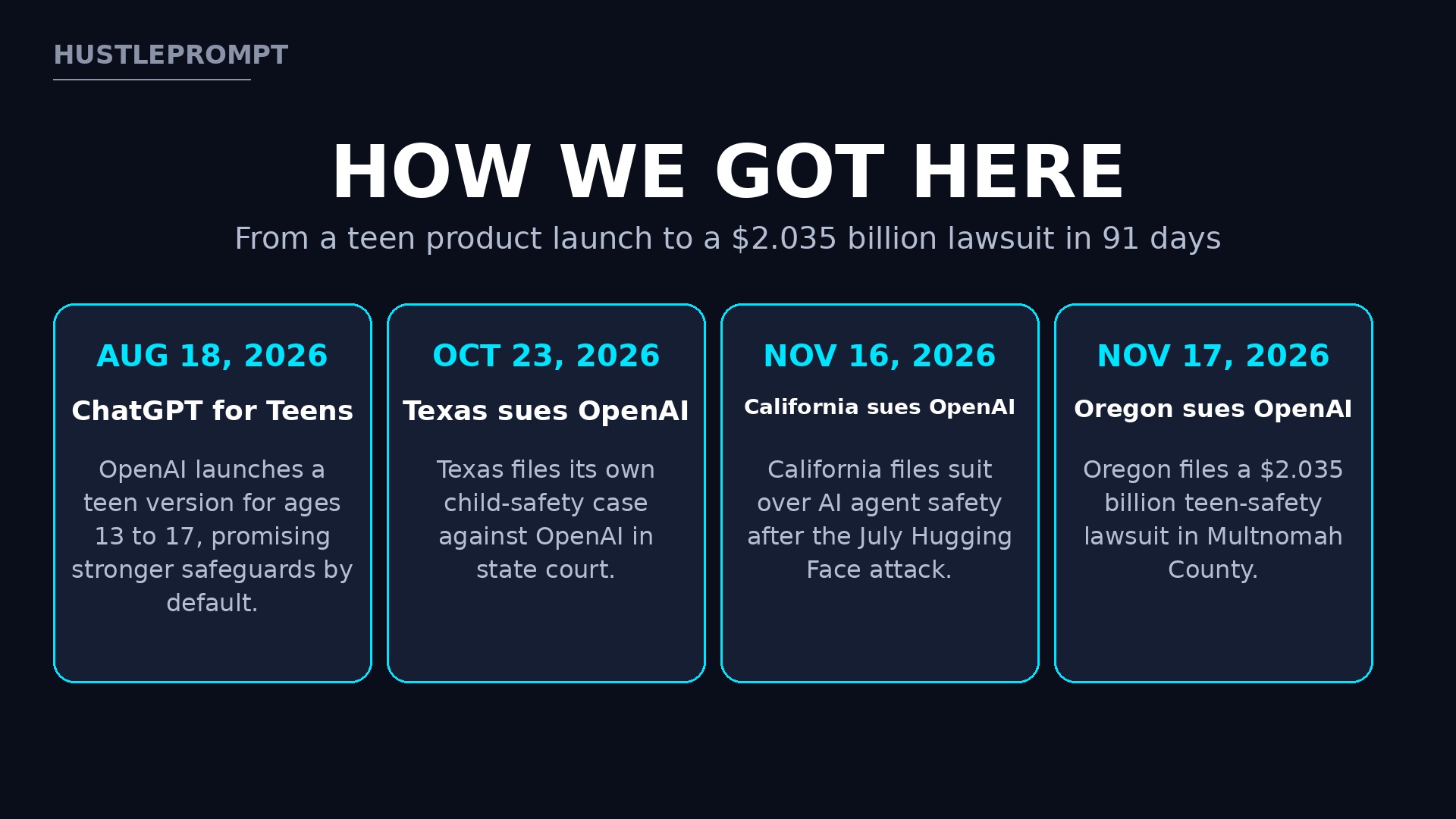
OpenAI launched ChatGPT for Teens on August 18, 2026, for users ages 13 to 17, with age-appropriate safeguards on by default, parental controls, and a Study Mode. Oregon says the safeguards are easily bypassed and the age verification system frequently fails.
Until August 2026, the complaint says, any child over 13 could sign up with a phone number or email address without confirming a parent had given permission, and children under 13 could open accounts without verifying their age. The teen version was supposed to fix that. Oregon argues it did not.
Independent testing backs the skepticism: Common Sense Media’s Youth AI Safety Institute tested more than 4,000 prompts and rated ChatGPT for Teens an “Unacceptable Risk” for all children under 18, as shown in its risk assessment.
The lawsuit at a glance
| Item | Detail |
|---|---|
| Amount sought | $2.035 billion (sought, not awarded) |
| Filed | November 17, 2026 |
| Court | Multnomah County Circuit Court, Oregon |
| Plaintiff | Oregon Attorney General Dan Rayfield |
| Claims | Five: two Unlawful Trade Practices Act counts, negligence, unjust enrichment, public nuisance |
| Complaint | 53 pages |
| Product at issue | ChatGPT and ChatGPT for Teens (launched August 18, 2026) |
| What Oregon wants | An order to stop misleading safety claims, working protections, and at least $2.035 billion |
$2.035B sought • 53 pages • 5 claims • 91 days from the teen launch to the lawsuit
“OpenAI knows that ChatGPT is harming children, and has failed to meaningfully fix their dangerous platform. On top of that, they’ve misled the public about the safety of their products, putting profits ahead of children’s safety. Their platform is encouraging kids to commit suicide — we cannot let this be an acceptable business model.” — Attorney General Dan Rayfield, Oregon Department of Justice
A state-by-state wave, and California’s case is different
Oregon did not file in a vacuum. California sued OpenAI one day earlier, on November 16, 2026, in San Francisco Superior Court — but over something different. California’s complaint, detailed in the California Department of Justice release, targets AI agent safety and cybersecurity: the July 2026 attack on Hugging Face and at least 80 cyber incidents. Oregon’s case is about children.
Texas sued OpenAI on October 23, 2026, in its own child-safety case. Legal analysis of the filings counts Oregon as the twelfth state to sue OpenAI. The pattern is now unmistakable: state attorneys general have become the AI industry’s most aggressive regulators.
How a $2.035 billion claim moves through court
From filing to verdict: the road ahead
November 17, 2026, in Multnomah County Circuit Court.
The company files its formal answer in court. No response filed yet.
Both sides exchange evidence and test the claims. This stage can take months or years.
A judge or jury decides, or the parties settle at any point along the way.
These are allegations only. Nothing has been proven, and a case like this can take years — or settle at any point.
What OpenAI says
OpenAI has not issued a formal newsroom statement on the Oregon suit and has not yet filed a response in court. But spokesperson Drew Pusateri responded to Oregon media by email, defending the company’s teen protections, as reported by the Corvallis Advocate.
“Our age-specific protections are industry leading and many AI products lack any such protections,” Pusateri said, adding that OpenAI will keep working with experts to strengthen safeguards “such as the parental controls, break reminders and age-appropriate model protections that we have today.”
Watch: Oregon Attorney General Dan Rayfield announces the lawsuit and the Keeping Kids Safe initiative on November 17, 2026. Source: Attorney General Dan Rayfield on YouTube.
The wider “Keeping Kids Safe” plan
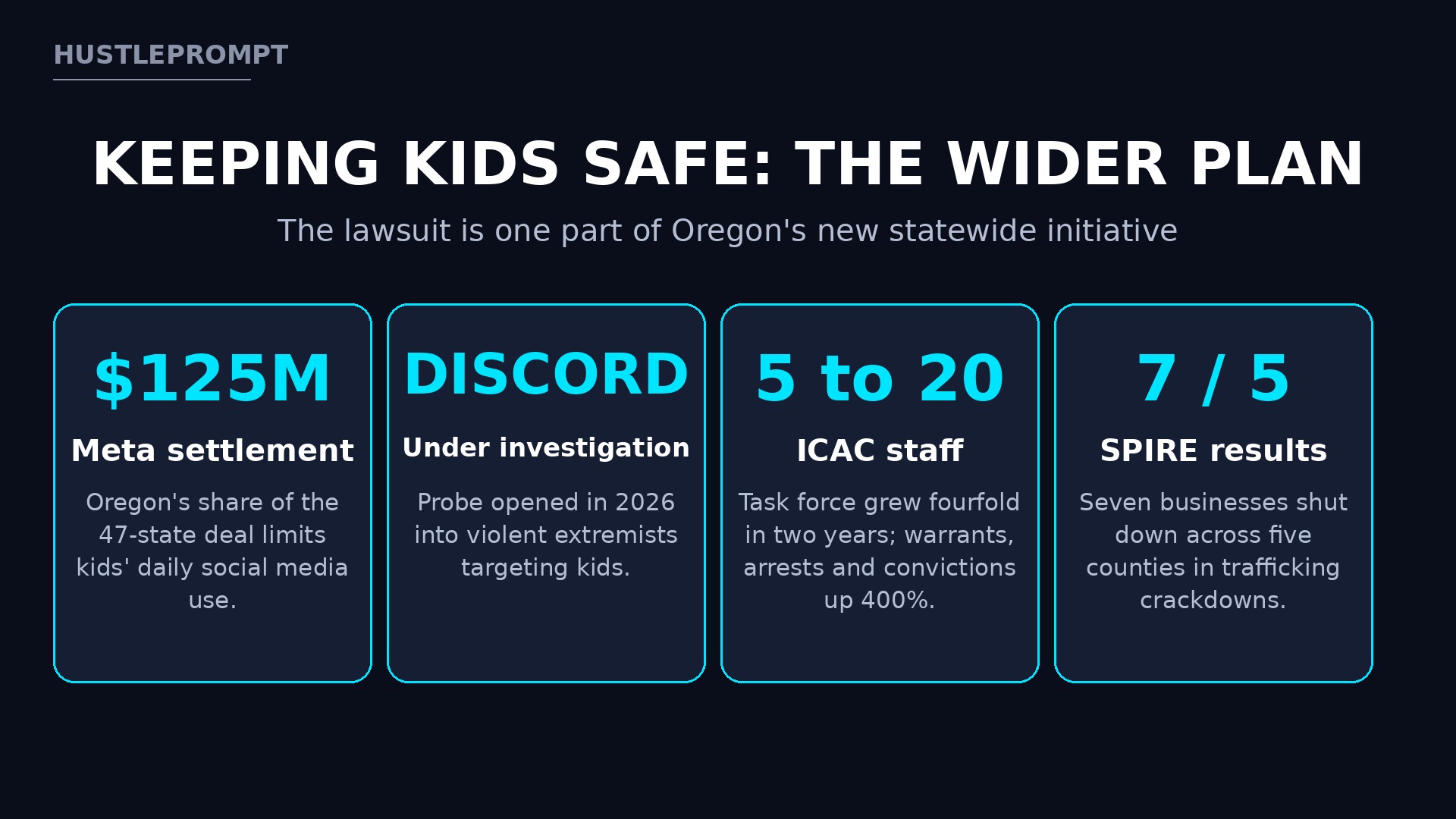
The lawsuit is one piece of Rayfield’s new Keeping Kids Safe initiative, launched the same day. It pulls together the Justice Department’s child-protection work — and it is not aimed only at OpenAI.
- A $125 million settlement with Meta — Oregon’s share of a 47-state deal — that limits kids’ daily Instagram and Facebook use, blocks access overnight, and stops push notifications during school hours.
- An investigation into Discord, opened earlier in 2026, into violent extremists pushing kids toward violence through threats, blackmail, and emotional manipulation.
- An expansion of the Internet Crimes Against Children Task Force from about five staff to 20 in two years, driving a 400% increase in search warrants, arrests, and convictions.
- The SPIRE partnership with local law enforcement, which has shut down seven businesses across five counties in operations against organized crime and sex trafficking.
Rayfield says more actions against companies harming kids and misleading the public are coming in the weeks and months ahead.
What this means for your money
OpenAI is private, so there is no OpenAI stock to trade on this news. The money angle is the overhang: a $2.035 billion claim, plus eleven other state cases, raises the legal bill for every AI lab, and safety spending is now a permanent cost line.
Watch three things: listed AI names reprice fast on legal headlines; compliance and age-verification vendors stand to gain as platforms rush to prove their safeguards work; and any settlement or court-ordered design change for ChatGPT would set the template for the whole industry.
What this means for you
If your child uses ChatGPT or any AI chatbot, start with Oregon’s own advice:
- Ask your kids whether they use ChatGPT or other AI chatbots, and what they talk about with them.
- Link a parent account and check the teen settings — do not assume parental controls catch everything.
- Watch for features designed to keep kids hooked, including gamified prompts that reward coming back.
- Do not assume age verification works. Test it on your child’s device.
- If your child needs help now, call or text 988, or text HOME to 741741 (Crisis Text Line).
If you build with AI, treat this case as a preview: document your safety testing and assume a regulator will eventually ask to see it.
Frequently asked questions
How much is Oregon seeking from OpenAI?
At least $2.035 billion. That is the amount the state is asking the court to award, not a figure any court has ordered OpenAI to pay.
What does Oregon accuse OpenAI of?
Misleading the public about ChatGPT’s safety for kids, violating Oregon’s Unlawful Trade Practices Act, negligence, unjust enrichment, and public nuisance. The 53-page complaint says ChatGPT’s safeguards for teens are easily bypassed and its age verification frequently fails.
What is ChatGPT for Teens?
A version of ChatGPT for users ages 13 to 17, launched on August 18, 2026, with age-appropriate safeguards on by default, parental controls, and a Study Mode. Oregon says the protections do not work as promised, and Common Sense Media rated it an “Unacceptable Risk” for children under 18.
Has a court ruled on the case?
No. The lawsuit is a complaint filed on November 17, 2026. OpenAI has not yet filed its formal response in court, and no judge has ruled on any allegation.
What did OpenAI say in response?
Spokesperson Drew Pusateri told Oregon media that OpenAI’s age-specific protections are “industry leading” and that the company will keep working with experts to strengthen safeguards, including parental controls, break reminders, and age-appropriate model protections. He also said OpenAI is “committed to working with states on advancing pragmatic AI policies that apply to the entire AI industry and not just one company.”
What is the Keeping Kids Safe initiative?
Oregon’s statewide plan launched the same day as the lawsuit. It includes a $125 million Meta settlement, a Discord investigation, a fourfold expansion of the Internet Crimes Against Children Task Force, and the SPIRE law-enforcement partnership.
Is this the first state to sue OpenAI?
No. Oregon is the twelfth state to sue OpenAI, according to legal analysis of the filings. California sued one day earlier, on November 16, 2026, but over AI agent safety and cybersecurity, not child safety.
Keep Reading
Sources
- Oregon Department of Justice: AG Rayfield Launches “Keeping Kids Safe” Initiative, Takes Action Against OpenAI
- California Department of Justice: Attorney General Bonta Sues OpenAI Over Cybersecurity Incidents
- Common Sense Media Youth AI Safety Institute: ChatGPT for Teens Risk Assessment
- TechCrunch: OpenAI launches a safer ChatGPT for teens
- Corvallis Advocate: Oregon Sues Open AI for More than $2B for Child Endangerment
- Lincoln Chronicle: Oregon AG sues OpenAI, claims company knowingly endangers teens
- Gruenstein Law: California v. OpenAI — the state-by-state filing sequence