
22% of all Eventbrite tickets are sold through Eventbrite’s own marketplace — people who never saw the venue’s post, never got its email, and never walked past its door. That is the business: selling AI event promotion services to venues and bars — a done-for-you push that fills one night, a gig, a tasting, an opening, a quiz night, with AI-built posters, posts, and listings. This is a one-off event push — not an ongoing calendar (post 9732), not wedding marketing (post 10007), not a neighborhood guide (post 9415) — and you sell a full room on one date.
Disclaimer: general business information, not legal advice. Use written agreements and the client’s own accounts. Prices are illustrative, never promises of income.
What the service is, exactly
A venue books an event, then hopes people show up. For a flat fee, you build the promotion kit with AI: the venue supplies the date, the act, and the ticket link. You supply the noise.
- The poster: print design and a square social version.
- The listing: an Eventbrite page, short title, 140-character summary, FAQs.
- The social push: 7 days of posts, stories, and one video teaser.
- The email invite: one send to the venue’s list.
- Local listings: Facebook Events, Google Business Profile, and local “what’s on” pages.
- The report: sales, views, and clicks, with the next event pitched.
The evidence: discovery happens on marketplaces, not on hope
Eventbrite says 22% of its tickets are sold through its marketplace, with 89 million monthly users and 4.7 million events. Listings with video convert 10% better, and events with FAQs get up to 8% more search views. Most of a venue’s potential crowd is not following the venue — they are browsing for something to do on Friday night.
The tools reward the tricks: events with buy-one-get-one offers sold 2.2 times more tickets and got 2.6 times more views. Events promoted with Eventbrite Ads got 9 times more visibility and 4 times more tickets. Eventbrite emails get 77% higher open rates than the industry average, and nearly half of its organizers say its AI saves them 2 or more hours a week.
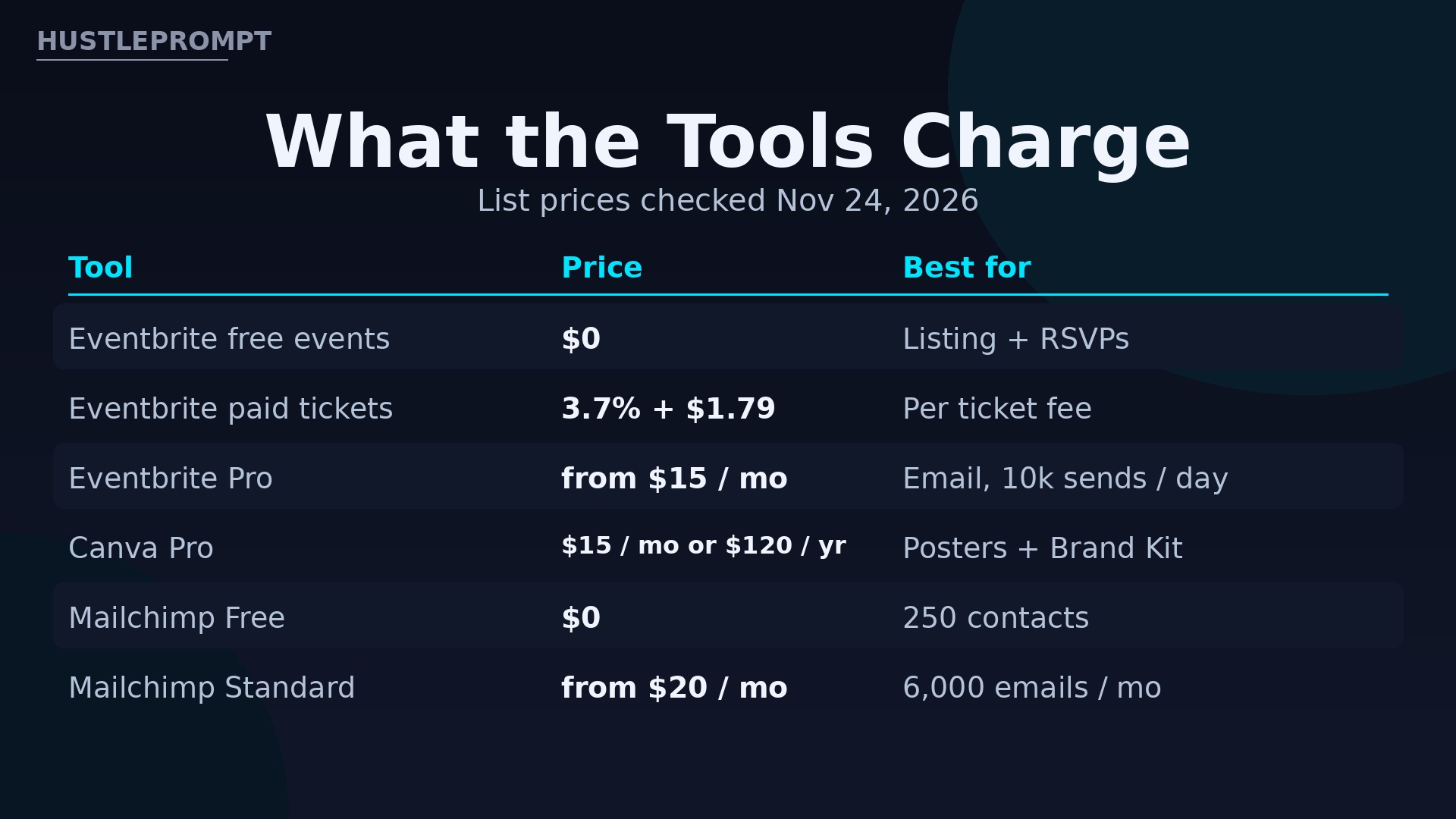
Your costs: what the tools charge
| Tool | Price (checked Nov 24, 2026) | Use it for |
|---|---|---|
| Eventbrite, free events | $0 | Listing, RSVPs |
| Eventbrite, paid tickets | 3.7% + $1.79 per ticket | Ticketing fee |
| Eventbrite, processing | 2.9% per order | Card payments |
| Eventbrite Pro | From $15/mo | Email, 10k sends/day |
| Canva Pro | $15/mo or $120/yr | Posters, Brand Kit |
| Mailchimp Free | $0 (250 contacts) | Small email lists |
| Mailchimp Standard | From $20/mo | 6,000 emails/month |
Start free. A free event on Eventbrite costs nothing to list, Canva Free covers the first posters, and Mailchimp Free covers lists under 250 contacts. Paid tiers only matter once a venue runs weekly events — then the venue pays, not you — and Eventbrite says Pro email saves organizers over $700 a year versus third-party tools.
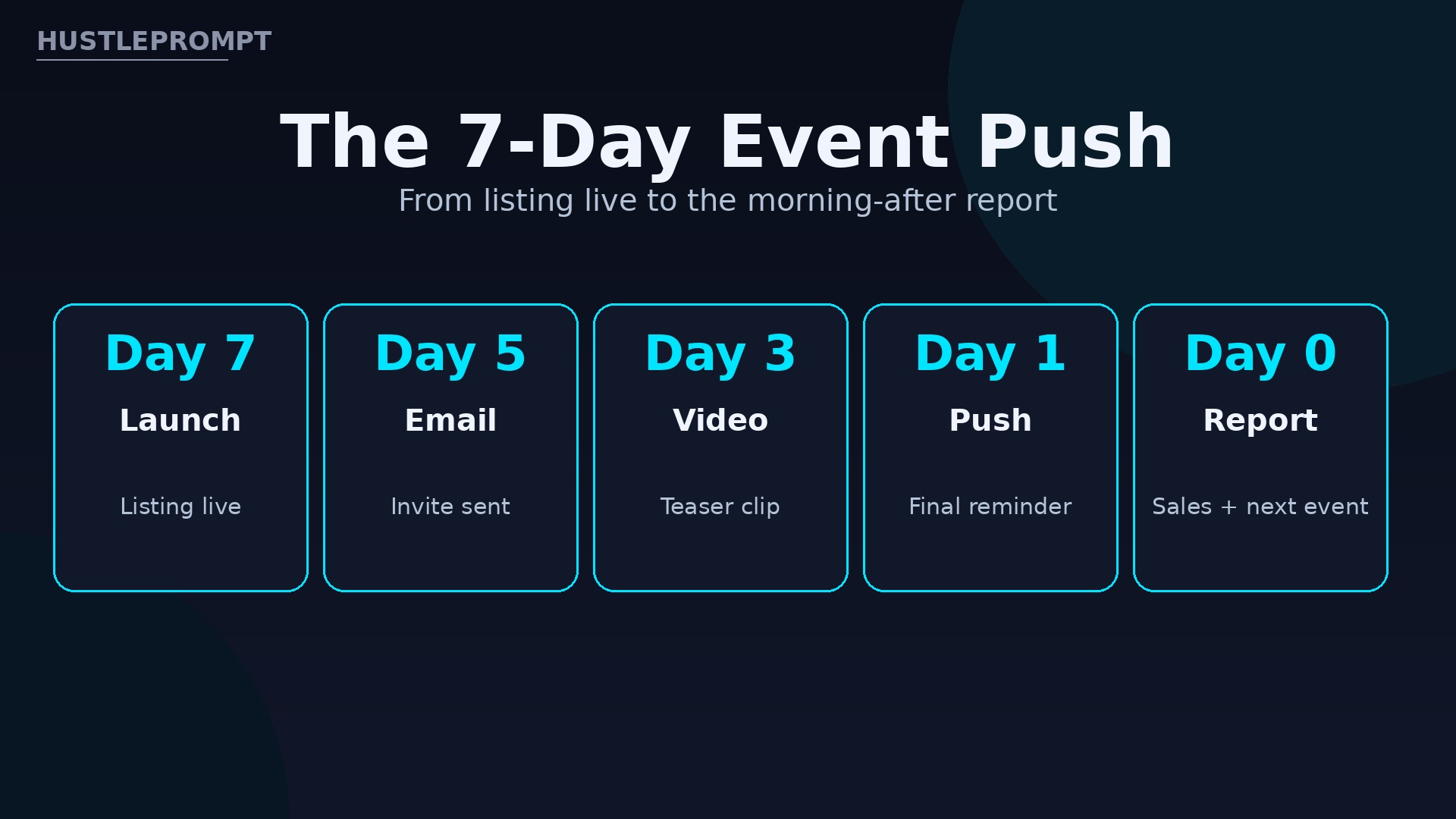
Listing live.
Invite sent.
Teaser clip.
Final reminder, last tickets.
Sales, views, next event.
How it works: the one-event promotion package
Every event gets the same five moves, in order. First, the listing: Eventbrite page, Facebook Event, and Google Business Profile post, live seven days out. Second, the creative: poster, square post, and story versions from one Canva design. Third, the email: one invite, with a 48-hour early-bird code. Fourth, the video: a 30-second teaser from the act’s own clips. Fifth, the countdown: daily stories and a final reminder on the day.
AI does the volume; you do the judgment. Eventbrite’s AI drafts the listing overview, summary, and image in seconds; Canva’s AI resizes one poster into every format. You check every fact — date, door time, age limit, price — because one wrong time in ten posts is ten wrong times.
Step 1: pick one venue type in one town
Pick one pair: live-music bars in your town, or craft breweries with weekly tastings nearby. List 30 venues; mark the ones with a full calendar and blurry phone photos. They already run events; their promotion is visibly weak.
Step 2: offer a free teaser for their next event
Walk in with a finished sample, not a pitch deck: take their next event, build the poster and three social posts, and show the owner what Friday could look like. One free teaser costs about an hour. It proves the gap: their post is a phone photo; yours is a poster with the date, the act, and the ticket link.
Step 3: build the kit in the client’s own accounts
Build everything in the venue’s own accounts: the Eventbrite listing in their organizer account, the Facebook Event in their page, the email list in their Mailchimp. You are a contractor with a login, not the owner of their audience. When the contract ends, the venue keeps the listing, the list, and the designs — that is why they trust you with the next event.
Step 4: run the 7-day push and spend the small ad budget
Launch seven days out and follow the diagram: listing first, poster next, email on day five, video on day three, final reminder on the day. If the venue has a small ad budget — even $25 — put it behind the Eventbrite listing or a Facebook Event ad, geo-targeted to 10 miles. A $25 test tells you more than any argument.
Step 5: report the night, then sell the season
The morning after, send a one-page report — tickets sold, listing views, email opens, and the top three posts by clicks — then pitch the season. A bar with a weekly gig needs this push 52 times a year; a brewery with monthly tastings needs it 12 times. Your best line is the room itself: “Last Friday sold out by 8 p.m. Shall we do the same for the next four Fridays?”
What to charge
No official price list exists — these are illustrative ranges.
| Package | Illustrative price | What it includes |
|---|---|---|
| Free teaser | Free | Poster + 3 posts |
| One-event push | $250 to $500 per event | Full kit, 7-day push |
| Monthly retainer | $800 to $1,500 a month | 4 events a month |
Scale it: 6 venues at $1,000 a month is $72,000 a year, plus seasonal one-offs. A sold-out Friday — 150 tickets at $15 — is $2,250 at the door, so a $350 push is an easy yes.
The mistakes that kill this business
- Starting too late. Three days is not a campaign; launch seven days out.
- One post, then silence. Events need repetition across the week.
- Wrong details. Check the date, door time, and price on every asset.
- Designing in your own accounts. The client must own the listing and the list.
- Promoting to everyone. Geo-target the town, not the internet.
- No report after the night. Without numbers, there is no retainer.

Frequently Asked Questions
What are AI event promotion services?
A done-for-you service that promotes one local event for a venue or bar — poster, posts, email invite, Eventbrite listing, local listings — built with AI and run over a 7-day push.
How is this different from a social media content calendar?
A calendar is ongoing content, week after week. An event push is a short, intense campaign for one date, with a ticket link, a countdown, and a morning-after sales report. Post 9732 covers calendars; this covers single nights.
What tools do I need to start?
Four, all with free tiers: Eventbrite for listing and ticketing, Canva for graphics, Mailchimp for email, Facebook Events for discovery. Paid tiers only matter once a venue runs weekly events.
How much can I charge for AI event promotion services?
Illustrative: $250 to $500 per event, or $800 to $1,500 a month per venue for four events a month. The free teaser is how you win the first client.
Do venues pay the Eventbrite fees?
Free events cost nothing to list. For paid tickets, Eventbrite charges 3.7% plus $1.79 per ticket, plus 2.9% processing per order — and the buyer usually pays the fee, not the venue.
How far ahead should promotion start?
Seven days for a regular gig, tasting, or quiz night: listing first, email on day five, video on day three, final reminder on the day. Bigger events need three to four weeks.
Keep Reading
- Sell AI Social Media Content Calendars to Restaurants.
- Sell AI Wedding Vendor Marketing Services.
- Sell AI Neighborhood Guides to Real Estate Agents.
Sources: Eventbrite pricing — eventbrite.com; Eventbrite listing and marketing tips — eventbrite.com; Canva Pro pricing ($15/mo or $120/yr, 2026 pricing checks; Canva page blocked direct fetch) — canva.com; Mailchimp pricing — mailchimp.com. Checked Nov 24, 2026.