
Nine days after two poisoned agent-framework releases stole Azure and CI secrets, the project’s GitHub repository is still offline. Microsoft Agent Framework — the open-source toolkit for building AI agents — returns a 404 at github.com/microsoft/agent-framework, and Microsoft has given no date for bringing it back.
What happened in 55 minutes
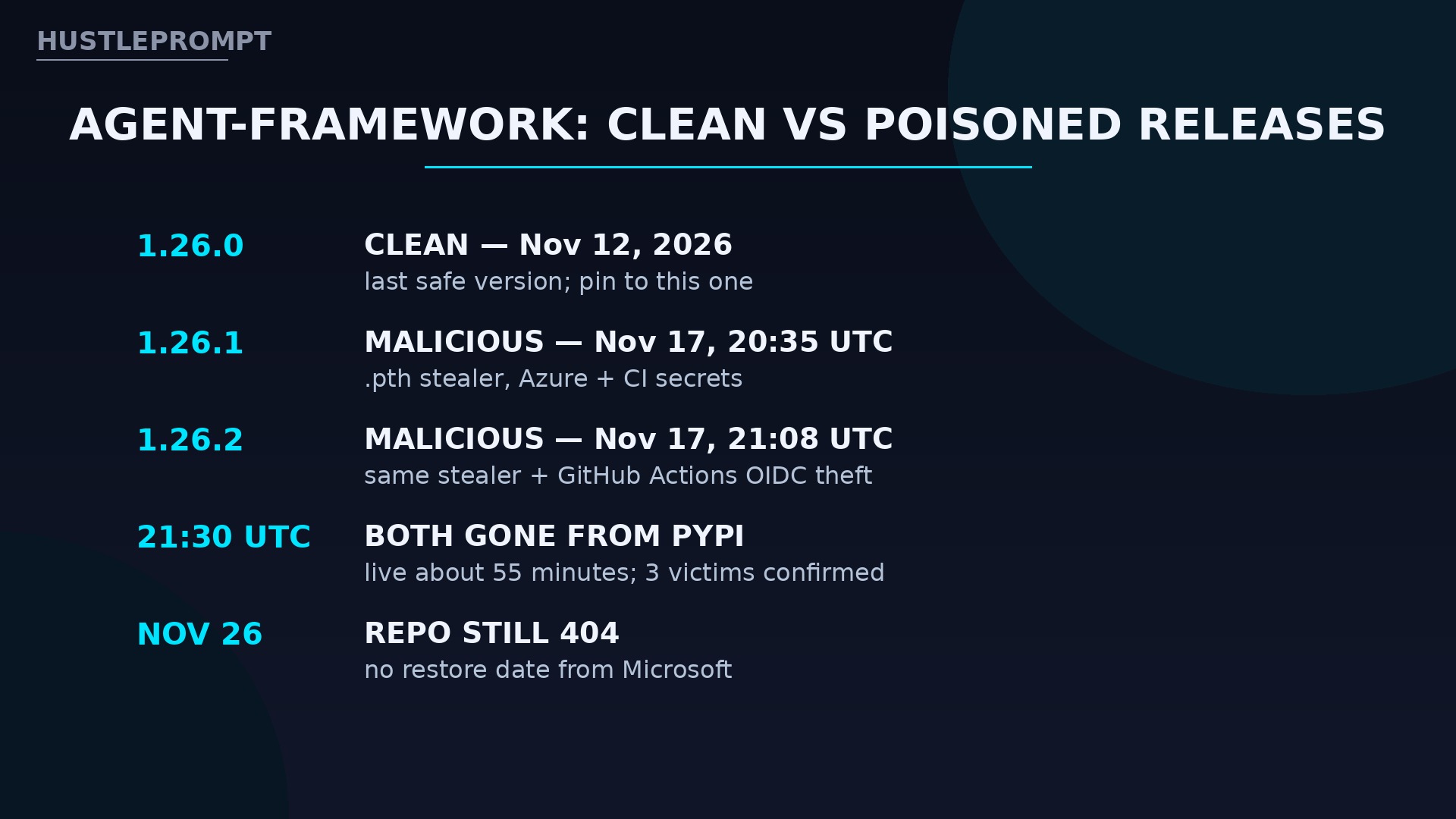
On November 17, 2026, agent-framework 1.26.1 appeared on PyPI at 20:35 UTC. 1.26.2 followed at 21:08 UTC. Both were gone by about 21:30 UTC — but anyone whose build pulled the latest version in that window got a credential stealer under Microsoft’s name.
| Version | When | Status |
|---|---|---|
| 1.26.0 | Nov 12, 2026 | Clean — last safe release |
| 1.26.1 | Nov 17, 20:35 UTC | Malicious — .pth credential stealer |
| 1.26.2 | Nov 17, 21:08 UTC | Malicious — same stealer + GitHub OIDC theft |
The package gets about 41,000 downloads a week — almost 200,000 a month, per Wiz. The malicious wheels were built from the legitimate 1.26.0 wheel, plus one .pth file.
What the advisory says
“Anyone who installed 1.26.1 or 1.26.2 should treat the environment as exposed and rotate the credentials reachable from it, including CI and GitHub Actions secrets.”
— GitHub Advisory Database, GHSA-764m-3ppc-5m73
How a package you never imported still ran
Python runs every .pth file in site-packages at interpreter start, executing any line that begins with import. The malicious wheels dropped agent_framework_meta.pth (1.26.1) or af_runtime_diag.pth (1.26.2) into that folder — so the stealer ran whenever Python launched there, even if no code ever imported agent_framework.
What the stealer hunted
The stealer hunted cloud and CI secrets: environment variables with names containing TOKEN, SECRET, PASSWORD, KEY, AZURE, AWS, GITHUB, OPENAI, HF_, FOUNDRY, NPM, PIP, and NUGET; secret-looking values from up to 300 other processes; and up to 60 credential files in 1.26.1 (80 in 1.26.2). It also requested fresh identity tokens: Azure DevOps OIDC tokens, Azure managed-identity tokens for 12 resources, and, in 1.26.2, GitHub Actions OIDC tokens.
The stolen data went to webhook.site, a public service whose free tier keeps at most 100 requests and expires after 7 days. Wiz confirmed the attacker’s token was on the free tier, and a maximum of 50 requests were captured: 4 from the attacker’s machines, 29 from sandboxes and scanners, and 17 that represent only three unique victim exfiltrations.
The AI angle: the attacker’s tool was an AI agent too
Wiz found something stranger in the attacker’s telemetry. The tooling identifies itself as Cairn, an open-source AI penetration-testing framework. It staged the package at /tmp/cairn_pkg. Before publishing, the attacker ran the stealer on its own machine — and that run captured an AI coding agent configuration: the open-source Pi harness backed by a GLM-family model.
The root cause, per Wiz’s November 18 update: the attacker “appears to have compromised a client certificate and private key for Microsoft ESRP,” the internal signing-and-publishing service. A first attempt from AWS was rejected by ESRP’s IP filtering; a second from Microsoft-owned IP space succeeded. How the credentials were obtained is not yet known.
It is the second agent-built attack on a public registry this week. On November 24, JFrog caught an autonomous agent called ARTEX uploading credential-stealing models to Hugging Face — and leaking its own keys. Same pattern: AI agents now write, test, and ship malware at machine speed, and the registries everyone trusts are the soft target. Read it here: AI Agent Built a Malware Model, Then Leaked Its Own Keys.
What Microsoft has said — and what is still dark
Microsoft’s only public statement came to The Register on November 18: “We have made some repositories private while we investigate malicious content.” The Register noted the agent-framework repository was offline.
On November 20, microsoft/agent-framework, microsoft/onnxruntime, and microsoft/onnxruntime-genai still returned 404. On November 26 — nine days after the hijack — the agent-framework repo and its documentation site still return 404. Microsoft has said nothing publicly about how the attacker published under its name, or when the repos come back. The PyPI advisory, PYSEC-2026-4388, says both versions were “uploaded without authorization”.
How to profit — and how to protect yourself
- Search lockfiles, CI logs, and virtualenvs for agent-framework 1.26.1 or 1.26.2, and check site-packages for
agent_framework_meta.pthoraf_runtime_diag.pth. Pin to 1.26.0. - Rotate everything reachable from an affected host: Azure CLI sessions, DevOps PATs, npm, PyPI, NuGet, Docker, and Hugging Face tokens, plus git credentials.
- Do not run pip uninstall in an affected environment. Starting the interpreter fires the hook one more time. Use tooling that does not execute
.pthfiles. - For GitHub Actions (1.26.2): treat OIDC tokens for
api://AzureADTokenExchangeandmanagement.azure.comas exposed.
The market signal: supply-chain security for AI tooling is now a front-page problem two weeks running — first durabletask, now agent-framework. Teams that pin versions, verify hashes, and gate registries are the ones that sleep.
Frequently asked questions
What is Microsoft Agent Framework?
Microsoft’s open-source SDK for building AI agents and multi-agent workflows in Python, on Azure AI Foundry and Azure OpenAI.
Which versions were poisoned?
1.26.1 (Nov 17, 20:35 UTC) and 1.26.2 (Nov 17, 21:08 UTC). Version 1.26.0 (Nov 12) and earlier are clean.
How many victims were confirmed?
Three unique successful exfiltrations. Any install in the window must still be treated as exposed.
How did the attacker publish as Microsoft?
Per Wiz, a compromised ESRP client certificate and private key; how they were obtained is unknown.
What if I installed 1.26.1 or 1.26.2?
Treat the environment as exposed: rebuild from a clean image, rotate every reachable credential, audit Azure and GitHub Actions identities.