
Retailers expect 19% of this holiday season’s sales to come back as returns — up from 17% in each of the past two seasons, per Happy Returns’ 2026 report. That is the market for AI returns automation: a self-service returns portal, exchange-first flows, instant refunds, automated labels, and restock routing, sold to e-commerce stores as a done-for-you service. This service starts after delivery, when the box comes back. Post-purchase upsell emails (post 11362) sell more after the order, abandoned cart recovery (post 10349) wins back shoppers who never checked out, and holiday sale campaigns (post 11471) drive the sale itself.
Disclaimer: general business information, not legal advice. Use written agreements and the client’s own tools. Prices are illustrative, never promises of income.
What the service is, exactly
You build and run a store’s returns system for one fixed fee: the branded portal and rules that turn a return into an exchange instead of a lost sale. The shopper starts the return alone, picks an exchange or store credit, and gets a label without emailing support. AI drafts the policy and messages; you set the rules and test every flow before it goes live.
- The returns portal: a branded page where shoppers start a return with an order number and email.
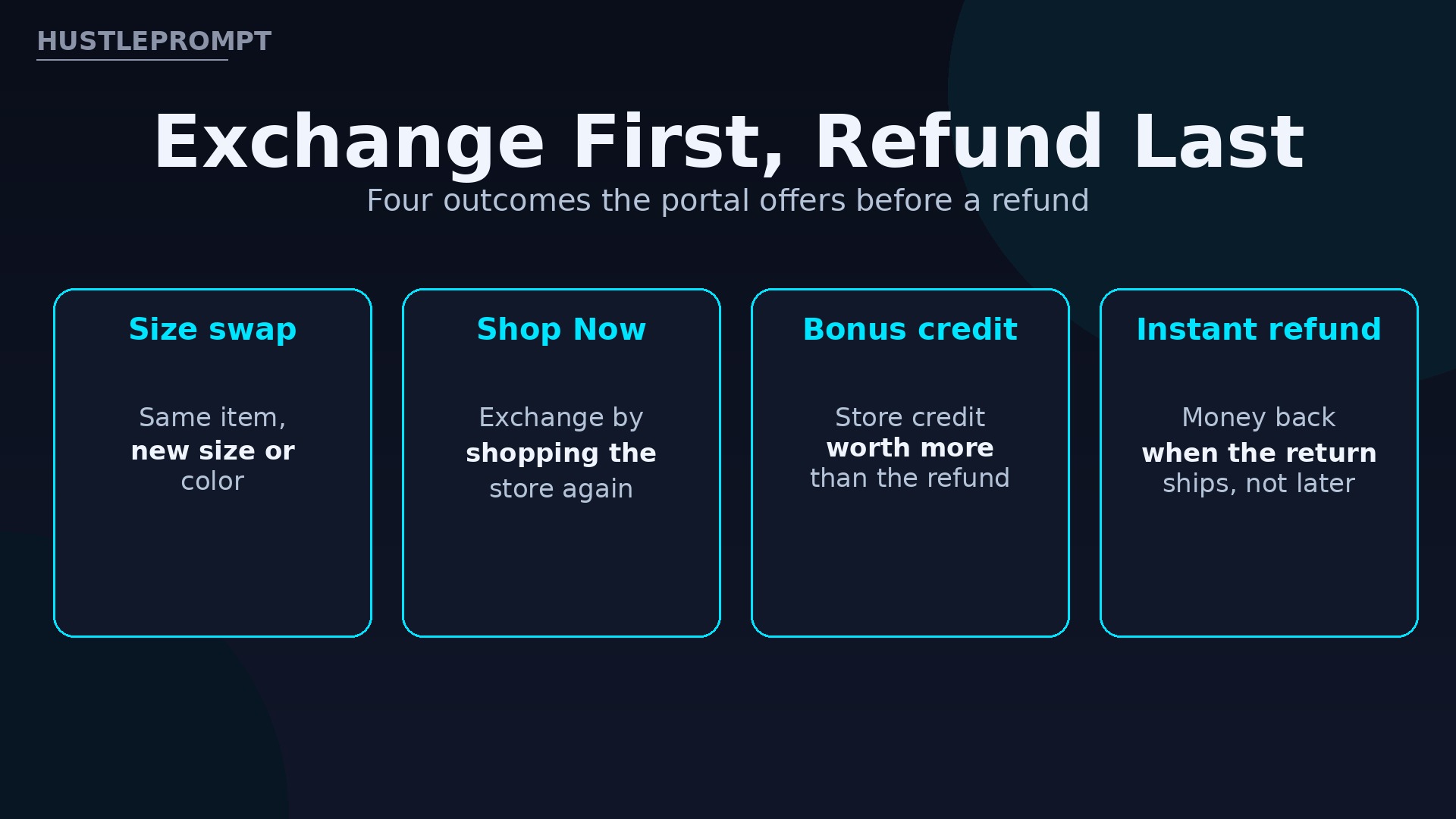
- The exchange-first flow: size swaps, Shop Now exchanges, and bonus store credit offered before a refund.
- Instant refunds: refunds or exchanges issued when the return ships.
- Automated labels: prepaid labels and QR drop-off codes, no staff needed.
- Restock routing: rules that send each return to resale, refurbishment, or liquidation.
- The report: return rate, exchange rate, revenue kept, fraud flags.
Portal lookup, no email.
Swap, Shop Now, or bonus credit.
Prepaid label or QR code.
Issued on scan.
Resale, refurbish, or liquidate.
The evidence: the returns surge is the pitch
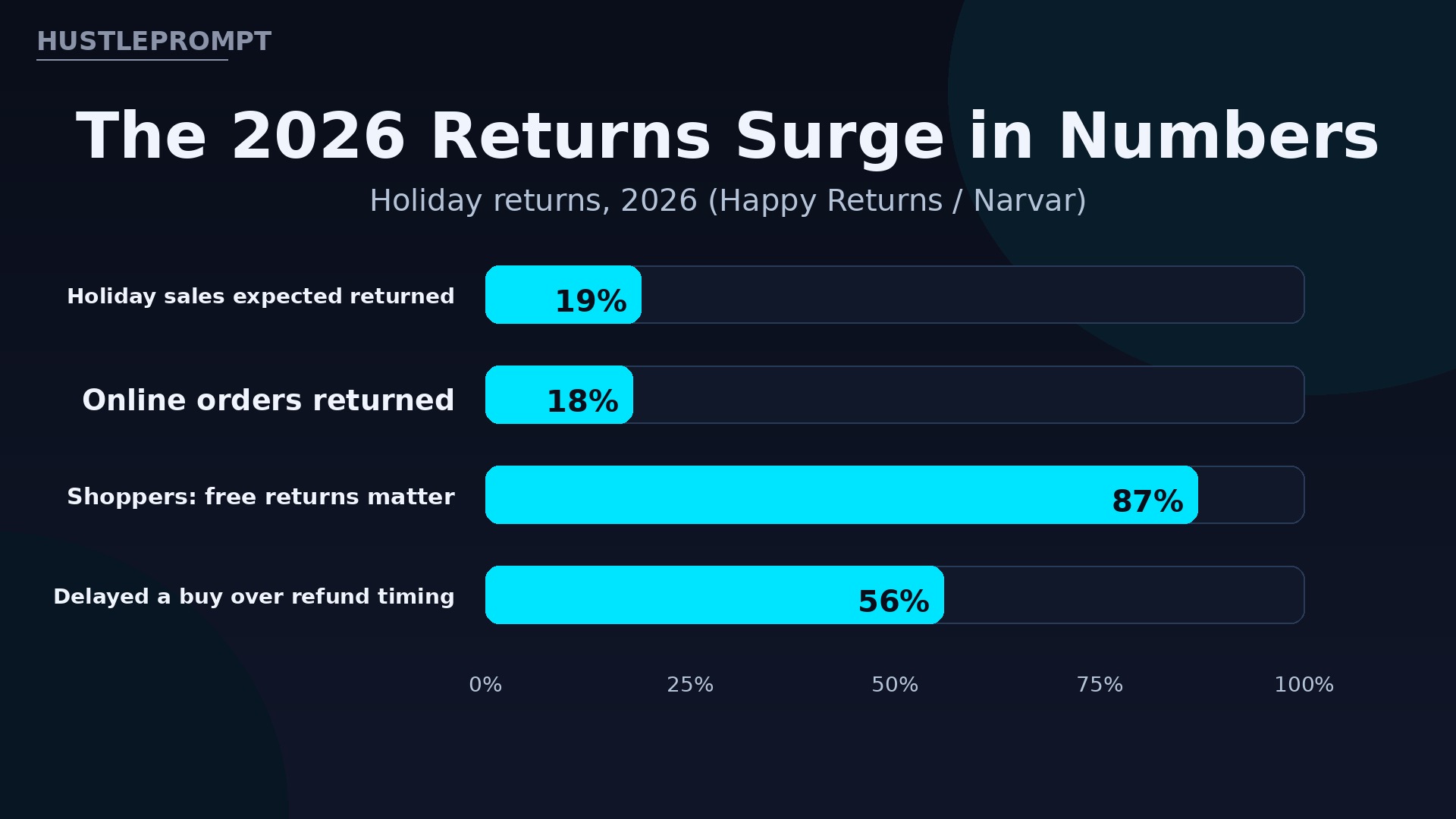
Happy Returns surveyed 2,006 consumers and 375 e-commerce professionals for Returns Happen 2026. Retailers expect 19% of 2026 holiday sales to be returned, up from 17% in the previous two seasons. Online orders come back at 18%, in-store purchases at 9%, and 47% of holiday purchases will happen online, up from 43%. Against NRF’s $1.013 trillion holiday forecast, 19% implies roughly $192 billion in returns — our calculation.
| Figure | Value | Source |
|---|---|---|
| Holiday sales returned, 2026 | 19% (was 17%) | Happy Returns |
| Online return rate, 2026 | 18% | Happy Returns |
| In-store return rate, 2026 | 9% | Happy Returns |
| U.S. returns, 2025 | $849.9B, 15.8% of sales | NRF |
| Online sales returned, 2025 | 19.3% | NRF |
| Shoppers: free returns matter | 87% | Happy Returns |
Returns decide the sale before it happens. Narvar surveyed 1,348 U.S. consumers and found 56% delayed or avoided a purchase over refund timing — and instant refunds would make nearly 9 in 10 more likely to buy. Three-quarters said a poor return experience would make them less likely to buy again.
Two forces squeeze the store: nearly three-quarters of retailers now charge for at least some returns, per NRF, yet 46% of shoppers avoid retailers that charge for returns, per Narvar. Fraud adds risk: Happy Returns puts fraud at 8% of returns, and 69% of retailers expect more of it this season. Your service sits in the middle — fast returns that protect the store’s margin.
Your costs: what the tools charge
| Tool | Price (Nov 27, 2026) | What you get |
|---|---|---|
| AfterShip Returns Essentials | $19/mo | 20 returns/mo, portal, auto labels |
| AfterShip Returns Premium | $119/mo | 100 returns/mo, AI exchanges |
| Loop Returns plan | From $340/mo | Up to 1,000 returns, Instant Exchange |
| ChatGPT Plus | $20/mo | Policy drafts, return reasons, customer messages |
AfterShip Essentials at $19 a month covers a small store’s pilot, with $0.50 per return over 20. Loop’s Returns plan, from $340 a month, fits bigger apparel brands that need Instant Exchange. The client pays for their own returns app — it is their asset. Your cost is ChatGPT Plus at $20 a month, reused across every client.
How it works: the returns service you sell
Here is how you sell it, step by step.
Step 1: pick one niche and twenty stores
Pick one niche: apparel brands on Shopify, or footwear stores. Audit 20 targets: can a shopper start a return without emailing support? Most small stores run returns by inbox. A store with 200 orders a month and a “email us to return” policy is a warm lead.
Step 2: build the returns kit
Build the whole service once for a demo store in your niche: a branded portal, a 30-day window, exchange-first rules, five return reasons. Draft the policy and emails in ChatGPT, then set them up in AfterShip. Test three returns end to end — a size swap, a refund, a damaged item — before you show anyone.
Step 3: sell it with a one-page sample
Skip the slide deck. Build one free sample: the store’s branded portal with a size-swap flow. Send it with the numbers: 19% of holiday sales come back, 56% of shoppers delay buying over refund timing. Your best line: “Your Black Friday orders are coming back. The question is whether they come back as exchanges or refunds.”
Step 4: launch before the returns wave and watch the portal
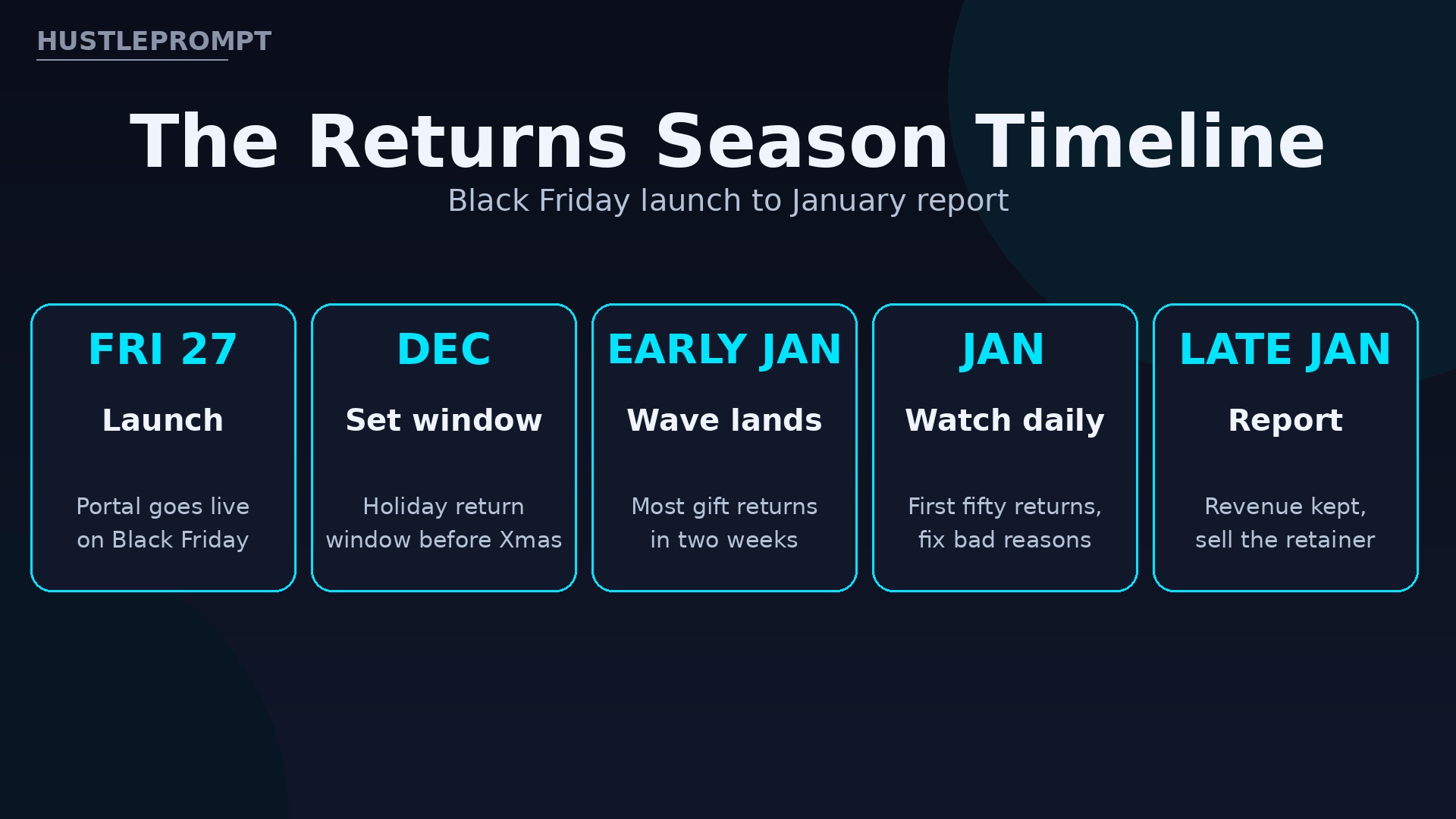
Install the portal in the client’s own AfterShip or Loop account and link it from the footer, order emails, and account page. Set the holiday return window before Christmas — 45% of shoppers return an unwanted gift within two weeks to a month, and 37% within a week. Watch the first fifty returns daily and fix the reasons shoppers pick wrong.
Step 5: report results and sell the year-round version
In late January, send a one-page report: return rate, exchange rate, revenue kept, fraud flags. Then pitch the follow-up: a monthly retainer that runs the portal and tunes the rules. The holiday setup is a one-time fee; the year-round version is how it becomes a retainer.
What to charge
No official price list exists — these are illustrative ranges.
| Package | Illustrative price | What it includes |
|---|---|---|
| One-page sample portal | Free | Branded portal, real products |
| Returns setup | $800 to $1,500 one-time | Portal, policy, exchange rules, labels |
| Setup + January management | $1,500 to $2,500 one-time | Above + daily monitoring, returns wave |
| Monthly retainer | $700 to $1,200 a month | Portal runs, rule tuning, reports |
Scale it: 6 stores at $1,100 is $6,600 for the season, and 2 on a $900-a-month retainer add $21,600 a year. Bill the returns app to the client: $19 a month on AfterShip Essentials.
The mistakes that kill this business
- Refunding first. Every refund is revenue gone; offer the exchange first.
- Charging for every return. 46% of shoppers avoid retailers that charge for returns.
- One rule for every return. A damaged item and a wrong size need different outcomes.
- Launching after Christmas. The wave lands in early January.
- Ignoring fraud flags. 8% of returns are fraud — instant refunds need limits.
- Working in your own account. The client must own the portal and the return data.
Frequently Asked Questions
What is AI returns automation?
A done-for-you service that sets up a store’s self-service returns portal — exchange-first flows, instant refunds, automated labels, restock routing — with AI drafting the policy and a human setting the rules.
How is returns automation different from upsell emails or cart recovery?
Upsell emails (post 11362) sell more after the order; cart recovery (post 10349) wins back shoppers who never checked out. Returns automation starts after delivery, when the product comes back.
When should a returns portal launch?
The portal goes live on Black Friday, November 27, 2026, with the holiday return window set before Christmas. Most gift returns land in the first two weeks of January.
Which tools do I need to automate returns?
AfterShip Returns — Essentials at $19 a month for 20 returns — or Loop Returns from $340 a month for bigger brands. ChatGPT Plus drafts the policy and messages.
How much can I charge for AI returns automation?
Illustrative: $800 to $1,500 for a one-time setup, $1,500 to $2,500 with January management, and $700 to $1,200 a month on retainer.
Do instant refunds invite fraud?
They can: Happy Returns puts fraud at 8% of returns. Limit instant refunds to low-value orders and tracked drop-offs, and review fraud flags weekly.
Keep Reading
- Sell AI Post-Purchase Upsell Emails to E-commerce Stores.
- Sell AI Abandoned Cart Recovery to E-Commerce Stores.
- Sell AI Holiday Sale Campaigns to E-Commerce Stores.
Sources: Happy Returns 2026 report, via Supply Chain 24/7 — supplychain247.com; NRF and Happy Returns 2025 returns report — emarketer.com; NRF 2026 holiday forecast — nrf.com; Narvar 2026 Holiday Shopping Report — corp.narvar.com; AfterShip Returns pricing — aftership.com; Loop Returns pricing — aftership.com; ChatGPT Plus — help.openai.com. Checked Nov 27, 2026.