
Back-in-stock alerts are the highest-converting email automation Omnisend measures: 58.8% open, 21.31% click, 6.72% conversion, $9.14 per email. This tutorial shows you how to sell that flow to e-commerce stores: a Notify Me button on sold-out products, a restock waitlist, and email and SMS alerts the moment stock returns, plus price-drop alerts. This is not competitor price monitoring (post 10101), which watches rivals’ prices, nor win-back (post 10091), which chases lapsed buyers. This is the store’s own sold-out products, and shoppers who asked to buy them. Black Friday is the perfect launch: this weekend’s sellouts become the waitlist.
Disclaimer: general business information, not legal advice. Use written agreements and the client’s own tools. Prices are illustrative, never promises of income.
What the service is, exactly
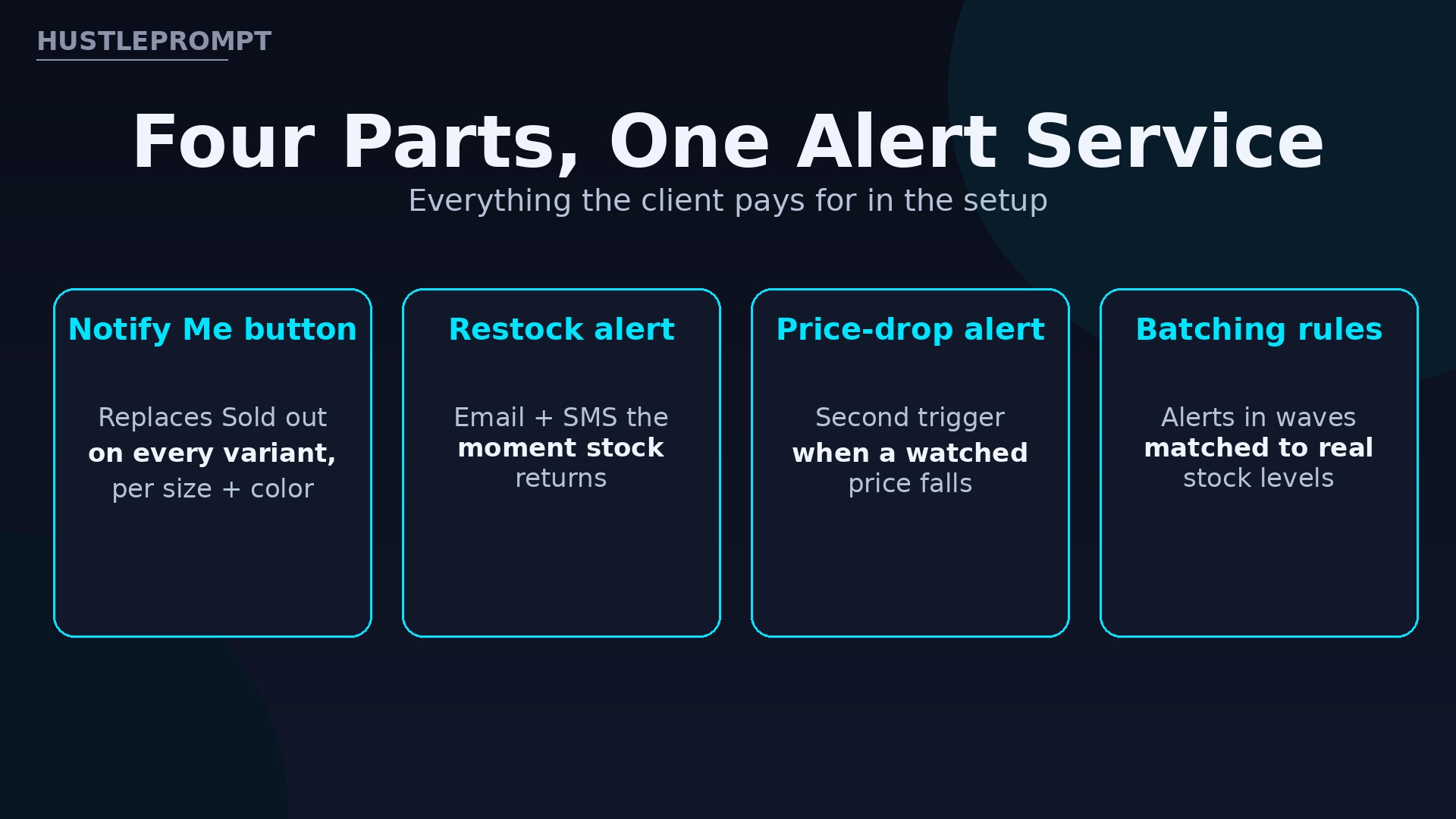
You sell a store its restock alert system for a fixed fee: a Notify Me button on every sold-out variant, a waitlist per size and color, and automatic email and SMS alerts the moment that variant is back. AI drafts the alert copy; you check every link, price, and stock rule before anything goes live.
- The Notify Me button: replaces “Sold out” on sold-out variants.
- The waitlist: one signup per variant, by email or SMS.
- The restock alert: one short email and text at restock.
- The price-drop alert: a second trigger when a watched price falls.
- The batching rules: alerts in waves matched to stock, never 400 alerts for 12 units.
- The report: signups, alerts, orders, and revenue from restocks.
Shopper clicks Notify Me.
Email or SMS, per variant.
Flow checks it.
Email + SMS, batched.
One link, one click.
The evidence: the best automation almost nobody runs
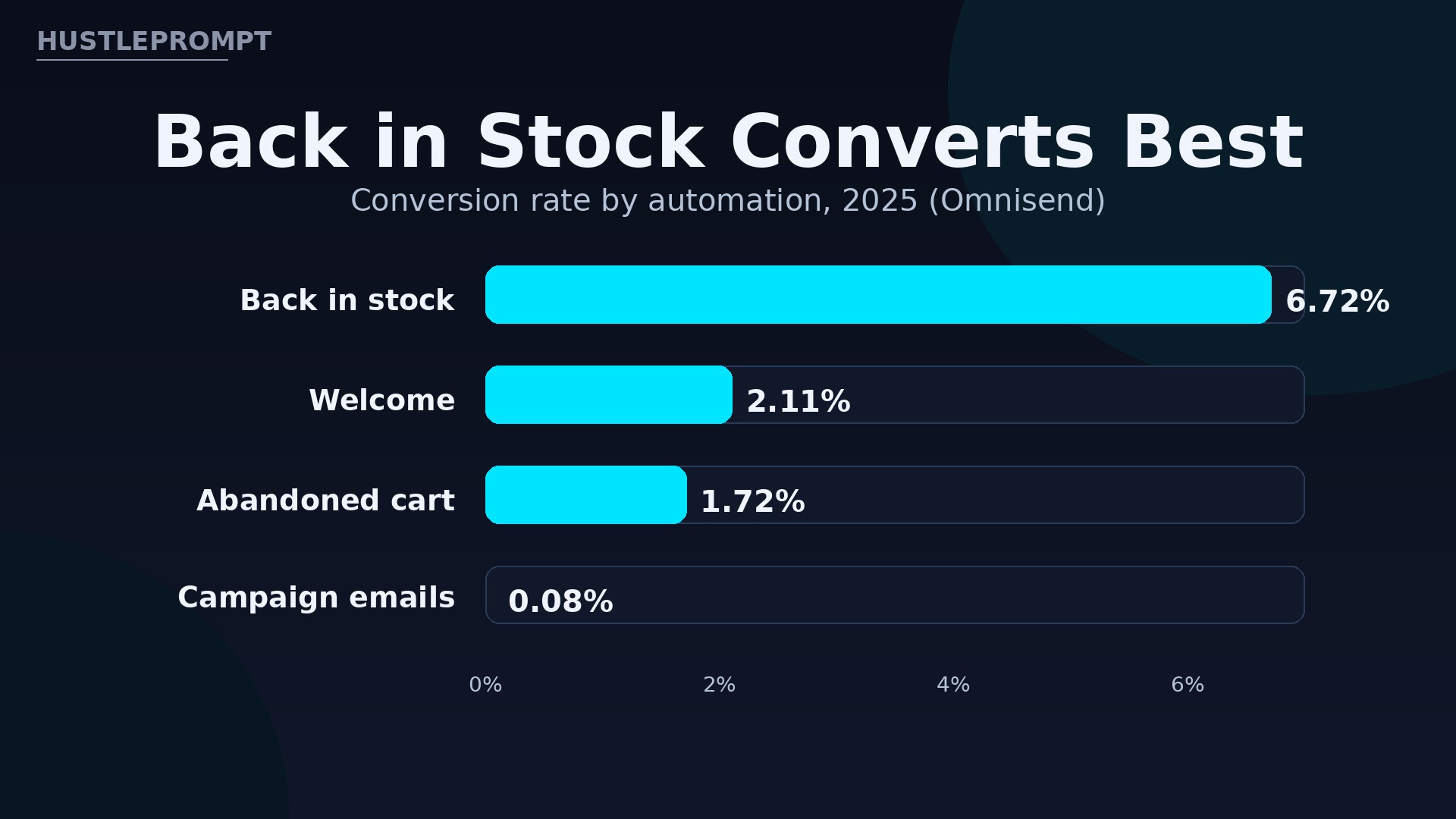
Omnisend’s 2026 benchmarks — 2025 data from 27,000+ brands and 470 million automated sends — put back-in-stock emails at 58.80% open, 21.31% click, and 6.72% conversion, earning $9.14 per email: the highest conversion and revenue per email of the twelve automation types Omnisend measures, ahead of welcome (2.11%) and abandoned cart (1.72%).
| Automation (Omnisend 2025) | Open | Click | Conversion | Revenue / email |
|---|---|---|---|---|
| Back in stock | 58.80% | 21.31% | 6.72% | $9.14 |
| Welcome | 35.53% | 3.94% | 2.11% | $6.16 |
| Abandoned cart | 37.12% | 4.13% | 1.72% | $3.59 |
| Campaign emails (average) | 30.41% | 0.74% | 0.08% | $0.16 |
The gap is the pitch: only 0.6% of brands with active automations run a back-in-stock flow, against 22.5% running abandoned cart. Klaviyo’s 2026 benchmarks agree: flows generate nearly 41% of email revenue from just 5.3% of sends, at a 5.58% click rate against 1.69% for campaigns. And SMS is the speed layer: 82% of consumers check a text within five minutes, so the best alerts go out on both channels.
Caveat: the 0.6% cell rests on a small brand base, and Omnisend does not publish per-automation sample sizes — treat 6.72% as indicative, not a promise.
Your costs: what the tools charge
| Tool | Price (Nov 27, 2026) | What you get |
|---|---|---|
| Klaviyo Free | $0/mo | 250 profiles, 500 emails/mo |
| Klaviyo Email | $20/mo | 500 profiles, 5,000 emails/mo |
| Back in Stock by Amp (Free) | $0/mo | 10 notifications/mo, Notify Me button |
| Back in Stock by Amp (Growth) | $49/mo | 2,000 notifications/mo, SMS, Klaviyo |
| ChatGPT Plus | $20/mo | Alert copy, price-drop drafts |
| Canva Pro | $18/mo | Alert graphics, button styling |
Start free: Klaviyo’s free plan includes the back-in-stock flow, and Amp’s free plan covers a pilot store’s restocks. The client pays for their own plans: Klaviyo Email $20 a month, Amp Growth $49. Your costs are ChatGPT Plus ($20 a month) and Canva Pro ($18), reused across every client. SMS is billed per message, from $0.02 in the US and Canada on Amp — price it into the retainer.
How it works: the alert flow you sell
Here is how you sell it.
Step 1: pick a niche and twenty stores
Pick one pair: fashion brands on Shopify, or beauty stores. Audit 20 targets: open their best sellers and look for sold-out sizes with no Notify Me button. A store whose hero product is sold out in three sizes is a warm lead — screenshot it.
Step 2: build the flow kit
Agree on the kit: a Notify Me button on every sold-out variant, a Klaviyo back-in-stock flow — trigger on Subscribed to Back in Stock, then a back-in-stock delay, then one email and one SMS, with Smart Sending off — and a price-drop flow. Set the two settings that decide whether it sells or annoys: a restock minimum, so one returned unit does not wake the whole list, and batching, so alerts go out in waves matched to stock.
Step 3: sell it with a one-page sample
Skip the slide deck. Build one free sample: the Notify Me button live on the store’s sold-out best seller, plus the alert email the waitlist would get. Send it with the numbers — 58.8% open, 6.72% conversion, $9.14 per email — and the fact that only 0.6% of brands run this flow. Your best line: “Your best seller is sold out, and the people who want it are leaving.”
Step 4: launch on Black Friday weekend
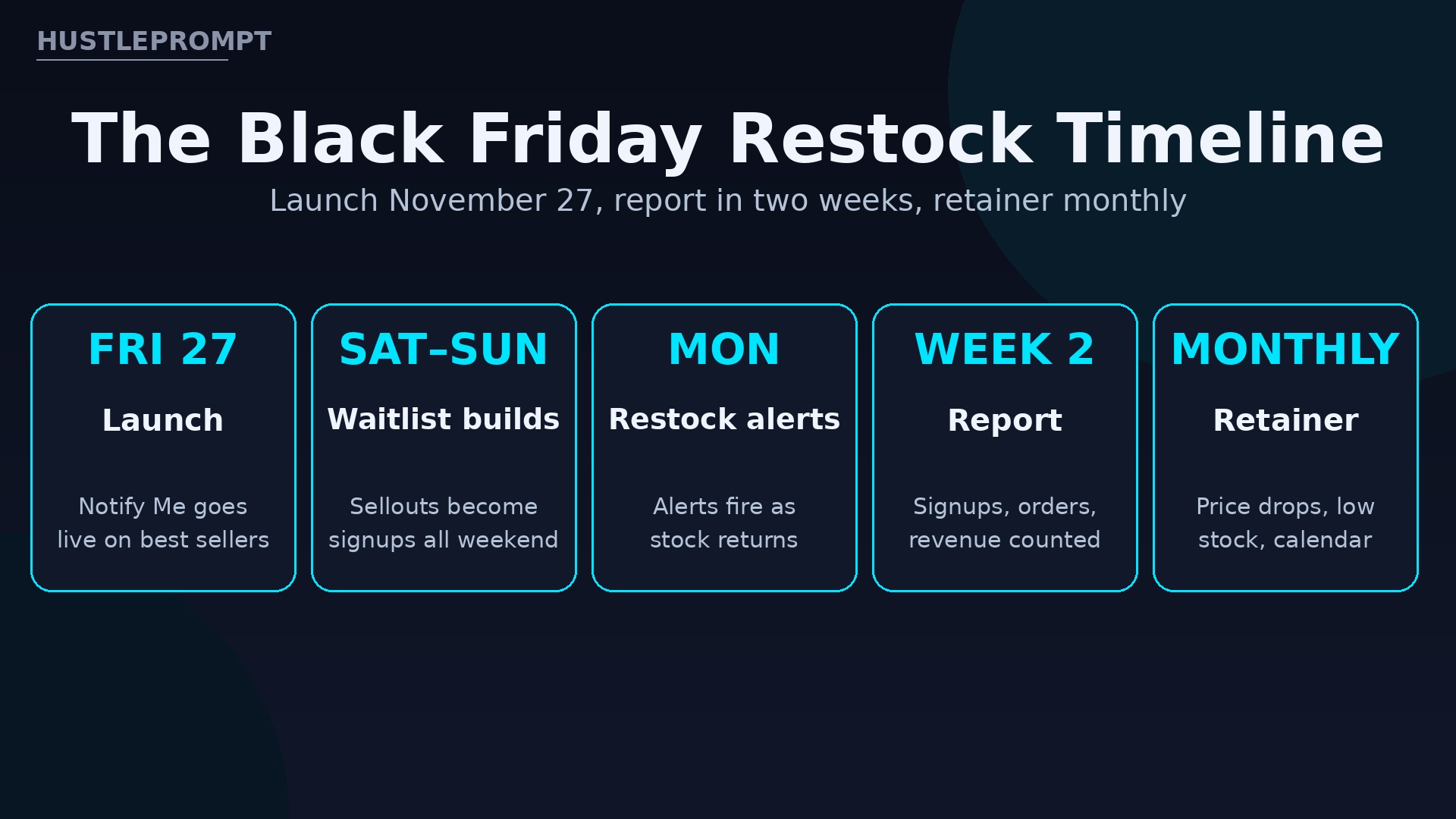
Go live before the weekend ends: every sold-out size on Friday becomes a signup by Sunday. Watch the first restock like a hawk — alerts must fire within minutes, and the link must land on the exact variant, pre-selected. Send the client a screenshot of the first alert and the first order it drives.
Step 5: report and sell the retainer
After two weeks, send a one-page report: signups, alerts sent, orders, and revenue from restocks. Then pitch the follow-up: price-drop alerts, low-stock alerts, and a restock calendar on retainer. The setup is a one-time fee; the alerts are the retainer.
What to charge
No official price list exists — illustrative ranges.
| Package | Illustrative price | What it includes |
|---|---|---|
| One-product sample | Free | Notify Me button + alert email, one best seller |
| Alert setup | $500 to $900 one-time | Notify Me button, Klaviyo flow, email + SMS, batching |
| Setup + price-drop | $900 to $1,500 one-time | Above + price-drop and low-stock alerts |
| Monthly retainer | $400 to $800 a month | Restock calendar, new-product alerts, monthly report |
Scale it: 6 stores at $700 is $4,200 in setup fees, and 2 of them on a $600-a-month retainer add $14,400 a year. Bill the app and email plans to the client: $49 a month for Amp Growth and $20 for Klaviyo Email — their assets, not yours.
The mistakes that kill this business
- Alerting 400 people for 12 units. Batch alerts to real stock.
- Sending the alert hours late. An alert that arrives after the item sells out again breaks the promise.
- Adding waitlist signups to the marketing list. A shopper asked for one alert.
- Texting without SMS opt-in. Email consent is not SMS consent.
- Alerting on the product, not the variant. Size M waiting does not mean size L is back.
- Working in your own account. The client must own the flow, the app, and the waitlist.
Frequently Asked Questions
What are AI back-in-stock alerts?
A done-for-you service: a Notify Me button on sold-out products, a waitlist per variant, and automatic email and SMS alerts the moment stock returns. AI drafts the copy; a human checks every link and stock rule.
How do they differ from competitor price monitoring?
Competitor price monitoring (post 10101) watches rivals’ prices so a store can react. Back-in-stock alerts watch the store’s own inventory and tell its shoppers when their item returns.
How do they differ from win-back emails?
Win-back (post 10091) re-engages buyers who went quiet months ago. Back-in-stock alerts reach shoppers who tried to buy yesterday and could not — the highest-intent audience there is.
How fast must a restock alert go out?
Within minutes. The alert fires the moment inventory rises above zero for that variant, and SMS reaches most shoppers within five minutes. A popular item can sell out again in hours.
Which tools do I need?
Klaviyo for the flow — free for 250 profiles and 500 emails a month, Email from $20. Or Back in Stock by Amp on Shopify: free for 10 notifications a month, Growth at $49 for 2,000. Add ChatGPT Plus and Canva Pro.
How much can I charge?
Illustrative: $500 to $900 for the setup, $900 to $1,500 with price-drop and low-stock alerts, and $400 to $800 a month on retainer for the restock calendar and monthly reporting.
Keep Reading
- Sell AI Abandoned Cart Recovery to E-Commerce Stores.
- Sell AI Customer Win-Back Services to E-Commerce Stores.
- Sell AI Competitor Price Monitoring Services to Sellers.
Sources: Omnisend 2026 benchmarks — omnisend.com; Omnisend automation table — clickminded.com, fractosolutions.com; Klaviyo 2026 benchmarks — klaviyo.com; Amp pricing — backinstock.org; Klaviyo pricing — klaviyo.com; Canva pricing — canva.com; ChatGPT Plus — help.openai.com. Checked Nov 27, 2026.