
OpenAI countersues Apple — and the AI hardware war just got its first two-way lawsuit. On Friday, November 27, 2026, the ChatGPT maker filed 81 pages of counterclaims in federal court in San Jose, accusing Apple of stealing its trade secrets and pressuring its suppliers.
The filing flips a fight Apple started in July, when it sued OpenAI and its hardware unit, io Products, over two former Apple engineers. Now OpenAI says Apple is the one stealing secrets — and using its size to choke off a rival before its first device ships. CNN reported the filing on Friday, and Reuters, citing the Financial Times, confirmed the supplier claims.
What OpenAI is accusing Apple of
The counterclaims bring three charges: federal trade-secret theft, interference with contracts, and unfair competition under California law.
- Stealing secrets through a returning employee. A worker who spent six months at OpenAI returned to Apple with dozens of confidential documents on an unreleased device and the hardware roadmap — then briefed senior Apple officials. The Washington Examiner’s account names the worker only as “Employee X.”
- Squeezing shared suppliers. Apple allegedly “coerced and threatened” manufacturers working with both firms — asking them to name staff on OpenAI projects and pressing one vendor to stop work for OpenAI. Decrypt’s breakdown carries the full allegation.
- Setting “trapdoors” for departing staff. Apple encourages employees to keep work files in personal iCloud and iMessage accounts, then forces same-day exits — making it nearly impossible to separate company secrets from personal data.
The evidence: OpenAI says Apple sued because it is losing the AI race.
“Apple has struggled to incorporate innovative AI capabilities into its previously popular products.”
— OpenAI’s counterclaims, Nov 27, 2026 (via CNN)
“OpenAI, meanwhile, is in the process of developing new, much-anticipated AI-enabled personal electronic devices — threatening to outcompete Apple on what Apple views as its own turf.”
The filing says Apple is trying to “compete unfairly by any means available.”
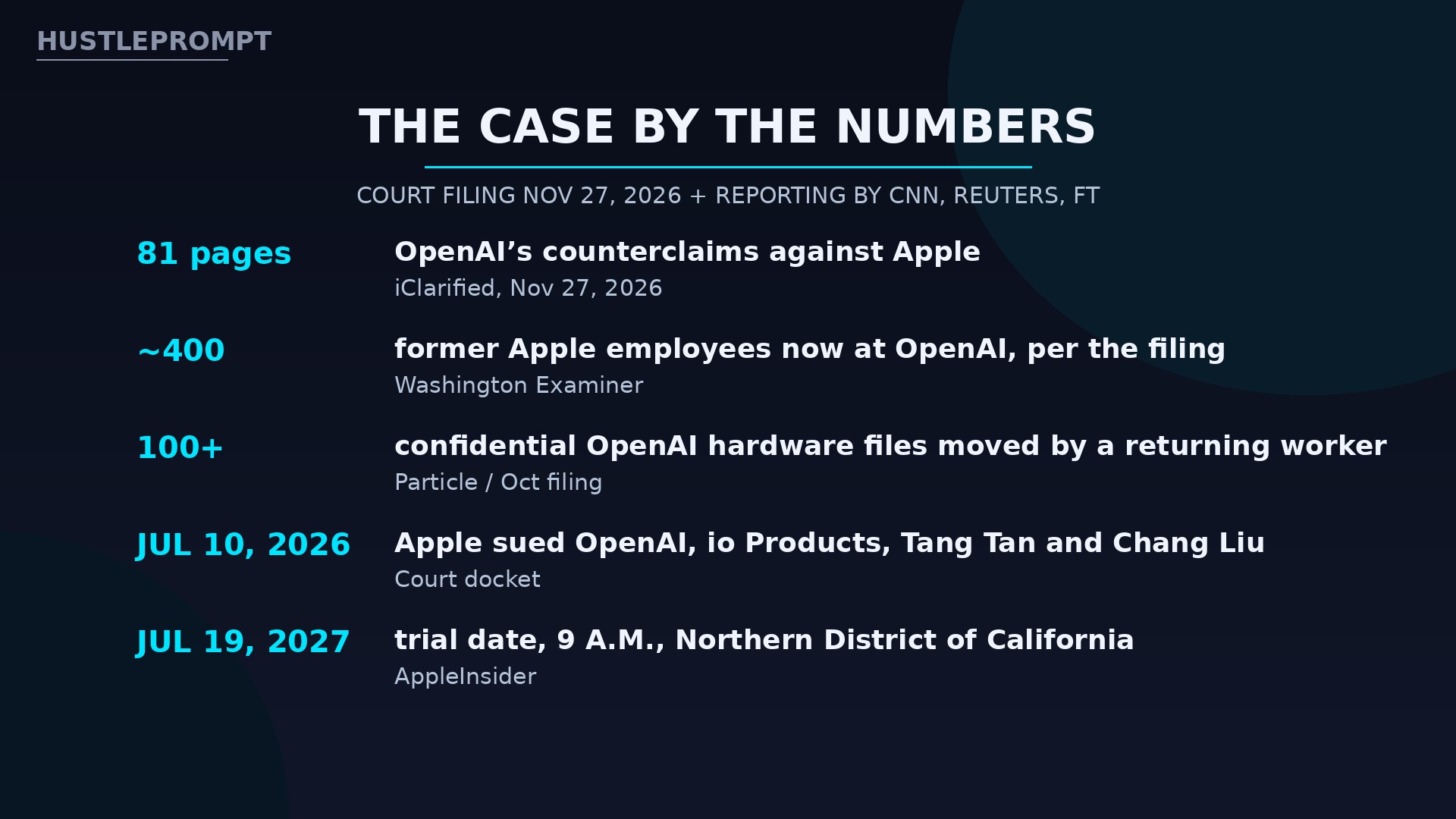
| Item | Detail | Source |
|---|---|---|
| Filed | November 27, 2026 — 81-page counterclaims | iClarified |
| Court | N.D. California, San Jose | CNN / Decrypt |
| Case | Apple Inc. v. Liu, No. 5:26-cv-07078 | Court docket |
| Claims | Trade-secret theft; contract interference; unfair competition | Decrypt |
| Apple sued first | July 10, 2026 — OpenAI, io Products, Tang Tan, Chang Liu | Court docket |
| Talent flow | ~400 ex-Apple staff now at OpenAI | Countersuit, via Washington Examiner |
| Trial | July 19, 2027, 9 A.M. — both sides want a jury | AppleInsider / CNN |
How the fight started
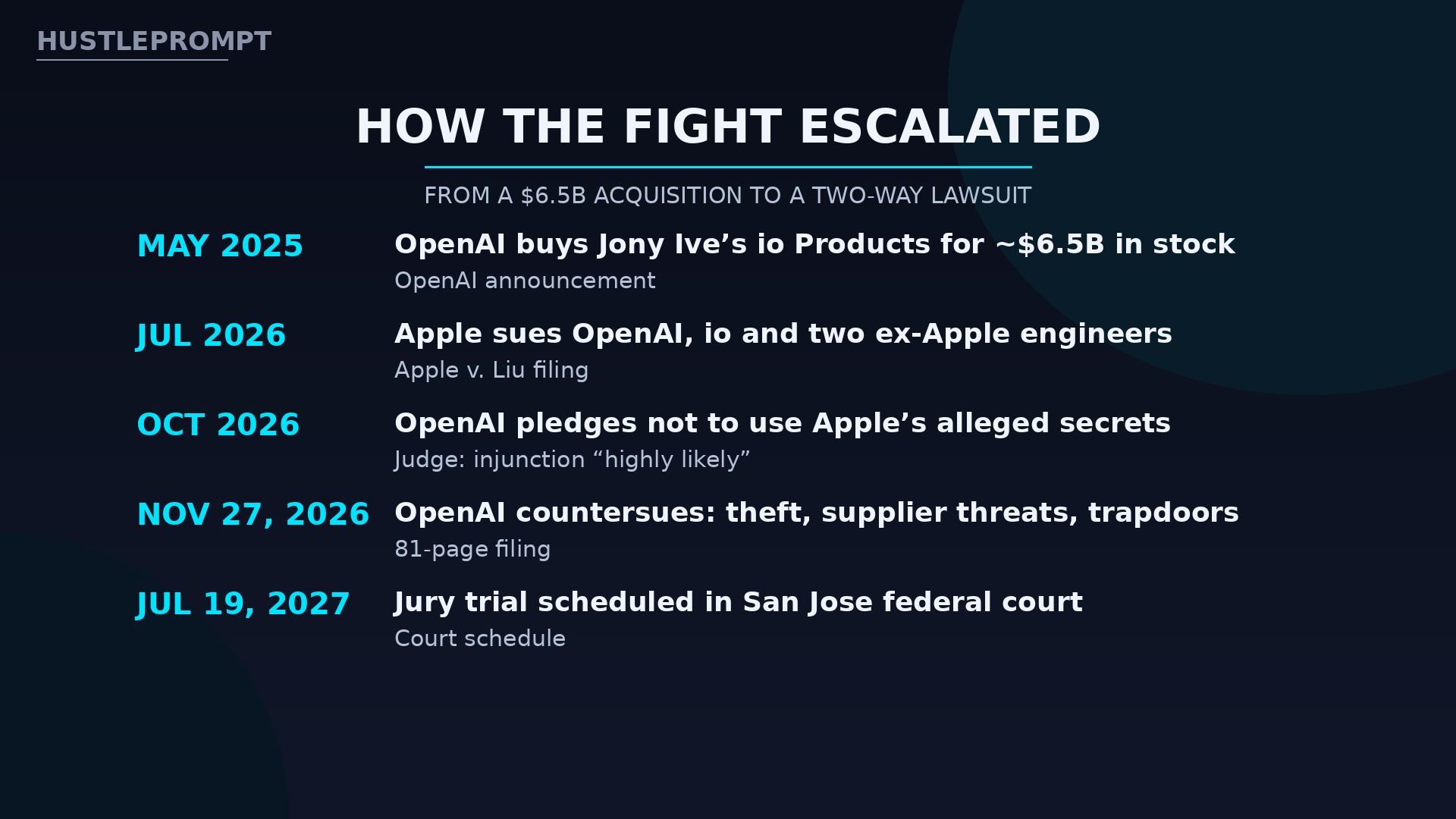
The prize is the device after the smartphone. In May 2025, OpenAI bought Jony Ive’s io Products for about $6.5 billion in stock to build AI-native devices. The first is reportedly due in 2027.
Apple sued on July 10, 2026, accusing OpenAI, io Products, and two former Apple engineers of carrying confidential hardware files to OpenAI. One, Tang Tan, was a 24-year Apple veteran who ran iPhone and Apple Watch design. OpenAI denied it. In October, after a judge signaled he was “highly likely” to grant an injunction, OpenAI pledged not to use the secrets at issue.
Apple calls it a distraction. Apple told 9to5Mac the case “is about OpenAI employees deliberately stealing, accessing, and using Apple’s secret and confidential information.” It has previously said its investigation found no OpenAI secrets.
THE TWO CLAIMS, SIDE BY SIDE
Apple says: OpenAI took our hardware secrets through two ex-Apple engineers to build a rival device.
OpenAI says: Apple took our device secrets through a returning employee, squeezed our suppliers, and set exit “trapdoors” for staff.
Both want: a jury trial, July 19, 2027, San Jose.
How to profit from the AI hardware race
Lawsuits do not ship products — but they move suppliers and talent.
- Watch the suppliers, not the press releases. If Apple can pressure shared manufacturers, OpenAI’s 2027 timeline is the first thing at risk. Suppliers serving both are the choke point — and the signal.
- Follow the talent. Roughly 400 former Apple engineers now work at OpenAI, per the filing. Teams, not patents, decide who ships first.
- Do not bet your product on one device. Design for the phones people already own — the AI-device market does not exist yet, and this case could push it past 2027.
- Use the delay. Apple’s AI catch-up and OpenAI’s device push both create demand for AI tools that run on today’s hardware. That gap is where small builders make money.
Watch: Altman and Ive introduce io, the hardware bet at the center of the case. Official OpenAI video, May 2025.
Frequently asked questions
Why did OpenAI countersue Apple?
OpenAI filed counterclaims on November 27, 2026, accusing Apple of stealing trade secrets, coercing shared suppliers, and using unfair employment practices — including exit “trapdoors” for departing staff.
What did Apple accuse OpenAI of first?
In July 2026, Apple sued OpenAI, io Products, and two former Apple engineers, Tang Tan and Chang Liu, alleging they carried confidential hardware files to OpenAI. OpenAI denied it.
What are the “trapdoors” OpenAI mentions?
Apple encourages employees to store work files on personal iCloud and iMessage accounts, then requires same-day exits. OpenAI says clean separation becomes nearly impossible.
When is the trial?
July 19, 2027, at 9 A.M. in federal court in San Jose. Both companies have requested a jury trial.
What device is OpenAI building?
AI-native personal devices from Jony Ive’s io team, acquired for about $6.5 billion in May 2025. Nothing is on sale yet; the first is reportedly due in 2027.
What does this mean for investors?
The case adds timeline risk to OpenAI’s hardware bet and spotlights the pressure on Apple to catch up in AI. Neither company has disclosed any financial impact.
Keep Reading