
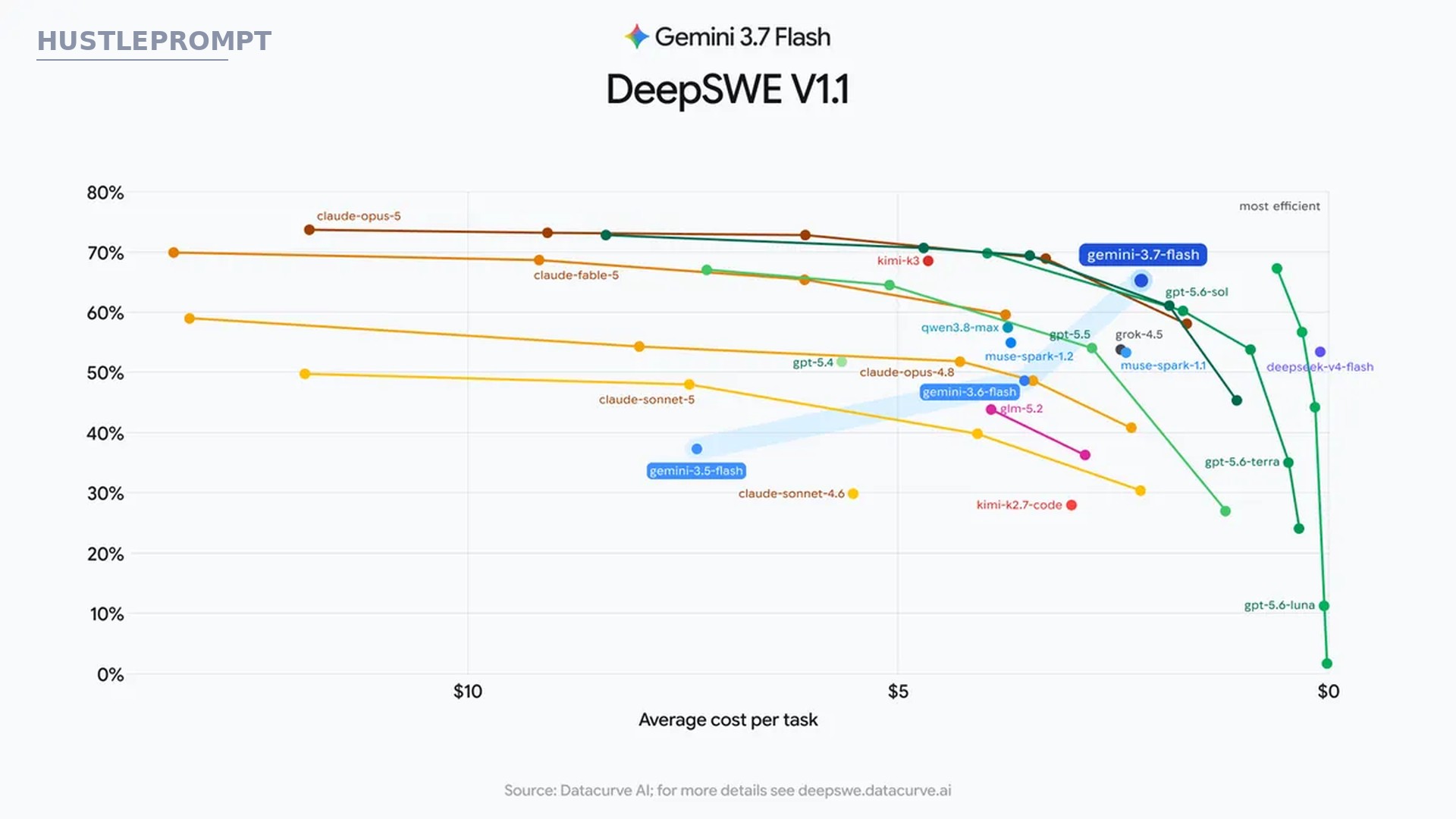
What if the cheap model stopped being the dumb one? Google’s Gemini 3.7 Flash scores 65.3% on DeepSWE v1.1, a long-horizon coding test where its predecessor managed 49.0%, and it costs half as much: $0.75 per million input tokens through December 31, 2026. For freelancers running coding agents for hours, that combination changes the math on every job.
The model launched on August 13, 2026, three weeks after Gemini 3.6 Flash, according to Google DeepMind. Fresh coverage on November 27, 2026 put it back in the headlines: the half-price window shuts at the end of the year. After that, the same tokens cost twice as much.
What Gemini 3.7 Flash actually is
Gemini 3.7 Flash is Google’s workhorse model for coding and agents. Flash is the speed tier of the Gemini family: built for high-volume work and long agent runs, where a giant reasoning model would burn the budget. Google calls it its most intelligent workhorse model yet.
It ships where developers already work: Google Antigravity, the Gemini API in Google AI Studio, and Android Studio. Enterprises get it in the Gemini Enterprise Agent Platform. For individuals, it powers Gemini Spark, Google’s 24/7 personal agent for Pro and Ultra subscribers in 160+ countries.
The upgrade is about discipline, not just raw scores. Google says 3.7 Flash adapts to roadblocks, asks for clarification when a request is unclear, and follows instructions with greater fidelity. It plans multi-step work with more care, so long jobs need fewer retries.
The price: half now, double on January 1
Here is the deal in plain terms. Through December 31, 2026, Gemini 3.7 Flash costs $0.75 per million input tokens and $3.75 per million output tokens. That is half the original 3.6 Flash cost per million tokens, says Google DeepMind.
Gemini 3.7 Flash pricing: intro rate vs. standard rate
| Rate | Input / 1M tokens | Output / 1M tokens | Valid |
|---|---|---|---|
| Introductory | $0.75 | $3.75 | Through Dec 31, 2026 |
| Standard | $1.50 | $7.50 | From Jan 1, 2027 |
| Batch API | $0.375 | $1.875 | Through Dec 31, 2026 |
Batch API runs at 50% of the standard rate across the Flash line. Source: Gemini Developer API pricing
The discount has a hard end date. Google’s pricing page lists the Flash models at $1.50 per million input tokens and $7.50 per million output tokens starting January 1, 2027. Build your budget on the 2027 rate and treat the next five weeks as margin.
The gap is easy to feel in real money. One million input tokens plus one million output tokens costs $4.50 at the intro rate and $9.00 at the 2027 rate. A freelancer pushing 10 million input tokens and 5 million output tokens through agents pays $26.25 now and $52.50 from January. Same work, double the bill.
How much smarter is it? The benchmarks
Google’s own numbers show a big jump in three weeks of work. The gains land where freelancers feel them: debugging, issue resolution, and finishing code that ships.
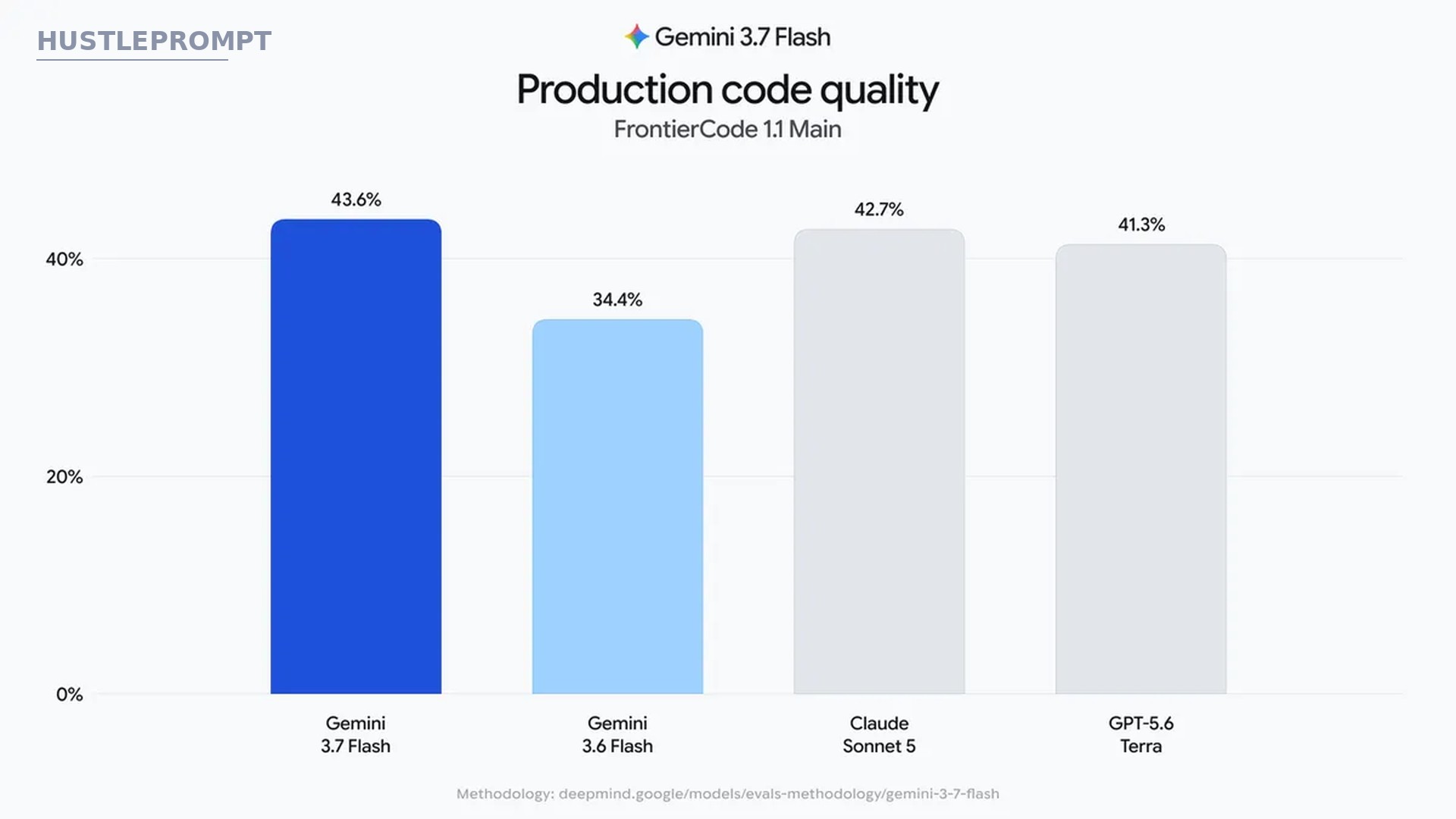
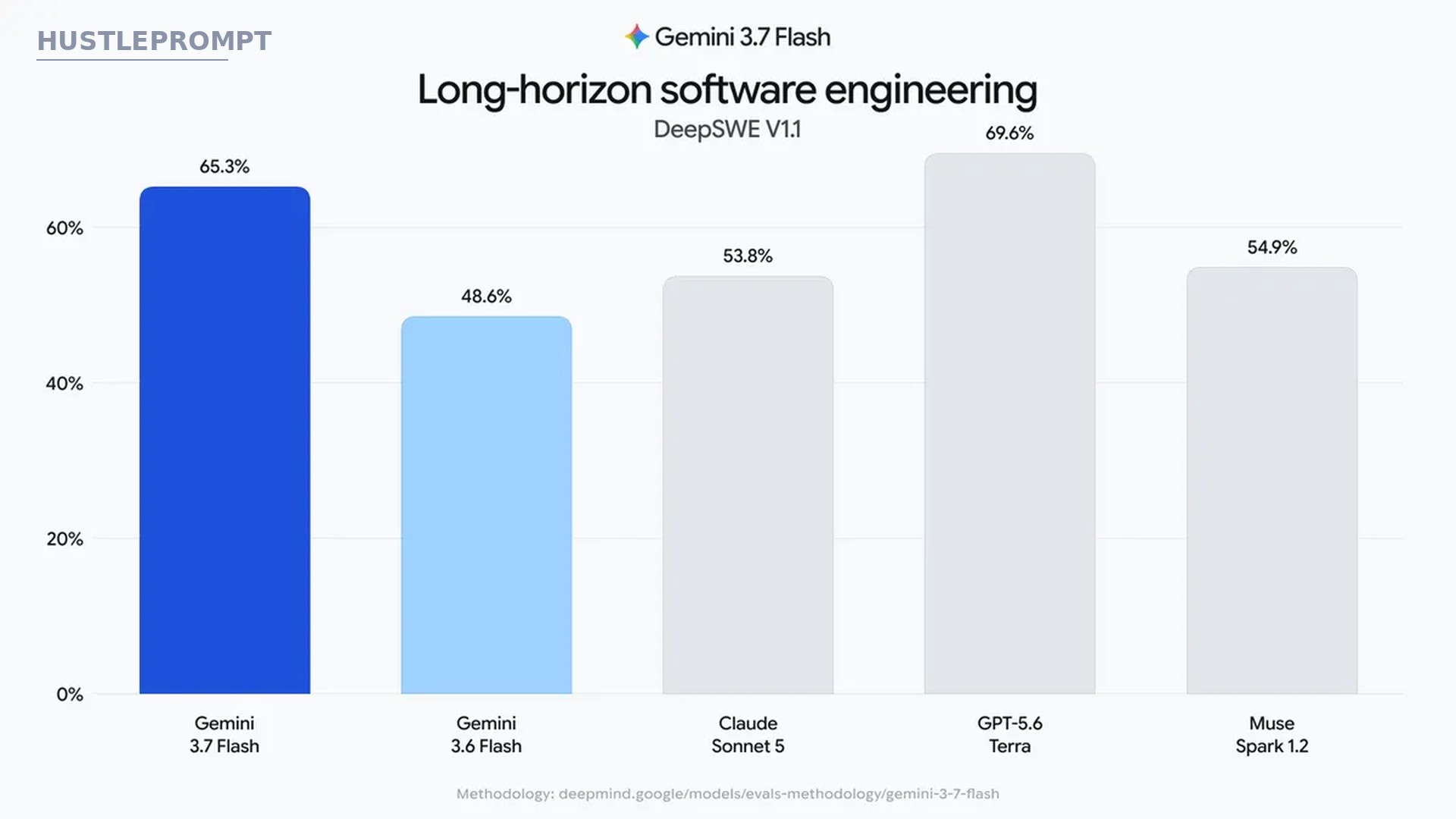
Two details matter. First, 3.7 Flash beats Claude Sonnet 5 on production code quality, 43.6% against 42.7% on FrontierCode. Second, it does not beat everything: GPT-5.6 Terra still leads on DeepSWE at 69.6%. The cheap tier is catching up, not lapping the field.
Gemini 3.7 Flash vs. Gemini 3.6 Flash: Google’s benchmarks
| Benchmark | Gemini 3.7 Flash | Gemini 3.6 Flash | Best rival in Google’s chart |
|---|---|---|---|
| FrontierCode 1.1 Main (production code) | 43.6% | 34.4% | Claude Sonnet 5, 42.7% |
| DeepSWE v1.1 (long-horizon coding) | 65.3% | 49.0% | GPT-5.6 Terra, 69.6% |
| WebDev Arena (Elo) | 1588 | 1538 | Not published |
| GDP.pdf (document comprehension) | 34.0% | 22.0% | Not published |
| AutomationBench (business workflows) | 30.4% | 17.0% | Not published |
Web development is the other headline. On WebDev Arena, 3.7 Flash scores an Elo of 1588 against 1538 for 3.6 Flash, and Google says it builds more functional layouts and feature-complete apps in fewer prompts. For freelancers who sell landing pages, fewer prompts means fewer billable tokens per deliverable.
Documents and workflows improved too. On GDP.pdf, a test of complex document work, the model jumps from 22.0% to 34.0%. On AutomationBench, which mirrors real business workflows, it jumps from 17.0% to 30.4%. That is the difference between drafting a report and finishing it.
Video work gets cheaper too
Coding is only half the story. On September 1, 2026, Google added agentic video understanding to Gemini 3.7 Flash, 3.6 Flash, and 3.5 Flash-Lite. Instead of scanning every frame, the model decides what to watch, at what speed, and whether to use frames, audio, or the transcript.
Google’s benchmarks put the savings at up to 88% fewer tokens and up to 66% lower cost, with accuracy up by as much as 7%. For creators who index long videos or client footage, that turns a job that was too expensive into a service worth selling. There is no extra fee: it bills at standard token rates.
How to profit from half-price Flash
A cheaper model only makes money if you use it where it wins. Here is a playbook for the five weeks left at the intro rate.
Your 5-week profit playbook
Move long agent jobs to 3.7 Flash: refactors, test fixes, doc rewrites.
Quote clients on the 2027 rate and keep the intro gap as margin.
Send overnight work to the Batch API at half the standard rate.
Sell a video service: searchable archives, summaries, clip finding.
- Move your longest agent jobs to 3.7 Flash first: refactors, test fixes, and document rewrites.
- Price every quote on the 2027 rate of $1.50 input and $7.50 output, and keep the intro gap as margin.
- Send overnight work to the Batch API, which runs at half the standard rate for jobs that can wait.
- Sell one video service built on agentic video understanding: searchable archives, chapter summaries, or clip finding.
The rule is simple: bank the discount, do not build on it. Any quote that only works at $0.75 input tokens breaks on January 1.
The fine print
Flash is still the speed tier, not the flagship reasoning model. Google’s own pricing page describes Gemini 4 Carbon as its most capable reasoning model, built for complex software engineering and deep math. When a job needs deep reasoning, Flash is the wrong tool.
Google has also moved on already. Its pricing page now lists Gemini 3.8 Flash as the most intelligent Flash model, at the same $0.75 and $3.75 intro rate through December 31, 2026. Starting fresh? Check 3.8 Flash first.
Finally, remember whose numbers these are. Every benchmark above comes from Google’s own announcement and charts, not from an independent test. Treat them as a reason to test the model yourself, not as a promise. The real test is your codebase, your documents, and your clients.
Frequently asked questions
What is Gemini 3.7 Flash?
It is Google’s workhorse model for coding and agents, launched on August 13, 2026, three weeks after Gemini 3.6 Flash. It is built for high-volume work and long agent runs, with stronger coding, web development, and document skills than its predecessor.
How much does Gemini 3.7 Flash cost?
Through December 31, 2026, it costs $0.75 per million input tokens and $3.75 per million output tokens. From January 1, 2027, the rate rises to $1.50 per million input tokens and $7.50 per million output tokens.
Is there a free way to try Gemini 3.7 Flash?
Yes. Google AI Studio has a free tier with limited access to selected models, and you can test the model there before you pay. Check the current free limits in AI Studio, because Google can change them.
What is Gemini 3.7 Flash best at?
Long-horizon coding, debugging, web development, document work, and workflow automation. Its headline scores are 65.3% on DeepSWE v1.1 and 43.6% on FrontierCode 1.1 Main, both well above Gemini 3.6 Flash.
How is Gemini 3.7 Flash different from 3.6 Flash?
It is the next revision, released three weeks later with stronger benchmark scores across coding, web development, and document work. It launched at half the original 3.6 Flash price, and both models share the same $0.75 and $3.75 intro rate through December 31, 2026.
Should I use Gemini 3.7 Flash or Gemini 3.8 Flash?
Google now lists Gemini 3.8 Flash as the most intelligent Flash model, at the same intro price through December 31, 2026. Test both on your own workload before you commit, and budget on the January 1, 2027 rate either way.
Keep Reading
- Gemini 4 Hydrogen Is Here and Free for Everyone
- Gemini 4 Carbon Takes MathArena Crown at 15x the Cost
- Gemini App Now Makes Custom GIFs Free in the US