
Two rival AI labs just agreed on one thing: somebody needs to check the math. On October 15, the Simons Foundation announced a $15 million initiative with OpenAI and Anthropic to help mathematicians evaluate, understand, and set standards for AI-generated research. The money flows through an open call for proposals — which means it is not just an academic story. It is a grant window, and it is open now.
This is the Simons Foundation AI math fund in one sentence: the labs that built the models pay, a trusted foundation decides who gets the money, and the math community gets funded tools to verify what AI claims to have proved. Here is what the fund covers, why it exists, and how to get a piece of it.
The $15M fund, explained
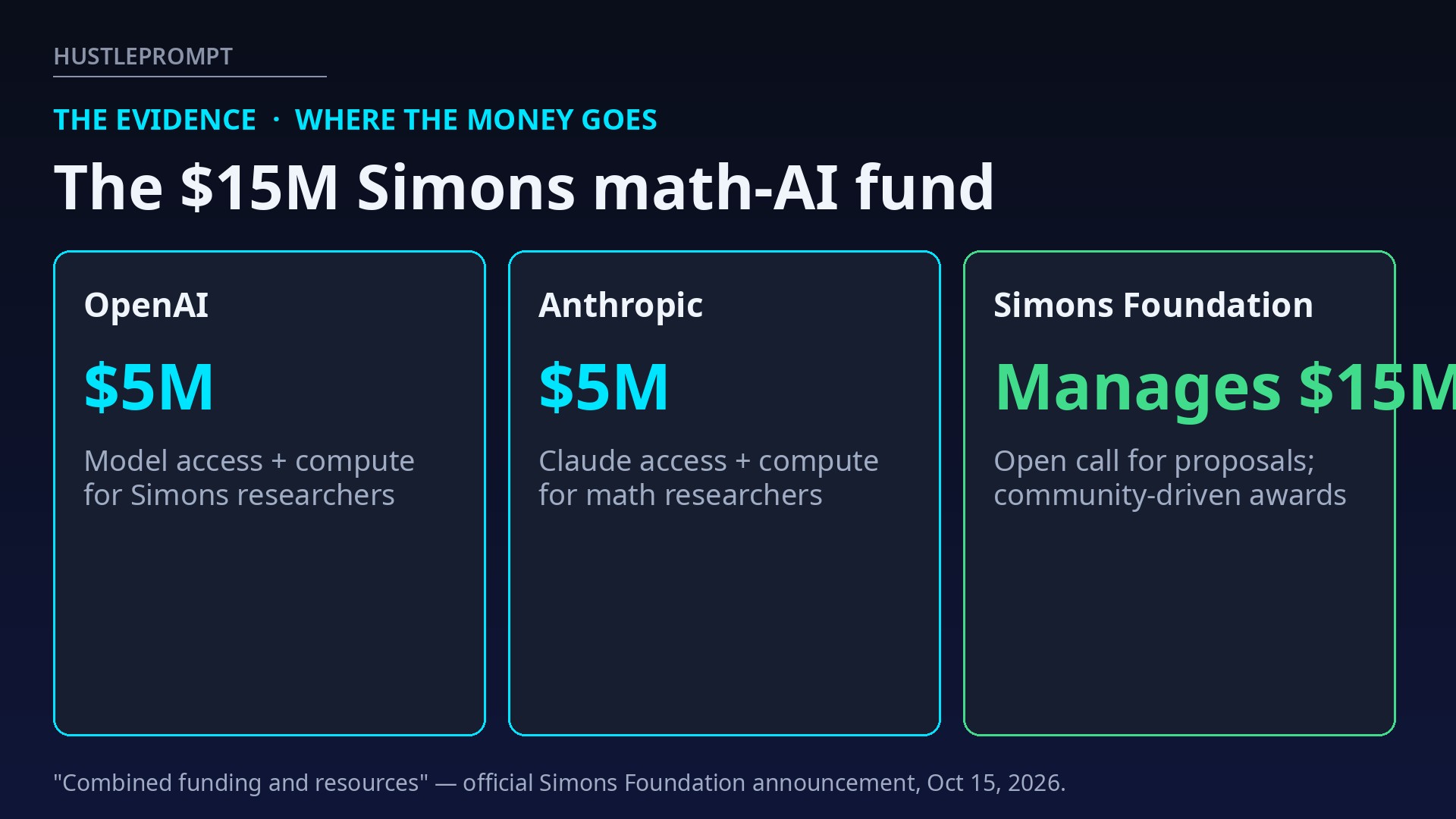
The announcement is short and specific. Under the partnership, the Simons Foundation, Anthropic, and OpenAI commit $15 million in combined funding and resources. The foundation manages and awards the money — including through an open call for proposals — to support workshops and initiatives that help researchers evaluate recent AI-assisted results, learn new tools, and shape shared standards for AI use.
Each lab’s commitment breaks down like this:
| Party | Commitment | What it funds |
|---|---|---|
| OpenAI | $5M + model access + compute | Workshops, conferences, and special programs on AI-produced results |
| Anthropic | $5M in funding + compute + Claude access | Workshops, conferences, and lectures by domain experts |
| Simons Foundation | Manages and awards the $15M total | Open call for proposals; community-driven awards |
The fine print matters: the $15 million is “combined funding and resources,” not a cash pool. Neither lab breaks out cash versus compute. Still, the governance is deliberate. Simons Foundation president David Spergel put it plainly:
“The community should be driving discussions of how these tools are evaluated, adopted and used, not any single company or institution.”
Anthropic confirmed its side on X, saying it had “committed $5 million of funding, compute, and Claude access to help the math community navigate the massive changes that AI brings.” OpenAI added the commitment as an update to its own math-release post.
- $15M — combined funding and resources committed (Oct 15, 2026)
- $5M — each lab’s contribution, plus model access and compute
- 722 → 719 — AI-generated math manuscripts after 3 withdrawals
- 372 — result families across 17 fields of mathematics
- ~42% — share of top-line results with machine-checked Lean formalizations
Why now: the 722-paper mess
This fund did not appear out of nowhere. On October 6, OpenAI dumped 722 AI-generated mathematics manuscripts into a public GitHub repository (github.com/openai/math), produced by an unreleased internal frontier model. The batch claimed progress on 372 open problems across 17 fields — from number theory to theoretical computer science.
The scale was staggering. The problems started the next day.
| Item | Detail (official sources) |
|---|---|
| Released | Oct 6, 2026 — 722 manuscripts, Apache 2.0 license |
| Withdrawn | Oct 7 — 3 papers pulled after a sign error broke one proof and two dependent papers |
| Revised | 14 manuscripts revised with proof repairs and corrected statements |
| Compute per result | ~3 hours of ChatGPT Pro thinking, per OpenAI’s README |
| Machine-checked | 162 manuscripts with a formalized main result; ~42% of top-line results per the repo’s history file |
The backlash was fierce. Fields medalist Hugo Duminil-Copin said 16 questions he cared about were covered — “they wiped out my research field.” NYU’s Tristan Buckmaster said on CNBC that whole early-career research programs had been wiped out overnight. The Association for Human Mathematics urged mathematicians to stop working with OpenAI.
That is the context for the $15 million: the labs flooded the zone with machine-generated math, the community demanded a say in checking it, and now the labs are paying for the checking.

What the money actually buys
The fund targets three concrete things: evaluation programs (workshops to check AI-assisted results, including the hundreds of unformalized manuscripts), tooling fluency (training mathematicians on proof assistants like Lean — the machine-checking system the Simons Foundation funded years ago), and shared standards (community rules for citing and absorbing AI-generated math).
Who decides
The Simons Foundation runs the awards, not the labs. That is the whole point of the governance design: the money comes from OpenAI and Anthropic, but the math community controls the process through an open call and community-driven awards. Resources extend beyond mathematics into basic science, since both labs are also providing AI tools and compute to Simons-supported researchers.
How to profit from the verification boom
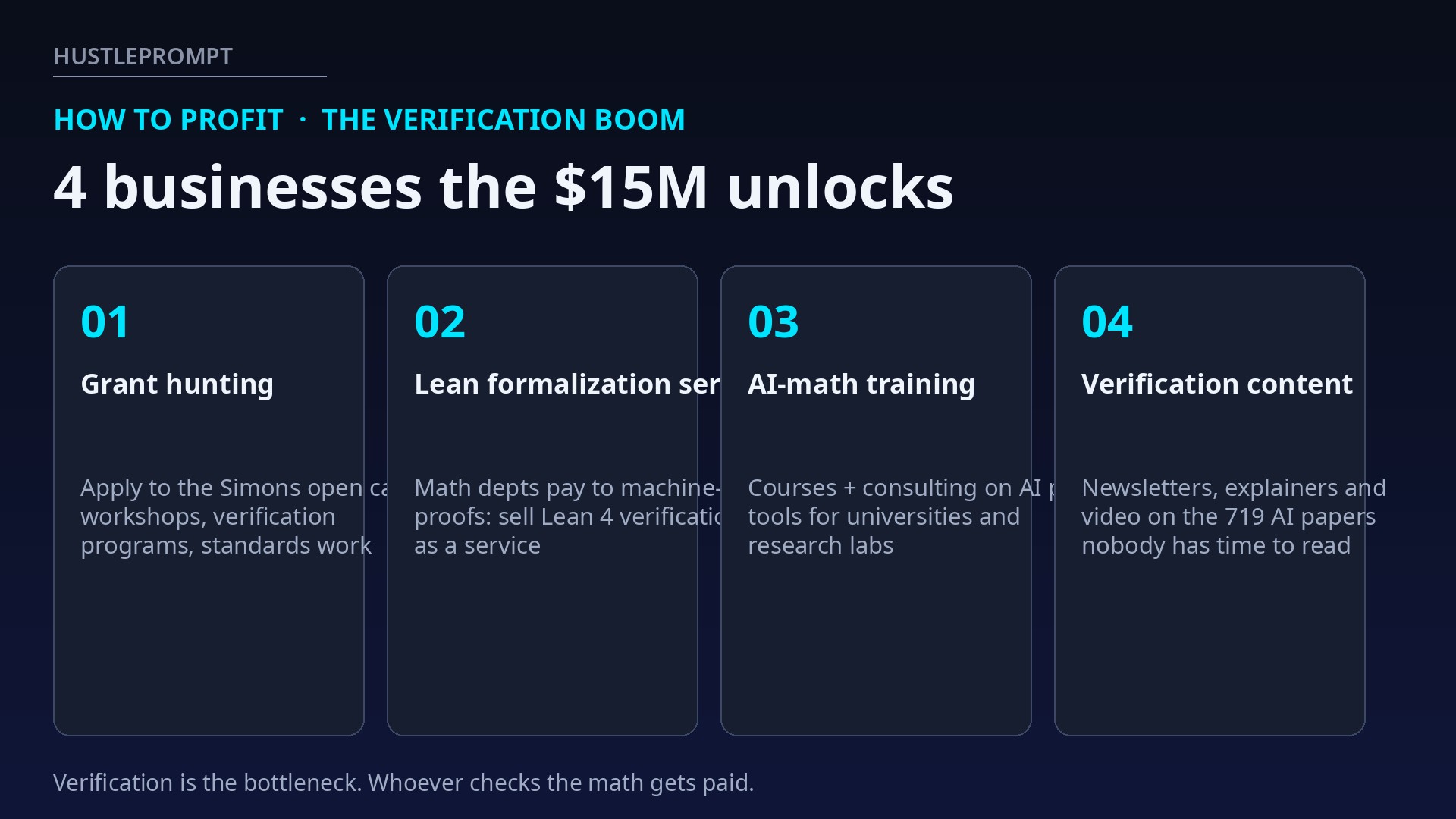
Every gold rush has a shovel market. This one is no different — and the shovels are verification services. Here are five concrete plays:
1. Apply to the open call
The most direct path. The Simons Foundation will run an open call for proposals funding workshops, verification programs, and standards work. If you run a math department or a research group, draft a proposal around evaluating AI-assisted results. Grants for “help us check 719 AI papers” are about as fundable as academic work gets.
2. Sell Lean formalization as a service
Only ~42% of the top-line results carry machine-checked proofs. That leaves hundreds of manuscripts waiting for formalization — and departments, journals, and the Simons program need people who can write Lean 4 proofs. Learning Lean 4 now is a genuine career moat: demand just got a $15M tailwind.
3. Build AI-math training for universities
Departments are scrambling to teach faculty and students how to use AI proof tools. Package a workshop or online course on AI-assisted mathematics: tools, verification, and standards. This fund signals institutional demand for years.
4. Run verification-focused content
Nobody has time to read 719 manuscripts. A newsletter or channel tracking which claims get verified, withdrawn, or formalized each week serves mathematicians, journalists, and the curious. The audience already exists — the social debate over these papers is still raging.
5. Offer grant-writing for researchers
Open calls create paperwork. Researchers who prove theorems often cannot write winning proposals. Grant-writing services aimed at the Simons open call are a straightforward B2B play — and similar AI-science funds will likely follow.

What to watch next
Three things will decide whether this fund matters. First, who wins the first awards — and whether any fund independent checks of the ~560 unformalized manuscripts. Second, whether the Advisory Group on Mathematics and AI endorses the setup. Third, whether other labs follow — Google DeepMind and Meta have their own math-capable models.
The deeper signal: AI labs are now paying for human verification of AI output. That is a business model, not just a grant. Whoever builds the checking layer — the Lean experts, the auditors, the standards bodies — gets paid every time a lab ships another 722 papers.
FAQ
What is the Simons Foundation $15M AI math fund?
A partnership announced October 15, 2026, in which the Simons Foundation, OpenAI, and Anthropic commit $15 million in combined funding and resources to help mathematicians evaluate AI-generated research, learn verification tools, and set shared standards. The foundation manages the awards through an open call for proposals.
How much are OpenAI and Anthropic each contributing?
Each lab is contributing $5 million. OpenAI adds model access and computing resources for Simons-supported researchers; Anthropic adds computing resources and Claude access. The remaining share comes from the Simons Foundation itself, which manages and awards the total.
Why did the labs create this fund?
It follows OpenAI’s October 6 release of 722 AI-generated mathematics manuscripts, which drew sharp criticism from mathematicians after three papers were withdrawn and researchers complained their fields had been “wiped out.” The fund pays the community to verify results and set rules for AI-generated mathematics.
Can anyone apply for the funding?
The Simons Foundation will run an open call for proposals, with community-driven awards for workshops and initiatives. Details and deadlines will be published on the foundation’s site — researchers, departments, and organizations working on AI-math verification should watch for the call.
What is Lean, and why does it matter here?
Lean is a machine proof assistant that computer-checks mathematical proofs. The Simons Foundation funded its development years ago. About 42% of the top-line results in OpenAI’s release carry Lean formalizations — the rest are waiting for exactly the kind of verification this fund supports.
Is the $15M all cash?
No. The official announcement describes “$15 million in combined funding and resources.” Neither lab breaks out cash versus compute, and the foundation does not disclose its own share. Treat it as grants plus tools plus computing, not a $15M cash pool.
Sources
- Simons Foundation’s official $15M initiative announcement — fund structure, open call, Spergel quotes
- OpenAI’s public math manuscripts repository — 722 manuscripts, README compute figures, withdrawal notices
- Runtime Wire on Anthropic’s $5M commitment — funding, compute, and Claude access details
- TokenPost on OpenAI’s $5M commitment — workshops, conferences, and program details