
Google just handed independent developers a free upgrade to their agent stack. In its October 15, 2026 open source roundup, Google’s Open Source Programs Office spotlighted the A2A CLI — an official command-line tool that turns your terminal into a remote control for AI agents — alongside EmbeddingGemma 2, an open multimodal embedding model that fits in 567MB of RAM.
No API keys, no per-query bills — Apache 2.0 licenses you can build a business on. If you sell automation or AI services, this is the week open agent infrastructure got serious — and seriously cheap.
Here is what landed, what the official numbers say, and how to turn it into revenue.
What Google’s open source team flagged this week
Google’s “This Week in Open Source” post for October 15 is dominated by one theme: autonomous AI agent infrastructure. The two headliners:
- The A2A CLI — the official command-line client for the Agent2Agent protocol, Google’s open standard for agents from different frameworks to talk to each other.
- EmbeddingGemma 2 — Google DeepMind’s open, natively multimodal embedding model for on-device search and retrieval.
The post’s key line: “the healthiest open source architectures don’t replace human agency—they give workers clearer boundaries, inspectable tools, and a genuine seat at the controls.” Translation: the open agent stack is maturing from research demos into production-grade tooling.
The A2A CLI: your terminal becomes an agent remote
A2A (Agent2Agent) is Google’s open standard for agent interoperability: agents discover capabilities via an agent card (a JSON manifest), then hand off tasks over HTTP. The new A2A CLI — Apache 2.0, from the official A2A project — is the command surface for all of it.
| Command | What it does |
|---|---|
a2a card get https://agent.example.com |
Discovers an agent’s capabilities from its agent card |
a2a send -a URL "message" |
Sends a message and waits for the result |
a2a server --exec "script" |
Turns any stdin/stdout script into a working A2A server |
a2a send --stream |
Streams task updates live as they arrive |
The --exec flag is the money feature: any program that reads stdin and writes stdout becomes a discoverable agent with zero SDK code — shell scripts, cron jobs, legacy tools.
Install is one line (Homebrew, WinGet, or Go), and an agent skill teaches coding assistants like Claude Code, Cursor, and Codex to drive the CLI themselves.
EmbeddingGemma 2: search that never leaves the device
Embeddings turn text, images, or audio into comparable numbers — the foundation of search and RAG (retrieval-augmented generation: the agent looks up your documents before answering). Serious multimodal embeddings mostly lived behind paid APIs. EmbeddingGemma 2 changes the math.
Google’s official numbers (blog.google, October 6, 2026):
| Spec | EmbeddingGemma 2 |
|---|---|
| Parameters | 740M total; modular: 270M text-only, +170M vision, +300M audio |
| License | Apache 2.0 (commercially permissive) |
| On-device RAM | ~191MB text-only, ~567MB full multimodal (Pixel 11 Pro, quantized) |
| Storage trick | Matryoshka (MRL): truncate 768-dim vectors to 128 dims, up to 6x less storage |
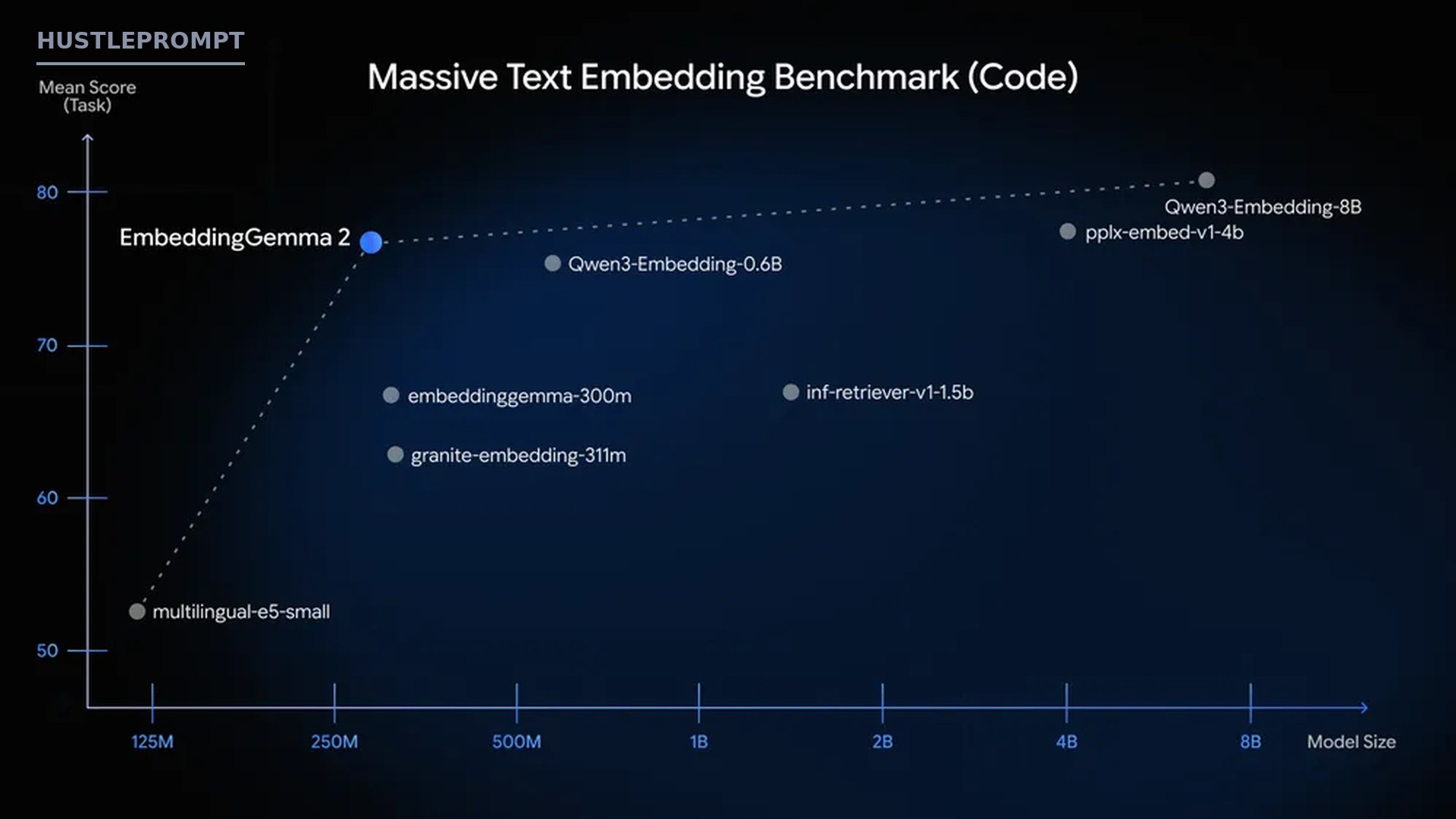
| Code search | 78.68 on MTEB Code (up from 68.76 — a 9.92-point jump) |
| Context | 8K tokens: 5.5 min of audio, 29 images, or 58 video frames |
| Ecosystem | transformers, llama.cpp, Ollama, vLLM, SGLang, LM Studio, Qdrant |
Source: Google: EmbeddingGemma 2 is a best-in-class open model for natively multimodal embeddings.
The killer detail is modularity: load only the encoders you need — 270M for text search, adding vision or audio only when required. Matryoshka learning nests smaller embeddings inside larger ones, shrinking stored vectors up to 6x with minimal accuracy loss.
The signal underneath: open agent infra is having its moment
The Linux Foundation’s 2026 State of OSPOs survey found 79% of AI-involved open source offices now shaping model policy, and 69% piloting agentic workflows. Governance money is following the agent trend.
The conference calendar agrees: AGNTCon + MCPCon North America (October 22–23, San Jose) is dedicated to production agentic systems on open standards, with an EvalBench benchmarking track — prove your agent is better, don’t just claim it. KubeCon (November 9–12) adds agent sandbox sessions.
One honest caveat: the post is a curated roundup, not a launch announcement — the A2A CLI itself shipped earlier in October. But curation by Google’s OSPO is the signal: the open agent toolchain has crossed from hobbyist to infrastructure. For freelancers, that means building on it today instead of waiting for permission.
How to profit: benchmark-backed agent services
Open infra gives you what closed APIs cannot: zero marginal cost per query and provable differentiation. The playbook:
a2a server --exec turns existing scripts — invoice parser, CRM export — into agents the network can call.- Sell private RAG, not chatbots: “your 10,000 PDFs searchable by your team, on your hardware, for a flat fee.” At 567MB, it runs anywhere.
- Use benchmarks as your sales deck: the 9.92-point MTEB Code jump, 6x storage savings, Apache 2.0 license. Screenshot the charts.
- Productize the A2A wiring: most small businesses have scripts and spreadsheets, not APIs. Charge a setup fee to A2A-enable their tooling, then a retainer.
- Stay protocol-native: A2A and MCP mean your work plugs into the ecosystem — Google’s ADK, future clients’ stacks — instead of one-off integrations.
FAQ
Is the A2A CLI really free for commercial use?
Yes — Apache License 2.0 permits commercial use, modification, and distribution. Repository: github.com/a2aproject/a2a-cli.
What is the difference between A2A and MCP?
MCP connects an agent to data and tools — how an agent reads files or calls APIs. A2A connects agents to each other — how they discover capabilities and delegate tasks. They complement each other.
Can EmbeddingGemma 2 really run on a phone?
Yes: ~191MB for text-only, ~567MB full multimodal on a Pixel 11 Pro with quantization. Private, offline, on-device search.
What does “Matryoshka” mean here?
Like the nesting dolls: smaller embeddings nest inside larger ones. Truncate 768 dims to 128, keep most accuracy — up to 6x less vector-database storage.
Do I need Google Cloud to use any of this?
No. The CLI installs via Homebrew, WinGet, or Go; EmbeddingGemma 2 weights are on Hugging Face and Kaggle, runnable with Ollama, llama.cpp, or LM Studio. Google Cloud is optional.
How do I prove my agent is better than competitors’?
Publish scores: public retrieval benchmarks (MTEB) plus task-based agent evals. In a market full of “AI-powered” claims, numbers differentiate.
Sources
- Google Open Source Blog: This Week in Open Source for October 15, 2026
- A2A Protocol: Meet the A2A CLI (official project blog)
- Google: EmbeddingGemma 2 is a best-in-class open model for natively multimodal embeddings (October 6, 2026)