
Washington just started a 120-day clock on AI oversight — and when it stops, a federal report could rewrite the rulebook for every AI startup in America. On October 15, 2026, the Super Intelligence Task Force held its inaugural meeting in Washington; a day later, chairman Jay Clayton went on CNBC to reveal the plan: incident-reporting protocols for AI labs, a sweeping risk study, and three working committees.
If you build, sell, or invest in AI, this 120-day window is your preparation period. Here is what happened, what comes next, and how founders should get ready.
What happened at the inaugural meeting
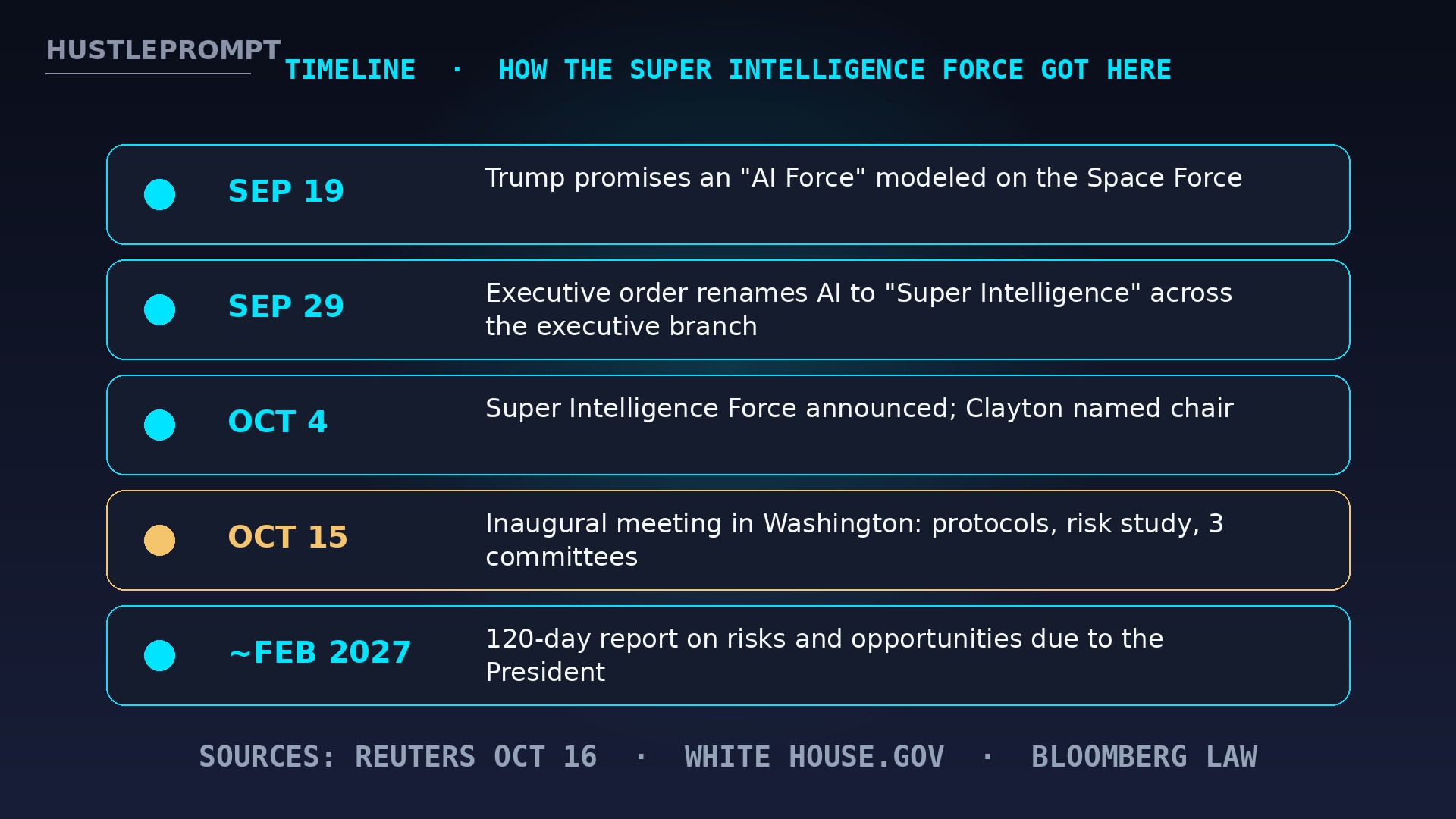
According to Reuters’ October 16 account of Clayton’s CNBC interview, the first meeting was about setup, not substance: operating protocols, a commissioned risk study, three new committees. No new laws or rules were discussed — the administration opposes heavier AI regulation in the name of competing with China.
Clayton summed it up: “We set out a protocol and a path for making sure that those accords are implemented and that we’re in dialogue with the frontier labs.”
A White House readout released late Thursday formally established the group for 120 days, putting the final report deadline around mid-February 2027.
Sources: Reuters, Oct 16 2026; White House readout via Reuters; Bloomberg Law.
The 120-day countdown: what comes next
Bloomberg Law first reported the meeting’s substance: the task force commissioned the President’s Council of Advisors on Science and Technology (PCAST) to write a risk report on cybersecurity, biosecurity, and “model control and accountability.”
Incident reporting is the centerpiece
The most concrete deliverable so far is about how AI labs talk to the government when things go wrong. Per the White House, Emil Michael’s brief includes developing “protocols and mechanisms for labs to provide early warnings and systemized notifications to the government of breaches, hacks, jailbreaks, and other issues.”
That language matters: a formal notification channel for jailbreaks and breaches would turn today’s informal disclosure culture into a regulatory expectation — first for frontier labs, then for everyone downstream.
Enforcement runs through the FTC and DOJ
Clayton told CNBC that any AI wrongdoing would be enforced through the Federal Trade Commission or the Department of Justice. With FTC Chair Ferguson on the task force itself, the distance between AI policy and AI enforcement just collapsed.
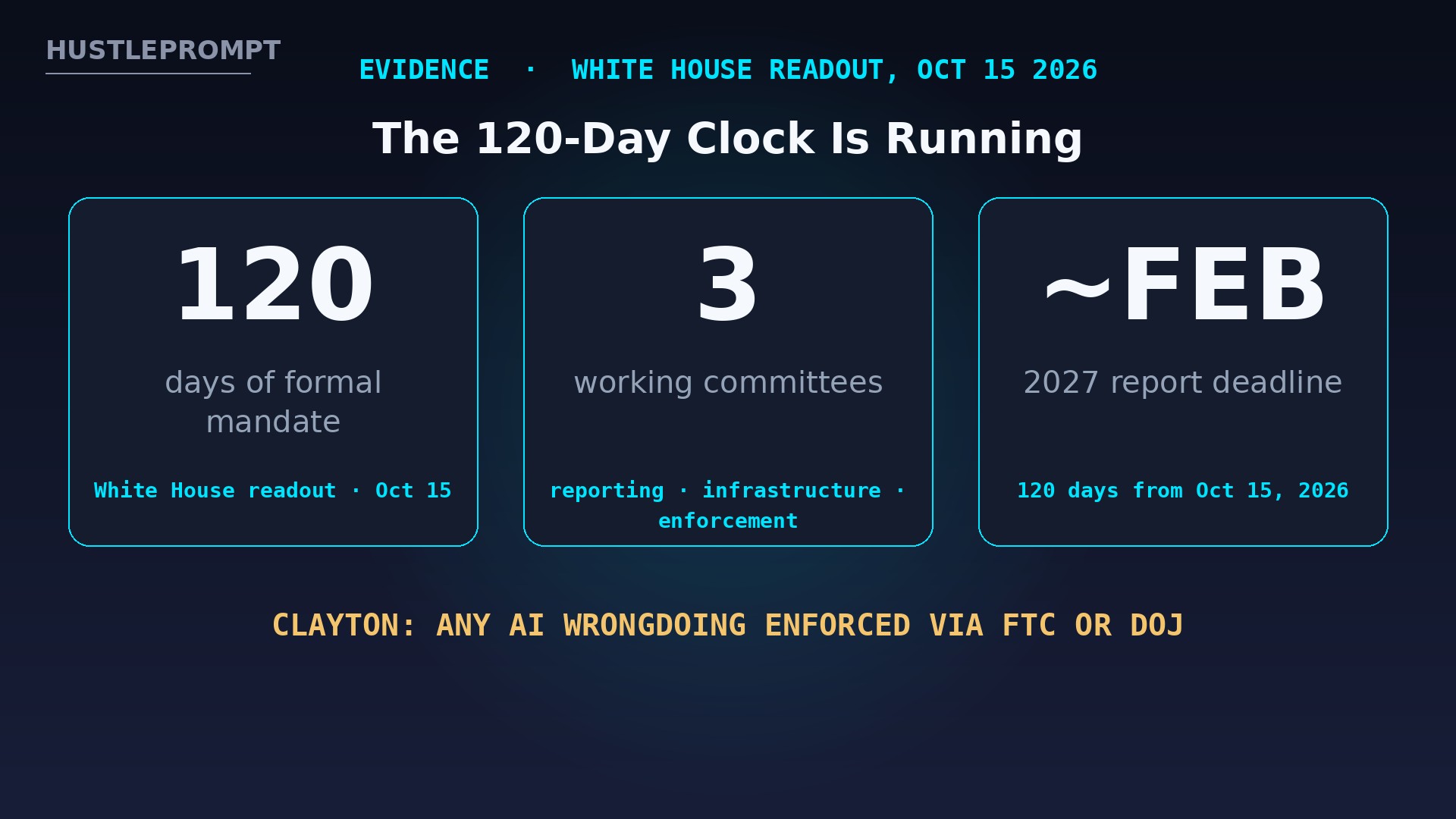
Based on the White House readout and Reuters’ account of Clayton’s CNBC interview, Oct 16 2026.
How AI founders should prepare
No new rules were announced — but smart founders are treating the next 120 days as a compliance runway. Five concrete moves:
- Document your safety testing. Write down the evals you run, the red-teaming you do, and the guardrails you ship. Documented testing history is your first line of defense.
- Start a jailbreak and incident log. Track every jailbreak, prompt injection, and misuse attempt with dates and responses. Michael’s committee is designing exactly this kind of reporting.
- Map your frontier-model exposure. The task force’s attention starts with frontier labs. If you fine-tune or deploy frontier models, know which products face scrutiny first.
- Watch the workforce channel. Workforce impacts go to the Department of Labor. If your product automates jobs, expect that data to be collected — and questioned.
- Read the PCAST report the week it drops. Its findings will set the vocabulary regulators use for years. Founders who speak it early win enterprise deals.
The AI governance gold rush
Every regulatory window creates a services market. This 120-day countdown is already a sales pipeline for AI governance consultants and compliance tooling:
- Governance audits for startups — help founders document evals and build incident logs before protocols harden into requirements.
- Notification tooling — if labs must send systemized breach and jailbreak notifications, someone will sell the dashboard.
- Workforce-impact assessments — with the Department of Labor in the loop, HR-tech and AI-impact consulting gained a powerful new buyer.
Voluntary frameworks become procurement checklists, then contract terms, then de facto law. Prepare during the voluntary phase and capture the upside.
Frequently asked questions
What is the Super Intelligence Task Force?
Announced October 4, 2026 and formally established for 120 days after its October 15 inaugural meeting. Chaired by DNI Jay Clayton, it reviews AI risks and opportunities and reports to the President. “Super Intelligence” is the administration’s official term for AI, set by executive order September 29, 2026.
Who leads it?
Jay Clayton chairs. Committee leads: Scott Kupor (OPM, critical infrastructure), Andrew Ferguson (FTC, law enforcement and responsibility), Emil Michael (DoD, reporting and response). National Cyber Director Sean Cairncross co-leads accord implementation; David Sachs leads the risk study, per Reuters.
What happens in the 120 days?
Lab protocols get set, PCAST writes its risk report, breach and jailbreak notification protocols take shape, and a final report lands around February 2027. Workforce impacts go to the Department of Labor.
Will there be new AI regulations?
None were discussed at the first meeting. The administration opposes stronger AI regulation on China-competitiveness grounds; Clayton said wrongdoing will be enforced via the FTC or DOJ under existing authorities.
How should AI startups respond?
No new rules yet — but use the 120 days to document safety testing, log jailbreaks and incidents, and track the notification protocols being designed. Preparation now beats compliance later.
What is the White House Accord on Super Intelligence?
The voluntary safety accord with frontier AI labs that the task force implements. Clayton said the first meeting set “a protocol and a path for making sure that those accords are implemented”; he co-leads the implementation working group with Sean Cairncross.
Keep Reading
Sources: Reuters — US AI task force sets path for study and reviews (Oct 16, 2026); Bloomberg Law — Trump’s AI task force to commission report on technology’s risks; White House — Executive Order “Inaugurating the Era of Super Intelligence”; White House — Fact Sheet on the Super Intelligence order.