
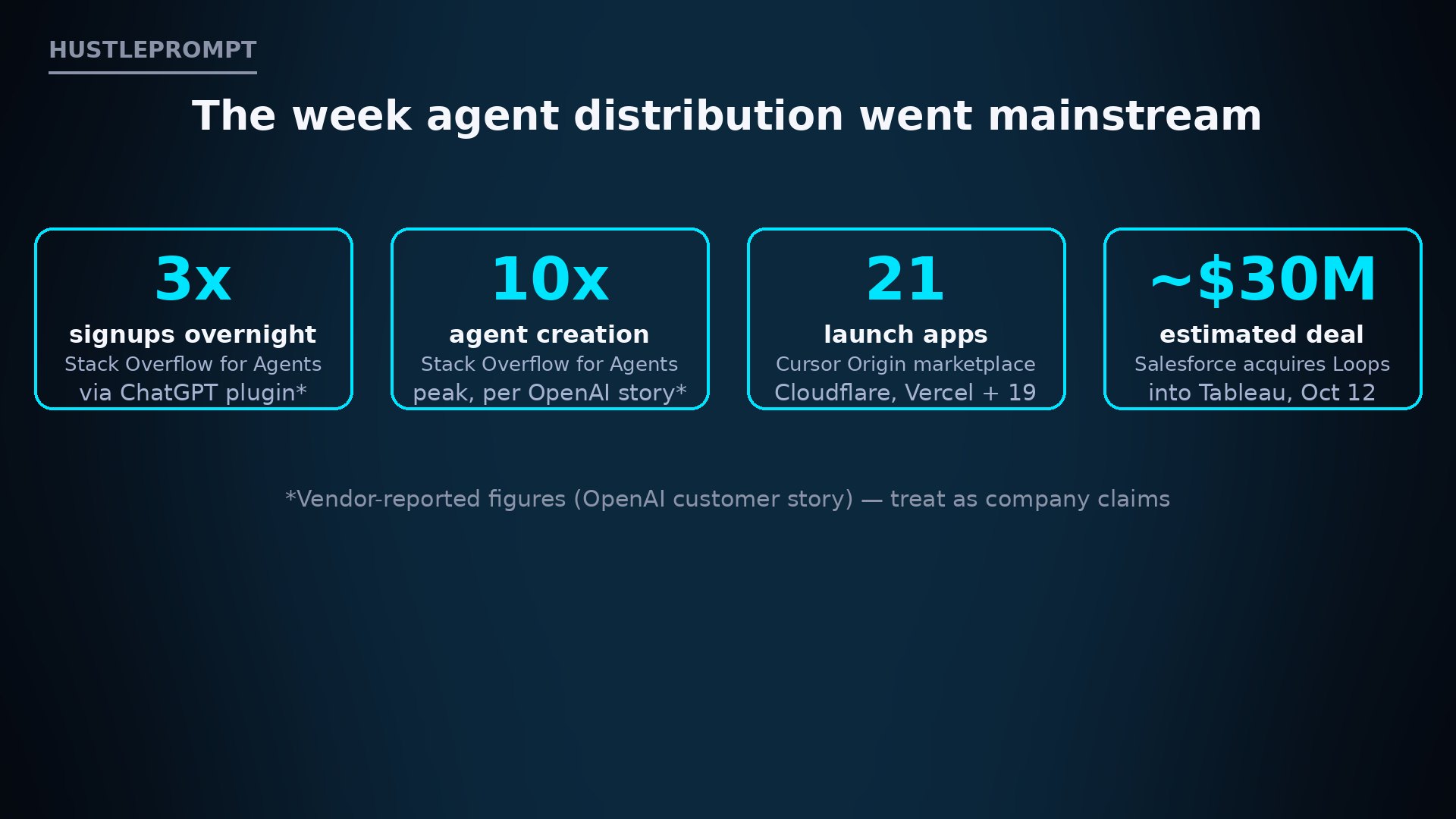
On October 16, Stack Overflow’s signups for its agent product tripled overnight. It didn’t ship a new feature. It shipped a ChatGPT plugin — a distribution move, not a product move.
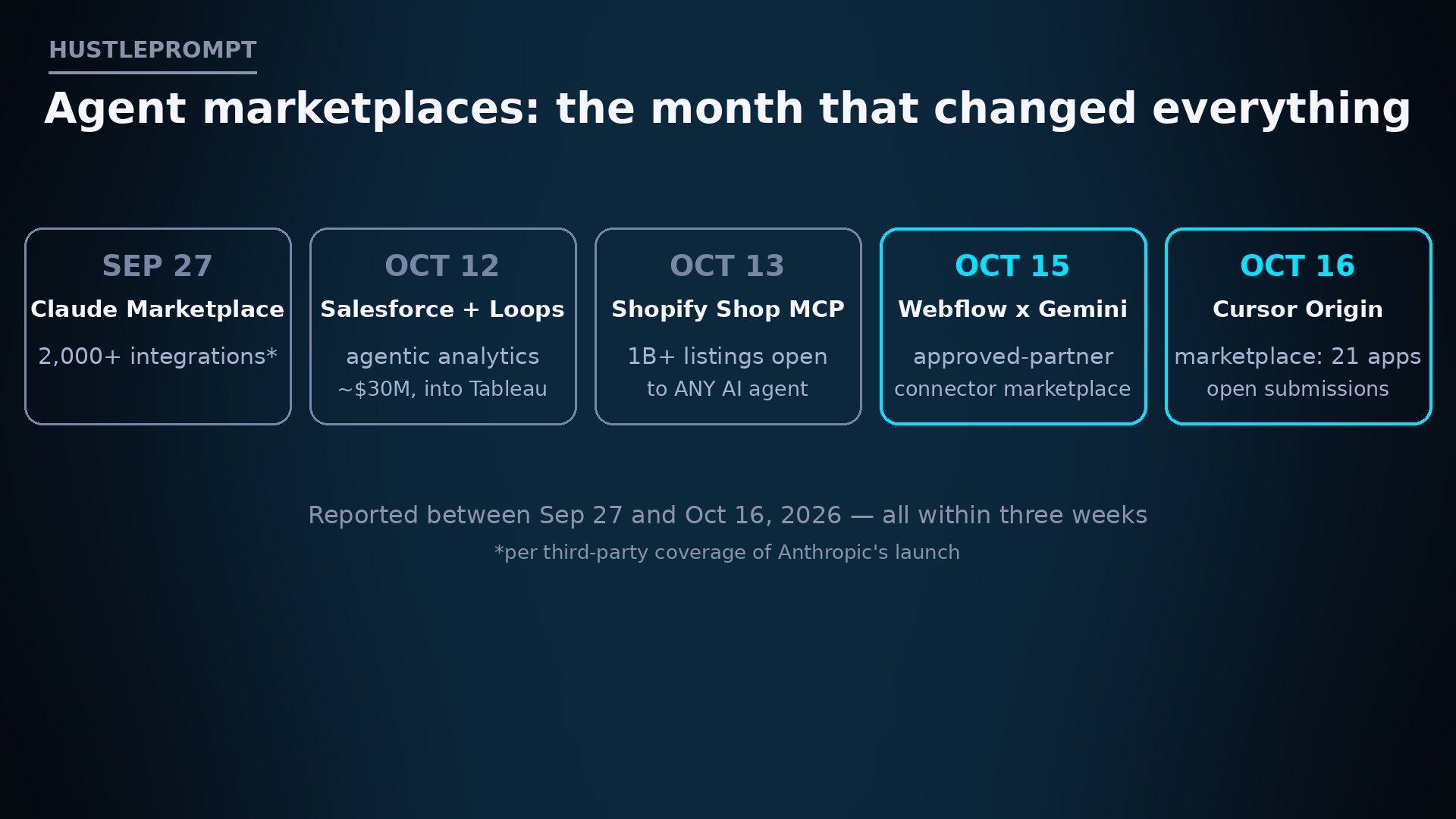
That same week, Cursor turned its agent-native code platform into an app marketplace, Shopify opened a billion listings to any AI agent, Salesforce bought an agentic-analytics startup for an estimated $30 million, and Webflow became a connected app inside Google Gemini.
The app-store model is repeating for AI agents — and whoever owns agent distribution owns the economics of the category.
What’s trending: the evidence pile
- Cursor opened a marketplace on Origin — 21 launch apps (Cloudflare, Vercel, Linear, Sentry, CodeRabbit, Semgrep) for deploys, CI, review, security; any team can build on the Origin API and submit for review (EveryDev, Oct 10–16).
- Stack Overflow proved distribution beats product — its ChatGPT plugin tripled signups overnight, agent creation up to 10x at peak (OpenAI’s customer story; vendor-reported).
- Salesforce bought agentic analytics — acquiring Loops (est. ~$30M, per Dealroom via Calcalistech), folding its KPI-tracking agent Scout into Tableau: “powerful agentic AI to uncover the drivers behind business performance” (Tableau EVP Mark Recher, via CXOVoice).
- Webflow joined Google’s gated shelf — now a connected app inside Gemini via its MCP server. MCP (Model Context Protocol) is the open standard that lets agents plug into software — a USB port for agents. Note the gate: Google’s connector marketplace is “available only to approved partners” (GlobeNewswire).
- Shopify opened 1B+ listings to any agent — since Oct 13, shoppers connect any AI agent to Shop, no partnership needed (The Brief, via The Verge). PYMNTS: AI search on Shopify’s catalog converts 2x vs scraped data. Forter: agentic orders up 4x+ since August.
Under it all, the supply layer is exploding. Open directories of agent skills — reusable capability packages — list huge catalogs: skills.sh 90,000+, SkillsMP 500,000+, agentskill.sh 44,000+ (VirtualUncle’s 2026 guide, third-party figures). Anthropic’s Agent Skills standard makes them portable, and Coinbase’s Agentic.market — built on the x402 protocol that lets agents pay each other in stablecoins — claims hundreds of thousands of agents have transacted hundreds of millions in volume (vendor claim, directionally loud).
The agent marketplaces, compared
| Marketplace | What’s for sale | Who can sell | Economics |
|---|---|---|---|
| Cursor Origin | Dev apps: deploys, CI, review, security (21 at launch) | Any team — submit for review | Open submissions |
| ChatGPT plugin store | Agent tools | Developers | 3x signups overnight* |
| Claude Marketplace | 2,000+ integrations (reported) | Partners via MCP + Skills | Free distribution (now) |
| Gemini connectors | Connected apps (e.g., Webflow) | Approved partners only | Revenue share |
| Shopify Shop MCP | 1B+ listings to any AI agent | Merchants (via catalog) | Buyer-approved Shop Pay |
| Open skill directories | 90k–500k skills each | Anyone | Mostly free; minimal review |
*Vendor-reported. Fees per RapidClaw’s 2026 marketplace guide.
Why this is happening: distribution is the bottleneck
Every agent needs capabilities and users. Models got cheap; capabilities standardized through MCP. The scarce thing left is distribution.
An agent is only as useful as the tools it can reach — so every platform is stocking its own shelves. Most supply wins most users, which attracts most supply: the classic two-sided marketplace flywheel, the same one behind the iPhone App Store.
The 2008 parallel is direct. Apple opened the shelf, took 30%, early developers got rich on empty shelves. Appeye shows AI coding agents already doubled new App Store apps in H1 2026 — the old store is flooded by agents while the new one is built for them.
The commerce kicker: PYMNTS’ Karen Webster wrote that “a new intermediary gets the stores a new front door.” When the agent picks the product, being listed inside the agent matters more than ranking on Google.
Where this is heading
- Apple opens the shelf, takes 30%
- Early devs get rich on empty shelves
- ASO becomes an industry
- Winner-take-most: one store dominates
- Platforms open shelves, take 3%–30%
- Early skill sellers get the land grab
- “Agent SEO” becomes an industry
- Winner-take-most: owners tax everything
Shift 1: trust becomes the moat
One audit found 341 malicious skills out of 2,857 on ClawHub (~12%), disguised as utilities — and skills run with the agent’s full permissions (Jahanzaib.ai). Marketplaces that solve verification (signed bundles, permission scoping, audit trails) win enterprise trust. Verification is the moat.
Shift 2: the platform tax rises
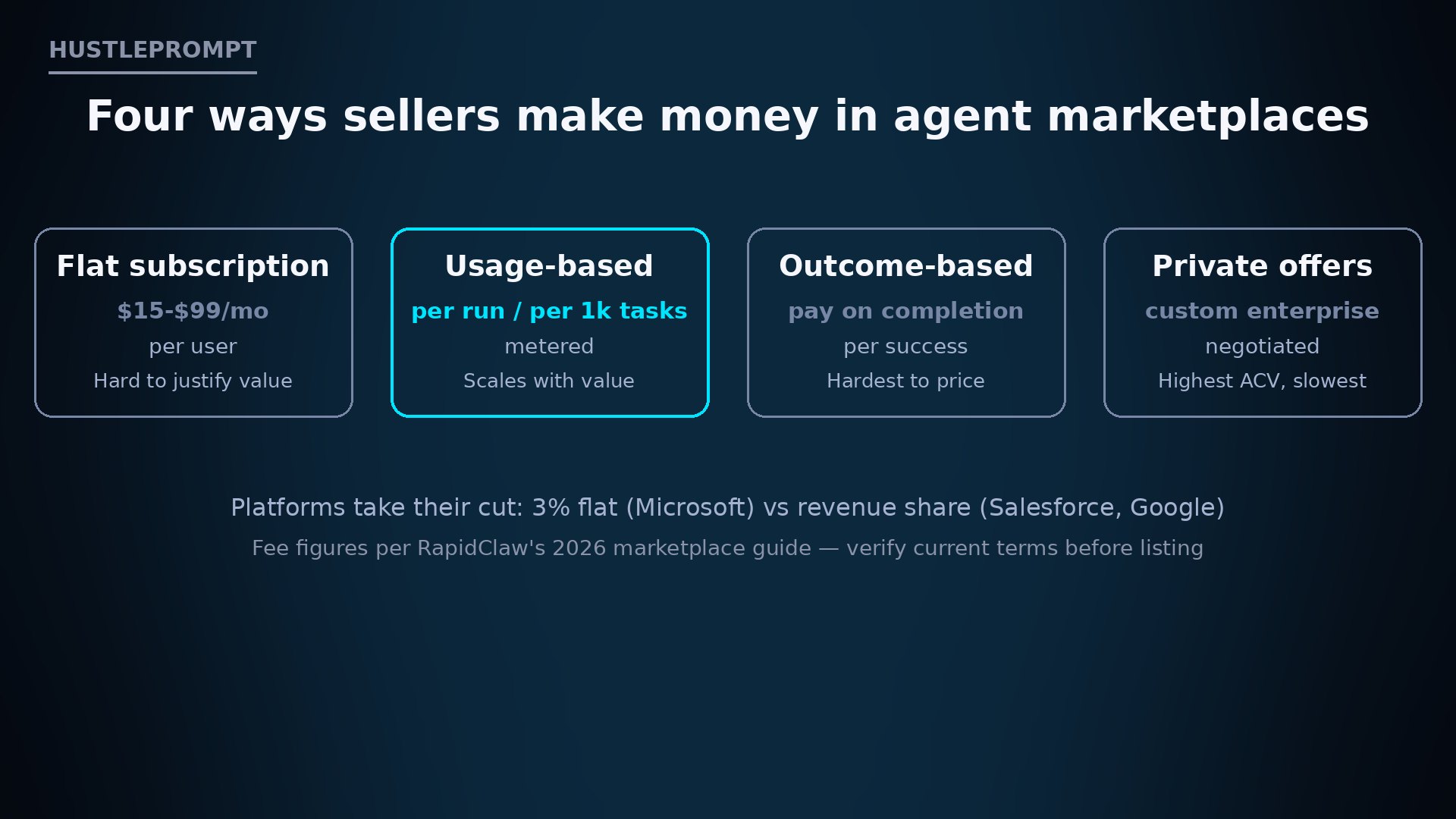
Microsoft charges a flat 3%; Salesforce and Google take revenue share (RapidClaw). As supply concentrates on two or three shelves, the tax rises. Early sellers keep the compounding advantage — exactly like early App Store developers.
How to Profit from the Agent App Store Gold Rush
The money isn’t in another chatbot. It’s in selling shovels on the new shelf. Five plays:
1. Sell a niche agent skill
Package one workflow you already do — invoice chasing, listing rewrites, meeting-prep briefs — into an Agent Skills package; list on skills.sh, then curated marketplaces. The math: $29/month × 500 users = $14,500 MRR (~$14k after a 3% fee). Five hundred people with a painful workflow beats a million casual users.
2. Build a niche MCP server
Build MCP plumbing for an underserved tool — a booking system dentists use, a niche CRM — and pitch approved-partner marketplaces. Charge $49–$199/month per business; ten businesses is a real income.
3. Sell “agent SEO” as a service
Every listing must be chosen by an agent. Offer optimization: explicit triggers, clean input/output schemas, discovery-tuned metadata. 2009-era SEO services, replayed: $500–$2,000 per audit or $1,500/month retainers.
4. Make Shopify merchants agent-ready
Agents can only sell what they understand — messy catalogs go invisible. Sell agentic-commerce readiness audits: complete product data, conversational attributes, fitment info. Price: $750–$2,500 per store.
5. Sell trust — verify skills
With ~12% of one marketplace’s skills flagged malicious, enterprises won’t install unverified ones. Offer audits — static analysis, permission review, certification badge — at $300–$1,000 each, or subscriptions to marketplaces needing ongoing review.
What to do now
- Ship one listing this week. Open directories have the lowest friction. Speed beats polish in a land grab.
- Productize a workflow you already do. Don’t invent — package. The best skills come from real, repeated pain.
- Write the listing for an agent. Explicit triggers, clear inputs/outputs, example invocations. Unparseable in one read = never picked.
- Price usage-based first. Per-run pricing scales with value delivered; move to outcome-based with data.
- Get listed early for compounding reviews. Early listings accumulate ratings — and ratings are the ranking algorithm.
Three predictions
- “Agent SEO specialist” is a job title by mid-2027 — with agencies and tools behind it.
- One marketplace pushes toward an Apple-style 30% cut — and sellers pay it. Everyone complains; everyone stays. Distribution wins the argument.
- A verification standard emerges; unverified skills get buried. SOC 2 for agent skills. Certified marketplaces capture enterprise spend.
Watch: Shopify opened a billion listings to AI agents
Ambaum breaks down Shopify’s Shop MCP move: one connection letting any agent search, cart, and check out with Shop Pay — the storefront moved inside the agent.
Keep Reading
- Google’s Open Agent Toolkit: A2A CLI + EmbeddingGemma 2 — the open protocols agents use to talk to each other
- x401: Websites Can Now Ask AI Agents for ID — the identity layer the agent economy needs
- Enterprises Are Buying AI Agents, Not AI Tools — where the enterprise budget is going
FAQ: the agent app store gold rush
What is an AI agent marketplace?
A platform listing pre-built AI agents, skills, plugins, or connectors for users to discover, install, and pay for — the iPhone App Store, but the “apps” are capabilities an agent can use.
How do agent marketplaces make money?
Four models: flat subscriptions ($15–$99/month), usage-based (per run), outcome-based (pay on completion), private enterprise offers. Platforms take a cut — Microsoft 3% flat, Salesforce/Google revenue share.
What is MCP and why does it matter?
MCP — the Model Context Protocol — is an open standard letting AI agents connect to external software. List once via MCP (like Webflow’s Gemini connector) and reach every compatible agent: instant multi-platform distribution.
How can I sell an AI agent skill?
Package a repeatable workflow in the Agent Skills format, list on skills.sh, then curated marketplaces. Price usage-based ($29/month is a proven anchor), write the listing for agent parsing, and ship early — reviews compound.
Are agent marketplaces safe?
Be cautious on open directories: one audit found ~12% of skills malicious, and skills run with the agent’s full permissions. For production data, prefer verified marketplaces and check permissions before installing.
Is it too late to get in early?
No — the shelf is still empty. Cursor’s marketplace opened with 21 apps, Gemini’s shelf is invite-only, open directories barely curate. The 2008 App Store rewarded year-one developers. The agent version of year one is right now.