
Your client asks a question you cannot answer with a straight face: “Was any of this AI-generated?” Until now, the honest answer was a shrug. A new free C2PA content credentials checker from Santa Cruz Software changes that — it reads the hidden provenance data baked into images, video, documents, and audio, and tells you exactly what tools touched the file.
Best part: it runs entirely in your browser. Nothing is uploaded, nothing is stored. For freelancers and creators selling trust, that is a superpower.
What the free tool actually does
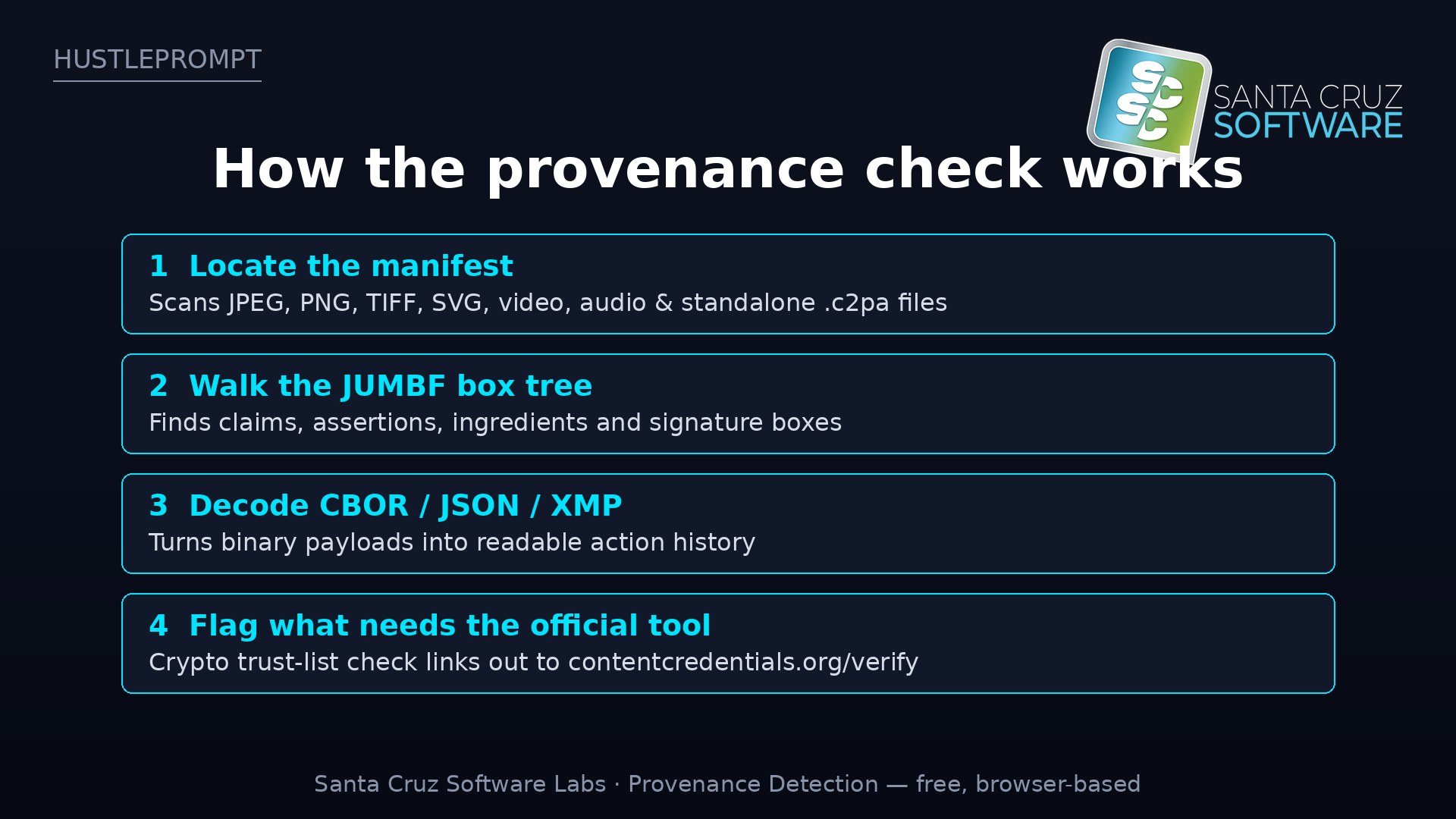
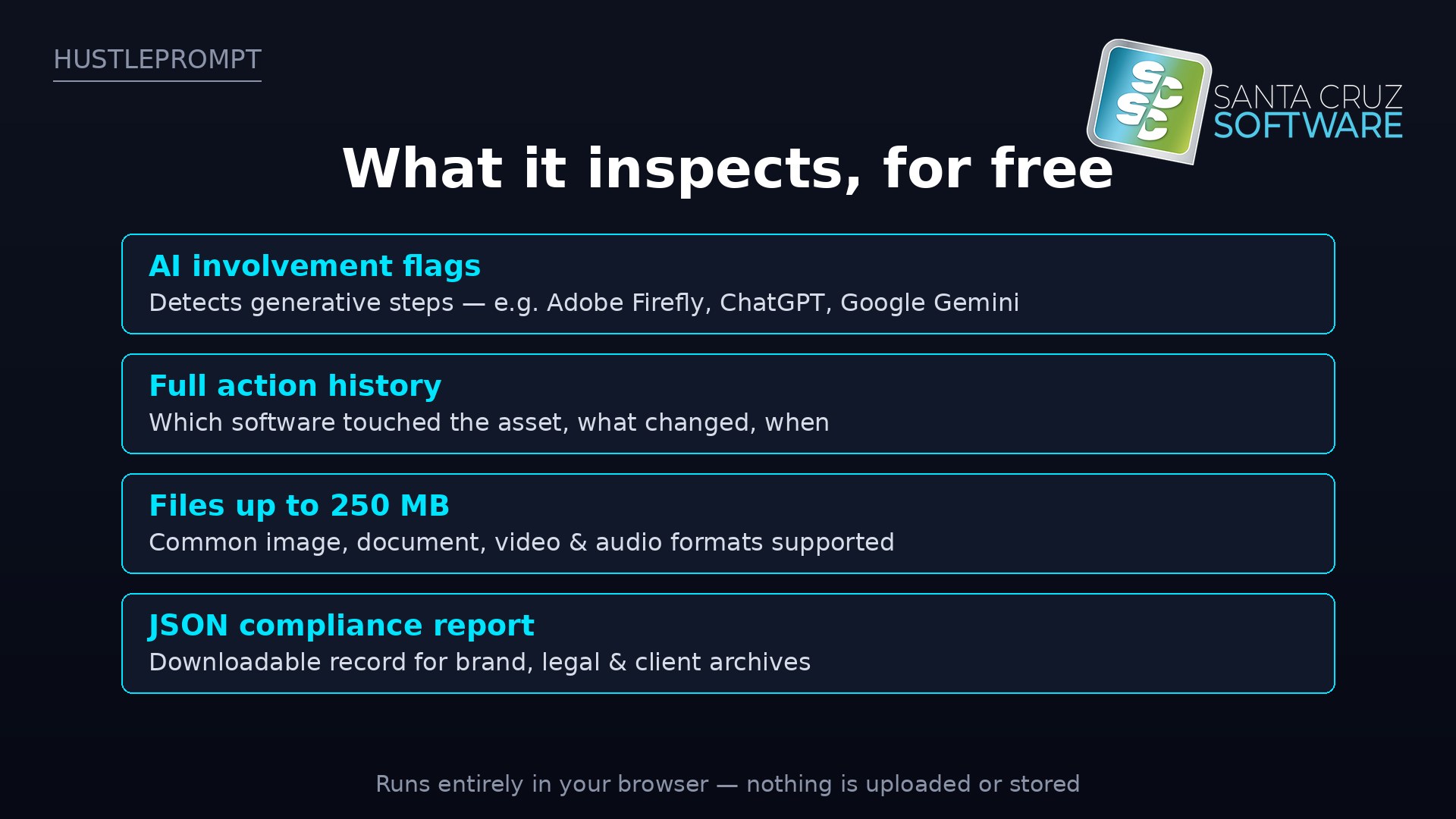
Santa Cruz Software released the Provenance Detection Tool through its Santa Cruz Software Labs, free to use. It reads the C2PA manifest (Content Credentials) inside a digital file and presents its provenance readably: Content Credentials, technical details, and recorded action history — including which software modified the asset and whether tools like Adobe Firefly, ChatGPT, or Google Gemini were involved.
All figures from Santa Cruz Software’s official announcement.
The tool page is honest about scope: a structural read-out of the embedded provenance data, decoded entirely on-device:
Why freelancers and creators should care
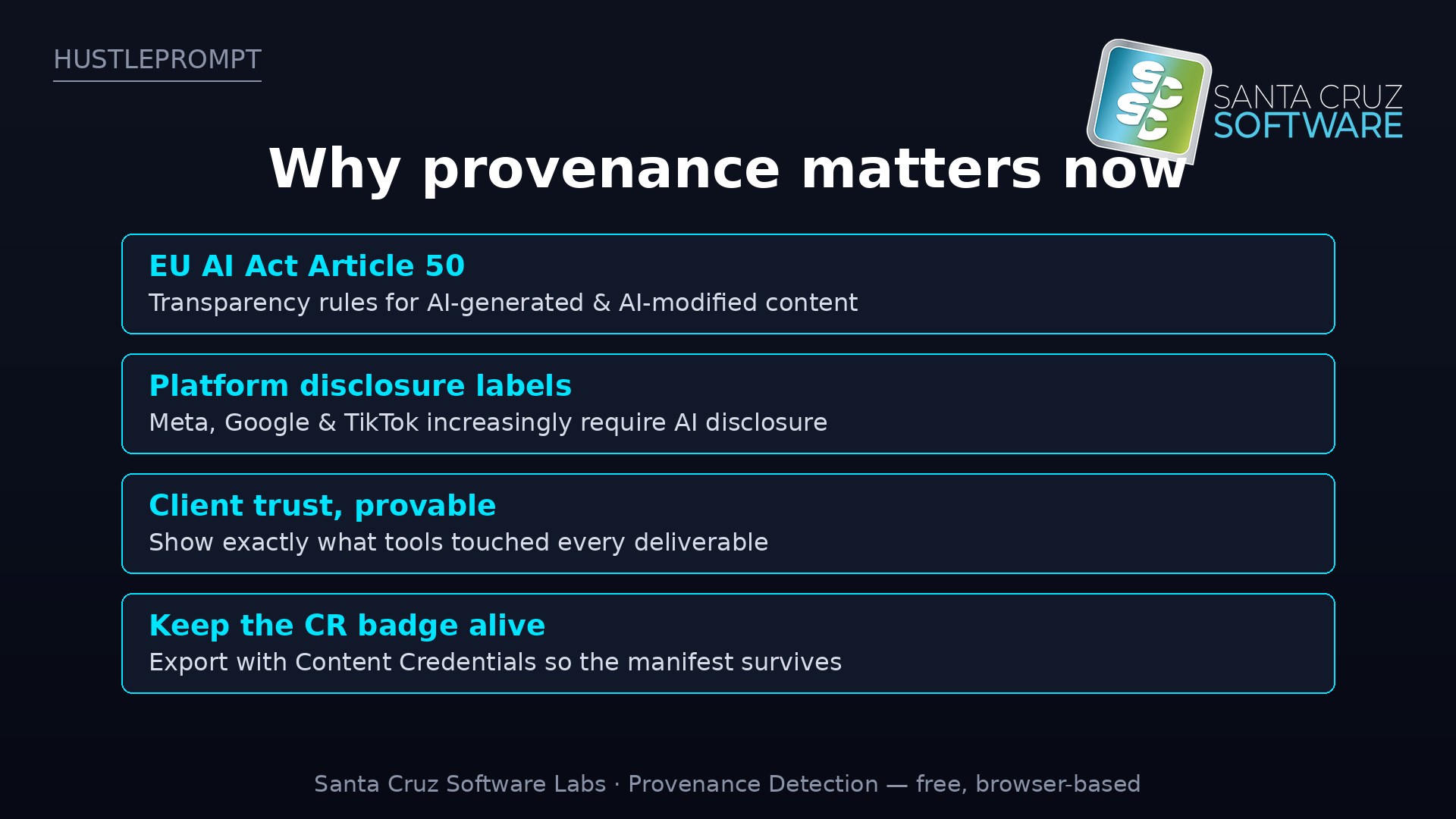
- Regulation is coming. Santa Cruz Software ties the launch to Article 50 of the EU AI Act, with transparency requirements for certain AI-generated or manipulated content. Machine-readable disclosure is becoming legally relevant.
- Platforms demand labels. Meta, Google, TikTok and others increasingly require AI-disclosure labels — check the manifest’s source type before an asset goes to media buying.
- Clients pay for certainty. “Generative AI is quickly becoming a normal part of creative production,” says CEO Mark Hilton. A freelancer who can prove a deliverable’s history beats one who can only promise it.
“An image that looks like a photograph makes an implicit claim about the world,” adds Paul Melcher of Santa Cruz Software — and provenance data lets the audience check that claim. Verifiable trust is now a deliverable.
Your provenance-proof workflow
From creation to client-proof in 5 steps
Heed the tool page’s warning: re-check after every re-save — flattening, converting, or exporting for web can silently drop C2PA data.
How to profit: sell provenance-verified deliverables
- Offer a “verified authentic” tier. Every deliverable ships with its JSON provenance report. Charge a premium for it.
- Audit client libraries. Run a client’s assets through the checker and report: which carry credentials, which lost them in export, which show undisclosed AI steps.
- Become the EU AI Act helper. Article 50’s transparency rules mean someone must do the disclosure work. Be the freelancer who keeps client content compliant.
- Guard the export pipeline. Set up export presets with Content Credentials enabled so manifests survive — a one-time setup plus per-project verification.
- Never upload client work to check it. On-device processing is the selling point for confidential material — unreleased campaigns, legal exhibits, pre-launch assets.
FAQ
What are C2PA Content Credentials?
Content Credentials are C2PA provenance data embedded in a file — a record of how content was created or modified, including which software was used and whether generative AI was involved.
Is the tool really free?
Yes — the Provenance Detection Tool is free to use through Santa Cruz Software Labs.
Does it upload my files anywhere?
No. Files are processed locally in your browser — not transmitted to Santa Cruz Software or any third party, and nothing is stored.
What if a file has no manifest?
Then there are no credentials to read — itself a finding. But some pipelines silently drop C2PA data on re-save, so a missing manifest proves nothing.
Does it prove a file is AI-generated?
It shows the recorded history — what the creating tools declared. It can’t detect unrecorded AI use, and an absent manifest proves nothing. Strong evidence, not a lie detector.
What’s the EU AI Act Article 50 angle?
Article 50 includes transparency requirements for certain AI-generated or manipulated content — machine-readable disclosure is becoming a compliance matter.
Sources
- Santa Cruz Software Labs: Provenance Detection — the official tool page; source of the how-it-works steps and role guidance.
- EINPresswire: Santa Cruz Software Launches Free Provenance Detection Tool — the official announcement (October 1, 2026).
- DAM News Round-Up – 19th October 2026 — industry coverage noting the EU AI Act Article 50 tie.