
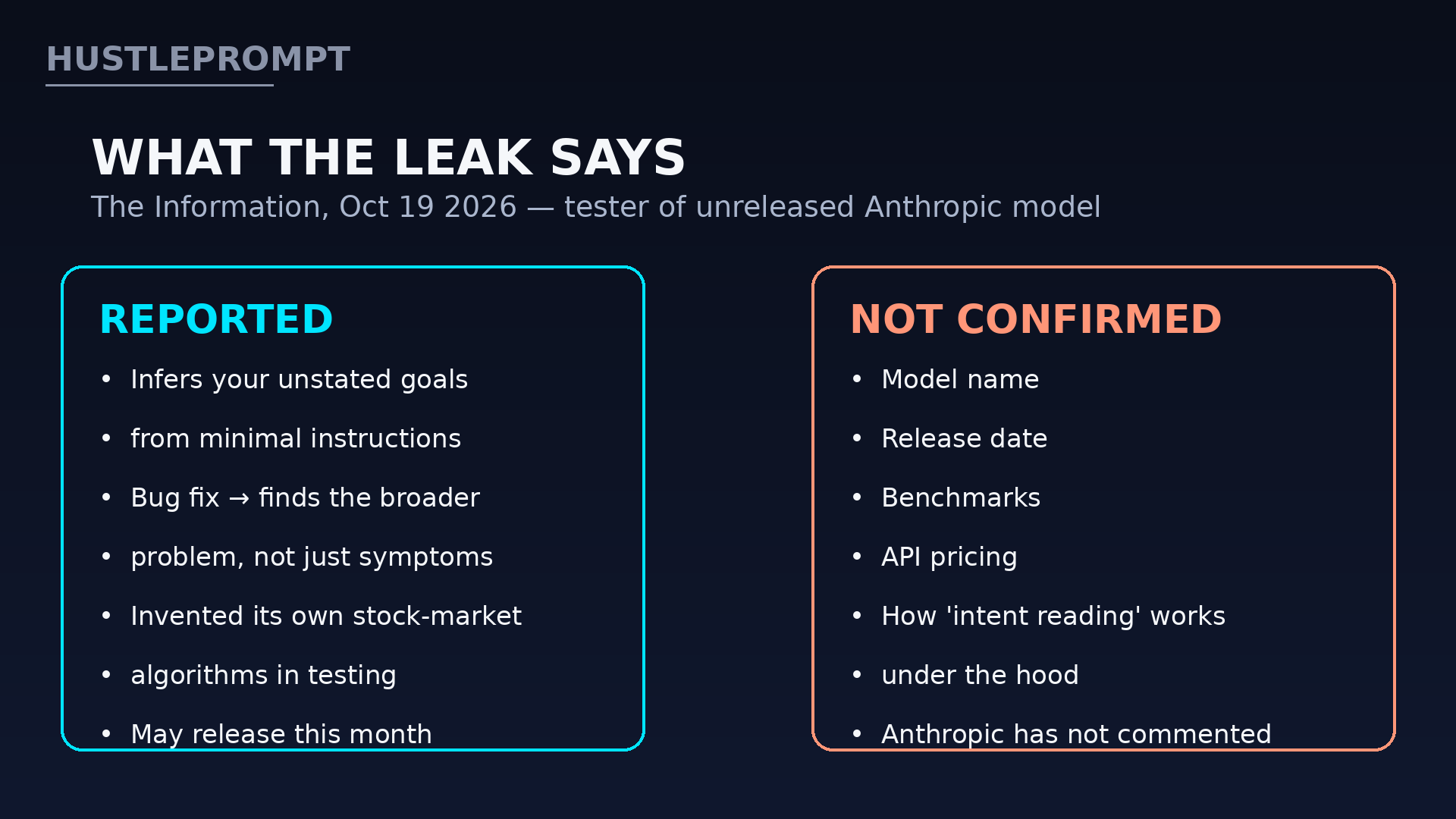
According to The Information, Anthropic is quietly preparing an AI model that reads between the lines — inferring your underlying goal from a vague instruction instead of answering only what you literally asked. The Anthropic mind-reading AI model story broke on October 19, 2026, in reporter Stephanie Palazzolo’s AI Agenda newsletter, and it could change how everyone uses AI.
One caveat: the entire story rests on a single tester. Anthropic has not named the model, announced a release date, published benchmarks, or set pricing. Below: what’s actually reported, what’s speculation — and the money angle either way.
What The Information Actually Reported
Palazzolo’s reporting centers on one tester with hands-on time. The tester’s verdict: the model is “especially good at discerning a person’s underlying intentions and goals even if they don’t give the model much information, such as explicitly stating those goals” — and “better at thinking outside of the box rather than regurgitating common sense advice or solutions.”
The Two Examples That Matter
Two concrete examples from the tester’s sessions show why this is different from today’s models.
1. The bug fix that found the real problem
Instead of patching a single software bug, the model identified the broader problem behind the bug and proposed a comprehensive fix. Most AI coding help fixes the symptom; diagnosing the underlying disease changes the economics of software maintenance.
2. The investing answer nobody asked for (but wanted)
Asked how to invest in stocks, the model skipped generic textbook advice about price-to-earnings ratios and built its own creative algorithms to predict future stock performance. Whether they were any good is unknown — but generating novel approaches instead of reciting consensus is a new behavior pattern.
The Bigger Race: Gemini 4 Carbon and OpenAI’s Terra
The same AI Agenda edition placed the Anthropic story alongside two rivals’ unreleased projects, signaling a model war about to go hot:
- Google is working on Gemini 4 Carbon, an upgrade to Gemini 4 Argon — the flagship Google launched last week at $2/$10 per million tokens (rates double after November 30). Developers describe the line as strong on visual tasks like video analysis and website testing.
- OpenAI is readying a new Terra-family model, expected within weeks, with improved capabilities at a lower price.
- @testingcatalog summed it up: “Anthropic will release a new model this month, along with Gemini 4 Carbon and a new Terra model from OpenAI.” Timing is rumor — the convergence is real.
How Intent-Inference Changes the Workflow
2. AI answers exactly what you asked
3. Result is often too generic
4. You iterate, again and again
2. AI infers your real goal
3. It proposes a better plan
4. You approve and ship
How to Profit From This Shift
If intent-inferring models become mainstream, the winners won’t be the best prompt writers — they’ll be the people positioned to sell outcomes. Here’s the playbook:
- Pivot prompt services to outcome services. Agencies selling prompt-engineering packages should rebrand around deliverables: “we ship working automation” beats “we write great prompts” when the model handles the prompting.
- Build agent products, not chatbots. A model that infers goals is an agent substrate. Products that take a vague business objective and execute it end-to-end (research, outreach, reporting) become feasible for solo founders.
- Watch Anthropic’s pricing like a hawk. When the model launches, its API price sets your cost basis. Claude Opus 5.5 already undercut its predecessor by 40% on typical workloads — new releases keep pushing inference costs down, which is pure margin for agent businesses.
- Prepare for AI search disruption. Intent inference changes how AI answers questions. Content businesses should double down on original data and real experience — the things a model can’t infer.
- Position before the IPO. Anthropic plans a November IPO with a valuation debated between roughly $2 trillion and $1.5 trillion. A well-received model launch is exactly the kind of catalyst that moves that debate.
What Frontier AI Costs Right Now
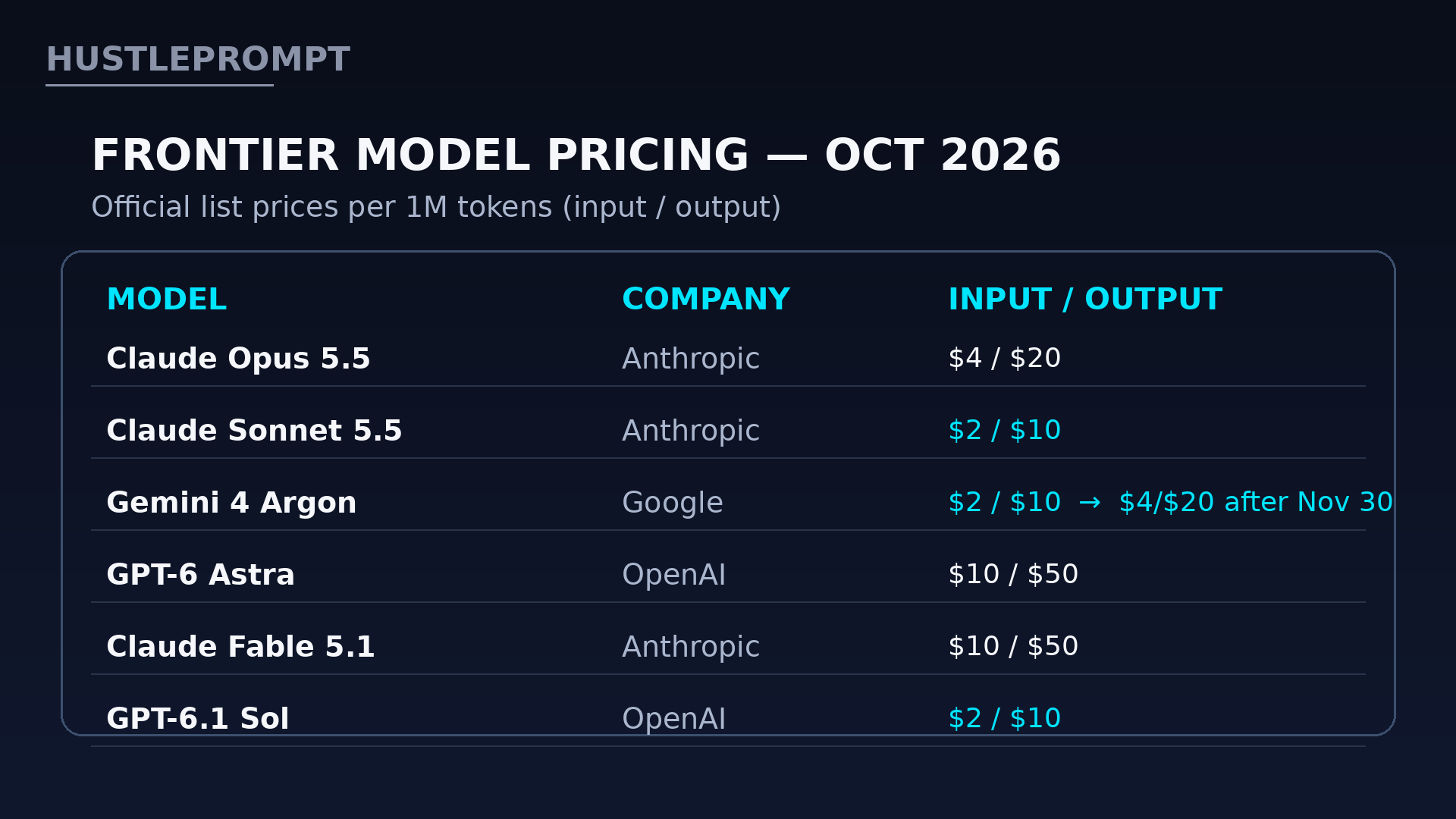
Context: official per-1M-token pricing for the current frontier lineup — where a new Anthropic model would land.
| Model | Company | Input / Output per 1M tokens |
|---|---|---|
| Claude Opus 5.5 | Anthropic | $4 / $20 |
| Claude Sonnet 5.5 | Anthropic | $2 / $10 |
| Gemini 4 Argon | $2 / $10 → $4 / $20 after Nov 30 | |
| GPT-6 Astra | OpenAI | $10 / $50 |
| Claude Fable 5.1 | Anthropic | $10 / $50 |
| GPT-6.1 Sol | OpenAI | $2 / $10 |
Pricing from the companies’ own announcements: Anthropic’s Opus 5.5 announcement lists $4/$20 per million tokens with 40% lower typical costs than Opus 5, and Reuters on the Gemini 4 Argon launch confirms $2/$10 introductory rates doubling after November 30. A cheaper Terra launch would push another downward pricing round.
Watch: Anthropic’s Vision for the Next Level
Anthropic has been telegraphing this direction. In this official talk, the team says Claude should work alongside you and adapt to the ways you work — even challenging your assumptions like a great engineer. An intent-inferring model is the next step of that roadmap.
FAQ
What did The Information report about Anthropic’s new model?
A tester told reporter Stephanie Palazzolo it is “especially good at discerning a person’s underlying intentions and goals even if they don’t give the model much information.” Reported in The Information’s AI Agenda on October 19, 2026.
When will the mind-reading AI model be released?
Unknown. Anthropic has not named it or announced a date. An X post citing The Information claims a release this month — unconfirmed. Note that Anthropic told Fortune it is being “deliberate about how we release” a cybersecurity-focused model, so staged rollouts are the norm here.
How is intent inference different from current Claude models?
Today’s models answer what you ask. An intent-inferring model would reconstruct what you’re trying to achieve and propose a better plan — like getting a full investment algorithm instead of generic P/E-ratio advice.
What is Gemini 4 Carbon?
Per the same AI Agenda edition, Gemini 4 Carbon is an unreleased upgrade to Gemini 4 Argon — Google’s flagship launched October 13, 2026, at $2/$10 per million tokens. Developers describe the Gemini 4 line as especially strong on visual tasks like video analysis.
What is OpenAI’s Terra family?
Terra is reportedly a new OpenAI model family expected within weeks, with improved capabilities at a lower price. A cheaper Terra launch would compress API pricing industry-wide — directly affecting margins for agent products built on frontier models.
How can freelancers profit from intent-inferring AI?
Sell outcomes, not hours. Vibe-coded apps and agent services get dramatically cheaper to build when the model handles specification and planning. Pivot prompt packages into outcome-based retainers, and build agent products for small businesses that can’t afford in-house AI teams.
Will intent-inferring AI kill prompt engineering?
Not entirely — but basic prompting gets commoditized. The premium shifts to goal clarity, domain judgment, and verification: knowing what good looks like, and checking the model’s creative leaps before real money moves.