
ElevenLabs just claimed something almost absurd: 98.8% accuracy on the Big Bench Audio benchmark, with voice replies landing in roughly half a second. On October 20, 2026, the company announced ElevenLabs Realtime — two native speech-to-speech models, v1 Max and v1 Mini, built to power voice agents that sound human and think fast enough to keep up.
Speech-to-speech means the AI hears your voice and answers in voice inside one model — no stitched chain of speech-to-text, language model, and text-to-speech. Latency is the gap between you finishing and the agent replying; turn-taking is knowing when you’re done versus just saying “mm-hmm.”
For anyone building or selling voice agents, this launch matters. The numbers:
Watch: ElevenLabs’ official launch video, “Introducing Eleven Realtime: a simpler way to build natural voice agents.”
Max vs Mini: the confirmed numbers
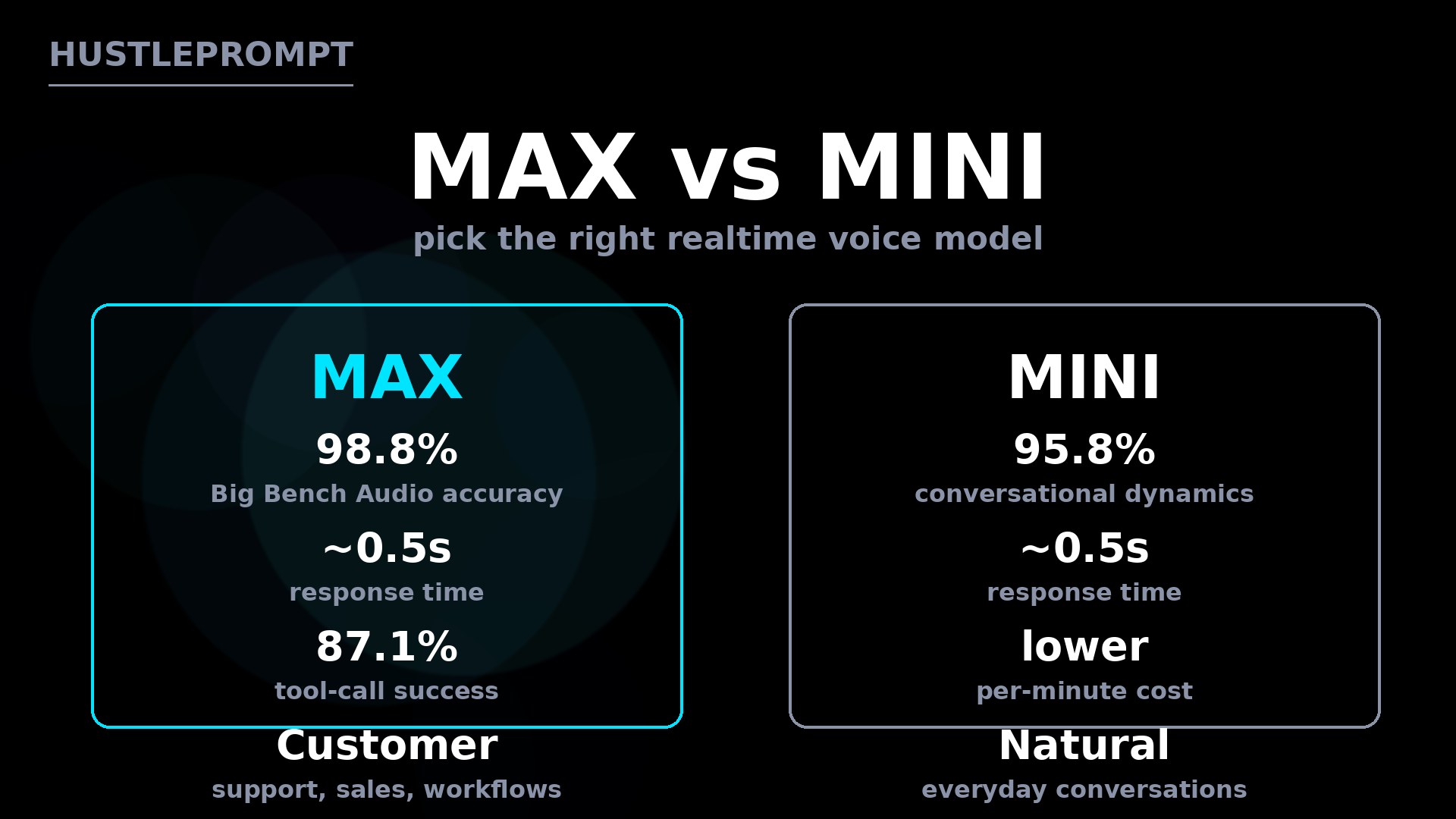
Two models, two jobs. Figures reported from ElevenLabs’ own launch materials:
| Model | Accuracy | Response time | Tool calling | Best for |
|---|---|---|---|---|
| v1 Max | 98.8% | ~0.5s* | 87.1% | Support, sales, complex workflows |
| v1 Mini | 75.9% | ~0.5s* | 60.3% | Natural everyday conversation |
*Reported response times differ slightly between outlets (470ms vs 0.57s for Max, 500ms for Mini) — treat them as approximately half a second until independent tests land.
More stats that matter, from Journal du Net’s launch coverage:
- Max beats the big names: 98.8% sits ahead of Grok Voice 3.0 (98.5%) and Gemini 3.8 Live Extended Thinking (97.7%) on the same benchmark.
- Mini wins on “human feel”: 95.8% on conversational dynamics — slightly above Max (94.1%) and on par with OpenAI’s GPT-Realtime 2.1.
- Blind tests agree: in the Speech Agent Arena, Max scores 998 points and Mini 988.
- Twice as fast: ~0.5s vs GPT-Realtime-2 (High) at 1.14s and Grok Voice 3.0 at 810ms.
“Precision and speed are no longer mutually exclusive. That’s what ElevenLabs aims to prove,” — Journal du Net, October 20.
“ElevenLabs says speech recognition, turn-taking, the language model and the voice are tuned together as a single system” — one model listens, thinks, and speaks, in up to 90 languages with any of 17,000 voices.
How a speech-to-speech voice agent works
Old way: 3 models stitched together. New way: 1 native speech-to-speech model.
The killer feature: an OpenAI-compatible API
The Realtime API is fully compatible with OpenAI’s Realtime API: migration means changing just the endpoint and the model name. The OpenAI SDK works as-is — switching costs are near zero.
Access is via ElevenAgents (phone, web, WhatsApp, contact-center platforms) or the Realtime API over WebSocket — WebRTC isn’t supported at launch.
Pricing: per minute, with the bill visible up front
In ElevenAgents, the Realtime models follow standard per-minute pricing, with an estimated cost per minute shown in the model selector. Via the API, you’re charged per minute of connected audio plus tokens — but the exact per-token price wasn’t announced at launch (per The Decoder). Confirm pricing before quoting clients.
How to profit: sell voice agents to local businesses
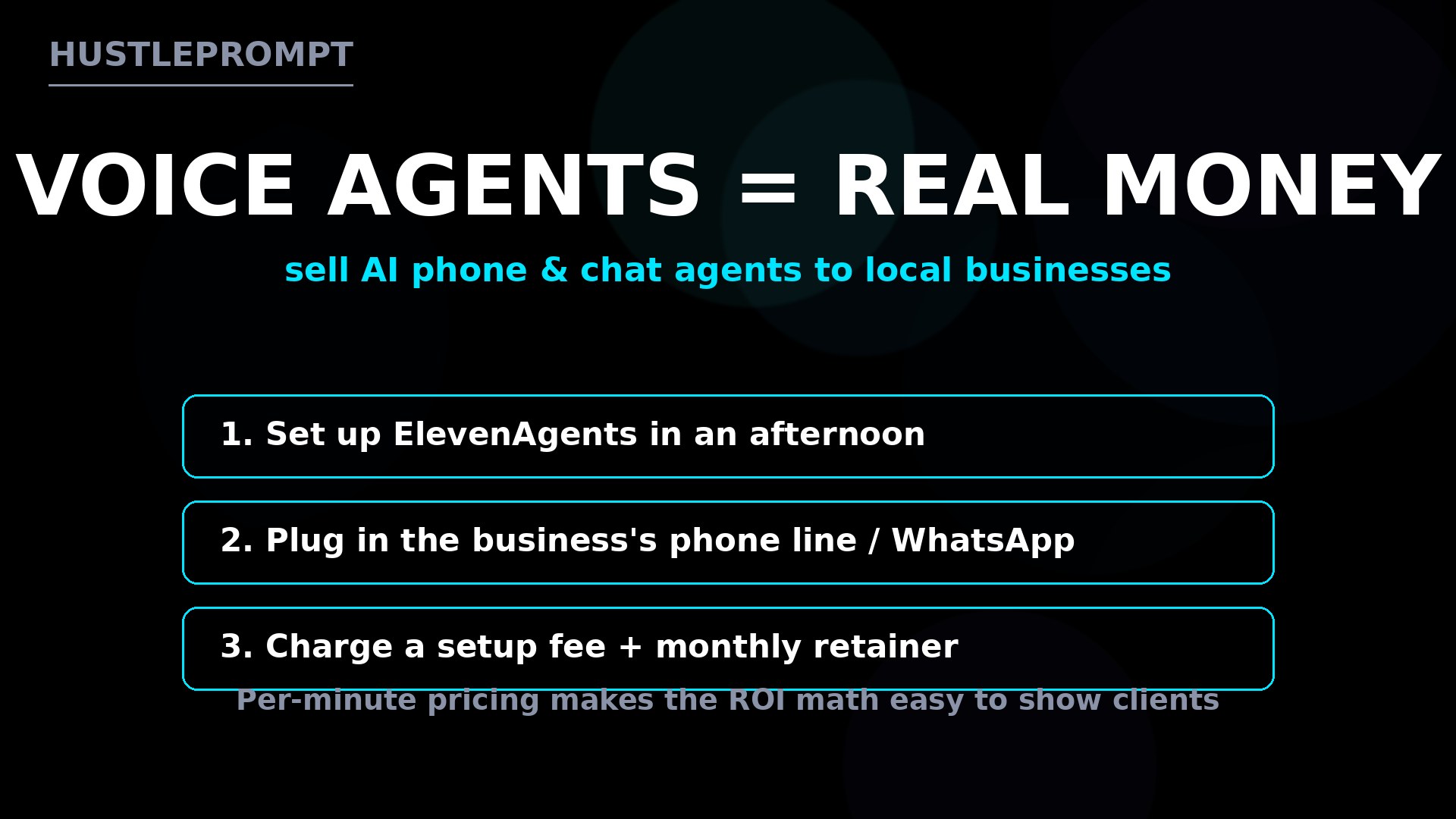
Voice agents just went from “experimental” to “production-ready,” and local businesses miss calls daily. A missed call is a lost customer. The playbook:
- Build one demo. Spend a weekend building an ElevenAgents receptionist for a fictional dental clinic: bookings, hours, FAQs. Mini keeps costs low.
- Record it in action. Call the agent, record 60 seconds booking an appointment. That audio clip is your entire sales pitch.
- Pitch with math. Per-minute pricing makes ROI calculable: call minutes × per-minute rate vs. the revenue of one captured appointment. Show the number.
- Charge setup + retainer. One-time build fee, then a monthly retainer for minutes and tweaks. Move heavy users from Mini to Max.
- Start with missed-call rescue. The agent answers only when the business can’t — after hours, during rushes. Zero disruption, captured revenue.
Journal du Net reports that large organizations now account for 55% of ElevenLabs’ revenue, up from 40% a year ago — with clients like Deutsche Telekom, Revolut, and Klarna. The enterprise wave is here; the SMB wave is next. Sell the shovels.
What to watch out for
- No independent benchmarks yet. As Oossa notes, nothing beyond ElevenLabs’ own claims is published. Vendor numbers are a starting point, not proof.
- Latency is slightly fuzzy. Outlets report 470ms and 0.57s for Max — both ~0.5s, but the exact millisecond is unconfirmed.
- Token pricing is pending. Until it’s published, finalize quotes with ElevenAgents’ per-minute estimates, not API math.
See Oossa’s model breakdown before building anything for production.
FAQ
What is Eleven Realtime?
ElevenLabs’ native speech-to-speech AI models, announced October 20, 2026. One model listens, reasons, and speaks — built for live voice agents.
What’s the difference between v1 Max and v1 Mini?
Max is the accuracy flagship (98.8%, 87.1% tool-call success) for support and complex workflows. Mini is smaller and cheaper for natural everyday conversation — and scores slightly higher on “human feel” (95.8% vs 94.1%).
How fast is Eleven Realtime?
Roughly half a second. Launch coverage reports 470ms and 0.57s for Max, 500ms for Mini — far ahead of GPT-Realtime-2 (High) at 1.14s.
Can I migrate my OpenAI voice agent to ElevenLabs?
Yes. The Realtime API is fully OpenAI-compatible: change the endpoint and model name, and the OpenAI SDK works as-is.
How much does Eleven Realtime cost?
Per-minute in ElevenAgents (cost estimate in the model selector), or per minute of connected audio plus tokens via the API. The exact per-token price wasn’t announced at launch.
How can I make money with Eleven Realtime?
Sell voice-agent setups to local businesses: a one-time build fee plus a monthly retainer, with per-minute pricing making ROI easy to show. Start with missed-call rescue.