
Imagine waking up to find an AI has rewritten your ad headlines, translated your copy into languages you never approved, and started sending your traffic to different pages on your site — all while you slept. For ChatGPT advertisers, that isn’t a hypothetical: chatgpt ads creative enhancements are being switched on by default, and you don’t approve each version before it runs.
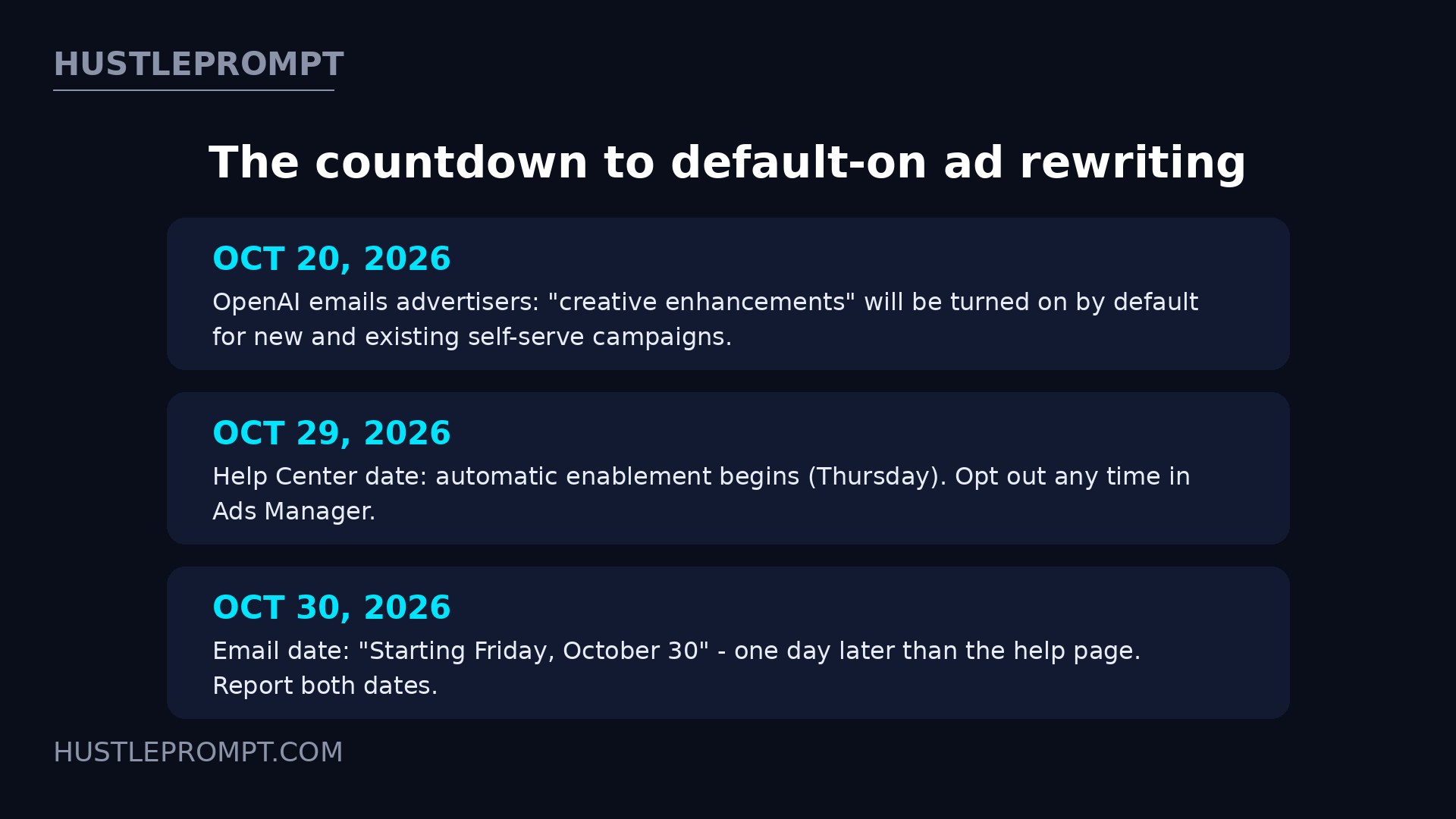
OpenAI notified advertisers by email on October 20, 2026: starting late October, “creative enhancements” go live for new and existing self-serve campaigns. The official help page even disagrees with the email about the exact start date — and that one-day gap tells you everything about how fast this is moving.
What just happened
Search Engine Roundtable’s Barry Schwartz published the email he received as a ChatGPT Ads advertiser on October 20. The key line: “Starting Friday, October 30, 2026, we’ll enable creative enhancements for your new and existing self-serve campaigns.” His screenshot shows the setting already toggled on in his ad account.
Meanwhile, OpenAI’s official Help Center article says something slightly different: “Starting Thursday, October 29, 2026, creative enhancements will be enabled automatically for new and existing campaigns.” We report both dates — plan for October 29, the earlier one.
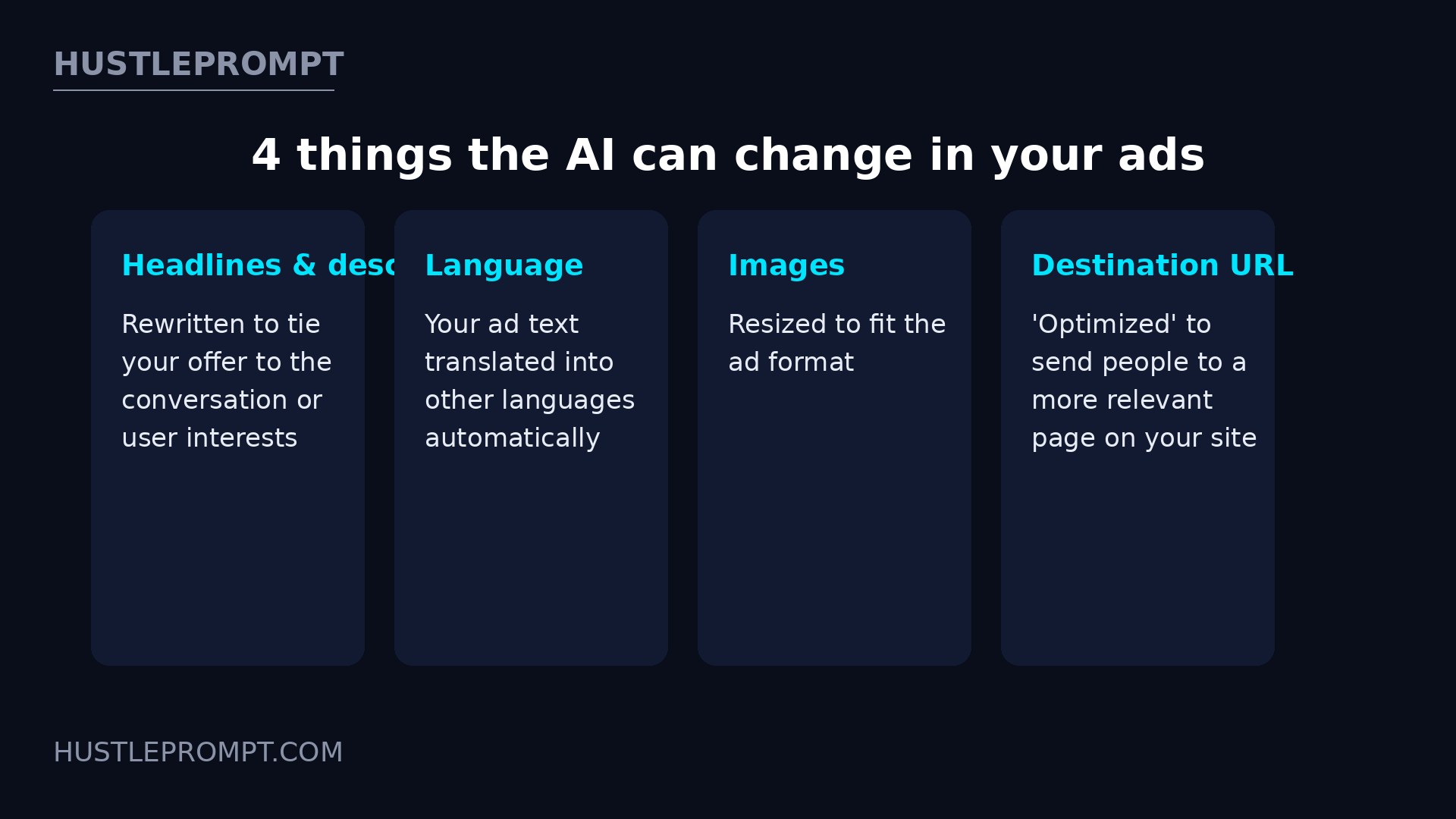
What the AI can change in your ads
Creative enhancements adapt your existing ad using three inputs: the conversation context or user interests, your existing ad, and content from your landing page. Variations can be prepared in advance or generated in real time as the chat unfolds.
The critical sentence from the help article: “When enabled, these ads can run automatically without requiring you to review or approve each version.” There is no preview of every variation. Your copy goes in; AI-remixed versions come out and serve.
See it in action: OpenAI’s own example
The help article walks through a concrete rewrite. A grocery delivery ad in a conversation about planning quick weeknight dinners:
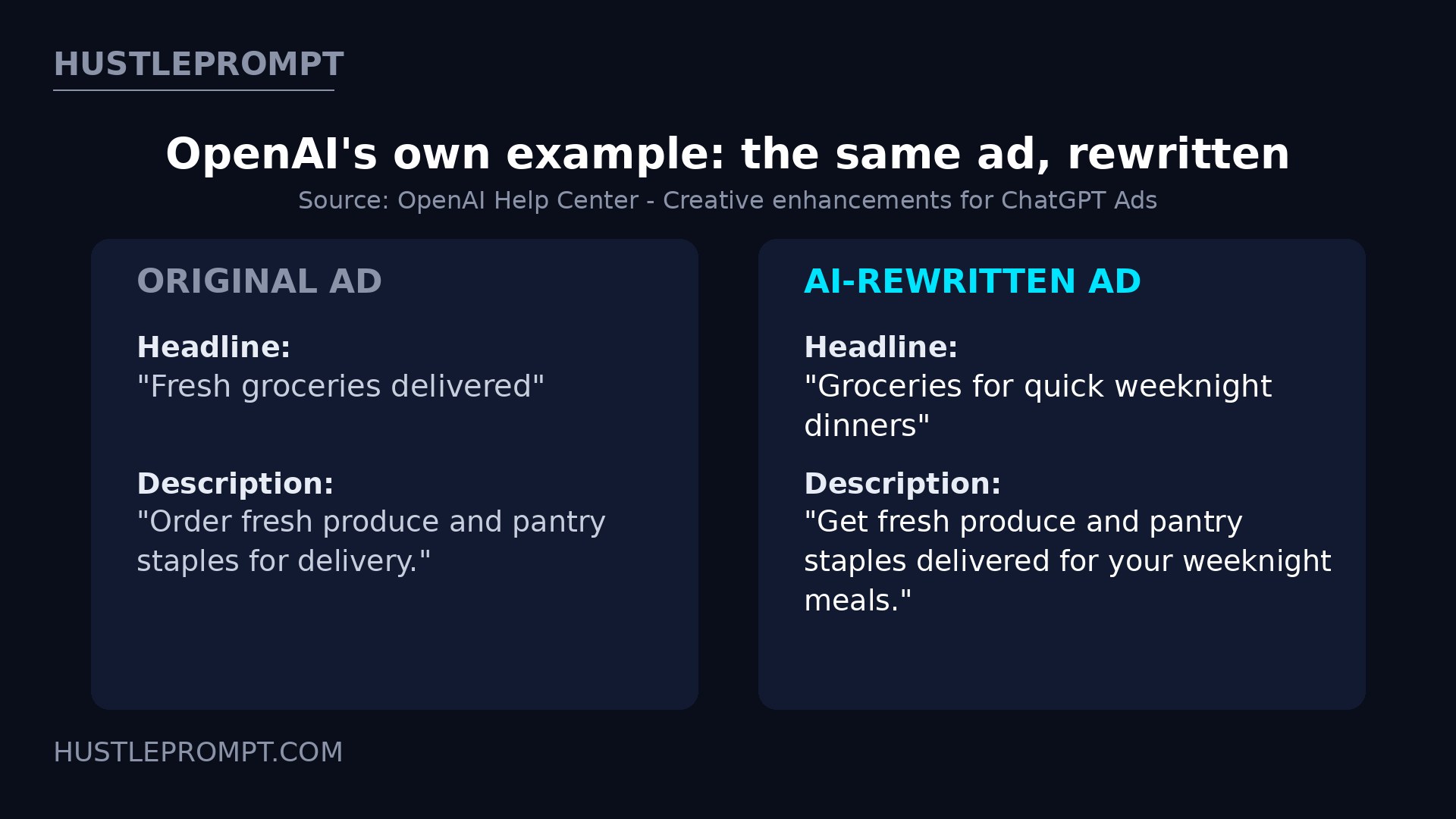
The enhanced version ties the same offer to the conversation. Reasonable — until the AI ties your offer to a conversation you wouldn’t have chosen, or translates a regulated claim your legal team never reviewed.
Email vs. help page: the facts side by side
Note this is a follow-up event, not the launch itself. Our October 14 coverage (“ChatGPT Visual Ads Are Coming: How to Profit From Them”) covered the format rollout. This is the automation layer switching on by default — a much bigger deal for anyone already spending.
What advertisers must do this week
One more thing to verify: destination URL “optimization.” If the AI starts routing clicks to a different page on your site, your conversion tracking, page-specific offers, and analytics attributions can all shift without you touching a thing. Check where the traffic actually lands in the first week.
How to profit: sell “ChatGPT ad guardrails”
Every automation wave creates a counter-wave of oversight services. Advertisers now need someone to watch what the AI writes in their name. That’s an agency product:
- Launch a “ChatGPT Ads Brand-Safety Audit” ($300–$800). Review the client’s ads, landing pages, and campaign structure for enhancement risk: regulated claims, multi-language exposure, URL routing. Deliver a written opt-in/opt-out map per campaign.
- Sell monthly “AI rewrite monitoring” ($150–$400/mo). Watch Ads Manager reporting for sudden CTR or conversion shifts after October 29, flag suspicious destination-URL changes, and keep landing pages enhancement-ready. Recurring revenue from a one-time platform change.
- Write “enhancement-proof” ad copy ($100–$250 per ad group). OpenAI’s own guidance says: keep ads current, write clear specific copy, comply with ad policies. Clients will pay for copy engineered to survive AI rewriting — tight claims, unambiguous offers, no fragile phrasing.
- Productize the opt-out decision. A simple flowchart — regulated industry? multi-language audience? complex funnel? — that tells an advertiser whether to leave enhancements on or off per campaign. Sell it as a $49 template or use it as lead gen for the audit.
Frequently asked questions
What are ChatGPT Ads “creative enhancements”?
An OpenAI feature that automatically rewrites your ad headlines and descriptions, translates ad text, resizes images, and “optimizes” destination URLs — using your existing ad, your landing page, and the conversation context. Starting late October 2026, it’s enabled by default.
When do creative enhancements turn on?
OpenAI gives two dates: the advertiser email says Friday, October 30, 2026; the Help Center article says Thursday, October 29, 2026. Plan for October 29, the earlier date. You can opt out before then or change the setting any time in Ads Manager.
Do I approve each AI-rewritten version?
No. OpenAI states enhanced creatives “can run automatically without requiring you to review or approve each version,” and the experience “does not provide a preview of every variation.”
Can I opt out?
Yes — opt out before the start date or change the setting at any time in Ads Manager. Existing account- and campaign-level opt-outs are preserved, and campaign-specific settings take priority over the account default.
Does this change what ChatGPT tells users?
No. OpenAI’s FAQ is explicit: “Ads do not influence ChatGPT’s answers. Ads are separate and clearly labeled.” This is about your ad creative, not the model’s responses.
Is this the same as the visual ads launch?
No. The October visual-ads announcement was about a new ad format during image generation. Creative enhancements are an automation layer that rewrites existing ads — a follow-up event we covered as the next chapter.
How do I know if the AI rewriting is helping or hurting?
Use Ads Manager reporting (impressions, clicks, spend, CTR, attributed conversions) at campaign, ad group, and ad level. OpenAI cautions that metric changes over time don’t, on their own, establish that creative enhancements caused them.
Keep Reading
Official sources: OpenAI Help Center: Creative enhancements for ChatGPT Ads and the advertiser email published by Search Engine Roundtable (October 20, 2026).