
The “robotic AI voice” is officially dead. In the last three weeks, the voice-AI leader shipped its most expressive model ever — and a music giant invaded voice with something nobody had tried before: narration and an original score generated as a single track. Benchmarks, pricing, and product moves all point the same way: the biggest voice-AI leap in a year.
But this isn’t just a tech upgrade — it’s a business opening. The same tools that once made narrators charge $500 per voiceover now let a freelancer deliver a scored, multilingual, studio-grade audio package from a laptop in an afternoon. This is analysis, not a news recap: why October 2026 mattered, where the voice wave is heading, and how you profit from it.
October’s Double Breakthrough
Two launches, days apart, attacked voice from opposite ends.
ElevenLabs’ Eleven v4: the leader doubles down
On September 28, 2026, ElevenLabs announced Eleven v4 — its highest-quality TTS (text-to-speech) model yet. The upgrade is qualitative: in-sentence expression tags ([whispering], [laughing], [quietly curious]) you write directly into the script, multi-speaker dialogue in one request, 10,000 characters per request (double v3), 90+ languages with native accents, voice cloning from just 10 seconds of audio, and captions with word timings. A Turbo variant starts speaking in about 150 milliseconds.
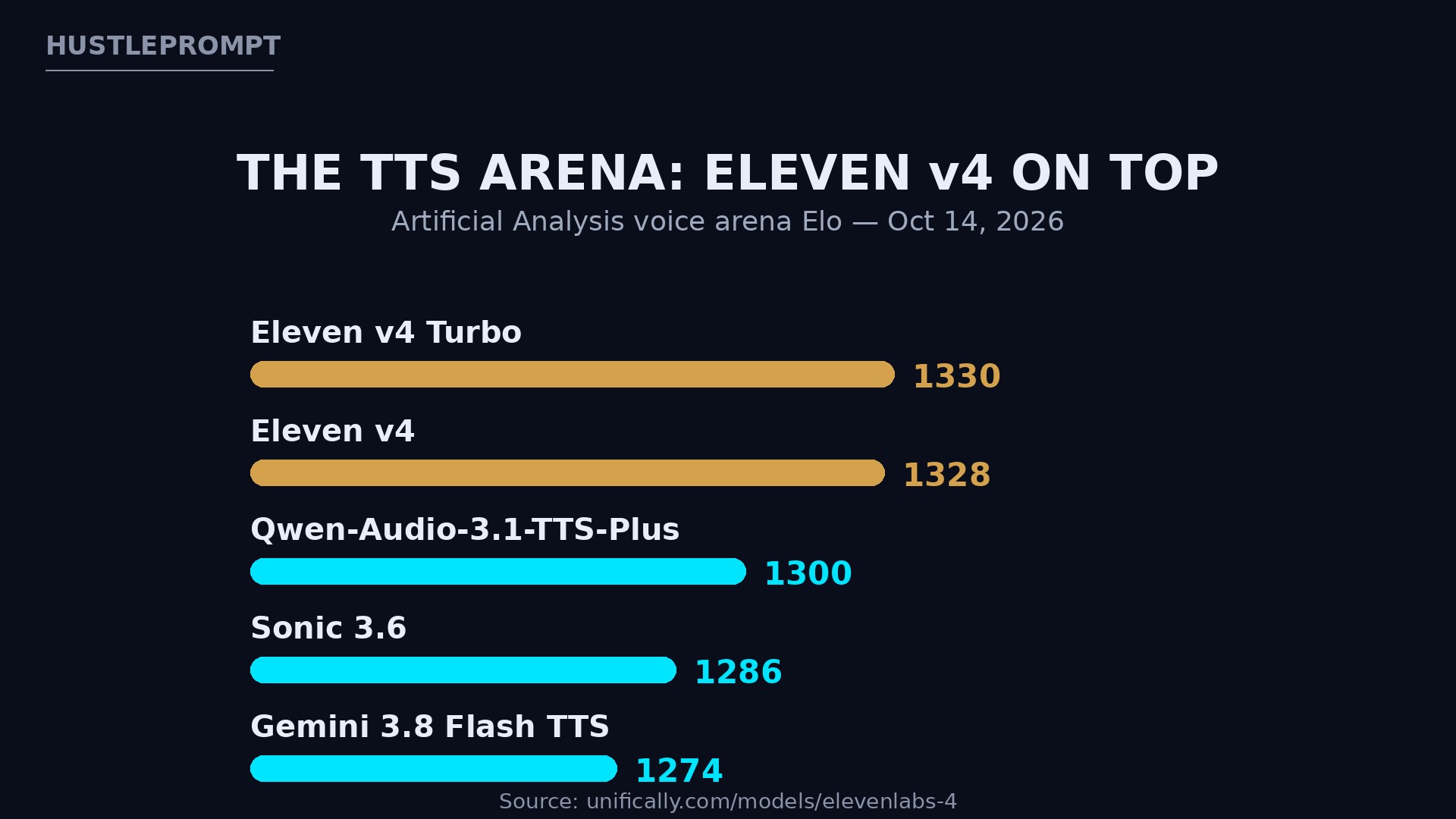
The independent scoreboard agrees: on Artificial Analysis’s voice arena — a crowd-voted Elo ranking of model quality — Eleven v4 and v4 Turbo held the top two spots as of October 14, 2026: Turbo at 1330, v4 at 1328, ahead of Qwen-Audio-3.1-TTS-Plus (1300), Sonic 3.6 (1286), and Gemini 3.8 Flash TTS (1274). Source: unifically.com/models/elevenlabs-4 And the market signal nobody should miss: ElevenLabs put v4 on its free plan (announced September 30). When the top-ranked model goes free, every competitor’s pricing is suddenly negotiable.
Suno Speech: a music giant invades voice
On October 1, 2026, Suno opened the public beta of Speech, which it calls “the first audio model that generates voice and music together as one cohesive track.” Paste your words, describe the voice and music style in plain language — out comes narration plus an original backing score in one take. No second app, no mixing. Live on the Suno site, iOS, and Android, open to every Suno account.
Suno is refreshingly honest about the rough edges. Chief product officer Jack Brody warns: “Occasionally, British accents can wander off to Australia and back. Dramatic pauses may be very dramatic.” His team kept finding uses that “made us laugh, or occasionally surprised us with how moving they could be” — bedtime stories, hype speeches, meditations, dramatic readings of friends’ texts. (Source: madrobot.blog)
The limits matter for client work: no custom voice cloning, no API, no published Speech-specific pricing, plan quota, language list, or length cap — and its terms limit free-plan use to personal, non-commercial purposes. (Source: dev.to hands-on review, Oct 16)
The right mental model comes from Dubspot: a dedicated voiceover tool gives you a clean, controllable voice — nothing else. Suno Speech gives you a voice and a soundtrack composed together, with less fine control. Exact client reads: dedicated engines win. Scored narration: Speech is new territory.
The Evidence: Voice vs Voice+Music, Priced Out
Block 1 — the comparison table. API pricing per 1 million characters; subscriptions as reported October 16, 2026.
| Model | Voice + music in one? | Languages | Price | Best for |
|---|---|---|---|---|
| Eleven v4 | No (voice only) | 90+ | $80/1M chars ($40 Turbo); Pro $99/mo for 600k credits; Creator $22/mo; free tier | Exact client reads |
| Suno Speech (beta) | Yes — first of its kind | Unpublished | No published Speech price or quota | Scored narration |
| OpenAI tts-1 | No | Multiple | $15/1M chars | Budget API volume |
| Google Chirp 3 HD | No | Multiple | $30/1M chars | High-volume scale |
| Fish Audio | No | Multiple | $15/1M UTF-8 bytes | Value challenger |
Sources: dev.to (Oct 16); dataist.ai (Eleven v4 API pricing)
Block 2 — the stats behind the timing.
- Decisive quality lead: v4 Turbo (1330) and v4 (1328) outrank the next-best model by 28 Elo points on a crowd-voted arena. (Source: unifically.com)
- Scale of the invader: Suno passed 2 million paid subscribers and $300M in annual recurring revenue; its CEO says it’s “far beyond” those numbers, and the company carries a $5.4B valuation after a $400M+ raise. (Sources: aimusicpreneur.com; musicbusinessworldwide.com)
Why This Time Is Different: Three Forces Converged
1. Expression became a first-class feature. Earlier models performed individual words; v4 performs entire sentences — context, flow, nuance. In-sentence tags, multi-speaker dialogue, consistency across regenerated lines: the “robotic” objection has lost its last refuge. The remaining barrier isn’t quality — it’s distribution and packaging.
2. The voice and music industries collided. Sept 9 — Suno V6 built with Warner Music Group, BMG, and Believe; Sept 11 — ElevenLabs makes Music v2.5 its default and announces a multi-year Universal Music Group agreement; Sept 18 — UMG and Sony file a second lawsuit against Suno, aiming at V6 with a “model laundering” theory over 60,202 recordings; Oct 1 — Suno steps onto ElevenLabs’ home turf with Speech. (Sources: undetectr.com; routenote.com) The music giants are now fighting on voice turf too — licensing deals and lawsuits at equal speed. That’s not a feature release; it’s a market formation.
3. The cost floor collapsed. v4 on the free tier. Starter at $6/month. A value challenger (Fish Audio’s Drama 3) matching v4 head-to-head at roughly a quarter of the price. Production-grade voice is becoming a commodity input — and commodities are sold packaged, not raw. That’s where the money is.
How to Profit: The Voice Agency in a Laptop
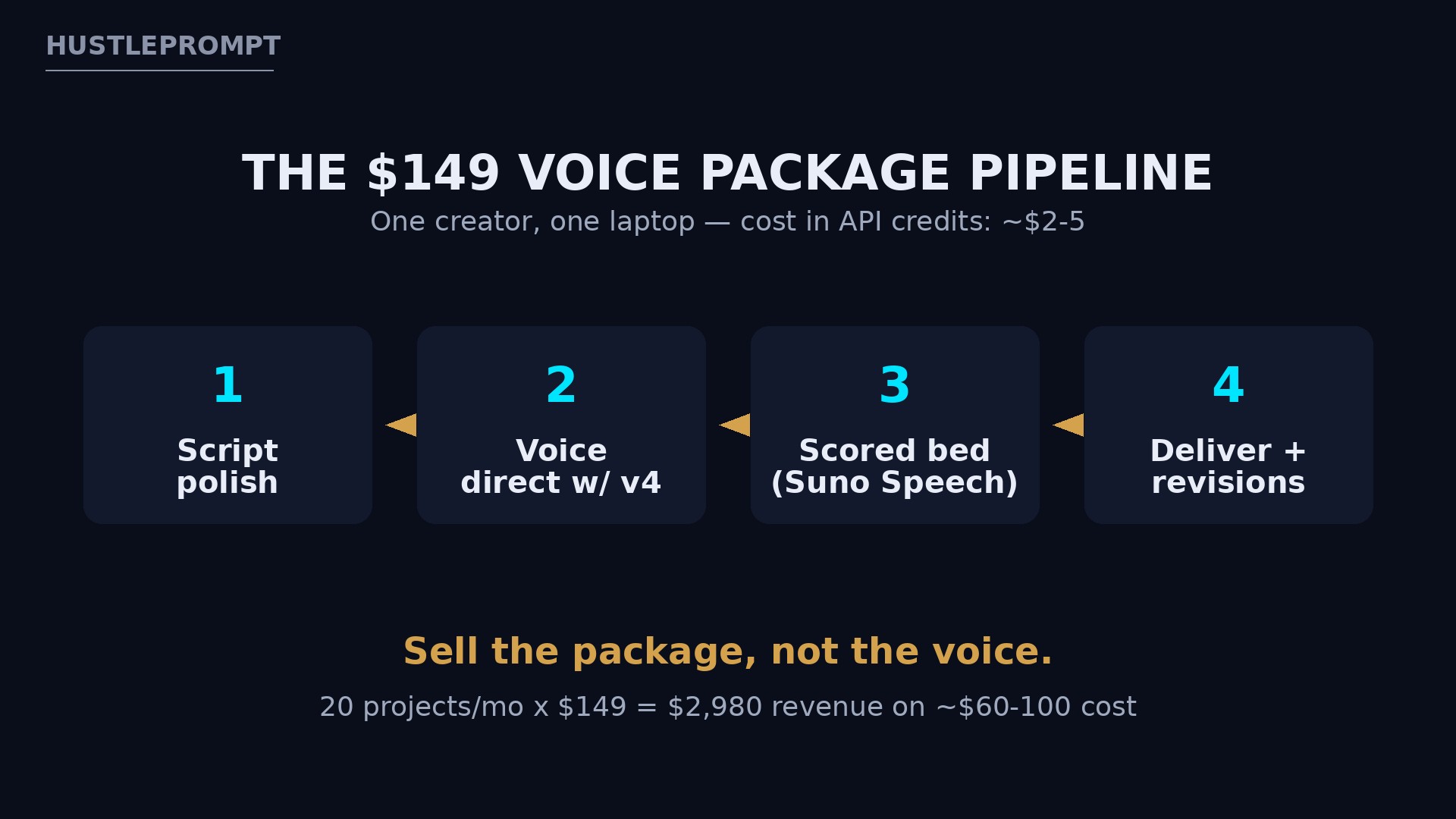
Forget per-word voiceover gigs — that market is compressing toward zero. The profitable model is the $149 package: script polish + directed voice + scored music bed + one revision round, delivered in 48 hours.
- Charge: $149 for a 60-second ad-read package
- Cost: ~$2–5 in API credits per project
- Time: 1–2 hours per project once your template is dialed in
- Volume: 20 projects/month = $2,980 revenue on ~$60–100 cost
How to start, step by step:
- Pick a niche with recurring buyers. Faceless YouTube channels, local-business radio and voicemail ads, podcast intros, audiobook demos, multilingual dubbing for course creators.
- Build 5 demo samples. One ad read, one podcast intro, one scored meditation-style piece (shows off Speech), one dramatic narration, one multilingual sample (shows off v4’s native accents).
- Price packages, not words. $149 ad-read package; $299 podcast-episode package (intro + outro + mid-roll); $499/month retainer for a faceless channel (4 scored narrations/month). Never sell per-word — that’s the commodity trap.
- Deliver with disclosure. YouTube and Spotify have disclosure rules for synthetic voices — put AI-disclosure in the contract and platform labels on upload. Disclosure isn’t a tax; it’s a trust feature that separates you from spam shops.
- Scale with v4’s killer features. Multi-speaker dialogue turns one request into a full scene (great for dramatized ads). Captions with word timings hand video clients an instant subtitle file — a $0-cost upsell.
Old workflow vs. new workflow
OLD (2024)
- Hire voice actor: $250–500
- Book studio time
- License music: $30–100
- Mix voice + music: hours
- Revisions = re-booking
- Total: $400+, 1–2 weeks
NEW (Oct 2026)
- Eleven v4 voice: ~$1–2
- No studio needed
- Score composed in one take
- Voice + music as one track
- Revisions = regenerate lines
- Total: ~$2–5, same day
The 100x cost gap is your margin. Clients don’t pay for your input cost — they pay for the finished, scored, on-brand result.
Where This Is Heading: Three Predictions
Prediction 1 — per-project prices compress, volume explodes. When the top model is free and the runner-up costs pennies, the “record my script” gig dies. What replaces it: retainers and packages. Winners sell speed, packaging, and reliability — not raw voice.
Prediction 2 — voice + music fuses into a new category. Within a year, expect scored narration (podcast intros, brand audio, meditation apps, faceless channels) to be its own category, with licensing partnerships deciding who can sell it commercially. Watch who signs the next UMG-style deal — that’s the compliance-safe lane.
Prediction 3 — the “AI voice” stigma flips. Expression tags and cloning with consistent character voices kill the last legitimate objection. Within 18 months, “human-sounding” is table stakes and the differentiator moves to direction skill, sound design, and niche expertise. Build those skills now while the tools are ahead of the crowd.
FAQ
Is Suno Speech free to use?
Speech is open to every Suno account in public beta and runs on existing credit plans. But Suno has published no Speech-specific credit cost, plan quota, language list, length cap, or commercial terms. Its terms limit free-plan use to personal, non-commercial purposes — treat paid-plan downloads as your only commercial candidates.
Is ElevenLabs v4 really free?
ElevenLabs put v4 on its free plan (announced September 30, 2026), with usage limits. Commercial-scale work runs on paid tiers — Starter $6/month, Creator $22/month, Pro $99/month for 600,000 credits — or the API at $80 per million characters ($40 for Turbo).
Can Suno Speech replace ElevenLabs for client work?
Not yet. Speech is a beta with less fine control — accents drift, pauses can run theatrical, no custom voice, no API. For exact, repeatable client reads, Eleven v4 still wins. For scored narration, Speech does something nothing else does.
Do I need to disclose AI-generated voices?
Yes — and you should want to. YouTube and Spotify have rules around disclosing synthetic content, and commercial clients will ask. Build disclosure into your contract and platform uploads. It’s a trust signal, not a penalty.
What services sell best?
Packages, not gigs: faceless-YouTube narration retainers, ad-read packages with scored beds, podcast intro/outro bundles, audiobook demos, local-business voicemail and radio ads, and multilingual dubbing — v4’s native accents are a genuine differentiator.
What’s the biggest risk?
Commercial rights. The UMG/Sony second lawsuit against Suno (September 18) shows the licensing fight is far from over. Do client work on paid plans, keep consent on file for cloned voices, and prefer engines with explicit licensing partnerships for commercial projects.
Keep Reading
Official launch video: Introducing Eleven v4 and Eleven v4 Turbo — ElevenLabs. See the expression tags and 10-second cloning in action.