
OpenAI just launched GPT-6.1 Terra at half the price of the model it replaces. Released October 26, 2026, it is built for computer use at scale: software that sees a screen, understands it, and acts across applications.
Cheaper, faster, and more accurate is exactly what makes a model commercially dangerous. Here is what OpenAI announced, what independent testing found, and how to profit.
What OpenAI actually announced
OpenAI’s official release notes for October 26, 2026 are short and specific: GPT-6.1 Terra is rolling out in the API as gpt-6.1-terra and in ChatGPT Work and Codex.
It supports visual reasoning, computer use, and writing. “Computer use” means an agent that looks at what is on screen — a proposal, a form, a drawing — and completes the task in the software itself, instead of just describing it.
- Where it runs: the API, ChatGPT Work, and Codex — but not regular ChatGPT chat.
- What it does: visual reasoning, computer use, and writing.
- One restriction: it does not support UAE inference residency, a limit based on where inference runs, not your location.
- How it is billed: API usage is billed separately from subscriptions.
Reports of the launch say it is available to Plus, Pro, Enterprise, and Edu users of ChatGPT Work and Codex, as well as through the API. Treat the tier list as reported — the notes name the surfaces, not the plans.
The price: half of what came before
The headline number is the price. Standard API pricing for GPT-6.1 Terra is $1 per million input tokens, $0.05 per million cached input tokens, and $5 per million output tokens.
That is a 50% cut versus GPT-5.6 Terra and versus GPT-6.1 Sol, according to launch coverage of OpenAI’s announcement. For agents running thousands of steps a day, that cut compounds fast — the token bill, not the model choice, is usually what kills an automation business.
| Terra API pricing | Per 1M tokens | Why it matters |
|---|---|---|
| Input | $1.00 | Half the old rate |
| Cached input | $0.05 | Cheap repeat context |
| Output | $5.00 | Half the old rate |
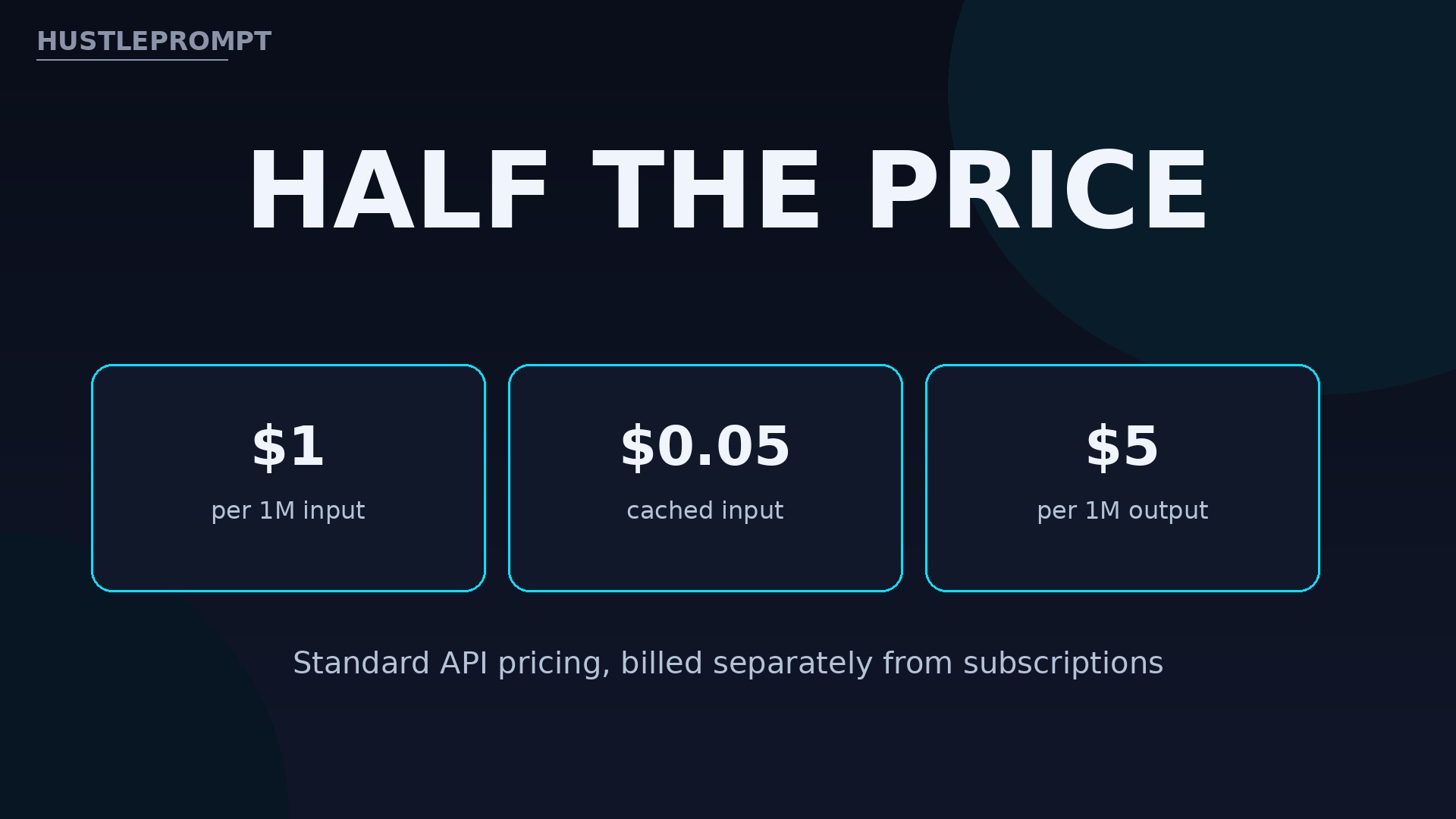
Evidence in one line: OpenAI’s notes confirm the $1 / $0.05 / $5 rate card; the 50% cut is launch coverage’s comparison vs GPT-5.6 Terra and GPT-6.1 Sol.
Source: OpenAI’s official model release notes, October 26, 2026.
Faster, and far fewer errors
OpenAI’s release notes list no benchmarks. The figures below come from OpenAI’s launch announcement as reported, plus independent testing by Artificial Analysis — not from the changelog.
- Speed: computer-use tasks finish 3x+ faster than GPT-6 Astra and GPT-6.1 Sol, as reported.
- Office-agent performance: on Agents’ Last Exam (office-software agents), Terra is reported as comparable to GPT-6 Astra at one-tenth of Astra’s per-token price.
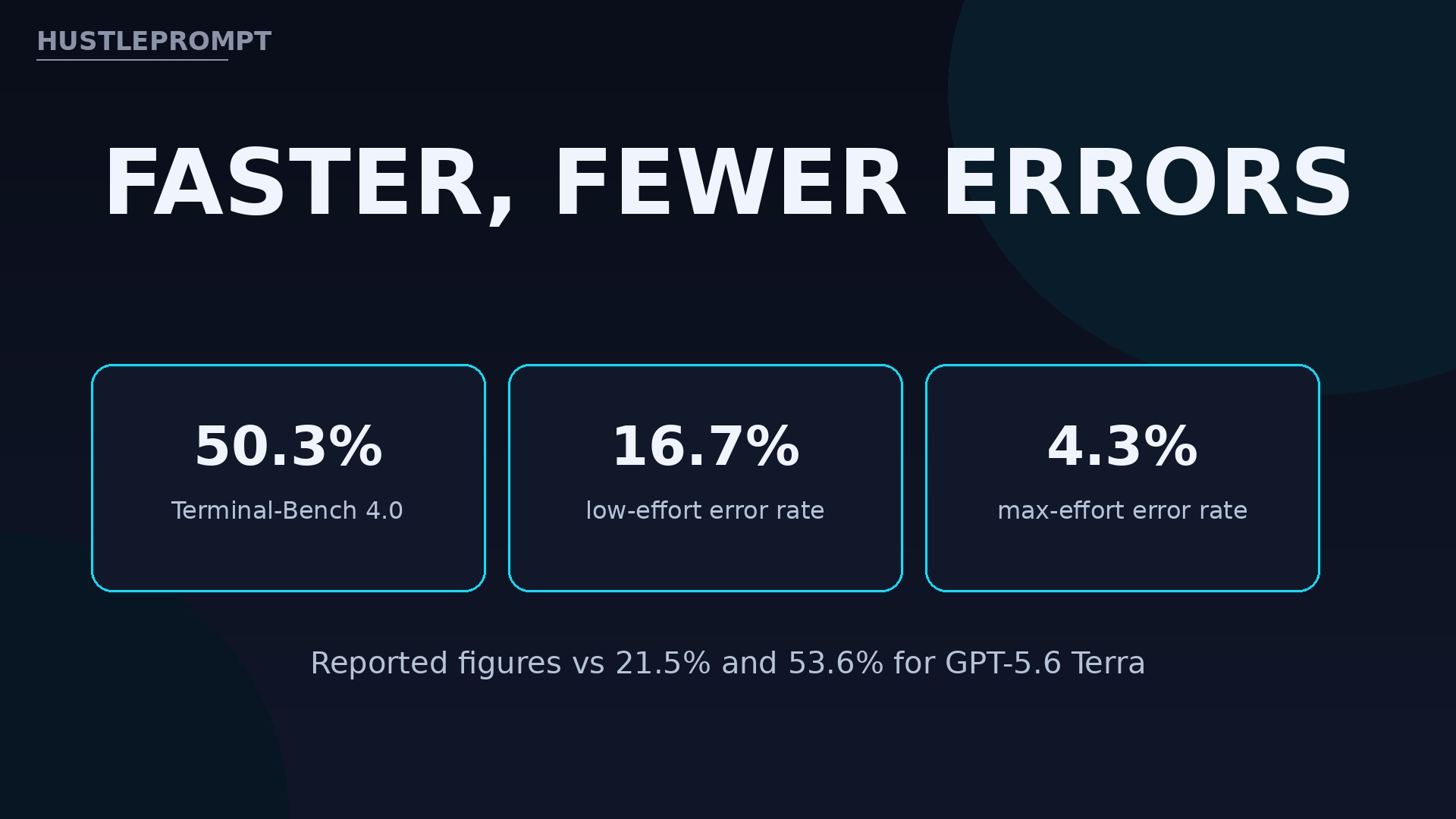
- Coding: at max effort, Terra solved 50.3% of Terminal-Bench 4.0 tasks, up from 21.5%.
- Errors: reported error rate fell from 53.6% to 16.7% at low effort, and to 4.3% at max effort.
Independent testing agrees on cost: Artificial Analysis found Terra gains 6 Intelligence Index points over GPT-5.6 Terra at max effort, with cost per task down to $0.40 from $1.40.
On Artificial Analysis’s Coding Agent Index, Terra scores 48 — below GPT-6.1 Sol (54) and above GPT-6 Luna (31). Its hallucination-guess rate fell to 38% from 88% for GPT-5.6 Terra.
How computer use actually works
The computer-use loop, step by step
1. See
Read the screen: forms, drawings, buttons.
2. Plan
Break the job into clicks and entries.
3. Act
Work across applications.
4. Verify
Check the result before finishing.
Terra’s pitch is doing that loop cheaper and faster.
How to profit from GPT-6.1 Terra
The opportunity is not “use a new model.” It is selling finished computer work at a price competitors using pricier models cannot match:
- Sell one workflow, fixed price. Pick a repeatable job — invoice entry, form filling, report assembly — and sell it done-for-you, not by the hour.
- Re-price existing automations. Test Terra on jobs you already run on Sol or GPT-5.6 Terra — a 50% cut and 3x speed can turn a thin-margin service profitable.
- Offer a “Terra audit” to small firms. Show which daily screen tasks an agent can now do for cents, and charge for setup.
- Build for Work and Codex, not just the API. Terra lives where office work already happens, so products there reach buyers faster.
- Keep a human in the verify step. A 4.3% max-effort error rate beats 53.6% — and still is not zero. Sell accuracy checks with the service.
The window is now, while most competitors have not repriced.
What is still unknown
OpenAI’s notes give no context window or benchmark table, and Terra is explicitly not in regular Chat. Before betting a business on it, run your own jobs and measure cost per completed task, not cost per token.
Frequently asked questions
What is GPT-6.1 Terra?
OpenAI’s new mid-tier model for visual reasoning, computer use, and writing, released October 26, 2026, in the API and in ChatGPT Work and Codex.
How much does GPT-6.1 Terra cost?
$1 / $0.05 cached / $5 per million input / cached / output tokens — 50% below GPT-5.6 Terra and GPT-6.1 Sol, per launch coverage.
Is GPT-6.1 Terra in ChatGPT?
Not in regular Chat — only in ChatGPT Work and Codex, plus the API.
How fast is GPT-6.1 Terra?
Reported at 3x+ faster than GPT-6 Astra and GPT-6.1 Sol on computer-use tasks.
How accurate is GPT-6.1 Terra?
Reported error rates fell to 16.7% at low effort and 4.3% at max effort, from 53.6%; Terminal-Bench 4.0 rose to 50.3% from 21.5%.
Is GPT-6.1 Terra better than GPT-6.1 Sol?
No — Sol still leads (54 vs 48 on Artificial Analysis’s Coding Agent Index). Terra wins on cost per finished task.
Where is the official announcement?
In OpenAI’s official model release notes for October 26, 2026, with analysis from Artificial Analysis.