
NVIDIA just put $3 billion behind Meta’s Muse. The NVIDIA Meta Muse deal announced on Tuesday, October 27, 2026, turns the chipmaker from a supplier into a shareholder in the company building one of the fastest-growing AI agents on the market.
The announcement landed at 05:52 UTC (06:52 CET) in a joint NVIDIA-Meta release. It is not a new model launch. It is rarer: the picks-and-shovels seller buying a stake in the mine.
What NVIDIA and Meta actually announced
According to NVIDIA’s official announcement, the two companies will expand their work on Muse and the Muse family of models to improve inference and training performance. The release says Muse models and agents run on NVIDIA infrastructure, with what the companies describe as frontier-level benchmark performance and surging downloads since launch. Those are their characterizations, not independent results, and no new benchmark numbers are given.
- A $3 billion investment: NVIDIA will invest $3 billion in Meta’s equity offering.
- Deeper technical work: joint optimization across workflows to maximize performance and improve total cost of ownership for Muse.
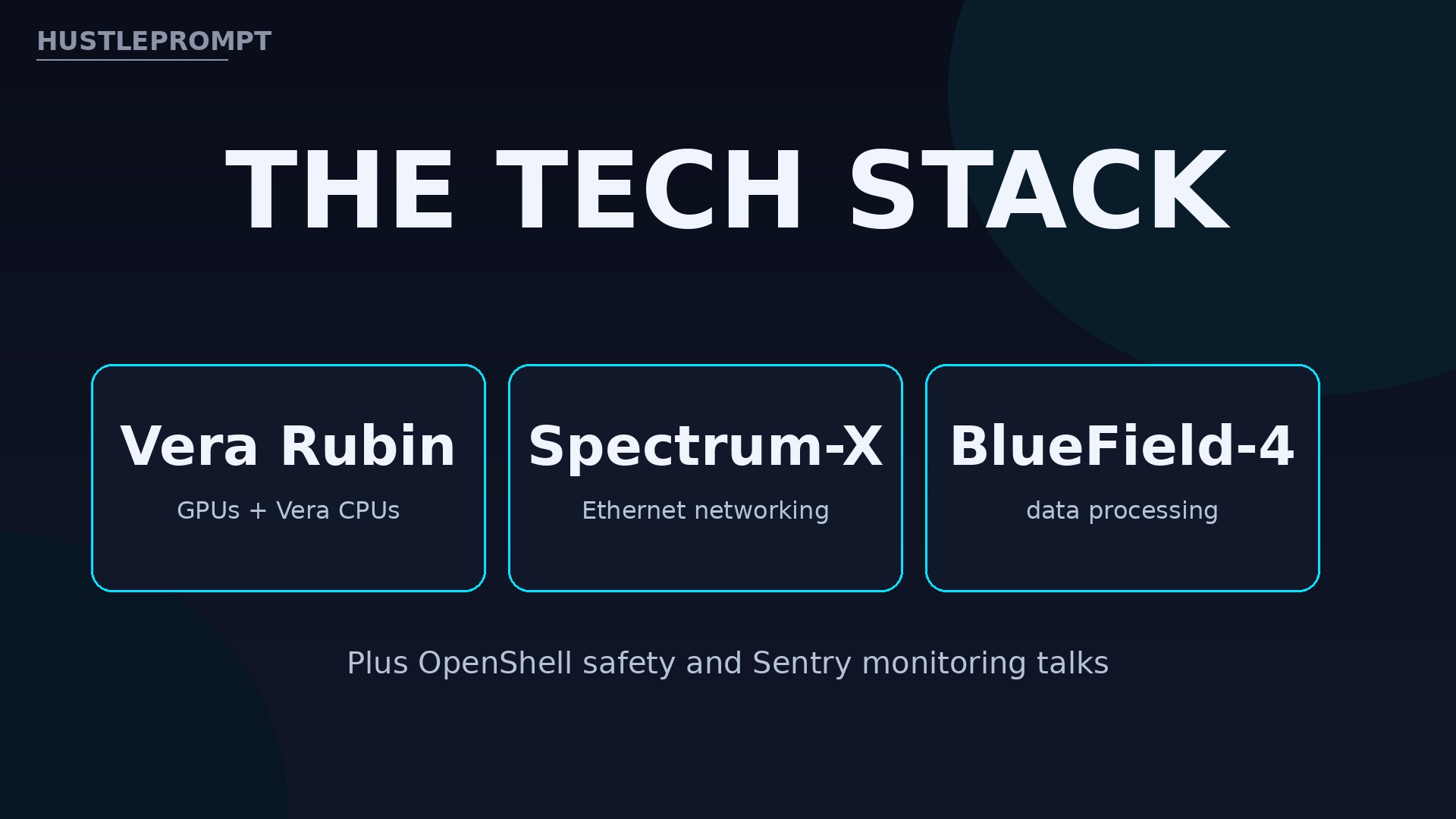
- More NVIDIA hardware at Meta: expanded Vera Rubin and Vera CPU deployment, plus Spectrum-X and BlueField-4.
- Safety talks: possible collaboration on OpenShell safe deployment and Sentry agent monitoring.
Reuters confirmed both headline facts on Tuesday in its report on NVIDIA and Meta’s Muse partnership.
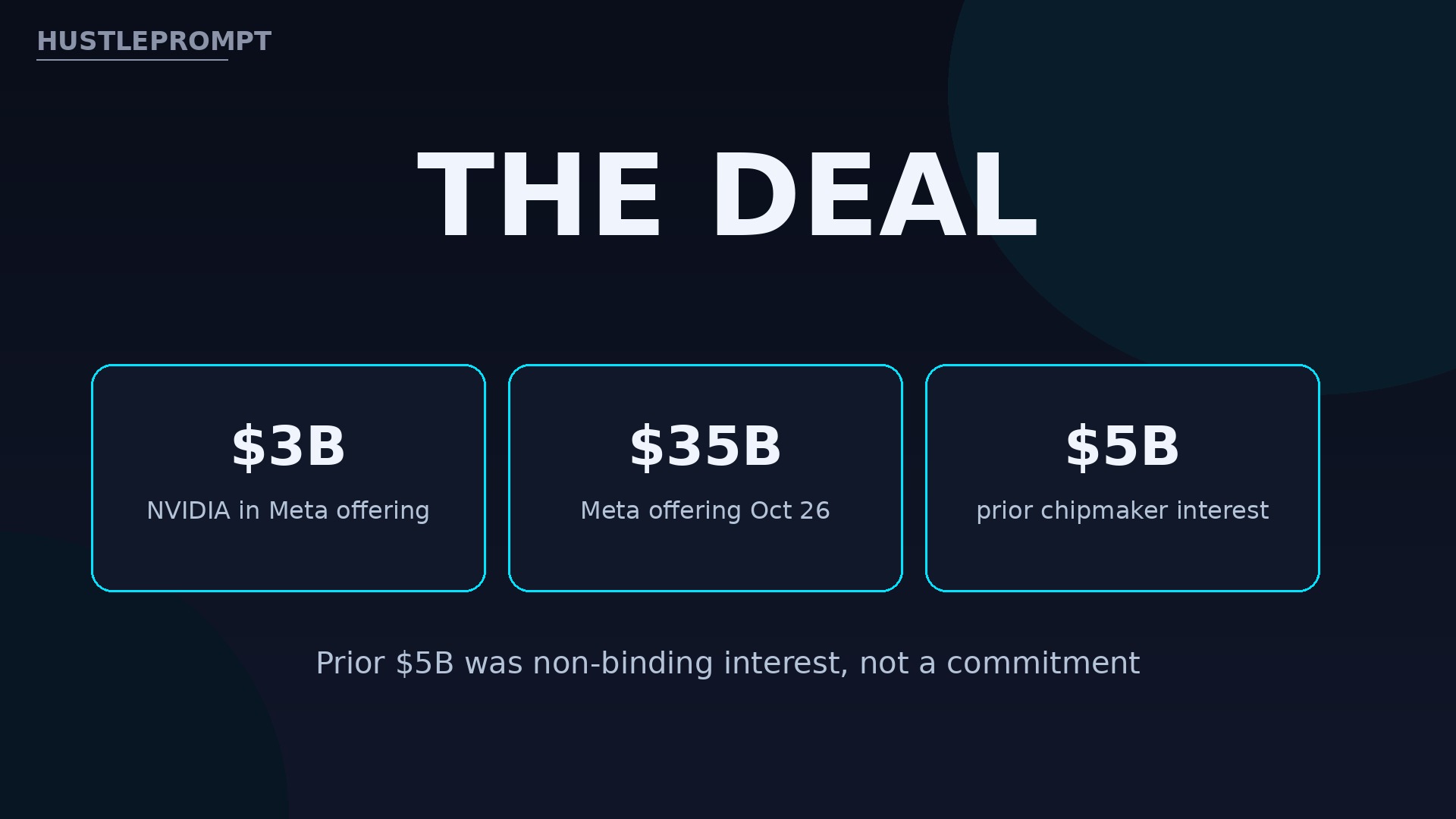
The $3 billion in context: interest is not investment
One day earlier, Meta launched $35 billion in stock offerings. At that time, NVIDIA, AMD, and Broadcom had only indicated non-binding interest in up to $5 billion of Meta’s Class A shares combined. Interest is not a commitment.
Today’s release moves NVIDIA from interested to invested, as announced. It does not say whether the $3 billion sits inside that earlier $5 billion indication or adds to it, and it gives no closing date. NVIDIA’s forward-looking statements flag anticipated completion and closing conditions, so treat the $3 billion as announced, not yet closed.
| Figure | What it is | Status |
|---|---|---|
| $3 billion | NVIDIA investment in Meta’s equity offering | Announced Oct 27, 2026 |
| $35 billion | Meta offerings launched Oct 26, 2026 | Launched |
| Up to $60 billion | Planned Class C at-the-market program | Planned; expected Q1 2027 |
| Up to $5 billion | Combined chipmaker interest (NVIDIA, AMD, Broadcom) | Non-binding interest only |
Meta’s spending is enormous: $135 billion to $145 billion in planned 2026 capital expenditure and about $825 billion in future commitments. A $3 billion check does not fund that bill. It signals alignment: NVIDIA profits when Meta builds, and now also if Meta’s stock rises.
Evidence in their own words: “AI agents represent a new computing paradigm — software that understands our goals, reasons, uses tools and gets work done on our behalf,” said Jensen Huang, founder and CEO of NVIDIA. Meta CEO Mark Zuckerberg added: “Muse is how we bring personal superintelligence to everyone.”
Source: NVIDIA’s official announcement, October 27, 2026.
The tech stack behind the deal
The money is the headline; the hardware list is the roadmap.
- Vera Rubin and Vera CPUs: NVIDIA’s next-generation platform for AI agents, aimed at maximum performance per watt.
- Spectrum-X Ethernet networking: the layer that keeps thousands of GPUs working as one system.
- BlueField-4: data processing hardware that offloads infrastructure work.
- OpenShell and Sentry (under consideration): safe deployment architecture and agent-behavior monitoring.
For builders, the gains come from tighter model-silicon integration and auditable monitoring.
How the NVIDIA Meta Muse partnership works
1. You ask Muse. The request goes to Meta’s agent.
2. Muse plans and picks tools. The model calls the tools it needs.
3. NVIDIA hardware runs it. Vera Rubin executes inference; Spectrum-X moves data between GPUs.
4. OpenShell and Sentry watch it. Safety rules and monitoring keep the agent in scope.
5. You get the result. Faster, cheaper agent work.
How to profit from the NVIDIA Meta Muse deal
This is not investment advice. The profit angle is on the builder side, where a deeper Muse-NVIDIA stack creates billable work.
- Build agents for Muse first. Workflows and automations that run well on Muse ride the jointly optimized platform.
- Sell inference optimization. Services that cut token waste, latency, and cost per task match the partnership’s stated goal.
- Sell agent safety and monitoring. Enterprises will require audit trails, permission controls, and kill switches.
- Target Meta’s advertiser base. AI ad creative and automation for its advertisers is the nearest paying market.
- Watch the closing, not the headline. Track pricing and completion before treating any figure as final.
What is still unknown
- Closing: no completion date or pricing terms disclosed for the $3 billion investment.
- The $5 billion question: whether the $3 billion is inside the earlier indication or separate.
- Benchmarks: frontier-level performance is claimed, but no new numbers are published.
- OpenShell and Sentry: collaborations under consideration, not shipped products.
- Deployment scale: no quantities or timelines for the Vera Rubin expansion.
Frequently asked questions
How much is NVIDIA investing in Meta?
$3 billion in Meta’s equity offering, as announced on October 27, 2026.
What is Muse?
Muse is Meta’s personal AI agent and model family, built for planning, tool use, and getting work done.
Is the $3 billion already paid?
Not as disclosed. NVIDIA’s release describes the investment as planned and flags anticipated completion and closing conditions.
What hardware will Meta deploy?
Meta intends to expand Vera Rubin and Vera CPUs, with Spectrum-X networking and BlueField-4.
What are OpenShell and Sentry?
OpenShell is NVIDIA’s safe-deployment architecture; Sentry monitors agent behavior. Both are under consideration.
How does this relate to Meta’s $95 billion raise?
Meta launched $35 billion in offerings on October 26 and plans up to $60 billion more. NVIDIA’s $3 billion goes into that equity offering.
Should builders switch to Muse because of this deal?
Not on this news alone. Test Muse for your workload and compare cost per completed task.