
Microsoft just turned its AI buildout into a record quarter, and the number everyone will quote is not the headline. Microsoft Q1 FY27 earnings, reported Wednesday, October 28, 2026, show revenue of $92.3 billion, up 19% year over year, but the real story is inside the cloud: Azure grew 48%, and Microsoft Cloud reached $63.9 billion, up 30%.
That acceleration matters because it answers the question hanging over every AI spender this year: is the demand real, or just promised? According to Microsoft’s official first-quarter results announcement, the quarter ended September 30, 2026, and CFO Amy Hood said results exceeded expectations across revenue, operating income, and EPS.
Evidence, from Microsoft’s official release: revenue $92.279 billion (+19%); operating income $45.915 billion (+21%); net income $36.629 billion (+32% GAAP), $36.422 billion (+18% non-GAAP); EPS $4.92 GAAP, $4.89 non-GAAP.
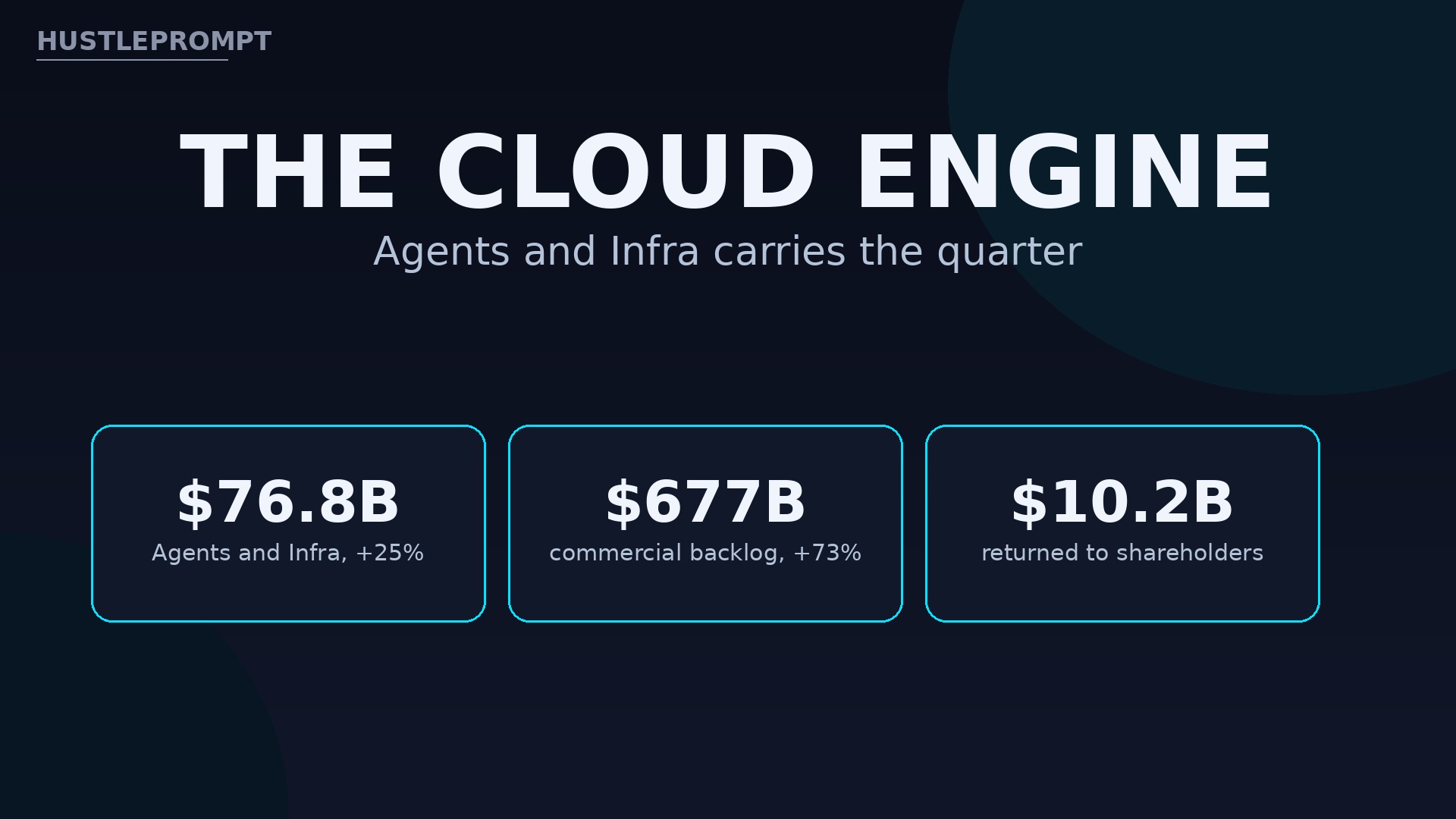
Cloud $63.9 billion (+30%); Azure +48%; backlog $677 billion (+73%); $10.2 billion returned to shareholders.
What the official release actually says
Microsoft now reports under two segments, recast in September 2026. The split tells the whole story in one glance: the AI and cloud side grows fast, while the consumer side shrinks.
| Metric | Q1 fiscal 2027 | Change year over year |
|---|---|---|
| Total revenue | $92.279 billion | +19% |
| Operating income | $45.915 billion | +21% (+22% constant currency) |
| Net income (GAAP) | $36.629 billion | +32% |
| Net income (non-GAAP, ex-OpenAI impact) | $36.422 billion | +18% |
| Diluted EPS (GAAP / non-GAAP) | $4.92 / $4.89 | +32% / +18% |
| Microsoft Cloud revenue | $63.9 billion | +30% |
| Agents and Infra revenue | $76.795 billion | +25% |
| Devices and Consumer revenue | $15.484 billion | -3% |
Coverage reported the quarter beat expectations, with revenue of $92.28 billion against consensus near $90.69 billion and adjusted EPS of $4.89 against $4.73 expected. Those figures are reported by coverage, not company figures.
Azure is the story, again, but faster
Azure revenue grew 48%, up from 42% in the June quarter as reported by coverage, and Microsoft disclosed that growth rate directly in its official highlights. Microsoft Cloud, which bundles Azure with Microsoft 365 and other online services, grew 30%, accelerating from prior quarters.
The backlog number is the one to watch next. Commercial remaining performance obligation, the contracted revenue Microsoft has not yet recognized, rose 73% to $677 billion. That is future demand already signed, including commitments from AI labs building on Azure.
How the quarter breaks down
Follow the money through Microsoft’s new structure.
1. Agents and Infra: $76.8 billion, +25%. This is 83% of total revenue, and it holds Azure, Microsoft 365 cloud, and the AI platform.
2. Microsoft Cloud: $63.9 billion, +30%. Growth accelerated year over year, per CFO Amy Hood.
3. Azure: +48%. The growth engine inside the cloud, now growing faster than last quarter.
4. Backlog: $677 billion, +73%. Signed future revenue, the pipeline that has to be delivered with data centers and chips.
The other side of the ledger
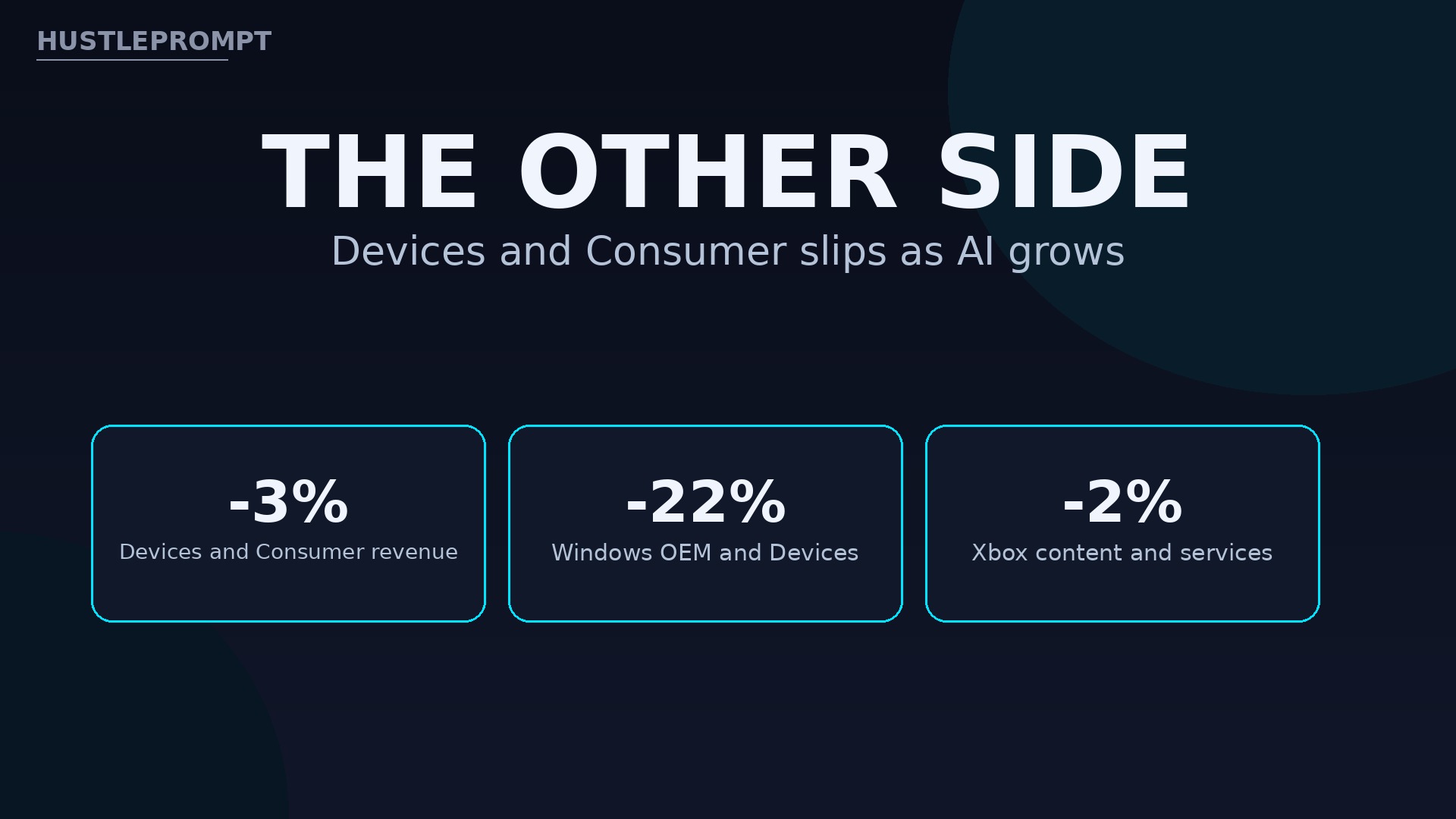
Not everything grew. Devices and Consumer revenue fell 3% to $15.5 billion, and its components show why Microsoft now reads as two companies.
- Windows OEM and Devices, -22%: the PC hardware side shrank sharply year over year.
- Xbox content and services, -2%: gaming slipped, with lower third-party content partly offset by first-party growth, per coverage.
- Search and advertising excluding traffic acquisition costs, +12%: the consumer-side bright spot.
- Microsoft 365 commercial cloud, +17% reported (+18% adjusted): steady growth, adjusted for a one-point prior-year benefit.
- Microsoft 365 consumer cloud, +17%: consumer subscriptions kept growing even as hardware fell.
The GAAP versus non-GAAP gap, explained
Two profit numbers, two stories, and both are correct. GAAP net income rose 32% to $36.6 billion, but that includes a $207 million net gain from Microsoft’s investments in OpenAI. A year earlier, those same investments produced a $3.1 billion loss that cut net income.
Strip out the OpenAI effect in both periods, and the cleaner comparison is non-GAAP net income of $36.4 billion, up 18%, with diluted EPS of $4.89, up 18%. That is the number to use when judging the operating business, and it is also the number that beat analyst expectations.
How to profit from Microsoft’s Q1 FY27 results
This is not investment advice. It is a playbook drawn from where Microsoft’s money is actually going.
- Sell Azure migration and optimization. With Azure growing 48% and a $677 billion backlog, companies need help moving workloads, controlling costs, and shipping AI features on Azure.
- Build AI agents on Microsoft’s stack. Agents and Infra is now 83% of revenue. Products plugging into Microsoft 365 and Azure agent tooling ride its fastest-growing part.
- Offer Copilot rollout services. Microsoft 365 commercial cloud keeps growing, and every seat added is a deployment, training, and governance project.
- Teach earnings reading. Founders misread GAAP versus non-GAAP headlines every quarter. A short workshop on reading releases like this one is a sellable product.
- Watch the backlog, not the hype. A 73% jump in remaining performance obligation means delivery work will follow. Position services where that backlog turns into projects: data, security, and AI integration.
Frequently asked questions
What was Microsoft’s revenue in Q1 fiscal 2027?
$92.279 billion, up 19% year over year, for the quarter ended September 30, 2026, per Microsoft’s official release.
How fast did Azure grow?
Azure revenue grew 48% year over year, per Microsoft’s official highlights, accelerating from 42% in the prior quarter as reported by coverage.
Why are there two earnings per share figures?
GAAP EPS was $4.92, including a $207 million OpenAI gain. Non-GAAP EPS of $4.89 excludes the OpenAI impact in both periods, giving an 18% comparison.
What is the $677 billion backlog?
Commercial remaining performance obligation: contracted revenue not yet recognized, up 73%. It signals signed future demand, not cash collected.
Did Microsoft beat analyst expectations?
Coverage reported revenue and adjusted EPS above consensus (about $90.69 billion and $4.73 expected). Those consensus figures come from coverage, not Microsoft’s release.