
What if every meeting your client attends could end with clean notes, clear owners, and a follow-up email already drafted? That is the promise of AI meeting summary services, and it is a real, sellable offer for agencies and consultants who live in back-to-back calls.
Agencies do not buy software. They buy time back and fewer dropped balls. This tutorial shows you how to build that service: pick your tools, define your offer, run a repeatable workflow, and price it honestly.
What You Are Really Selling
You are not selling a transcript. A raw transcript is a wall of text nobody wants to read. You are selling clarity after the call.
A good package includes three things: a short summary of decisions, action items with an owner and deadline each, and a draft follow-up email.
Anyone can press record. Few people turn the recording into next steps.
Who Buys This Service?
Start with people who meet constantly and hate admin work: marketing agencies, consulting firms, sales teams, and coaches. Small law, accounting, and recruiting offices also fit, with extra care around confidentiality.
Your best first clients are usually:
- Agency owners who run five or more client calls a week
- Consultants who bill by the hour and lose time to note-taking
- Sales leads who need clean call recaps for their CRM
- Team leads who want consistent notes across their whole team
The Market Is Already There
AI note-taking is no longer a novelty. Otter.ai reports more than 40 million users and over 1 billion meetings transcribed (October 2026 announcement). Clients already understand this category, so you spend less time explaining it.
Evidence: AI meeting notes at scale
Otter.ai states it serves “more than 40 million users” and has transcribed “1 billion+ meetings.” Source: Otter.ai announcement via Business Wire, October 2026.
Your edge is the human layer: checking the AI output and formatting it the way each client likes it.
Choose Your Toolkit
You need two layers: capture (record and transcribe) and polish (turn the transcript into a summary, action items, and an email draft).
For capture, tools like Otter.ai and Fireflies.ai join calls as a bot or record audio, then produce a transcript and summary. For polish, a general AI assistant such as ChatGPT or Claude can reshape the transcript using a fixed template.
Prices change often, so re-check the official pricing page before you quote a client.
| Tool and plan | Price (annual billing) | What you get |
|---|---|---|
| Fireflies.ai Free | $0 | Unlimited transcription, limited AI summaries, 400 minutes of storage per team |
| Fireflies.ai Pro | $10 per seat per month | Unlimited transcription and AI summaries, 8,000 minutes of storage per seat |
| Fireflies.ai Business | $19 per seat per month | Unlimited storage plus team features |
Evidence: Fireflies.ai pricing
Fireflies.ai lists a Free plan at $0, Pro at $10 per seat per month billed annually, and Business at $19 per seat per month billed annually. Source: Fireflies.ai pricing page, checked October 2026.
Start on a free plan while you test, and upgrade only when a paying client covers the cost.
The Meeting-to-Summary Workflow
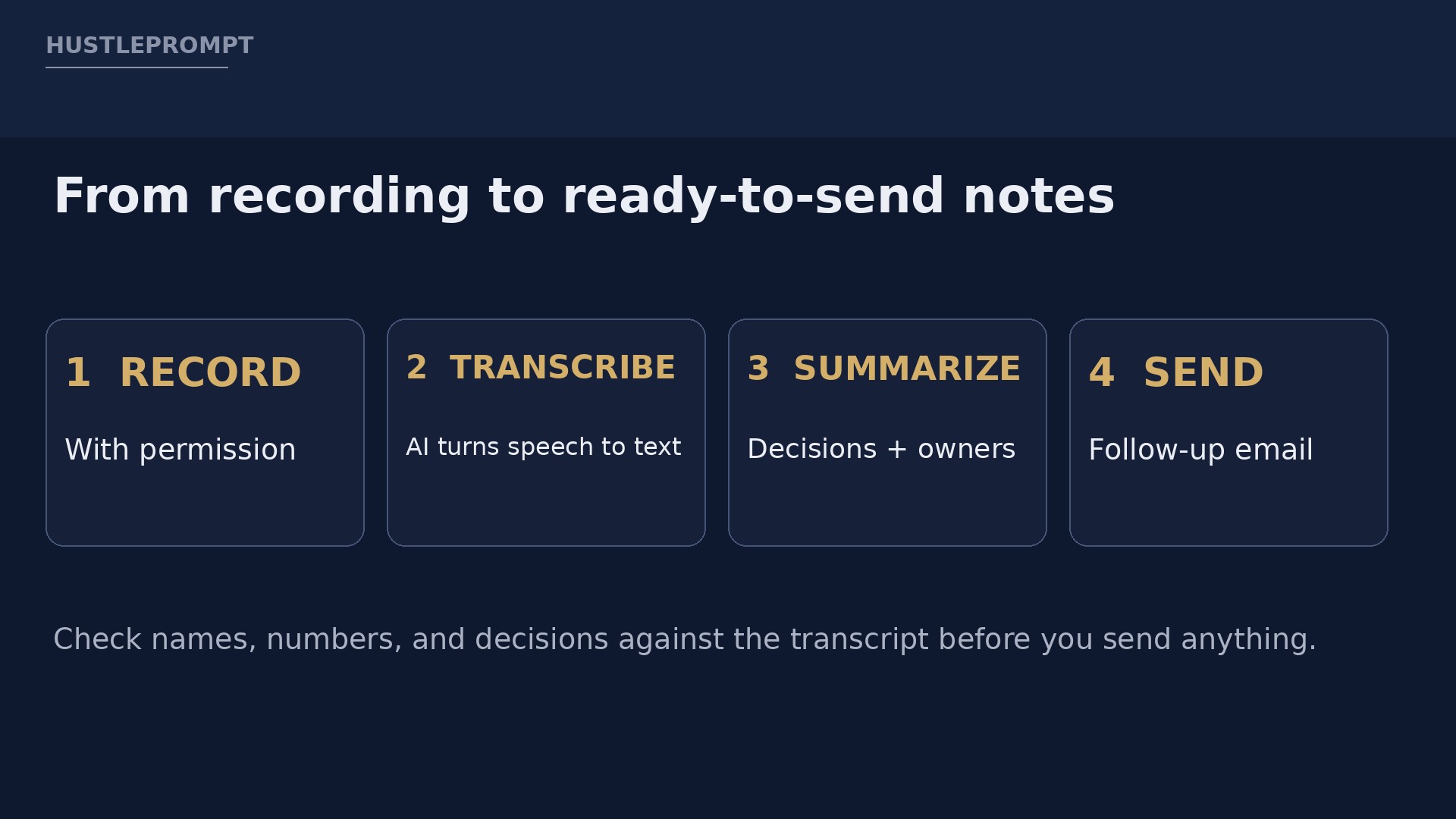
Clients pay for reliability, so run the same steps every time:
Step 1: Record
Get permission, then capture the call or the uploaded audio file.
Step 2: Transcribe
Let the AI tool produce the full transcript and identify speakers.
Step 3: Summarize
Draft decisions, action items with owners, and open questions.
Step 4: Verify
Check names, numbers, dates, and decisions against the transcript.
Step 5: Send
Deliver the summary plus a draft follow-up email by the agreed deadline.
The verify step is the whole business. Skip it, and you are just forwarding AI output anyone could generate.
Step-by-Step: Launch in Seven Steps
Step 1: Define One Clear Package
Do not offer “AI services” in general. Offer one thing: “meeting summaries with action items and a follow-up draft, delivered within 24 hours.”
Step 2: Set Up Your Capture Tool
Connect your calendar so the note-taking bot can join scheduled calls, then test it on a call with a friend. Check that speakers are labeled correctly.
Also learn the manual route: uploading an audio file after the meeting, since some clients send recordings instead of inviting a bot.
Step 3: Build Your Summary Template
Use the same template for every client. A strong template has:
- Meeting title, date, and attendees
- Key decisions in plain language
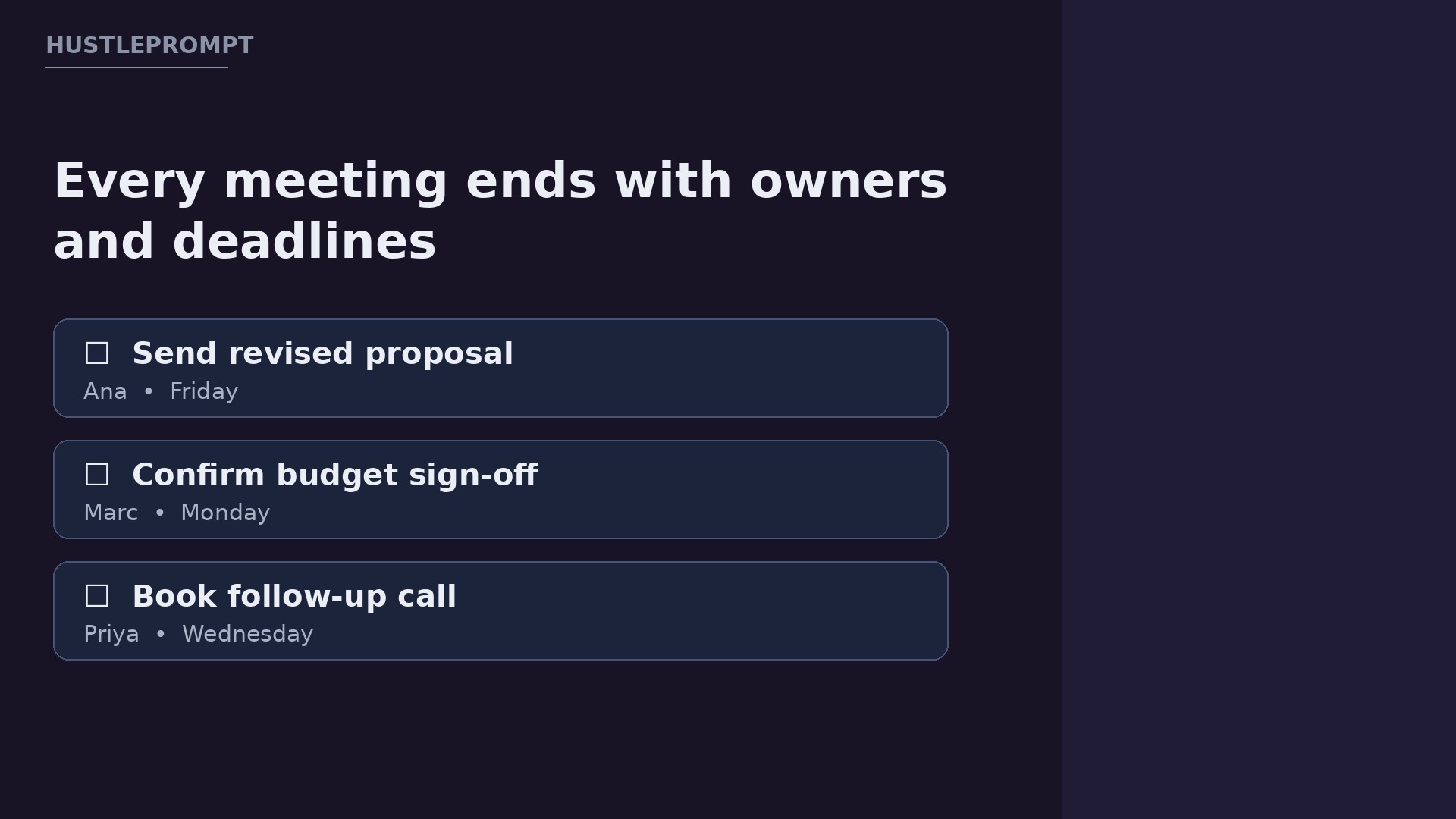
- Action items with one owner and one deadline each
- Open questions that still need an answer
- Next meeting date, if one was set
Feed the transcript to your AI assistant with this template and one strict instruction: only include what was actually said, and mark anything unclear as “to confirm.”
Step 4: Do a Free Pilot for One Client
Offer one agency a free pilot of three meetings. Ask for honest feedback and, if they are happy, a testimonial and a referral.
Time yourself: if a one-hour meeting takes you 45 minutes end to end, that number drives your price.
Step 5: Add the Human Quality Check
Before delivery, read the summary against the transcript. Fix misheard names, wrong figures, and action items with no owner.
Step 6: Deliver Fast and Consistently
Agree on a turnaround time and keep it. Twenty-four hours is a sensible standard; same-day delivery can be a paid rush option.
Send it in the client’s preferred format: a shared document, an email, or their project tool. Ask once, then remember the answer.
Step 7: Ask for the Next Order
Do not wait for clients to reorder. End each delivery with: “Want me to cover next week’s calls too?”
After three successful deliveries, propose a weekly or monthly package. Retainers smooth out your income and your schedule.
How to Profit: Pricing That Makes Sense
Price the service, not your tool subscription. Clients pay for the finished brief, the hours you save them, and your quality check.
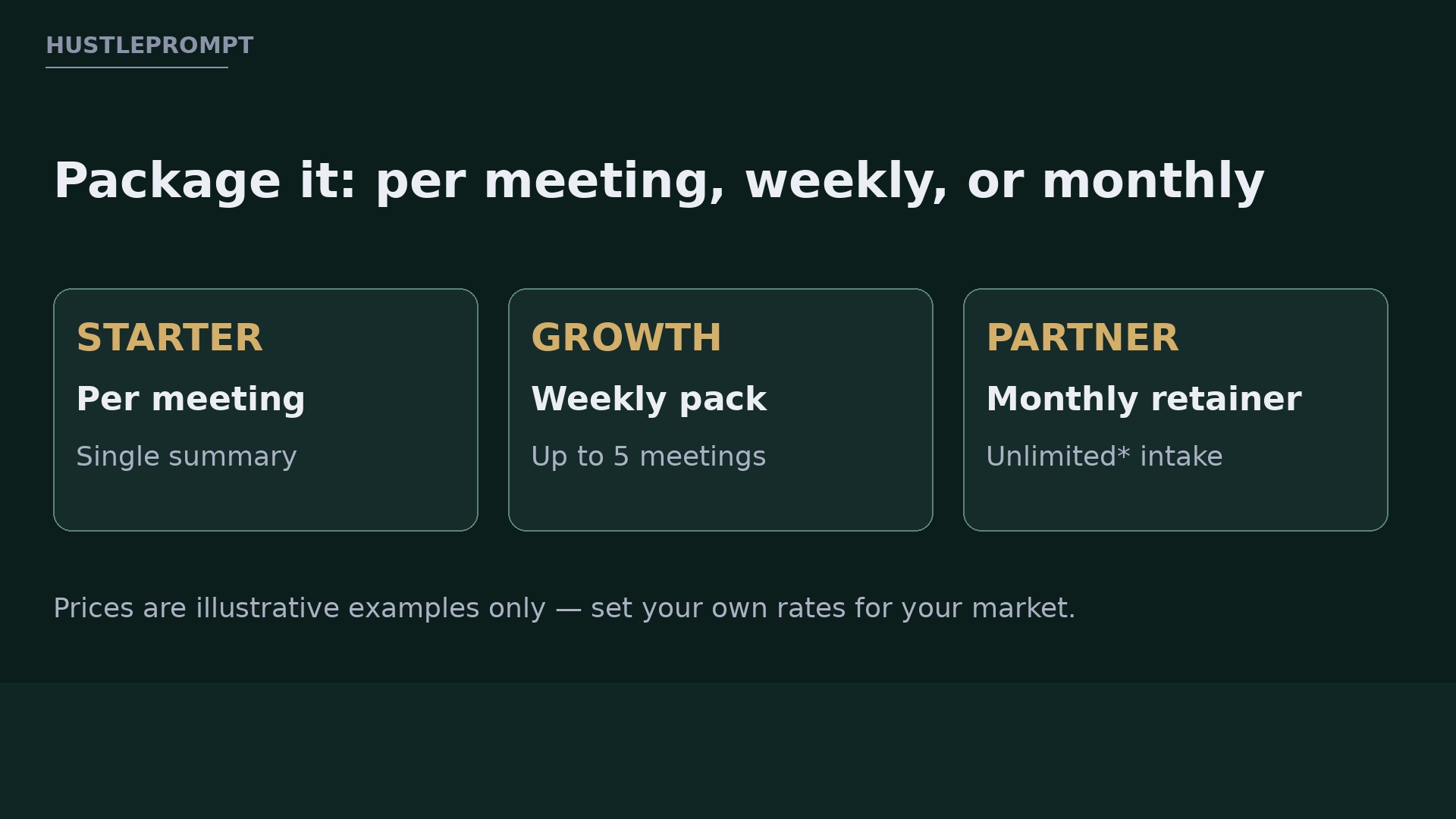
The table below shows illustrative example prices only. They are not an income promise or market rates; set your own rates based on your costs and speed.
| Package (illustrative) | Example price | What is included |
|---|---|---|
| Single meeting | $25 per meeting | One summary, action items, one draft email |
| Weekly pack | $100 per week | Up to 5 meetings, same delivery format |
| Monthly retainer | $350 per month | Regular weekly coverage, priority turnaround |
Work out your real margin before you celebrate any price. Suppose, as an illustrative example, you charge $100 for a weekly pack and your tool subscription works out to $10 for that week. Your gross before taxes and other costs is $90, not $100.
Track meetings delivered, minutes per delivery, and revenue per client each month. When minutes per delivery fall, your hourly rate rises without raising prices.
Privacy and Confidentiality: Non-Negotiable
Meeting recordings are sensitive. Handle them only with permission from the client and, where required, the participants, and tell everyone on the call what the recording will be used for.
Delete raw audio and transcripts per each client’s policy. Do not reuse one client’s material for another, and do not feed confidential material into public AI tools without the client’s knowledge.
This is practical guidance, not legal advice. If you serve regulated industries, ask about their rules before you start.
Watch: How AI Summarizes a Sales Call
The video below is an official Fireflies.ai tutorial walking through a real AI-written sales call summary, section by section.
Note: this is a tool tutorial, not a guide to selling the service. Use it to learn the format, then apply the steps above to turn it into an offer.
Frequently Asked Questions
Do I need technical skills to offer this service?
No. You need to run a note-taking tool, follow a template, and check the output carefully.
What if the AI transcript gets names or numbers wrong?
It will, sometimes. That is why the human check exists: listen back, fix the error, and never guess at a figure or name.
Should I use the client’s tool or my own?
Use your own tool when you can, so you control the template and turnaround. If a client insists on theirs, agree on who owns the checking step first.
How do I find my first clients?
Start with people you know who run agencies or consult. Offer a three-meeting pilot, deliver excellent work, and ask for one introduction each.
Can I do this part-time?
Yes, if you set honest turnaround times. A weekly pack for one or two clients fits around other work.
What should I never include in a summary?
Never include another client’s private details, off-the-record remarks, or anything you are unsure was agreed. When in doubt, mark it “to confirm.”
Keep Reading
How to price freelance AI services without underselling your time
A beginner’s guide to prompt engineering for client work
How to turn one-off gigs into monthly retainers
Start small, deliver clean work, and let one happy agency lead to your next three clients. Checking every summary before you send it is what clients will pay for.