
The data center backlash just moved from comment sections to construction sites — and to the ballot box.
On Friday, November 6, more than 100 protesters broke into the construction site of a planned Microsoft data center in Amsterdam, climbed a crane and hung anti-AI banners. Days earlier, American voters had rejected data center projects in 40 of 41 local ballot measures.
The two events are one story. The AI industry’s biggest bottleneck is no longer chips or power — it is permission. And this weekend, the people who grant it started saying no, in two continents at once.
What happened in Amsterdam
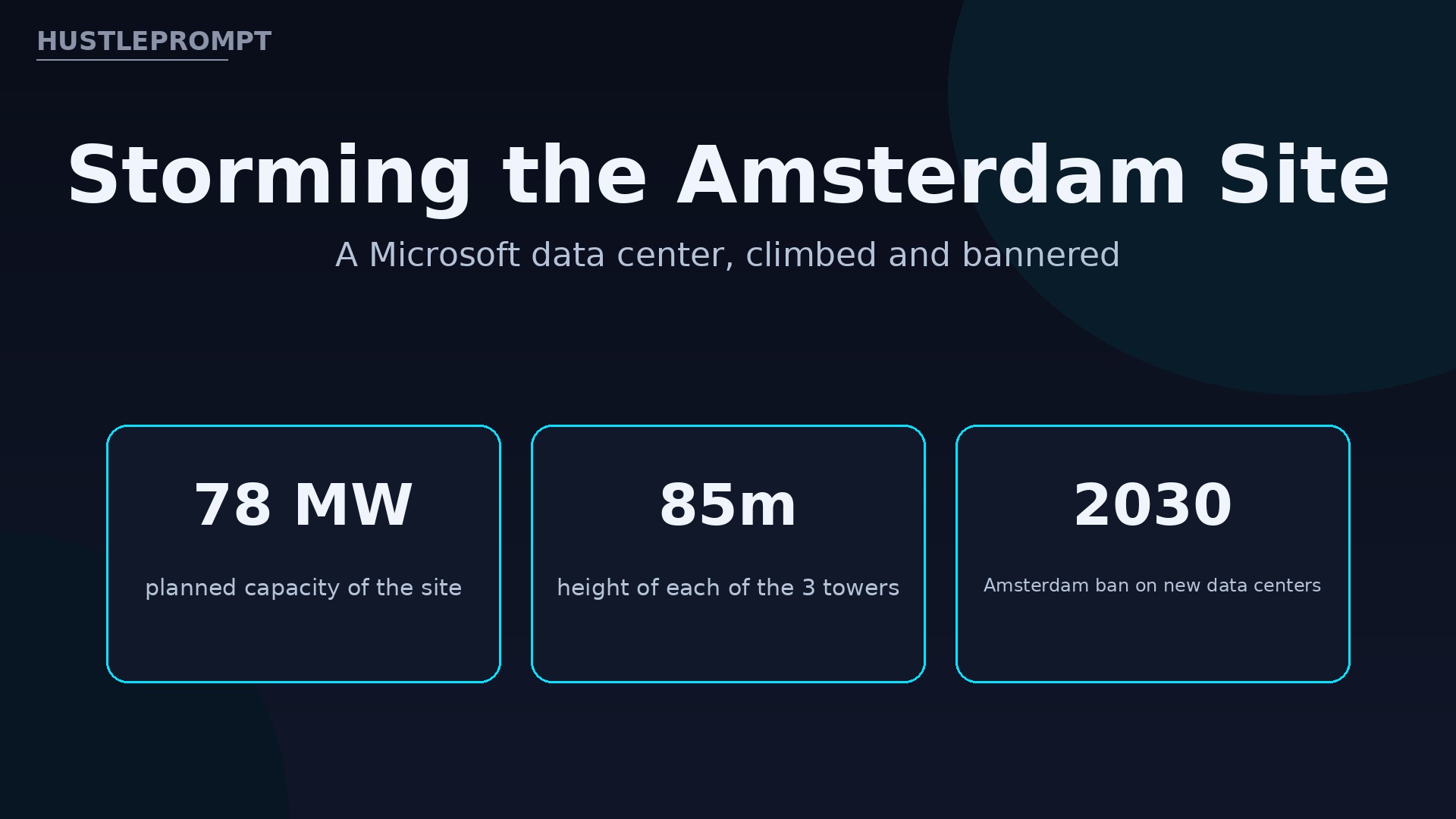
The Amsterdam site is a planned data center in the city’s Sloterdijk port area, developed by the British firm Pure Data Centres Group, with Microsoft set to be its sole tenant. The planned capacity is 78 megawatts, spread across three towers of 85 meters each, according to Gizmodo’s reporting.
Protesters pushed through a fence, swarmed the site and climbed one of its cranes. A campaigner with the activist group Fossil Free Netherlands told Bloomberg that an estimated 400 people took part in the demonstration. The city’s mayor had banned the protest, and riot police made a number of arrests at the site.
Microsoft said it respects the right to peacefully express opinions, but that illegal acts or behaviors that threaten safety cannot be tolerated.
The Amsterdam site is not a random target. The city has banned new data centers until 2030, and the project was already controversial — the same Microsoft campus was hit in July by Extinction Rebellion activists with balloons filled with acetic acid and paint.
Evidence: the Amsterdam site in numbers
| Fact | Detail |
|---|---|
| Site | Planned Microsoft data center, Sloterdijk, Amsterdam |
| Developer | Pure Data Centres Group; Microsoft sole tenant |
| Planned capacity | 78 megawatts, three towers of 85 meters each |
| Protesters | 100+ broke in; ~400 took part, per Fossil Free Netherlands via Bloomberg |
| City rule | Amsterdam banned new data centers until 2030 |
| Authorities | Mayor banned the demonstration; riot police made arrests |
Sources: Gizmodo, November 6–7, 2026; Associated Press reporting via Second Read.
Two days, 15 countries, one demand
Amsterdam was one stop in a coordinated weekend. The coalition Stop Dirty Data Centres organized two days of demonstrations on November 6 and 7 across 15 European countries, with around 100 campaign groups taking part.
Events were planned in the UK, Spain, France, Germany, Poland, Ireland, Denmark and Finland, among others. The actions included a protest outside the Polish parliament in Warsaw, a demonstration outside a Microsoft data center in Denmark, and a march to the Scottish Parliament in Edinburgh planned for November 14.
The demand is simple and sweeping: a moratorium on large data centers at local, national and European level — a pause on construction until voters have democratically decided what is needed.
The coalition’s stated concerns are concrete, not abstract:
- Energy bills: data centers push up electricity prices for nearby residents.
- Water: cooling the servers that power AI consumes enormous amounts of water.
- Climate: the buildout’s carbon and resource footprint keeps growing.
- AI in warfare: the same infrastructure powers military AI applications.
- Big Tech power: a handful of companies deciding where the infrastructure goes.
The ballot-box verdict
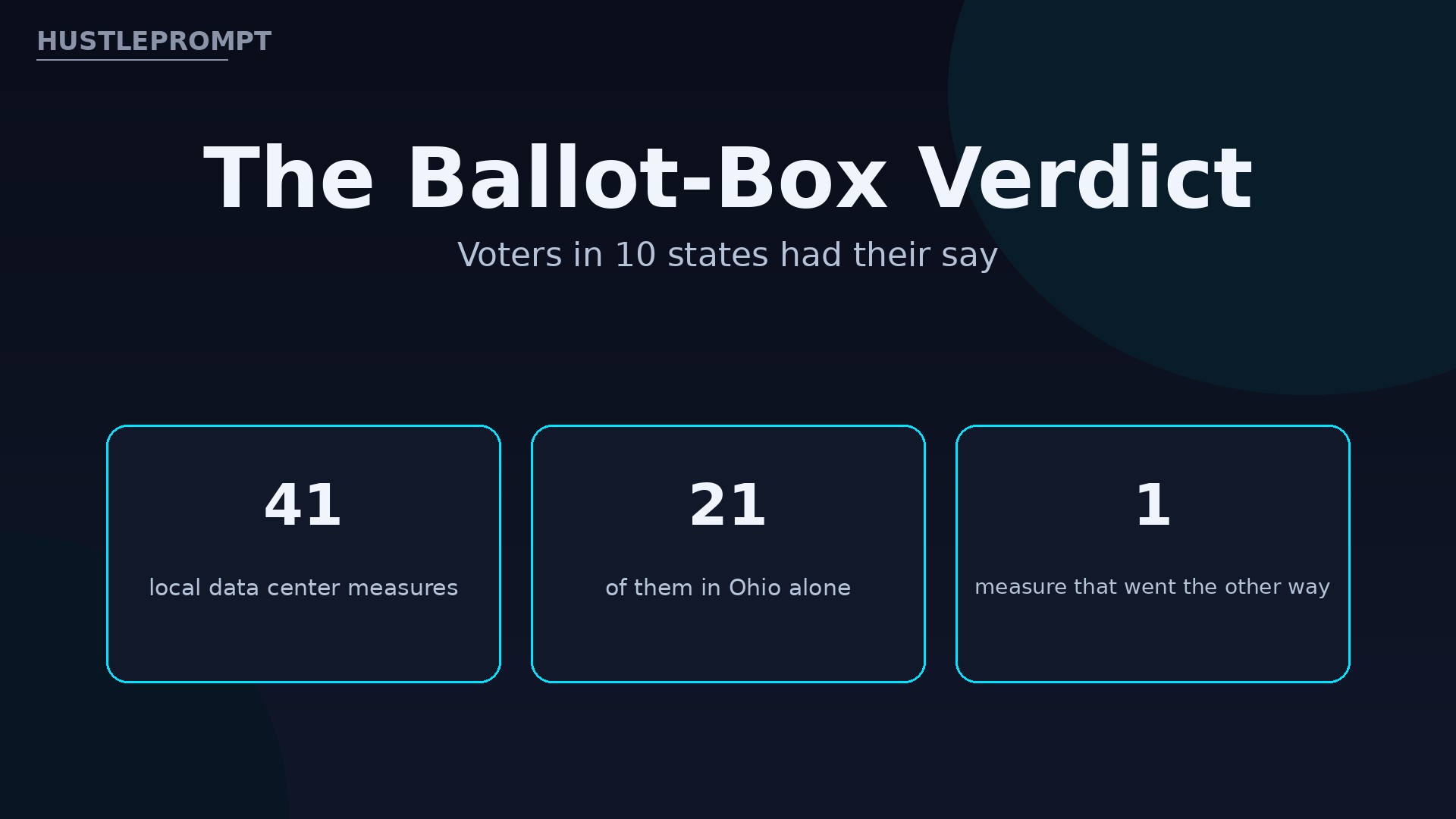
The street protests landed three days after American voters delivered their own verdict. In the US midterm elections on Tuesday, November 3, voters in 10 states decided 41 local data center measures — the largest number of such votes on record, according to Ballotpedia’s count.
Voters sided against data centers in all but one: Harwood, North Dakota. Ohio alone held 21 of the measures. The approved measures included outright bans, temporary moratoriums and new development restrictions.
The backlash is already blocking real projects. In Maryland, a community effort helped block a $5 billion data center, according to NPR. Industry tracker Capacity reported that at least 75 US data center projects worth almost $130 billion were blocked or delayed in the first quarter of 2026 alone.
And the politics have flipped. The incoming governors of Texas and Georgia have called for pausing new data center development, and Ohio’s incoming governor has pledged tougher restrictions, according to reports from the week.
Evidence: the US numbers behind the backlash
| Metric | Detail |
|---|---|
| Ballot measures | 41 local data center measures, 10 states, Nov 3, 2026 |
| Against data centers | 40 of 41; only Harwood, North Dakota went the other way |
| Ohio | 21 of the 41 measures — more than half |
| Blocked in Q1 2026 | 75+ US projects worth almost $130 billion (Capacity) |
| Maryland | Community effort blocked a $5 billion data center (NPR) |
| Europe | 22 live or proposed restrictions across 10 countries (StackPath) |
Sources: Ballotpedia via Gizmodo and Sovereign Magazine; Capacity and StackPath via protest coverage, November 2026.
The market noticed
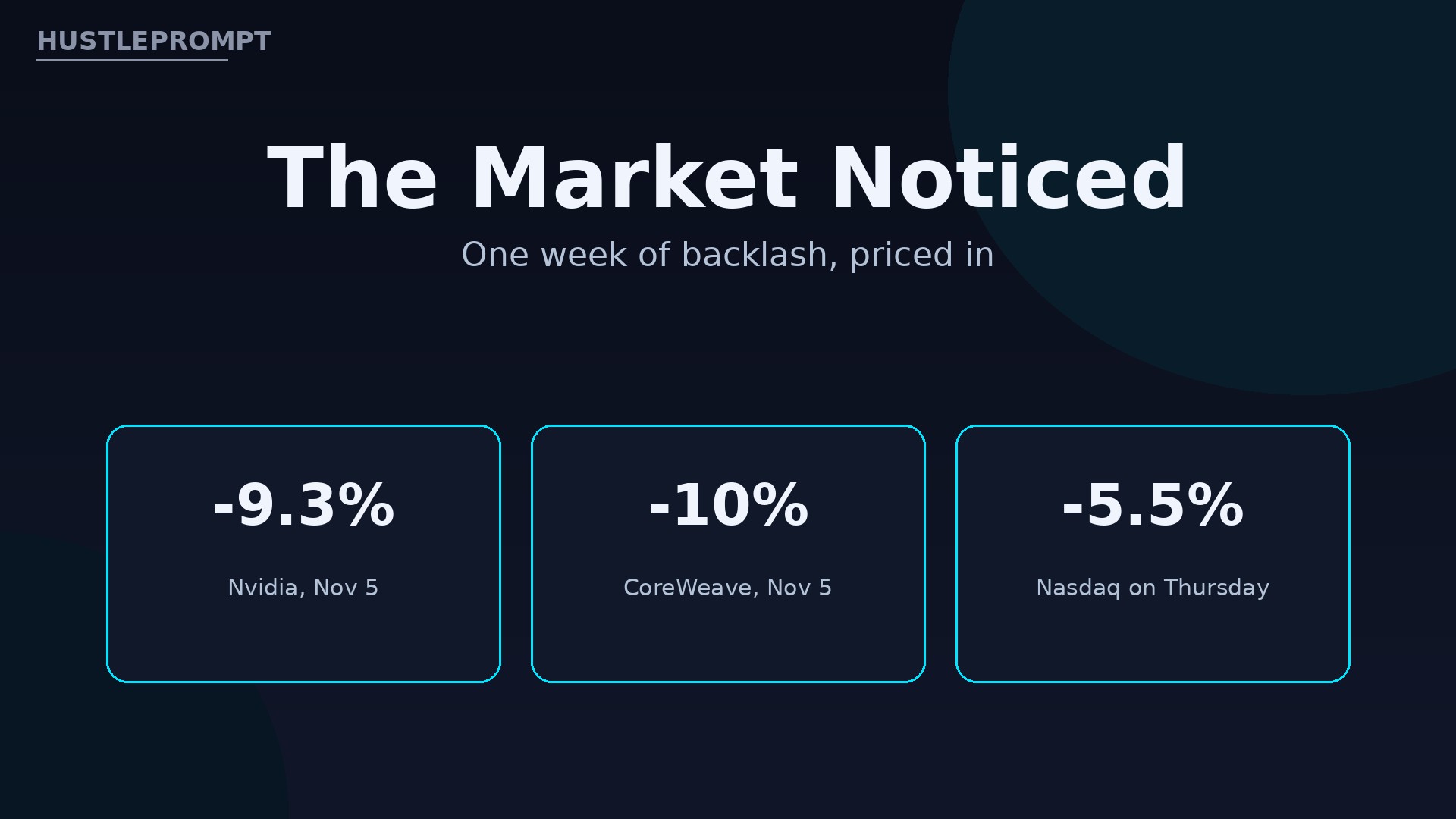
Investors are already repricing the risk. On Wednesday, November 5, Nvidia closed down 9.3% and CoreWeave fell around 10%, as the Nasdaq dropped 5.5% on Thursday — its worst day in 19 months — and fell into correction territory, more than 10% below its October peak.
The scale of the planned buildout is enormous. Amazon, Microsoft, Alphabet and Meta are all committed to spending hundreds of billions on data center infrastructure to support AI. Every one of those dollars now depends on permits, grids and local consent — the three things the backlash is squeezing.
Europe is tightening from the other side too. Research firm StackPath counts 22 live or proposed restrictions on data centers across 10 European countries, led by the Netherlands and Germany with five each. The Netherlands has banned new hyperscale data centers outside designated exemption areas since January 1, 2024, for facilities above 70MW and 10 hectares — yet around 200 data centers are still planned, under construction or operating in the country.
Diagram: how a data center gets blocked
- Announcement: a hyperscaler or developer files plans for a new site — often 70MW or more.
- Local pushback: residents raise energy bills, water use and land prices at council hearings.
- Ballot or ban: voters approve a moratorium or ban, or the city blocks new permits outright.
- Political cover: governors and councils adopt the restrictions as policy.
- Capital stalls: $130 billion of projects sit blocked or delayed — and the stocks reprice.
The pattern now repeats on both sides of the Atlantic: the fight is local, the money at stake is global.
How to profit from the backlash
A backlash is a market. The companies building AI infrastructure now have a problem they will pay to solve — and the protesters just published the checklist. Here is how to sell into it:
- Sell permitting and community-engagement help. Developers need locals onside before they file. A service that runs town halls, answers energy and water questions honestly, and negotiates community benefits is now a core part of every big build.
- Audit energy and water use. The protesters’ top complaints are the compliance checklist. Offer efficiency audits, cooling-water reports and grid-impact studies for sites that need to prove they are good neighbors.
- Retrofit existing sites. Bans target new builds. Existing capacity just got more valuable — and owners will pay for upgrades that squeeze more compute out of approved square footage.
- Build small and permitted. Edge data centers and sub-70MW sites in designated zones face fewer restrictions. Small, fast, legal beats big, contested and stalled.
- Monitor the policy map. Track the 41 US ballot measures, the 22 European restrictions and the next votes. Investors, developers and journalists will pay for a clear, current map of where building is still possible.
What happens next
The two sides are moving in opposite directions. The European Commission wants to triple EU data center capacity within five to seven years under its Cloud and AI Development Act, and bids for up to seven EU-backed AI gigafactories close on November 12. The protesters want a moratorium until the public decides. Both cannot win everywhere.
Big Tech is already adapting. OpenAI has launched what Reuters described as a charm offensive: a pledge to stop signing non-disclosure agreements with local officials and to cover the cost of the power its data centers use. That is the industry admitting the old playbook — quiet deals, sealed terms — is dead.
Watch three dates: the gigafactory bids on November 12, the Scottish Parliament march on November 14, and the next round of local votes. The backlash is no longer a fringe cause. It won 40 of 41 ballot measures — and it climbed a crane in Amsterdam to make sure everyone noticed.
Frequently Asked Questions
What happened at the Microsoft data center site in Amsterdam?
On Friday, November 6, more than 100 protesters broke into the construction site of a planned Microsoft data center in Amsterdam’s Sloterdijk area, climbed a crane and hung anti-AI banners. The site is being developed by Pure Data Centres Group at a planned 78 megawatts, with Microsoft as sole tenant. The mayor had banned the demonstration and riot police made arrests.
Why are people protesting against data centers?
The Stop Dirty Data Centres coalition cites rising energy bills, water shortages, the climate impact of the AI buildout, the use of AI in warfare, and Big Tech’s growing power. Their demand is a moratorium on large data centers at local, national and European level until the public has democratically decided what is needed.
How did US voters rule on data centers in the midterms?
On November 3, voters in 10 states decided 41 local data center measures — the most on record, per Ballotpedia. They sided against data centers in 40 of 41, approving bans, moratoriums and new restrictions. Ohio alone held 21 of the measures; only Harwood, North Dakota went the other way.
How much data center investment is already blocked?
Industry tracker Capacity reported that at least 75 US data center projects worth almost $130 billion were blocked or delayed in the first quarter of 2026 alone. In Maryland, a community effort blocked a $5 billion data center, according to NPR.
How did the stock market react?
On November 5, Nvidia closed down 9.3% and CoreWeave fell around 10%, and the Nasdaq dropped 5.5% on Thursday — its worst day in 19 months — falling into correction territory, more than 10% below its October peak.
What is Big Tech doing about the backlash?
OpenAI has pledged to stop signing non-disclosure agreements with local officials and to cover the cost of the power its data centers use. Meanwhile the European Commission is pushing the other way: it aims to triple EU data center capacity in five to seven years, with bids for up to seven EU-backed AI gigafactories closing November 12.
Keep Reading
Sources
- Gizmodo — More Than 100 Protesters Storm a Microsoft Data Center Site in Amsterdam (Nov 6–7, 2026)
- Sovereign Magazine — Data Centre Protests in Europe After the US Midterm Vote (Nov 6, 2026)
- Second Read — Protesters break into Microsoft data center site in Amsterdam (AP reporting, Nov 7, 2026)
- Europe Says (SBS) — Protesters Storm Microsoft Construction Site, Netherlands (Nov 7, 2026)