
Seven out of ten online shopping carts are abandoned before checkout — and most of those shoppers had a question nobody answered. AI chatbot setup services for e-commerce stores close that gap, and store owners pay a monthly retainer for the bot that does it.
You install an AI assistant that answers product questions, checks order status, and recovers abandoned carts around the clock. This guide covers the service, the numbers, the workflow, and the pricing.
Watch first: VOC AI builds a GPT-powered chatbot for a Shopify store — a video blueprint for this service.
Why Stores Pay for an AI Chatbot
Baymard Institute’s average of 50 published studies puts the documented cart abandonment rate at 70.22% — roughly seven in ten carts never become an order. Among shoppers who were not just browsing, 40% left because extra costs were too high and 18% because the site forced them to create an account.
A chatbot catches shoppers at the exact moment they hesitate. It explains shipping costs before checkout, answers a sizing question, or points to guest checkout — while the shopper is still on the page.
Shoppers expect that speed. A 2025 Harris Poll reported by Shopify found 41% of adults prefer live chat, and the Five9 2025 report found 86% of consumers try to solve the issue themselves first — and 59% prefer a chatbot over waiting for a human agent.
The three numbers that sell this service
70.22% — average documented cart abandonment rate (Baymard).
30% — average support cost reduction with AI chatbots (IBM, 2025).
$9.6B — global chatbot market in 2025, heading to $41.2B by 2033.
IBM’s 2025 research measured an average 30% operating cost reduction across enterprises that deployed AI chatbots for tier-one support.
What the Service Includes
A complete package has five parts.
- Chatbot install: the widget on the store, styled to match the brand.
- Product and policy training: the bot learns from the catalog, shipping and returns pages, and the FAQ.
- Cart recovery flows: a message when a shopper hesitates at checkout, offering help or a shipping explainer.
- Order tracking and support answers: “where is my order?”, sizing, and stock questions answered instantly, 24/7.
- Human handoff and reporting: tricky questions route to the owner, plus a weekly report on conversations and unanswered questions.
You are not promising sales. You sell a working assistant, faster answers, and fewer lost carts. Build it with proven tools — Tidio with its Lyro AI agent is the common choice for small stores — or work inside what the client already uses, such as Intercom, ManyChat, or Shopify Inbox.
The Numbers That Sell It
Store owners think in lost revenue and support hours. Every figure below comes from a published source, linked at the end.
| Why shoppers leave | Share of abandoners | What a chatbot does |
|---|---|---|
| Just browsing, not ready to buy | 42% | Captures email, answers questions |
| Extra costs too high (shipping, tax, fees) | 40% | Explains shipping before checkout |
| Did not trust the site with card details | 19% | Answers security and payment questions |
| Site wanted an account created | 18% | Points shoppers to guest checkout |
Baymard’s reasons come from a survey of US shoppers who abandoned a cart, and shoppers could pick more than one reason — so the shares do not add to 100%. The point for your pitch: most abandonment is not price. It is unanswered questions at the worst possible moment.
What the chatbot platforms cost
| Platform | Starting price (2026) | Notes |
|---|---|---|
| Tidio (Lyro AI) | Free; Starter $24.17/mo (annual) | Lyro AI add-on from $32.50/mo |
| Intercom (Fin) | $29/seat/mo (Essential, annual) | Fin AI $0.99 per resolution |
| ManyChat | Free; Essential $14/mo (annual) | Best for Instagram and Messenger |
| Shopify Inbox | Free | Live chat only, no AI agent |
Prices change, so confirm at checkout. The client pays the platform bill, not you.
How the System Works
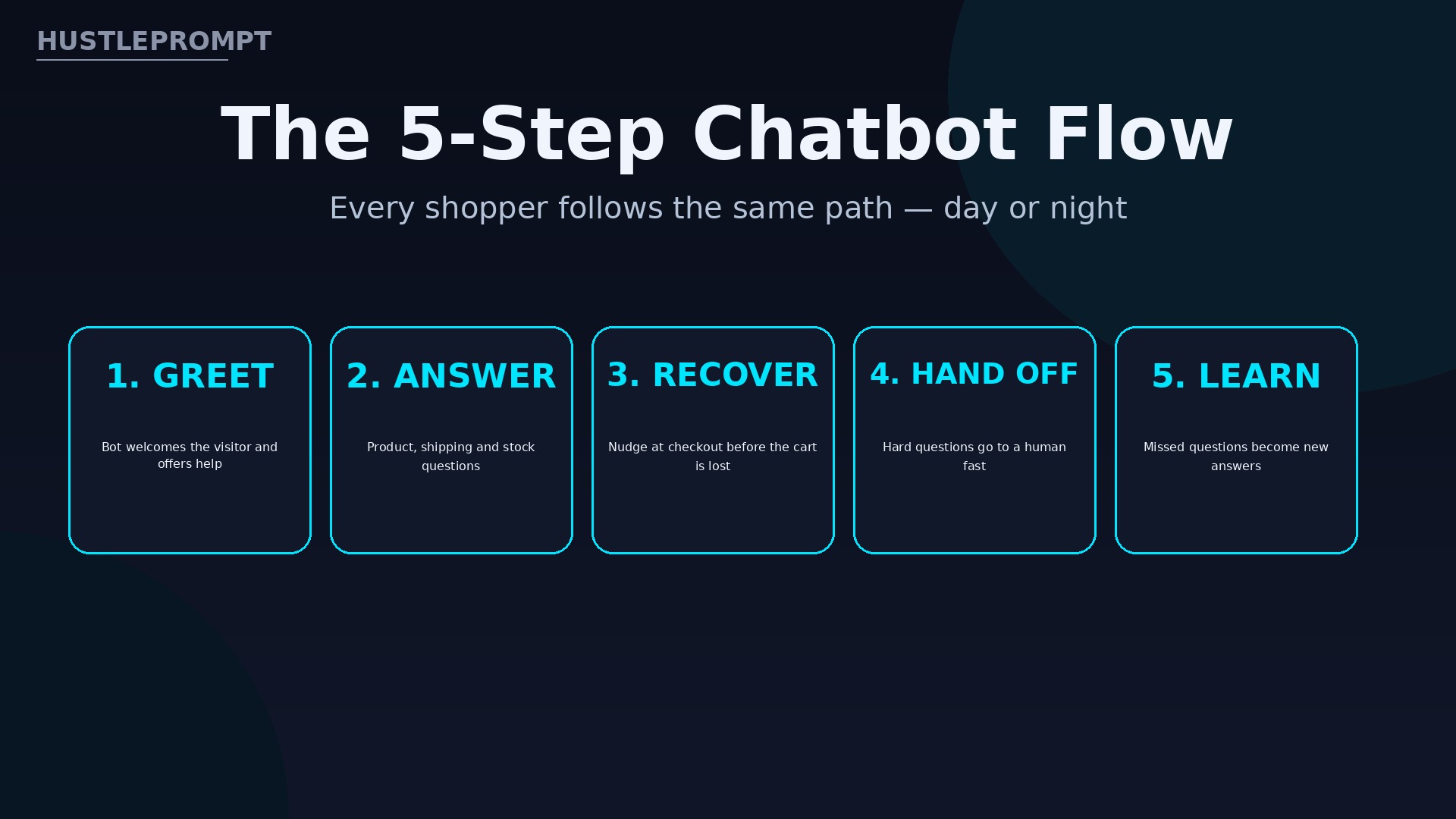
Every shopper follows the same five steps.
1. Greet
Bot welcomes the visitor and offers help
2. Answer
Product, shipping and stock questions
3. Recover
Nudge at checkout before the cart is lost
4. Hand off
Hard questions go to a human fast
5. Learn
Missed questions become new answers
The owner only talks to shoppers the bot could not help.
That last step is the whole business model. Every week you read the conversations the bot failed on, add the missing answers, and the bot gets better. Clients stay because the assistant visibly improves — and because the Five9 survey found 72% of consumers are open to AI interactions as long as they can reach a human quickly.
How to Profit: Your Step-by-Step Workflow
Follow these steps in order.
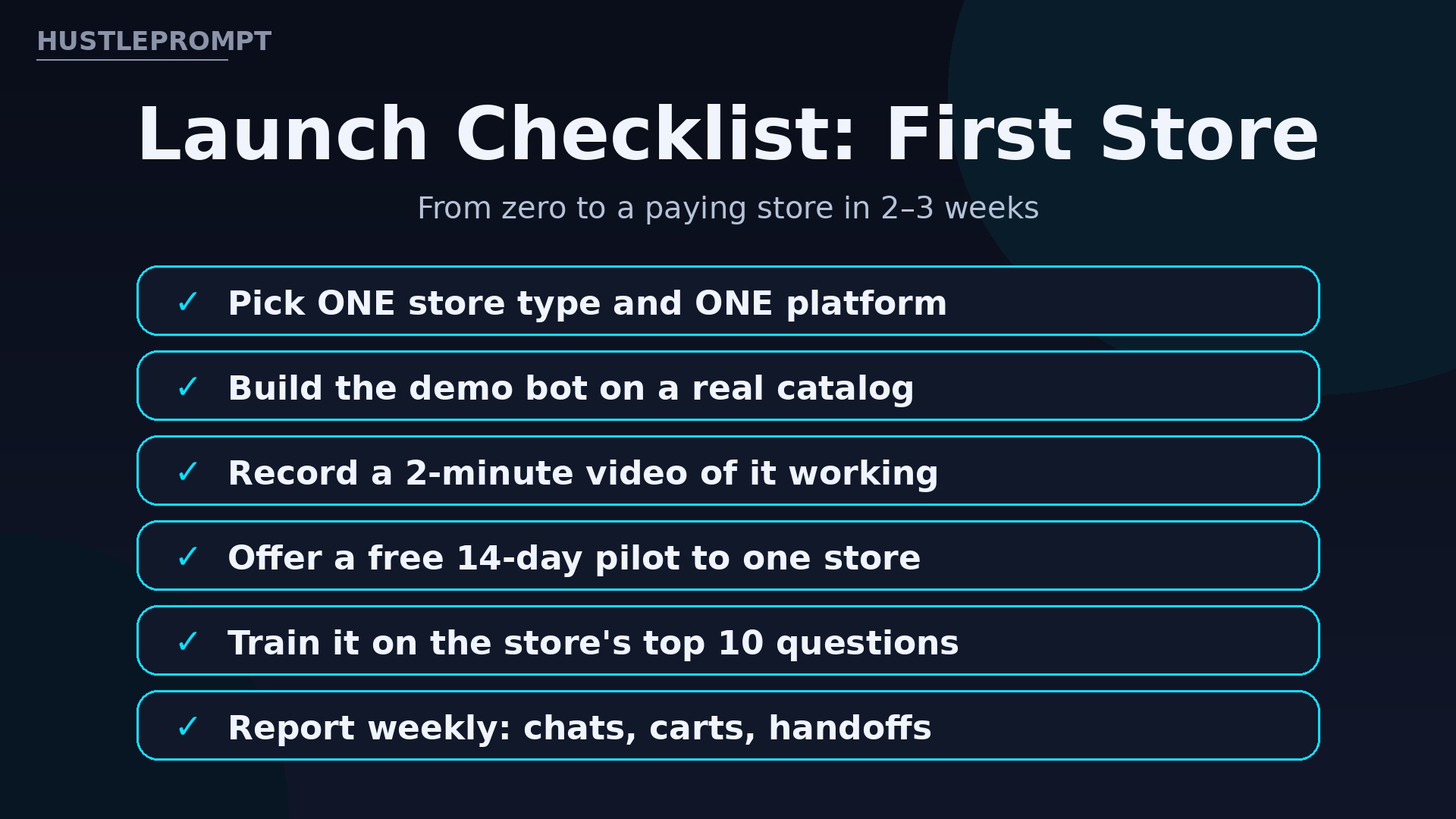
Step 1: Pick one store type and one platform
Do not sell “AI chatbots for e-commerce” in general. Sell it for Shopify fashion stores, or WooCommerce beauty shops. One niche makes your pitch specific.
Step 2: Build the demo bot before you pitch
Build a chatbot on a demo store first, trained on a real catalog. Record a two-minute screen video: a shopper asks about shipping, the bot answers in seconds, a cart gets recovered at checkout. That video is your sales deck.
Step 3: Offer a free 14-day pilot to one store
Pick a store doing steady orders but answering support by hand. Run the bot free for two weeks, with one condition: if it handles real conversations, they sign a monthly retainer. One working pilot beats ten slide decks.
Step 4: Train it on the store’s real questions
Ask the owner for their ten most repeated questions, then add the answers from the shipping page, returns policy, and product pages.
Step 5: Tune the answers every week
Read the actual conversations. Where do shoppers stop replying? Shorten the answer and add the missing fact. Tidio claims its Lyro agent can automate up to 70% of conversations — measure your own rate instead.
Step 6: Report weekly, in plain numbers
Send a one-page report every Monday: conversations handled, carts nudged, handoffs to a human. No jargon. Clients who see answered shoppers every week do not cancel.

Pricing Your Packages
Charge for the system, not your hours. Store owners compare your retainer with a part-time support hire — or with the orders they lose to unanswered questions.
| Package (illustrative) | Monthly retainer | Included |
|---|---|---|
| Starter | $500 | 1 bot, FAQ training, cart recovery, weekly report |
| Growth | $1,000 | Starter + order tracking, 2 channels, tuning |
| Scale | $2,000 | Growth + Instagram/WhatsApp, multi-store |
These prices are illustrative, not market rates — set yours from your costs and what your pilot proves. Add a $400 to $1,000 setup fee.
How to Find Your First Clients
Your first three clients come from direct outreach, not ads.
- Stores with slow replies: message a store’s chat at night. If nobody answers for hours, they need you.
- Stores running ads to a leaky checkout: they lose the most to unanswered questions. Offer the pilot and show the demo video.
- Newer stores: in their first year, they need support most and try new tools fastest.
- Local shops with an online store: one boutique with a Shopify site is an easier yes than a big brand.
Keep outreach short: one sentence about the problem, one line about the pilot, and the demo video.
FAQ
Do I need to know how to code to sell this service?
No. Tidio, ManyChat, and Chatfuel are no-code tools — install an app or paste a snippet, then train the bot on the store’s pages.
How much does it cost to start?
A free Tidio plan, a demo store, and a screen recording can run a demo for under $50.
What if the store already has live chat?
Keep it. Add the AI as the first responder and let it hand off to the owner’s team.
Will shoppers hate talking to a bot?
Most do not — if it resolves their question and a human is one tap away. Five9 found 72% of consumers are open to AI when they can escalate to a human quickly.
How fast will the chatbot start helping?
A trained bot can answer on day one, but a reliable flow takes two to four weeks of tuning. Set that expectation before the pilot.
Do I guarantee recovered sales?
No. Guarantee the system, the speed, and the reporting — not recovered revenue or sales volume.
What makes this better than the store owner answering chats themselves?
Speed and coverage. The bot answers in seconds, at 2 a.m., and never misses a message.
Keep Reading
- Sell AI Lead Generation Services to Real Estate Agents — the same playbook, another niche.
- Sell AI Email Newsletter Services to Local Gyms — monthly retainers from local businesses.
- Free AI Tools — test chatbot ideas before you pitch.
Sources: Baymard Institute cart abandonment statistics and reasons survey (updated 22 Sep 2025); Grand View Research chatbot market report; IBM 2025 research via 2026 roundups; Five9 2025 Customer Experience Report; 2025 Harris Poll via Shopify; Tidio, Intercom, ManyChat, and Shopify Inbox pricing via Oct 2026 comparisons. Prices change — confirm at checkout.