
Fireworks AI breach news just got worse. On November 9, 2026, the AI inference platform told customers that hackers had reached far more than it first disclosed: account and billing information, and — for a limited set of accounts — secrets, datasets, and unfinished model weights. It is the company’s second breach disclosure in a matter of weeks, and it lands on a platform used by more than 10,000 customers, including Notion and Cursor.
Here is why this one matters more than the October bulletin it updates. Fireworks first said no customer models or datasets had been touched. The November update says the opposite for some accounts — and it links the attack to a criminal trade called LLMjacking, where stolen AI access is resold for cash. Google’s own threat researchers say a single LLMjacking incident can rack up more than $100,000 in fraudulent charges in one day.
Fireworks AI runs inference and fine-tuning for more than 10,000 customers, including Notion, Cursor, and Harvey. Image: Fireworks AI.
What happened: two intrusions, one investigation
Fireworks published its update on November 9 as a follow-up to the security bulletin it first issued on October 9. The timeline now has two separate intrusion paths inside a single October investigation:
| Date | What happened | What Fireworks says now |
|---|---|---|
| Oct. 6, 2026 | Unauthorized use of internal Fireworks credentials detected | Attacker read environment variables used in evaluation jobs in a limited number of accounts |
| Oct. 7–10 | Affected customers notified; bulletin published Oct. 9 | Employee API keys rotated Oct. 9; more user keys revoked and service-account tokens rotated Oct. 10 |
| Oct. 23 | A third-party cloud provider hosting Fireworks R&D machines had its own security incident | The provider breach became the second way in |
| Oct. 24 | Intruder used the provider breach to reach Fireworks development machines and run an unauthorized workload | Detected the same day; remediation started immediately |
| Oct. 25 | No further successful unauthorized access detected on the customer platform since this date | Still the company’s position as of Nov. 9 |
| Nov. 9 | Fireworks publishes the update | Wider impact disclosed: billing data, secrets, datasets, incomplete model weights |
The October bulletin had said Fireworks “had not detected evidence of unauthorized access to customer models, datasets, training data, personal information, or inference traffic.” The November update reverses part of that, in the company’s own words:
“Since then, we discovered impacts to account and billing information. For a limited set of accounts, we also discovered impact to secrets, datasets, and incomplete models.”
— Fireworks AI, Update on October 2026 security incident, November 9, 2026
Fireworks also disclosed a second route it had not described before: “A third-party cloud provider that hosted Fireworks R&D machines experienced a security incident on October 23. On October 24, the unauthorized third party used it to reach Fireworks development machines and then run an unauthorized workload that led to additional customer data impact.”
What the hackers actually took
The update lists three categories of information the affected internal application exposed. The table below is taken directly from Fireworks’ own bulletin:
| Category | What was accessed | Scope |
|---|---|---|
| Resource metadata | Resource identifiers, display names, descriptions, creation times | Affected internal application |
| Billing information | Billing and shipping addresses, invoice and payment history, account balance, credit usage | Affected accounts; payment card numbers are not stored and were not impacted |
| Model weights and datasets | A subset of incomplete model weights and datasets | Certain customers only; no complete production model reported stolen |
Bloomberg Law, which reported the disclosure on November 9, added a detail Fireworks did not put in its bulletin: the October 24 breach included “tens of thousands of files that contained customer data in some cases,” according to a person familiar with the matter. A Fireworks spokesperson told Bloomberg the company is “actively working with our customers to manage the incident, including Notion, Cursor and others.”
What Fireworks says was not affected matters too. The company reports no detected impact to Inference, the Training SDK, or Nexus — all zero data retention by default — but it stresses that finding is “based on our investigation to date” and the investigation is ongoing. It does not say customer prompts or inference traffic were leaked, and it does not say they were not. Fireworks has notified law enforcement and brought in Palo Alto Networks Unit 42 for forensic analysis.
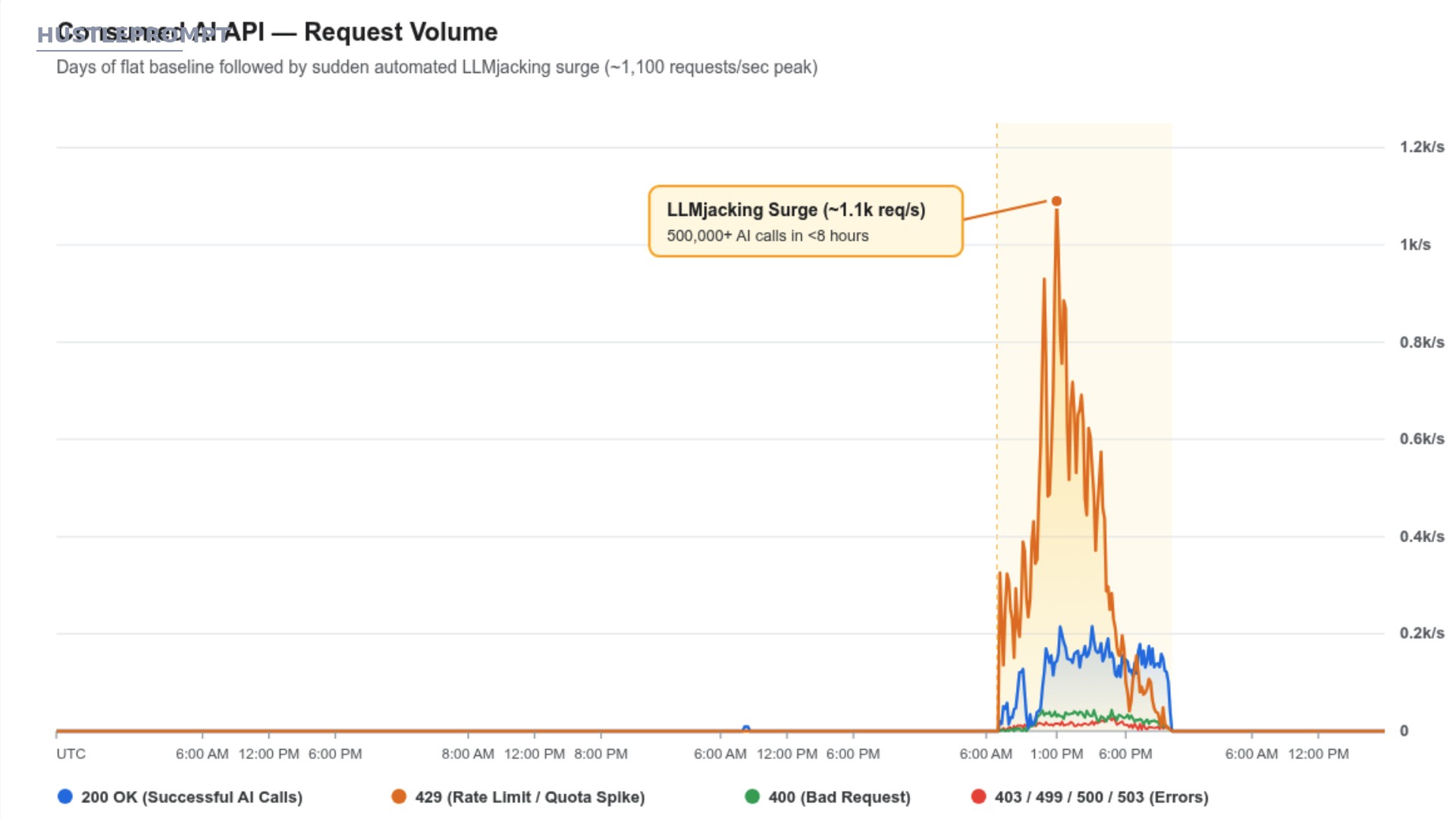
Google’s Threat Intelligence Group chart shows an LLMjacking attack in action: days of flat baseline, then a surge to about 1,100 AI API requests per second — more than 500,000 calls in under eight hours. Image: Google Cloud / Mandiant.
LLMjacking: the business model behind the breach
Fireworks links the attack to a financially motivated cybercriminal group that steals access to large language models and resells it through illicit routing gateways known as LLM Mixers. Its bulletin points to the November 2, 2026 post from Google’s Threat Intelligence Group and Mandiant on the rise of LLMjacking — and the numbers in that post explain why this trade is growing so fast.
- More than $100,000 in a single day. Across individual incidents, Mandiant observed fraudulent charges from resource consumption exceeding $100,000 in one day, with cumulative charges at some organizations reaching $1 million before access was revoked.
- 500,000+ API calls in under eight hours. In one investigation, a threat actor executed more than 500,000 LLM API calls in less than eight hours, at a peak of about 1,100 requests per second.
- Nearly $1 million passed to one victim. A token-routing service called Jet Night passed nearly $1 million in token costs to a single victim organization. Jet Night sells an “unlimited” token plan for about $60 a month — a service level that would typically cost $100 to $250 a month with legitimate access — which Google says suggests it relies on stolen keys to operate profitably.
- It beats cryptojacking on speed. Unlike cryptojacking, which burns resources gradually, LLMjacking “can generate large spikes in fraudulent cloud charges in a matter of hours,” according to Google.
The pattern is not unique to Fireworks. Security firm Wiz counted at least nine AI developer platforms that disclosed security incidents in October 2026 alone — Fireworks on October 6, Andromeda on October 9, Zeabur on October 14, Lightning AI on October 15, OpenCode on October 16–17, Railway on October 20, Warp on October 23, CommandCode on October 28, and Northflank on October 30. Almost all of them involved hunting for stored environment variables, especially keys that grant access to AI models.
STEP 1 — STEAL THE KEY
Attackers grab API keys and cloud credentials from exposed endpoints, public code repositories, or a breached provider — exactly the secrets Fireworks stored for evaluation jobs.
STEP 2 — VALIDATE IT QUIETLY
Stolen keys are tested with tiny single-token requests, so the check stays under the victim’s detection thresholds while confirming the key works.
STEP 3 — PROXY IT THROUGH A MIXER
The key is plugged into an illicit routing gateway — an “LLM Mixer” — that pools stolen credentials, meters usage, and hides where the requests really come from.
STEP 4 — SELL IT CHEAP, BILL THE VICTIM
Access is resold at prices no legitimate provider can match — like $60 a month for “unlimited” frontier models — while the real bill lands on the company whose key was stolen.
The money at stake for Fireworks
Fireworks is not a small startup anymore. The Nvidia-backed company was last valued at $17.5 billion in July 2026, and reports put its annualized revenue run rate above $1 billion. Bloomberg reported that Fireworks is in talks to raise a new funding round at a valuation between $30 billion and $40 billion — talks now running alongside a second breach disclosure in weeks.
The commercial risk is visible already. Forbes reported on November 9, citing two people with knowledge of the breach, that two customers had already substantially moved their business off Fireworks’ systems. Those are anonymous-source claims, not Fireworks statements — but the company itself confirmed it is working directly with large customers including Notion and Cursor to manage the incident.
There is also a product cost. As part of its response, Fireworks has disabled self-serve dataset uploads and downloads used by Batch Inference and dataset-based training while the investigation continues. The Training SDK remains available with zero data retention, and Fireworks Lab-based training now runs in an isolated environment with extra network and storage protection. For customers, that means slower onboarding of new training data until Fireworks says otherwise.
How to protect your AI spend right now
If you run models on Fireworks — or on any hosted inference platform — the Fireworks update is a checklist, not just a headline. Work through it today:
- Check for the incident email first. Fireworks says it is notifying customers whose data was impacted with details and recommended actions. If you got no notice, its October bulletin said your account had not been identified as affected — but that can change, so keep watching official channels and only trust the notification thread or security-notice@fireworks.ai.
- Rotate keys at the issuer, not just at Fireworks. Replace revoked Fireworks API keys, then rotate any third-party credentials that were stored as Fireworks secrets with the provider that issued them — cloud, database, Git, Slack, payment. Deleting the stored secret does not invalidate the underlying credential.
- Read your bill like a security log. LLMjacking usually shows up as a sudden spike. Set spend caps and anomaly alerts on every AI-provider key, and treat any unexpected enablement of a new LLM service as a critical security event.
- Stop storing production credentials as provider secrets. The October intrusion started with environment variables in evaluation jobs. Production database and cloud credentials do not belong in an inference or evaluation platform.
- Ask vendors three questions before you sign. Which third-party clouds host their R&D machines? Is inference zero data retention by default? What is the breach-notice SLA? The answers are now part of the price.
How to profit from the Fireworks breach
Every breach creates a market for the people who can prevent the next one. Three services are suddenly easier to sell this week:
- AI key-hygiene audits. Most teams have API keys scattered across repos, eval jobs, and shared docs. A fixed-price audit that inventories keys, scopes them per environment, and sets spend caps is a concrete offer with a news hook clients already understand.
- Vendor-risk reviews for AI stacks. Companies running on Fireworks, or on any of the nine platforms Wiz flagged in October, now need a second opinion on their inference provider. A short review — data retention, key storage, breach history, exit plan — is a service you can productize and repeat.
- Incident-response retainers for AI teams. The Fireworks timeline shows what “we’ll handle it” looks like in practice: weeks between detection and full disclosure. Teams that sell a 24-hour response plan for AI-key incidents are selling against a fear that is fresh in every buyer’s inbox today.
What Fireworks has not said yet
Four gaps remain, and they decide how big this story gets:
- How many accounts? Fireworks says “a limited set of accounts” for the datasets and weights, but has not given a number. The scale of the exposure is still unknown.
- Which datasets and weights? A “subset of incomplete model weights and datasets” could mean anything from test data to near-finished fine-tunes. The commercial value depends entirely on whose data it was.
- Who is the third-party cloud provider? Fireworks has not named the provider whose October 23 incident opened the second path — or the vulnerability involved.
- Is the investigation really closed? The company says it has not detected further successful access since October 25, but also says the investigation is ongoing and “may reveal additional information.” Expect another update if the categories widen again.
The honest read: Fireworks caught the second intrusion the same day it happened, and its core inference service shows no detected impact. But the company told customers in October that their models and datasets were safe, and in November it told them otherwise. That reversal — not the breach itself — is what will decide whether customers stay, and whether a $30-to-$40 billion valuation survives contact with the next update.
Frequently asked questions
What happened in the Fireworks AI breach?
Fireworks AI disclosed in October 2026 that attackers misused its internal credentials to access environment variables in evaluation jobs. On November 9, 2026, it updated the disclosure: a second intrusion through a third-party cloud provider on October 23–24 exposed account and billing information, and for a limited set of accounts, secrets, datasets, and incomplete model weights.
Was my Fireworks AI account affected?
Fireworks says it is notifying customers whose data was impacted, with details and recommended actions. If you received no notice, its October bulletin said your account had not been identified as affected based on the investigation at that time — but that can change. Contact Fireworks through your incident notification email or security-notice@fireworks.ai.
Were payment card numbers stolen in the Fireworks breach?
No. Fireworks says it does not store payment card numbers, and they were not impacted. Billing information that was accessed includes billing and shipping addresses, invoice and payment history, account balances, and credit usage.
What is LLMjacking?
LLMjacking is a cybercrime tactic where attackers steal access to large language models — usually API keys or cloud credentials — and resell it through illicit routing gateways called LLM Mixers. Google’s Threat Intelligence Group reported in November 2026 that single incidents can generate more than $100,000 in fraudulent charges in a day, with cumulative bills at some organizations reaching $1 million.
Did hackers steal complete Fireworks customer models?
Not according to Fireworks. The company says attackers accessed “a subset of incomplete model weights and datasets” for certain customers. It has not reported theft of complete production models, and it says it has detected no impact to Inference, Training SDK, or Nexus.
Which companies use Fireworks AI?
Fireworks says it serves more than 10,000 customers. Bloomberg reported that its customers include the legal tech firm Harvey, productivity software startup Notion, and coding company Cursor, and a Fireworks spokesperson said the company is actively working with Notion, Cursor, and others to manage the incident.
Should I switch away from Fireworks AI?
That is a vendor-risk decision, not a fact the disclosure settles. Forbes reported, citing anonymous sources, that two customers had substantially moved their business off Fireworks. Fireworks says its inference services show no detected impact, dataset uploads are temporarily disabled, and the investigation continues. Review your own exposure — keys, datasets, spend caps — before deciding.
Sources: Fireworks AI — Update on October 2026 security incident (November 9, 2026) · Fireworks AI — Security bulletins · Google Cloud / Mandiant — The Rise of LLMJacking (November 2, 2026) · Bloomberg Law — Nvidia-Backed Fireworks AI Discloses Its Second Hack in Weeks (November 9, 2026) · Unite.AI — Fireworks AI Expands Breach Disclosure to Datasets and Model Weights (November 9, 2026)
Keep Reading