
ByteDance Muse-style assistant is coming — at least, that is what Bloomberg says. The TikTok owner plans to launch an AI assistant modeled on Meta’s Muse within weeks, according to a Bloomberg report published on November 11, 2026, citing people familiar with a recent all-hands meeting of ByteDance’s AI team. Co-founder Zhang Yiming laid out the plan himself — and paired it with a blunt timeline: ByteDance will not match OpenAI and Anthropic at the frontier before 2029 or 2030.
That honesty is what makes this story worth watching. Most companies announce an AI assistant and claim they are already winning. ByteDance’s co-founder told his own team the opposite: the catch-up will take years, the training data is far behind, and the shortcut — distilling bigger models’ outputs — is off the table. The assistant is real and near. The frontier is not.
What Bloomberg reported
Bloomberg’s report, carried by The Next Web and confirmed across multiple outlets, says the plan came out of an all-hands meeting of ByteDance’s AI team. Zhang Yiming set out the timeline there. The assistant is meant to build on ByteDance’s lead in AI video, where its Seedance models are already a paid product — and it is meant to close the gap with the leading US labs.
What the reporting does not say matters as much as what it does. There is no name for the assistant, no list of features, and no word on whether it will reach users outside China or come with hardware of its own. ByteDance did not respond to Bloomberg’s request for comment, and the company has announced nothing.
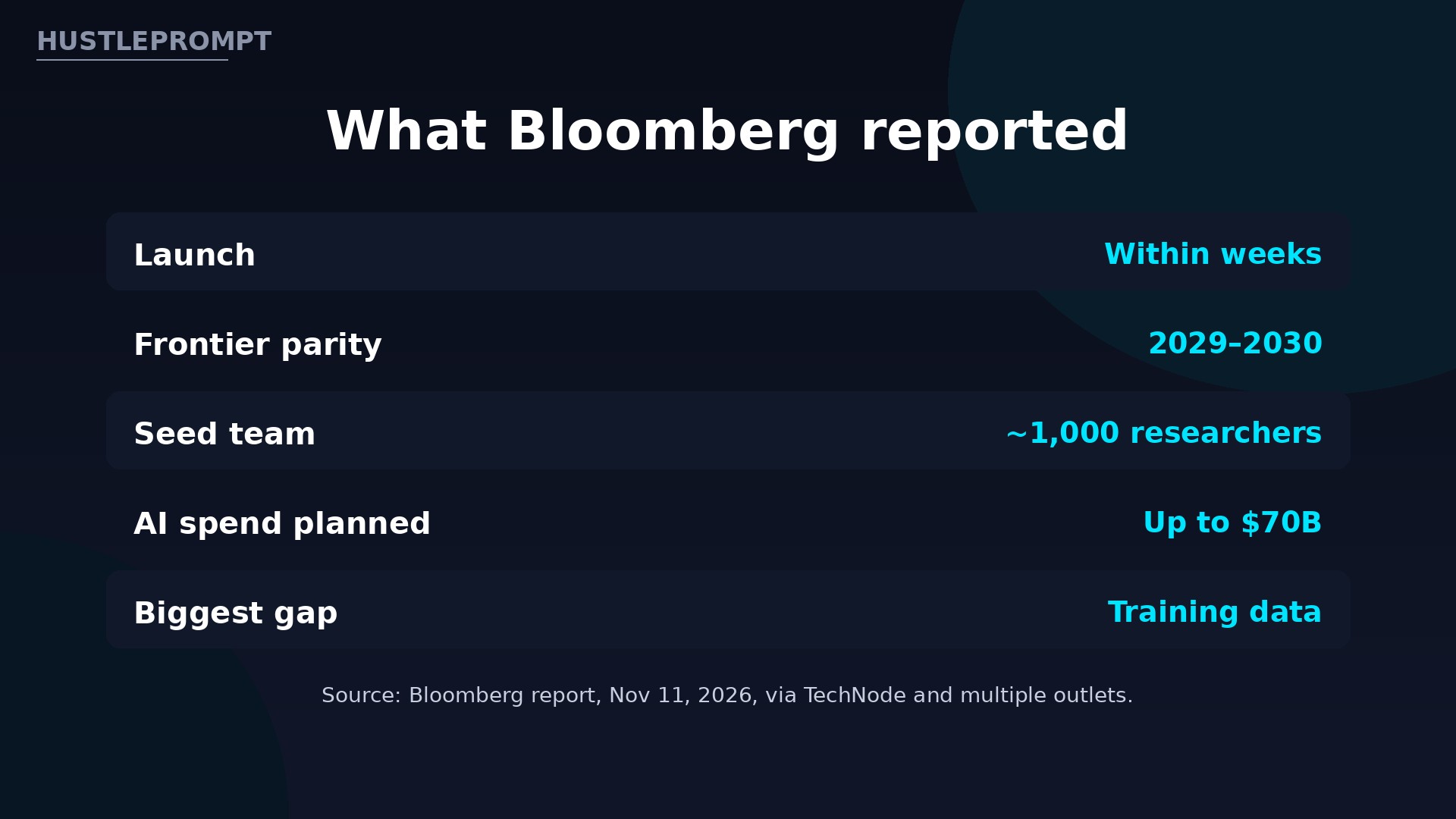
What Bloomberg reported
| Launch | Within weeks, per Bloomberg’s sources |
| Frontier parity | 2029\u20132030 at the earliest, per co-founder Zhang Yiming |
| Seed team | About 1,000 researchers and engineers, led by Wu Yonghui (ex-Google DeepMind, joined 2025) |
| AI spend planned | Up to $70 billion in AI infrastructure |
| Biggest gap | Training data: Seed language models are pre-trained on datasets orders of magnitude smaller than frontier rivals |
| Distillation | Zhang says the team should not lean on it — no training on bigger models’ outputs |
| Status | Unconfirmed: ByteDance did not respond to Bloomberg’s request for comment |
Source: TechNode: ByteDance reportedly plans AI assistant similar to Meta’s Muse, November 12, 2026, reporting the Bloomberg story of November 11, 2026.
Why Muse is the target
Muse is the product every AI lab is now chasing. Meta introduced it in September 2026 as a voice-based agent with an animated avatar, distributed through its smart glasses and a planned device called the Muse Charm, due in December. It passed 10 million US downloads within its first 40 days, and 10.9 million global downloads since launch, according to TipRanks — one of only a dozen mobile apps ever to reach that milestone that fast. Meta CEO Mark Zuckerberg has predicted the assistant could generate more revenue per user than Meta’s existing family of apps.
Meta is not standing still either. Reports this week say the company is preparing to launch Muse to users in the UK and build a sales team to sell its AI products to businesses. ByteDance is aiming at a moving target — and a target with a head start of months, millions of users, and hardware already in the pipeline.
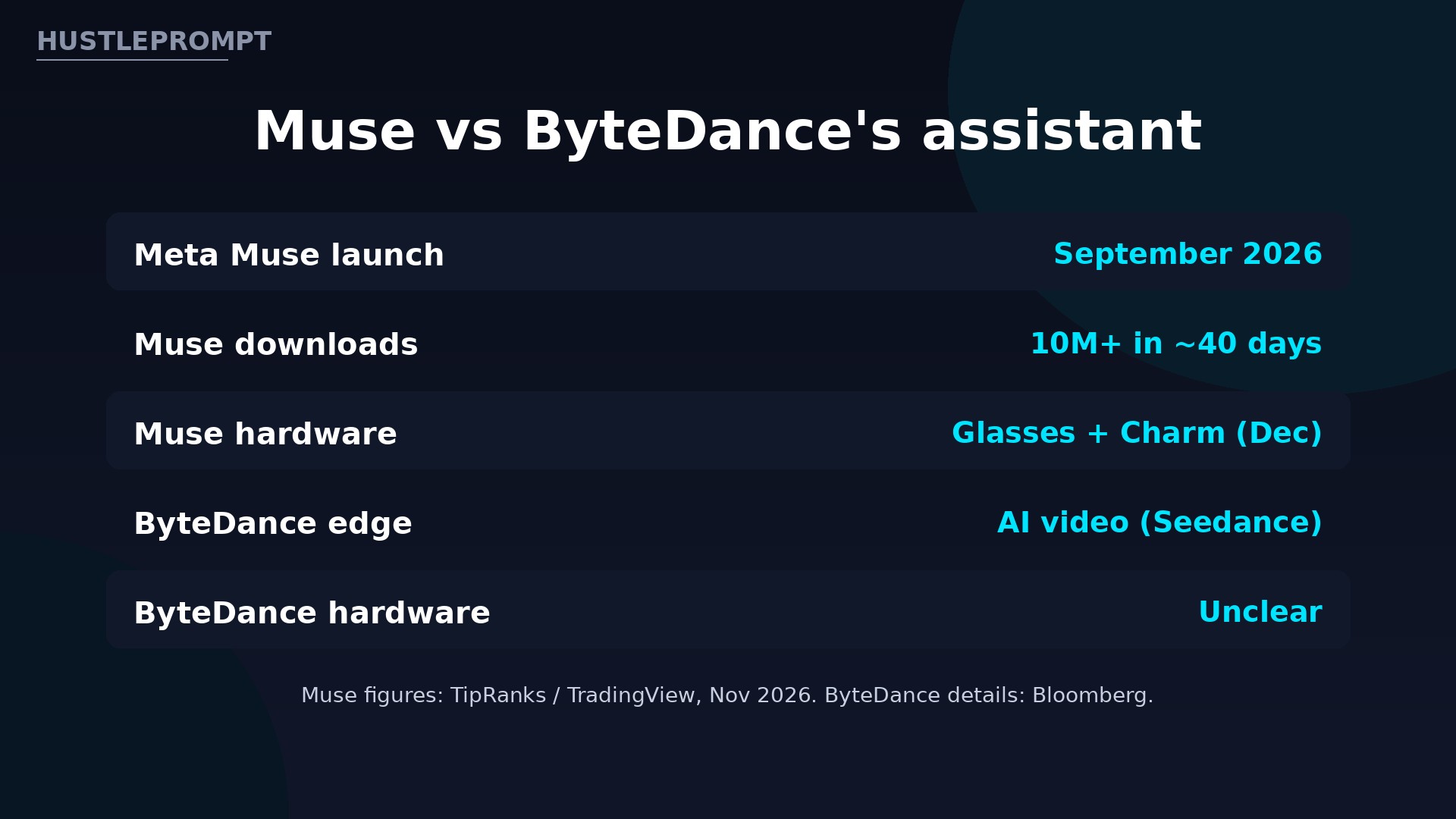
Muse vs ByteDance’s assistant
| Meta Muse launch | September 2026 — voice-based agent with an animated avatar |
| Muse downloads | 10M+ in ~40 days (US); 10.9M global since launch |
| Muse hardware | Smart glasses now; Muse Charm device due December 2026 |
| ByteDance launch | Within weeks, per Bloomberg — unconfirmed by ByteDance |
| ByteDance edge | AI video: Seedance models are already a paid product; Doubao chatbot live |
| ByteDance hardware | Unclear — Bloomberg reports no word on a companion device |
Sources: TipRanks and TradingView/Benzinga for Muse figures; Bloomberg via TechNode for ByteDance plans, November 2026.
Bloomberg reports Zhang Yiming told staff ByteDance can compete with OpenAI and Anthropic at the cutting edge — “but not before 2029 or 2030.” — as reported by Bloomberg, November 11, 2026
What ByteDance has that Meta doesn’t
The assistant is not ByteDance’s first AI product. The company already operates Doubao, its AI chatbot, and sells access to its Seedance family of video-generation models. The reported plan is to build the new assistant on that video strength — a voice-style agent that can make and edit video, not just chat about it. That is the one area where ByteDance can credibly claim a lead today, while its language models catch up.
Distribution is the other asset. TikTok is one of the largest consumer apps on earth, and ByteDance knows how to put a new feature in front of a billion people overnight. Meta’s answer to that is its own distribution — Facebook, Instagram, WhatsApp, and the Ray-Ban glasses on people’s faces. The assistant race is a distribution race, and both sides know it.
How to profit while the assistant is still a rumor
Nobody can build on a product that has no name, no price, and no launch date. But the direction of travel is clear enough to act on — and the skills it rewards are the same ones ByteDance is hiring for.
Test Doubao and the Seedance video models now, plus CapCut — ByteDance’s editor — so you know the toolchain before the assistant lands.
The winning format will be short video made by an agent, not text. Practice prompts that direct a video model like a film crew.
A named product, a demo, or a ByteDance announcement — not another report — is the moment to move. Until then, treat it as a rumor.
New assistants need creators, templates, and services on day one. The first video-agent services for the new assistant will be the ones clients remember.
For creators, the near-term play is video: short-form clips, product demos, and ads made with AI video tools are already selling, and a ByteDance assistant would only widen that market. For developers and agencies, the play is packaging — offer “video-agent content” as a service to businesses that want TikTok-style output without hiring a team. The 2029–2030 frontier timeline means the smart money is on the video layer now, not on waiting for a ByteDance model to beat GPT or Claude.
The catch
First, this is a report, not an announcement. One Bloomberg story, sourced to people familiar with an internal meeting, is the entire basis of the news. ByteDance has said nothing, and the assistant has no name, no demo, and no confirmed date. Reports can be wrong, and plans can change.
Second, the founder’s own timeline is the warning label. If ByteDance’s co-founder says frontier parity takes until 2029 or 2030, then whatever launches in the coming weeks is a product built on models that trail the leaders by years — useful for video and everyday tasks, not a rival to the best reasoning models. The data gap he named is the reason: Seed models are pre-trained on datasets orders of magnitude smaller than the frontier labs’.
Third, it may never reach you. Bloomberg says it is unclear whether the assistant will be offered outside China, and unclear whether ByteDance will build hardware for it. A China-only launch with no device would still matter — it would be a huge market — but it would not change anything for a US creator or business.
Frequently asked questions
Is ByteDance’s Muse-style assistant confirmed?
No. Bloomberg reported on November 11, 2026 that ByteDance plans to launch it within weeks, citing people familiar with an internal meeting. ByteDance has not confirmed the plan and did not respond to Bloomberg’s request for comment.
When will ByteDance’s AI assistant launch?
Within weeks, according to Bloomberg’s sources — but there is no confirmed date, no product name, and no public demo. Treat the timing as reported, not announced.
What will ByteDance’s assistant do?
That is unclear. Bloomberg says it will serve a similar role to Meta’s Muse — a voice-based agent with an animated avatar — and build on ByteDance’s strength in AI video. ByteDance already runs the Doubao chatbot and sells Seedance video-generation models.
Will it be available outside China?
Unknown. Bloomberg reports it is unclear whether the assistant will reach users outside China, and unclear whether ByteDance will build companion hardware for it.
What is Meta Muse?
Muse is Meta’s voice-based AI assistant with an animated avatar, launched in September 2026. It runs on Meta’s smart glasses and is coming to a dedicated device, the Muse Charm, due in December. It passed 10 million US downloads in its first 40 days.
What does this mean for TikTok creators?
Not much yet. Until ByteDance announces a product, the practical move is to learn its existing video tools — Seedance, Doubao, and CapCut — because a video-first assistant would reward creators who already work in that format. Watch for a named launch before changing any plans.