
The biggest chip order you’ve never heard of just rewrote the AI supply map. ByteDance, Alibaba, and Tencent have ordered more than 3 million NVIDIA RTX PRO 5500 China graphics cards in a deal worth over $35 billion, according to Reuters’ exclusive reporting.
That’s roughly $11,400 per card — and the buyers may receive as little as 5-10% of what they asked for. This is the AI chip gold rush, 2026 edition, playing out in the one market NVIDIA is barely allowed to serve.
The Numbers Behind the $35B Order
Reuters reports the three Chinese tech giants placed a combined order for more than 3 million RTX PRO 5500 cards. Here is the deal, sourced to Reuters (Oct 20, 2026) and TrendForce (Oct 21, 2026):
| Metric | Figure | Source |
|---|---|---|
| Cards ordered (3 giants) | 3M+ | Reuters |
| Total China orders | 6M+ | Reuters (source) |
| Sticker price per card | ~$11,400 | Reuters |
| Combined order value | Over $35B | Reuters |
| Max global production (2027) | 3M cards | Reuters (source) |
| Expected fulfillment | 5-10% of requests | Reuters (source) |
| Samples / commercial shipments | Dec 2026 / Q1 2027 | TrendForce |
The stat highlights:
- $35 billion+ — combined sticker price of the three orders (Reuters exclusive).
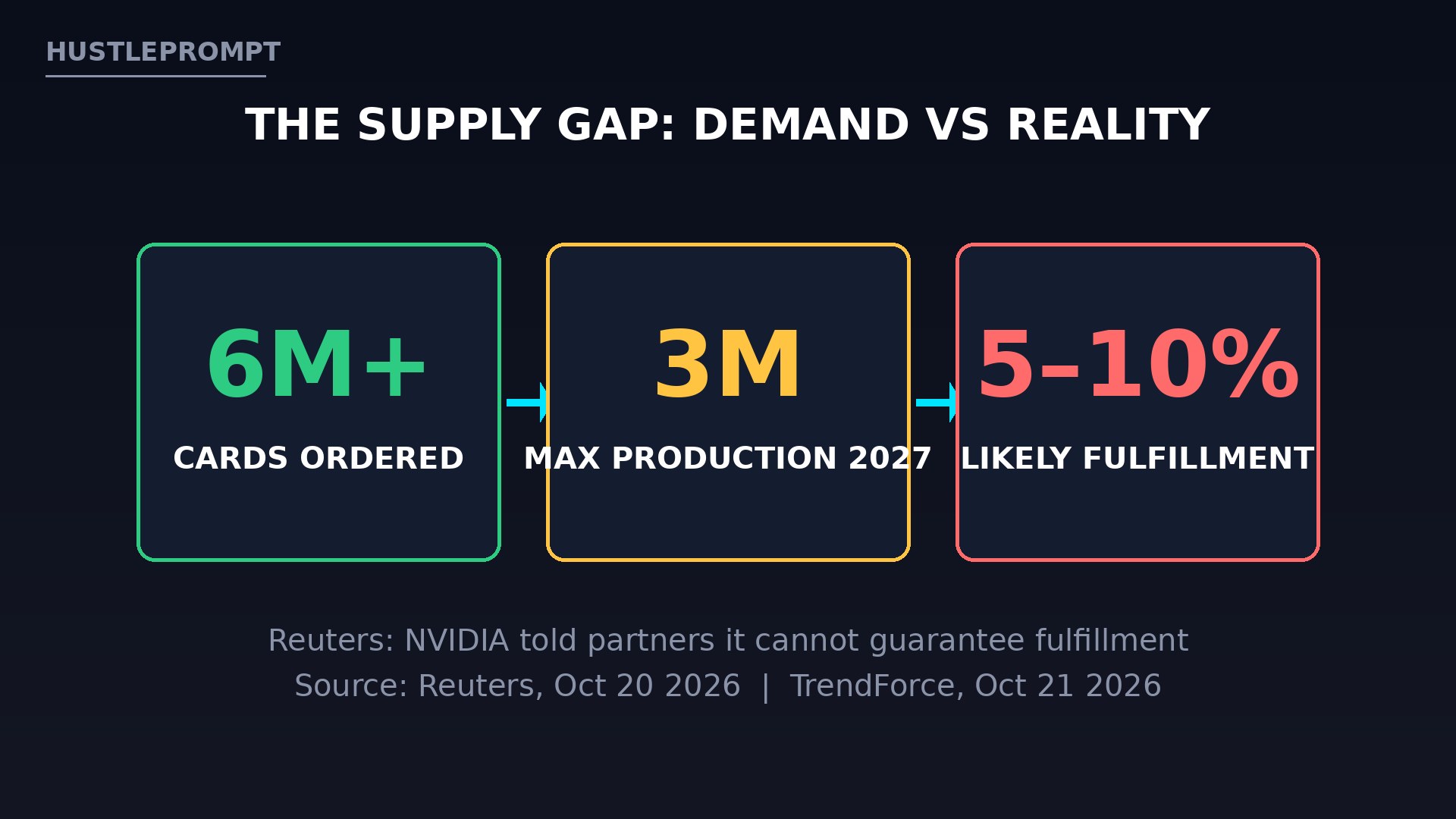
- 6 million+ — total China orders vs. a hard ceiling of ~3M cards NVIDIA can produce globally in 2027.
- 5-10% — share of requested volumes partners may receive (Reuters source).
- Over 90% to nearly zero — Jensen Huang on NVIDIA’s collapsed China AI accelerator share.
NVIDIA told partners it cannot guarantee fulfillment: buyers may see only 5-10% of requested volumes, and Chinese orders already exceed 2027’s global production ceiling.
What the RTX PRO 5500 Actually Is
Here’s the twist: the RTX PRO 5500 is a workstation chip — the kind built for high-end professional desktop computers — not a data-center AI accelerator. Per NVIDIA’s official specs: Blackwell architecture, 84 GB of GDDR7 memory, fifth-gen Tensor Cores, and multi-instance GPU support that splits one card into two isolated 42 GB instances.
Why spend $35 billion on workstation cards? Because the RTX PRO 5500 is among the most powerful NVIDIA chips still legally available to Chinese buyers. US export controls bar Blackwell-based B300 sales to China, and the Hopper-based H200 needs case-by-case licensing. The workstation route is the legal gap in the wall.
Export Controls, Explained Simply
The US restricts which advanced chips can be sold to China: the fastest data-center chips (like the B300) are banned, mid-tier ones (like the H200) need licensing, and workstation GPUs like the RTX PRO 5500 currently fall on the permitted side. China’s giants are stockpiling while they can.
The Supply-Demand Gap, Visualized
Why Inference Is the Real Story
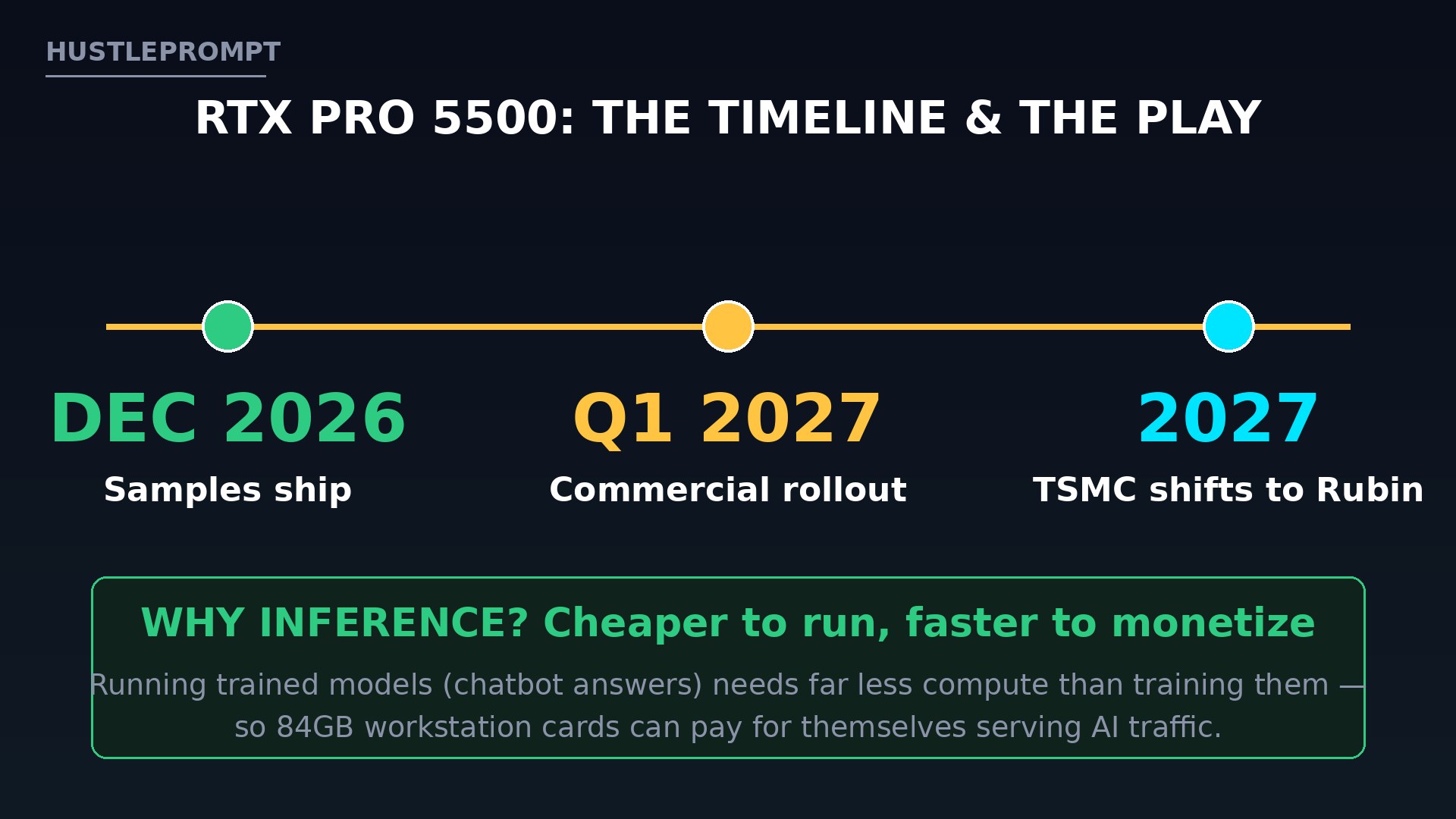
The giants don’t want these cards for training — the massively expensive process of teaching a model from scratch. They want them for inference: running already-trained models to serve chatbot answers to users.
Inference is the cheaper, faster side of AI: training costs hundreds of millions, serving answers costs a fraction — and generates revenue from day one. The RTX PRO 5500 is a revenue machine, not a science project.
Samples are expected in December 2026, commercial shipments in Q1 2027. NVIDIA is expected to devote much of its TSMC capacity to the next-gen Rubin architecture from 2027 — so this card’s production window may be short. Buy now or miss it.
How to Profit: What This Means for You
This isn’t just a China story. It’s a market signal. Here’s how to read it — and act on it:
- Treat chip supply as a market indicator. When the world’s biggest AI buyers bid 2x over available supply, compute scarcity is the thesis. Watch GPU cloud pricing — sustained highs confirm the squeeze.
- Build on inference, not training. You’ll never out-train a tech giant. But serving models — chatbots, agents, voice AI — runs on exactly this class of hardware. That’s where the margin is.
- Sell picks and shovels to the inference boom. Inference needs orchestration, monitoring, and cost optimization. Every restricted buyer becomes a customer for efficiency software — the export-control gap expanded your market.
- Watch the secondary market. A 2x order-to-supply ratio means gray-market premiums on workstation GPUs — know the legal boundaries before touching this trade.
- Position before Q1 2027. Shipments land Q1 2027; Rubin eats TSMC capacity after that. The window for inference-compute plays is roughly 12-18 months.
FAQ
What is the NVIDIA RTX PRO 5500?
A Blackwell workstation GPU with 84 GB of GDDR7 memory for professional desktops and enterprise racks. It powers LLM inference, AI agents, simulation, and rendering (NVIDIA).
How much did ByteDance, Alibaba, and Tencent order?
More than 3 million cards combined, worth above $35 billion — roughly $11,400 per card (Reuters).
Will NVIDIA fulfill the full order?
No. NVIDIA told partners it cannot guarantee fulfillment: buyers may receive only 5-10% of requested volumes, and total Chinese orders (6M+) exceed NVIDIA’s max 2027 production (~3M cards).
Why are Chinese companies buying workstation chips instead of data-center GPUs?
Export controls block B300 sales to China and require licensing for the H200. The RTX PRO 5500 is among the most powerful NVIDIA chips still legally available there.
What is AI inference and why does it matter?
Inference is running a trained model to serve answers — like a chatbot responding to you. It needs far less compute than training, costs less, and earns revenue immediately.
When will the RTX PRO 5500 ship?
Samples in December 2026, commercial shipments in Q1 2027 (TrendForce). NVIDIA is expected to shift much TSMC capacity to next-gen Rubin from 2027.
What does this mean for AI investors and builders?
Compute scarcity is deepening. Inference businesses, GPU cloud capacity, and efficiency software all benefit. The 12-18 month window before Rubin is the play.