
Nearly half of all online products change price within a single month. PriceRest’s 2026 study of 522,878 daily prices across 261 stores in 24 countries found 46% changed price at least once in 30 days. The typical gap between two changes was about six days. Most online sellers still check competitor prices by hand — a spreadsheet, a quick look once a week. By then the market has moved twice. That gap is the business: selling AI competitor price monitoring to Amazon, Etsy and Shopify sellers. You track their rivals’ prices, alert them when something moves, and use AI to suggest the next move.
Transparency note: this article uses the standard HustlePrompt block that embeds a third-party video tutorial. Where the tutorial text cites earnings examples or ranges, they are always presented as illustrative references — never as promises of income.
What the service is, exactly
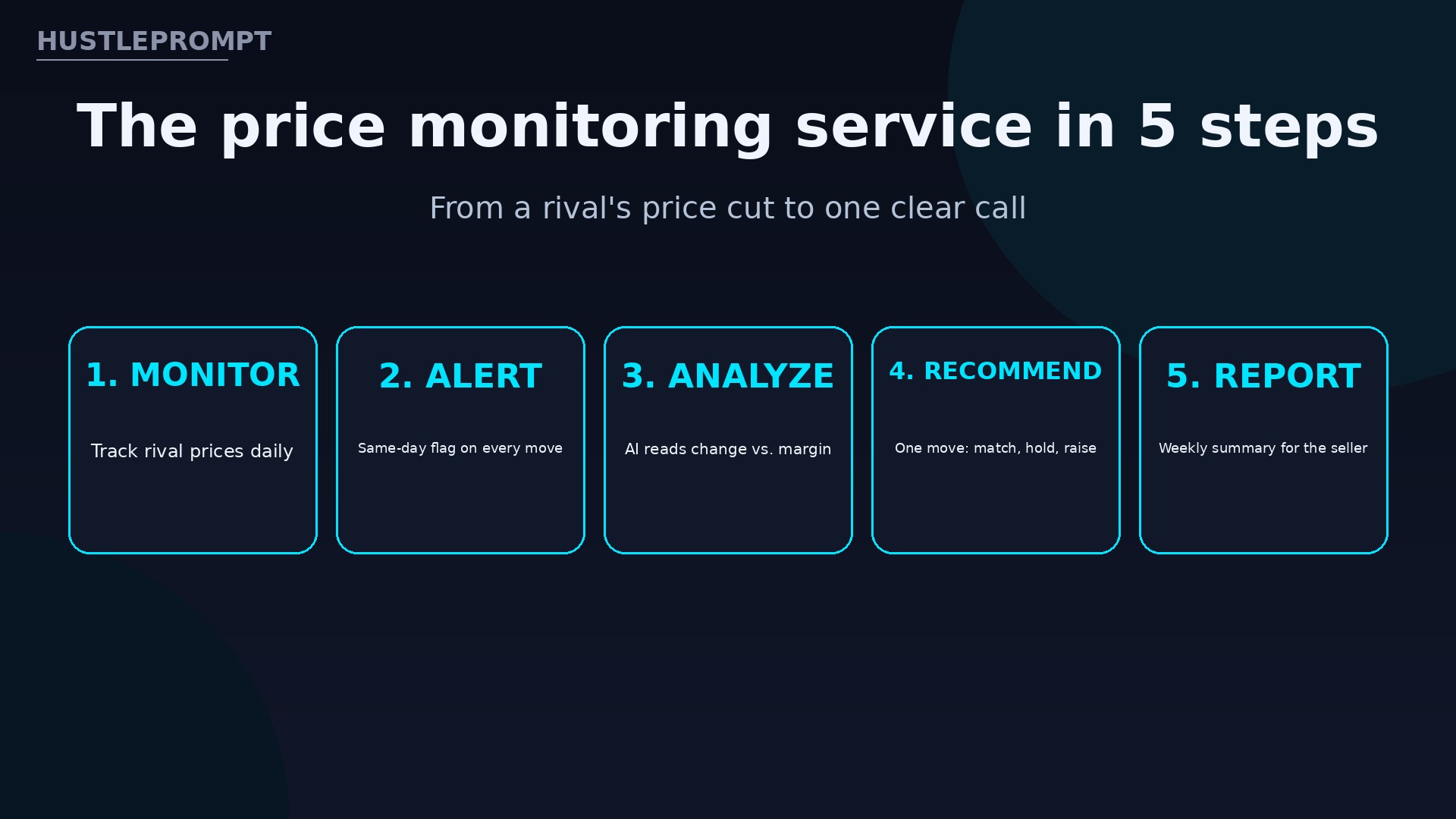
You run a price watch for one online seller:
- Track: the seller’s top products and rival listings chasing the same buyers, checked daily.
- Alert: a same-day message when a rival cuts a price or runs out of stock.
- Recommend: AI reads the change, margin and stock, then suggests one move — match, undercut a little, hold, or raise.
- Report: a weekly report — what moved, what you recommended, what is next.
The AI never sets the price. It reads the market and drafts the recommendation.
Rival prices on Amazon, Etsy, Shopify.
Same-day flag when a price moves.
AI reads the change against margin and stock.
One move: match, undercut, hold or raise.
Weekly summary: moves, calls, watch list.
The evidence: prices move faster than any human can watch
Sellers who check by hand are not lazy — they are outnumbered. PriceRest tracked the same products daily for 90 days, July 8 to October 6, 2026:
| Metric | Result | What it means |
|---|---|---|
| Products that changed price in 30 days | 46% | Half the catalog moves monthly |
| Products that changed 3+ times in 30 days | 23% | A quarter move constantly |
| Gap between two changes | About 6 days | Weekly checks miss most moves |
| Median price change | 10% | Big enough to cost real money |
Amazon is the fastest market of all. Decodo tracked 12 products on each of 120+ e-commerce sites through 2025, checking prices every four hours. Amazon alone recorded 116,509 price changes — ahead of Walmart at 68,926 and Target at 39,386. About half were increases and half decreases.
The evidence: the Buy Box rewards the seller who reacts first
On Amazon, speed pays twice. Over 82% of Amazon sales go through the Buy Box — the “Add to Cart” button only one seller holds — and 70% of shoppers never scroll past the first offer. Ascent Repricer found consistent Buy Box winners average 47% higher sales volume (1,000+ UK Amazon sellers). Their AI repricing users win it 73% of the time, against 45% for manual repricing.
The lesson is not “always be cheapest.” Feedvisor’s 2026 guide puts Amazon’s pricing tolerance at roughly 5% of the lowest offer — inside that window, delivery speed and seller metrics decide the winner. React within hours and you keep the Buy Box. Check on Sunday and you lost a week of sales.
Your costs: what the tools actually charge
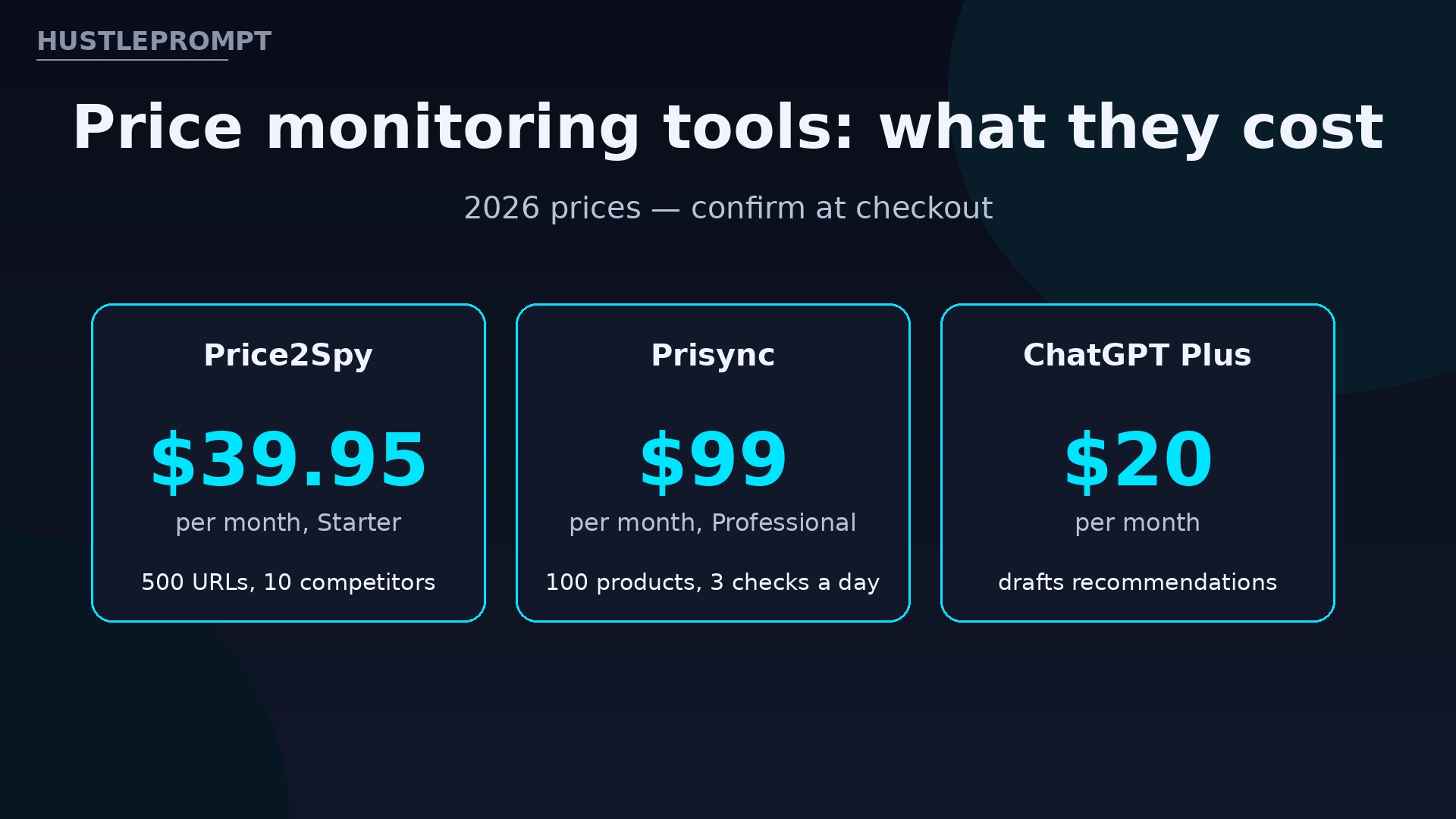
| Tool | Price (Nov 12, 2026) | What you get |
|---|---|---|
| Price2Spy Starter | $39.95/month | 500 URLs, 10 competitors, alerts |
| Prisync Professional | $99/month | 100 products, unlimited competitors, 3 checks a day |
| Prisync Premium | $199/month | 1,000 products, repricing engine |
| ChatGPT Plus | $20/month | Drafts price recommendations |
| Google Sheets | $0 | Price log and client dashboard |
Prices change, so confirm each at checkout. Price2Spy’s figure comes from October 2026 roundups — its pricing page now points to a quote — and Prisync’s from its published plans. Normal practice: the client pays the tool and you pay the $20 AI plan. A realistic starter stack: Price2Spy at $39.95 plus one $20 AI plan.
Step 1: pick one marketplace and one niche
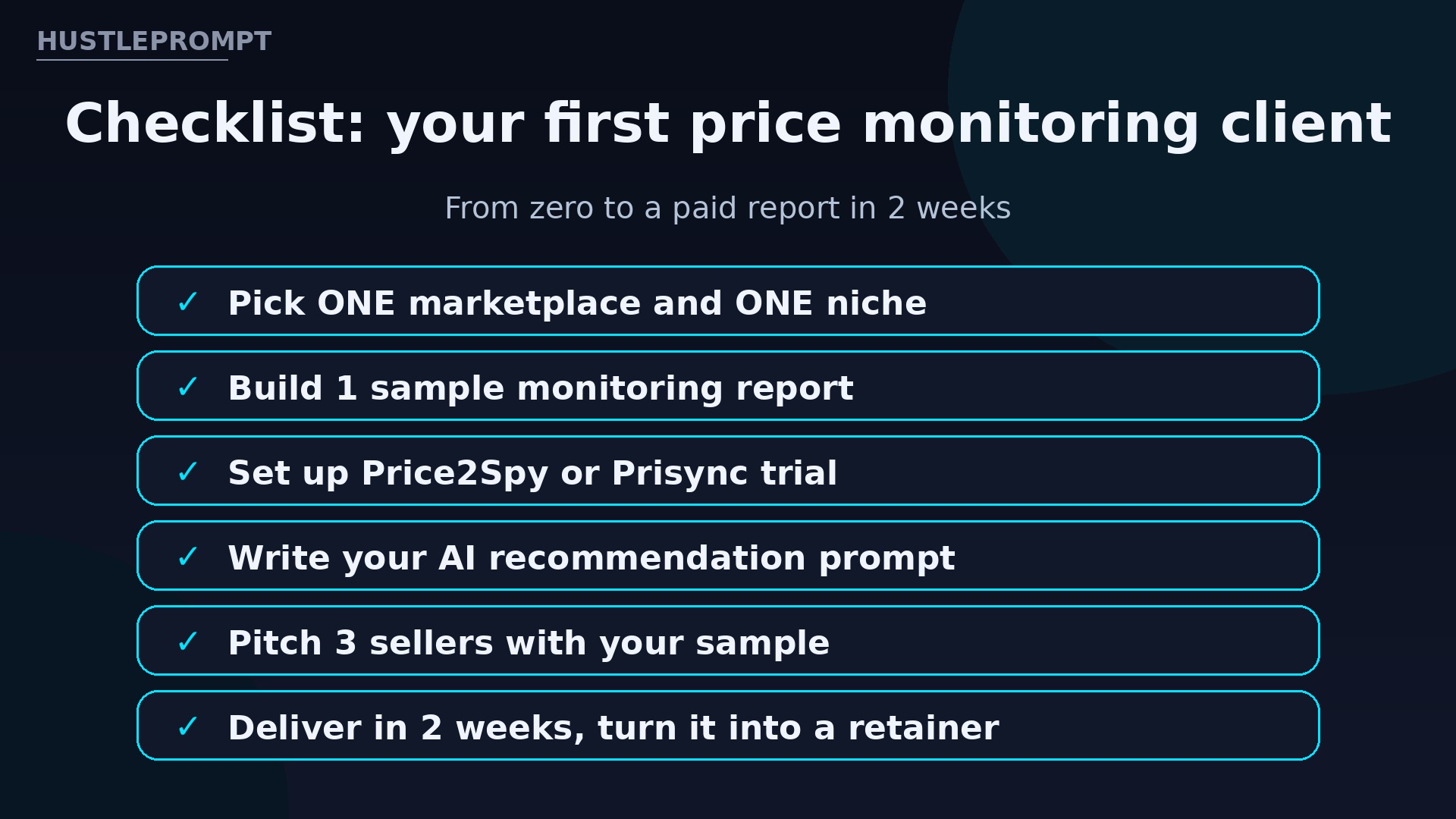
Do not start with “any online seller.” Pick one marketplace — Amazon, Etsy or Shopify — and one fast-moving niche: phone accessories, beauty, home goods or pet supplies. One niche means reusable competitor lists, one pitch and referrals in one community. Beauty is a strong first pick: 65% of beauty products changed price within 30 days in the PriceRest study, typically every 4.5 days.
Step 2: build a sample monitoring report first
Pick five real products in your niche and track rival prices by hand for one week. Turn the results into a one-page sample report: which rival moved, by how much, and the move you would have recommended. The report is your portfolio. Sellers do not buy “AI monitoring” — they buy the page showing a rival cut $4 on Tuesday while they found out on Sunday.
Step 3: set up the stack and the AI prompt
Start on Price2Spy’s Starter plan or Prisync’s 14-day trial: add the client’s products, paste in three to five competitor URLs per product, and set the check frequency. Then write your recommendation prompt once and reuse it: paste the price change, cost, price limits and stock level, and ask the AI for one move with the margin math shown. Never let the AI change a price on its own.
Step 4: the pitch — sell the missed sale, not the dashboard
Sellers in Facebook groups, Etsy forums and Amazon communities already complain about rivals undercutting them. Join with your sample report, not a sales pitch. Lead with their problem — a rival dropped $3 and they kept the old price for a week — show the report that would have caught it in hours, and offer a 30-day trial. Promise tracking, alerts and recommendations — never a Buy Box win.
Step 5: deliver weekly, review monthly, renew
In month one, deliver exactly what was sold: daily checks, same-day alerts on real moves, and a weekly report — how many rivals moved, the biggest change, and the one call that mattered. At the monthly review, show the log: moves caught and margin on the products you watched. If the seller sees the moves they would have missed, the retainer sells itself.
What to charge: an illustrative framework
There is no official price list — treat this as a framework to validate, not as expected income. Most solo operators charge a one-time setup fee plus a monthly fee that scales with products watched, with the tool billed separately:
| Package (illustrative) | What it includes | Typical structure |
|---|---|---|
| Setup | Product list, competitor URLs, price limits | One-time fee |
| Monitor | 50 products, daily checks, weekly report | Monthly fee |
| Monitor + Recommend | 200 products, checks several times a day, AI recommendations, alerts | Higher monthly fee |
The logic: a client whose best seller turns over daily covers your monthly fee with one avoided undercut. Price from catalog size and sales volume, not from your tool cost.
The mistakes that kill this business
- Chasing every price cut. Matching a rival below the floor price burns margin.
- Letting the AI reprice alone. A wrong cost becomes a real loss.
- Tracking too many products. Fifty products watched well beat 500 watched badly.
- Alerting on noise. A 1% wobble is not a move — set a 3% or $1 threshold.
- Promising the Buy Box. You sell tracking and recommendations. Amazon decides the Buy Box.
Frequently Asked Questions
Is tracking competitor prices legal?
Monitoring publicly listed prices is standard practice. Read only public listings, follow each marketplace’s terms, and never share one client’s prices with another seller.
Do I need the client’s Amazon Seller Central access?
Not to start. Monitoring reads public listings, so you need only the product list and price limits. Automatic repricing is separate and needs account access and a written agreement.
How often should prices be checked?
Daily is the minimum — PriceRest shows a typical gap of about six days between changes, so weekly checks miss most moves. For fast niches like beauty, check three times a day.
Will the AI change my client’s prices automatically?
No — not in this service. The AI drafts one recommendation with the margin math shown, and you approve it first. Automatic repricing is separate and higher-priced. The embedded video shows how rule-based repricing strategies are built.
What does the service cost the seller?
The tool part is small: Price2Spy Starter is $39.95 a month and Prisync Professional is $99 a month, checked November 12, 2026. Your fee is separate.
Keep Reading
- Sell AI Amazon Listing Services to E-Commerce Sellers — the same seller playbook for listings.
- Sell AI Product Photo Enhancement Services to Etsy Sellers — win the click before the price war.
Sources: PriceRest, “How Often Do Online Prices Change? (2026)” — pricerest.com; Decodo 2025 data via eCommerceNews Asia — ecommercenews.asia; Ascent Repricer, “How to Win the Buy Box on Amazon UK” — ascentrepricer.com; Feedvisor, “FBA Repricers (2026)” — feedvisor.com; pricing checked Nov 12, 2026 via 2026 roundups — Prisync, Price2Spy.