
The company behind the toolkit that built the agent economy just got a lot more expensive. LangChain $300M is the headline: LangChain raised $300 million at a $3 billion valuation in a round led by CapitalG, Alphabet’s independent growth fund, according to The Wall Street Journal on November 12, 2026. That is 2.4 times the $1.25 billion valuation from just a year ago — and the money is going straight into the software layer that sits between AI models and the businesses trying to use them.
LangChain is not a model company. It makes the open-source framework developers use to connect language models to data and tools, coordinate multi-step agent workflows, and monitor agents after deployment. The raise is a bet that the agent boom’s winners will be the companies that make agents reliable — not the ones that make the models. Here is the deal, the history, and how to profit from it.
LangChain’s $300M round, at a glance
| Amount raised | $300 million |
| Valuation | $3 billion — 2.4x the $1.25 billion of October 2025 |
| Lead investor | CapitalG, Alphabet’s independent growth fund |
| Other investors | IVP, Sapphire Ventures, GIC (Singapore’s sovereign wealth fund), DFJ Growth |
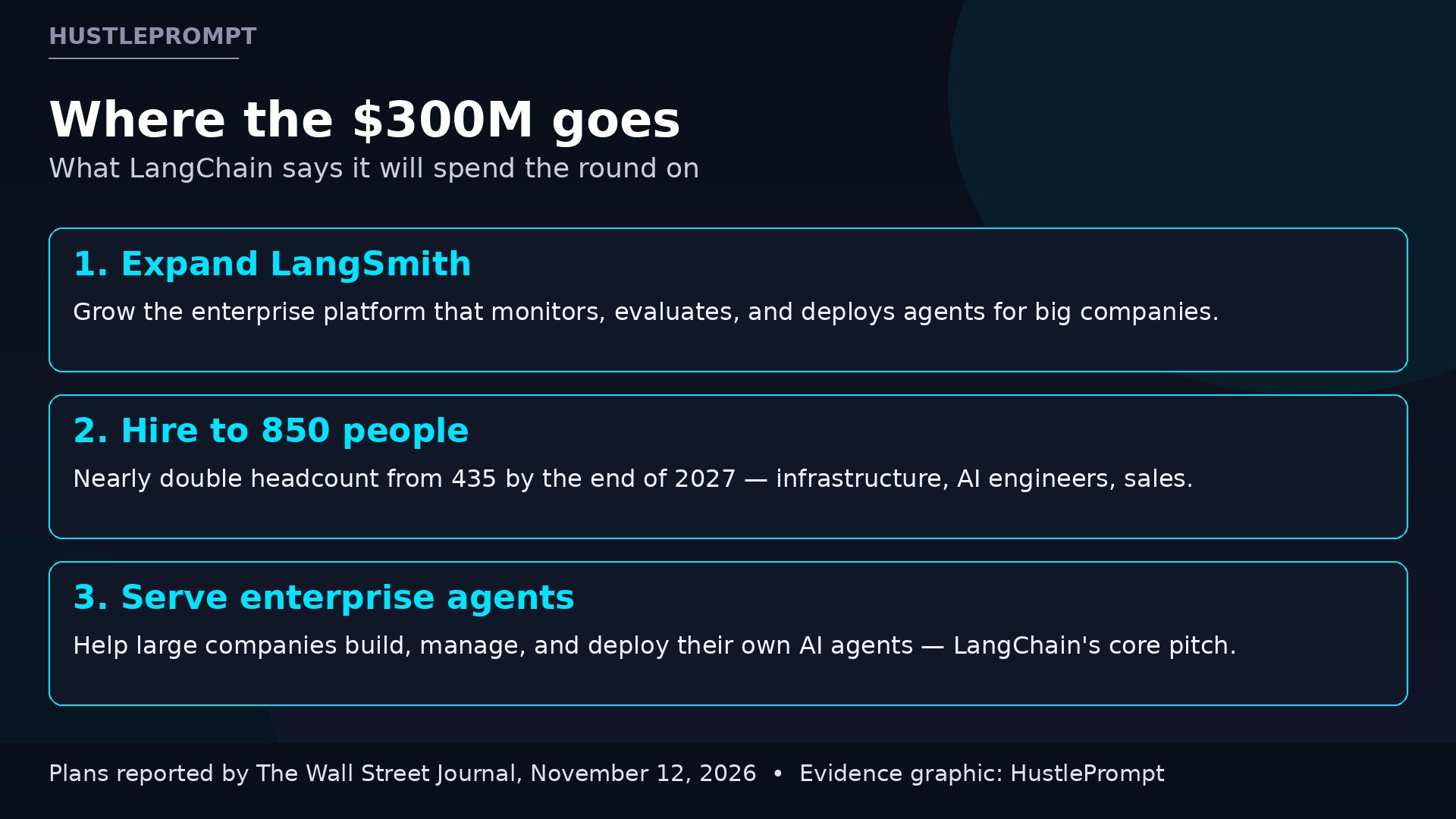
| Use of funds | Expand LangSmith, the enterprise platform for monitoring, evaluating, and deploying AI agents |
| Headcount | 435 employees now; plans to nearly double to 850 by the end of 2027 |
| Status | Reported by The Wall Street Journal, November 12, 2026. LangChain has not published its own announcement, and the exact closing date has not been disclosed. |
Source: The Wall Street Journal — AI Startup LangChain More Than Doubles Its Valuation to $3 Billion, November 12, 2026; corroborated by SiliconANGLE and Dealroom coverage.
From a $10M seed to $3B in three years
LangChain started in October 2022 — five weeks before ChatGPT — as an open-source project by Harrison Chase, then an engineer at Robust Intelligence. The framework became the standard toolkit for building on language models, and the company grew with it:
- April 2023: $10 million seed round led by Benchmark.
- 2023: $25 million Series A led by Sequoia, at about a $200 million valuation.
- January 2024: LangGraph launches, for building agents as stateful, multi-step workflows.
- July 2025: Deep Agents arrives — an open-source agent harness for long, multi-step tasks.
- October 2025: $125 million Series B led by IVP at a $1.25 billion valuation, alongside the LangChain 1.0 and LangGraph 1.0 releases.
- November 2026: $300 million at a $3 billion valuation, led by CapitalG — which first invested in the Series B, alongside Sapphire Ventures.
Before this round, LangChain had announced about $160 million across three rounds. The new round nearly triples that total in one move. LangChain says it works with 35% of the Fortune 500, has crossed 1 billion open-source downloads, and its LangSmith platform ingests more than 1 billion events per day, according to the company’s own About page. Revenue is not publicly disclosed — the company has never published it — so do not trust any revenue number you see attached to this deal unless LangChain says it itself.

Why CapitalG is paying 2.4x
The funding story is about the layer around the model. Models are getting cheaper and more interchangeable — Google’s Gemini, Anthropic’s Claude, OpenAI’s GPT, and open models all compete on price and capability. What companies actually struggle with is everything around the model: connecting it to their data, chaining it into workflows that do not break, and knowing when an agent goes wrong in production.
That is LangChain’s business. Its pitch, in CEO Harrison Chase’s words, is to help large companies build, manage, and deploy their own AI agents. The commercial product is LangSmith, and the new money goes to expanding it:
- Observability: traces, version comparisons, and tools that show exactly where an agent’s execution went wrong.
- Evaluation: testing agents against real workloads before they reach customers, and catching regressions after every change.
- Deployment: Managed Deep Agents, in public beta since August 2026, deploys a Deep Agent to a managed runtime with one command — durable execution, sandboxes, and tracing built in.
- Improvement: LangSmith Engine tests its own fixes on production deployments and red-teams agents for failure modes.
CapitalG is Alphabet’s growth fund, and Alphabet owns Google — which sells the very models LangChain’s tools sit on top of. The fund betting $300 million on the agent layer, rather than on another model lab, is a strong signal about where the durable value is: in the harness, the observability, and the governance around agents, not in the weights themselves.

The numbers behind the valuation
A $3 billion private valuation is a financing signal, not an independent measurement of customer return on investment. But the trajectory is real, and the context makes it more striking — the wider AI funding market is cooling, not heating up:
LangChain’s funding history — and the market around it
| Round | Amount | Lead | Valuation |
|---|---|---|---|
| Seed, April 2023 | $10M | Benchmark | Not disclosed |
| Series A, 2023 | $25M | Sequoia | About $200M |
| Series B, October 2025 | $125M | IVP | $1.25B |
| New round, November 2026 | $300M | CapitalG | $3B |
Sources: The Wall Street Journal, November 12, 2026; company announcements for earlier rounds. Market context: global AI venture funding passed $500 billion in the first nine months of 2026, but third-quarter deal value fell 43.4% from the second quarter to $94.3 billion, according to PitchBook data cited by the Journal.
Read that context carefully. In a quarter when AI deal value dropped more than 40%, a $300 million round at a 2.4x valuation still got done — and it was led by a fund that already knew the company from the inside. That is what “flight to quality” looks like in a cooling market: fewer bets, bigger checks, on companies with real enterprise traction. It also means the bar for everyone else just went up. Agent-infrastructure startups now compete against a $3 billion incumbent with 435 people and a hiring budget for 415 more.
How to profit from the agent-infrastructure boom
A $300 million raise is a hiring wave, a skills signal, and a market map all at once. Here is how to get paid from it:
- Learn LangGraph and Deep Agents now. The framework is free and open source, and the company is about to hire 415 people to build on it. Developers who can ship reliable agents with LangGraph are exactly who enterprises are hiring — agent roles already pay up to $230K, and demand is rising with every funding round.
- Sell LangSmith observability setups. Companies deploying agents need tracing, evaluation, and monitoring — and most do not have it. Offer a fixed-price “agent observability audit”: wire up LangSmith, find where agents fail, and deliver a report. The reliability gap is the product.
- Offer agent evaluation as a service. Before an agent reaches customers, someone has to test it against real workloads and catch regressions. Build evaluation suites for verticals you know — legal, finance, e-commerce — and sell them as a recurring service.
- Build vertical agents on the open framework. LangChain’s tools are open source. The money is in vertical agents — a claims-processing agent for insurers, a research agent for law firms — built on the free harness and sold as a product or service.
- Teach it while the news is hot. A course or workshop on Deep Agents and LangSmith, published this week, rides the search wave from the funding news. Managed Deep Agents in public beta is the natural hands-on module.
- Watch the hiring wave. 415 new roles — infrastructure specialists, AI engineers, salespeople, marketers — will open over the next year. If you sell to LangChain’s ecosystem (consulting, training, tooling), its hiring page is your lead list.
From prototype to production in 4 steps
The LangSmith lifecycle the $300M is funding
1. Build it
Author a Deep Agent in Python or TypeScript with the open-source harness — planning, memory, and subtasks included.
2. Test it
Run evaluations in LangSmith against real workloads. Trajectories show every agent session as a readable conversation.
3. Deploy it
Ship to a managed runtime with one command. LangSmith handles persistence, sandboxes, and deployment.
4. Improve it
Monitor production traces, spot failures, and let LangSmith Engine test fixes and red-team the agent.
Every step is where LangChain now makes its money — and where the $300M goes. The framework stays free; the reliability layer is the business.
Watch it in action
LangChain’s own introduction to Managed Deep Agents — the product the new funding is built to expand — shows how a Deep Agent goes from prototype to a managed production runtime:
Watch: Harrison Chase introduces Managed Deep Agents — deploy your Deep Agent to a managed LangSmith runtime with one command. Video: LangChain (official channel).
Frequently asked questions
How much did LangChain raise?
$300 million, at a $3 billion valuation, in a round led by CapitalG and reported by The Wall Street Journal on November 12, 2026. IVP, Sapphire Ventures, GIC, and DFJ Growth also took part. LangChain has not published its own announcement of the round.
Who led LangChain’s $300M round?
CapitalG, Alphabet’s independent growth fund. CapitalG and Sapphire Ventures first invested in LangChain’s $125 million Series B in October 2025, led by IVP.
What is LangChain?
LangChain is a San Francisco startup founded in late 2022 by Harrison Chase. It makes the open-source framework developers use to build AI agents — connecting language models to data and tools — plus LangGraph for multi-step agent workflows and LangSmith, its commercial platform for monitoring, evaluating, and deploying agents.
What is LangSmith?
LangSmith is LangChain’s enterprise platform. It gives teams observability over agent runs (traces), evaluation against real workloads, deployment to managed runtimes, and tools to continuously improve agents — including Managed Deep Agents, in public beta since August 2026.
What will LangChain spend the $300M on?
Expanding LangSmith and nearly doubling headcount, from 435 employees to 850 by the end of 2027, hiring infrastructure specialists, AI engineers, salespeople, and marketers, according to the Journal’s reporting.
Has LangChain confirmed the $300M raise?
Not yet. The round was reported by The Wall Street Journal on November 12, 2026, and corroborated by SiliconANGLE and Dealroom coverage. LangChain has not published its own announcement, and the exact closing date has not been disclosed.
Can I invest in LangChain?
No. LangChain is a private company with no IPO filing. The only way to profit from the raise is indirectly: build skills in its tools, sell services to companies deploying agents, or apply for one of the roughly 415 roles it plans to add by the end of 2027.
Keep Reading
- Agentic Hiring Boom: $230K AI Agent Jobs Explained — Agent roles already pay up to $230K — and LangChain’s 415 new hires are just the start of the wave.
- Spec-Driven Development Is Replacing Vibe Coding — The discipline behind reliable agents: write the spec first, then let the agent build to it.
- Anthropic IPO Wobbles as $1.5T Valuation Questioned — The other giant valuation story in AI right now — and why the market is questioning $1.5 trillion while rewarding $3 billion.
Sources: The Wall Street Journal — AI Startup LangChain More Than Doubles Its Valuation to $3 Billion (November 12, 2026); SiliconANGLE and Dealroom coverage of the round; LangChain’s About page and blog for company background. Revenue is not publicly disclosed and is not estimated here.