
A 145-billion-parameter AI model just moved onto your laptop. Edge0-145B, open-sourced on November 12, 2026, is the world’s first open-source on-device model at the 145B scale, according to its maker — and it runs locally with 29GB of peak memory and decoding above 80 tokens per second. The weights are free to download. Local inference carries no cloud-model token or API fees.
That combination changes the math for anyone who pays for AI by the token. A frontier-class coding and reasoning model that lives on your own hardware means no per-token bill, no data leaving your machine, and work that keeps going when the internet drops. Here is what Edge0-145B is, what the numbers actually say, and how to make money from it.
Edge0-145B, at a glance
| Released | November 12, 2026, by Edge0 (with sibling Edge0-120B) |
| Parameters | 145 billion, sparse mixture-of-experts; only about 10B take part in each inference step |
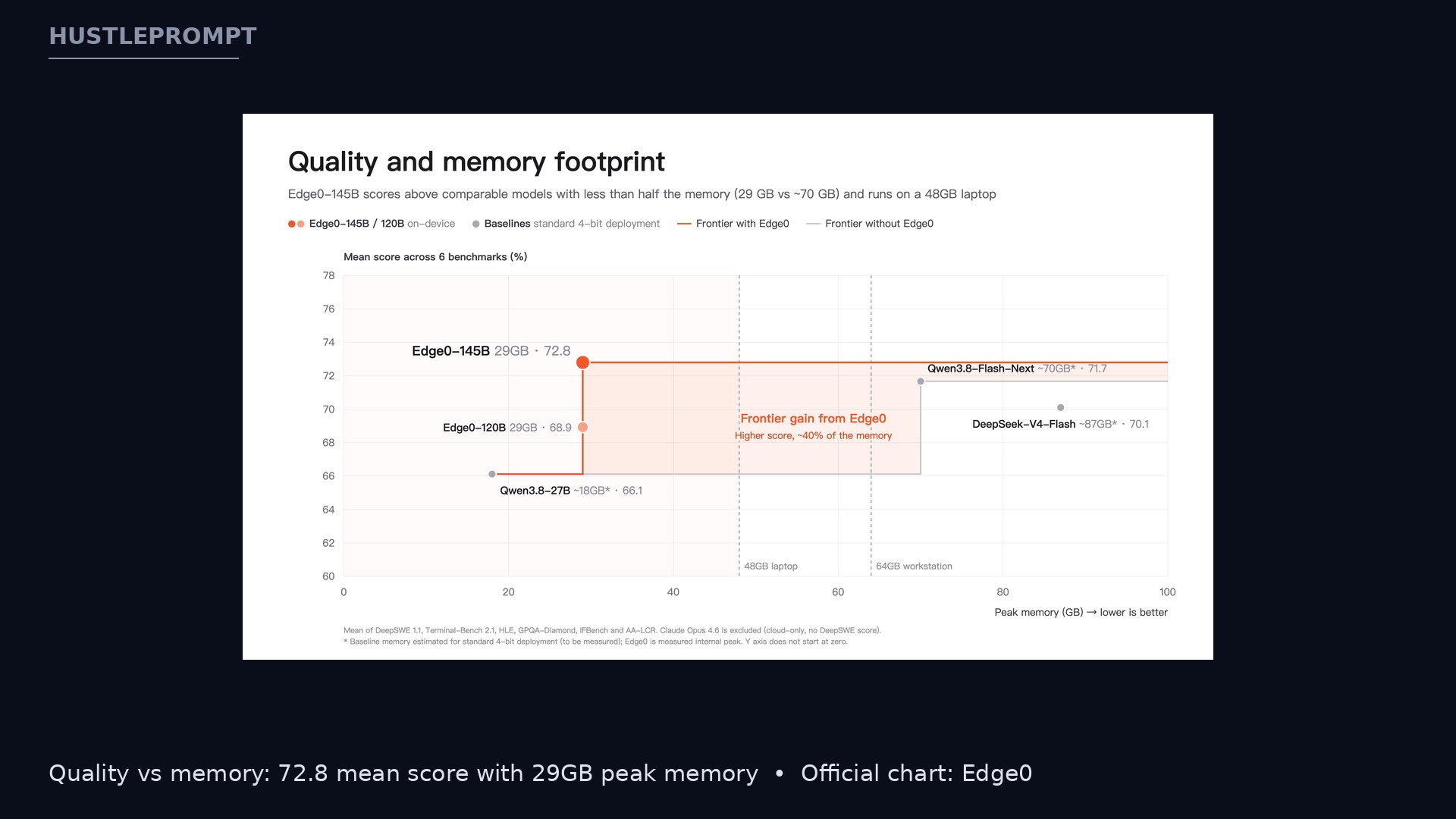
| Memory / speed | 29GB peak memory; 80+ tokens/s decode; 1,100+ tokens/s prefill; about 120W typical power |
| Context | 128K–256K tokens, at essentially the same speed on long inputs |
| License | Code under Apache 2.0; weights free to download under Edge0’s community license (see the limits below) |
| Platforms | macOS, Windows, and Linux from day one, including Apple M-series chips and NVIDIA RTX Spark, RTX 4090, and RTX 5090 |
| Get it | Weights on Hugging Face, inference framework on GitHub, one-click Edge0 App with no account or usage quota |
Source: Edge0 — Introducing Edge0-145B: Frontier AI Capabilities on Your Own Computer (official announcement, November 12, 2026). Performance figures are Edge0’s reported internal measurements.
How a 145B model fits on a laptop
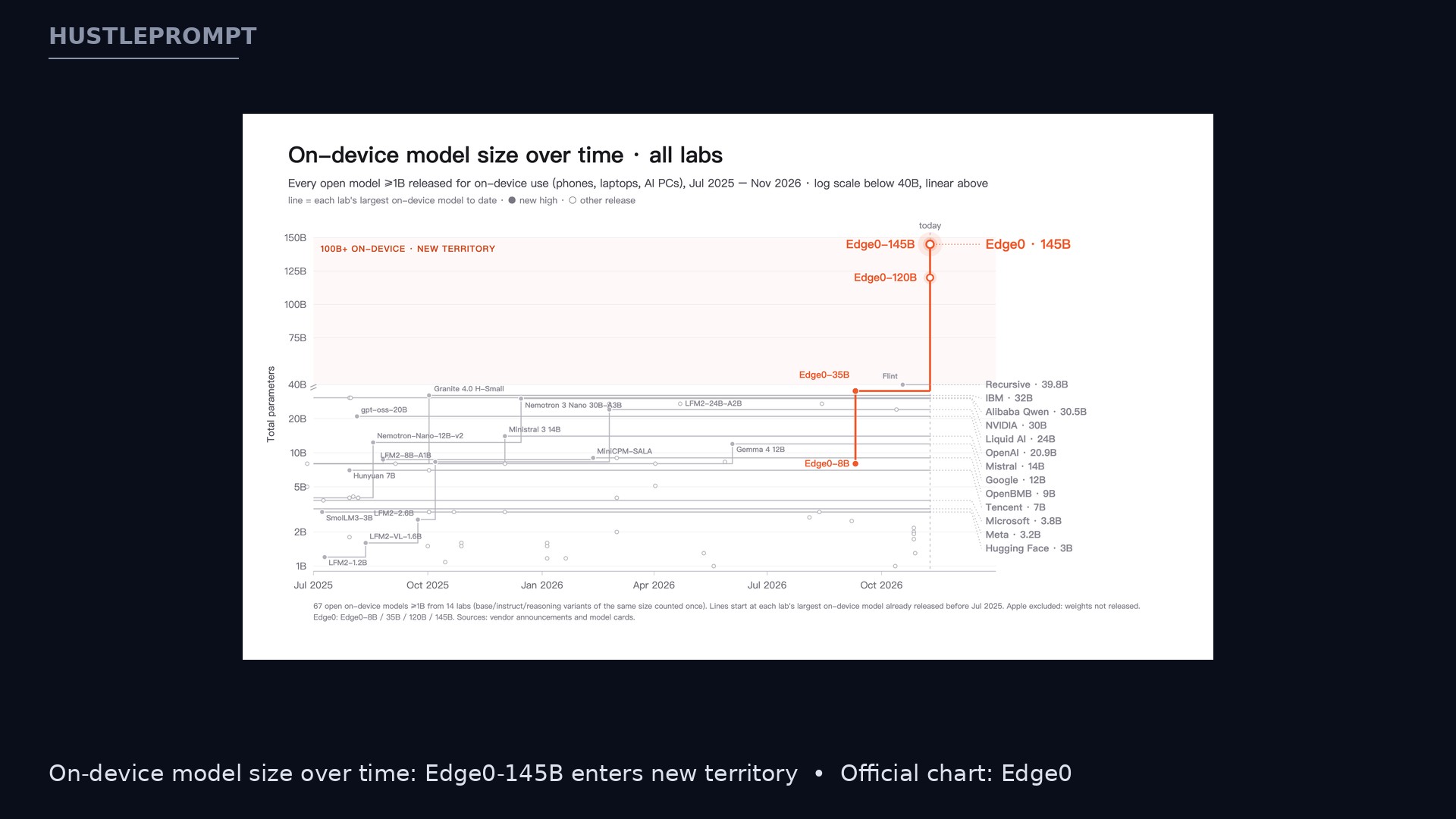
Until now, on-device models stayed small because memory forced them to. Most stayed below 10 billion parameters: Apple Intelligence’s on-device model is about 3B, Google’s Gemini Nano came in 1.8B and 3.25B versions, and even a heavily compressed 35B model could need around 20GB of memory. Edge0-145B breaks that wall with four design choices, built into the model and its inference engine together:
- Shared matrices across sparse experts. Each group of 64 experts shares two large matrices, while each expert keeps a small set of parameters for what makes it different. Of the model’s 145B total parameters, only about 10B participate in computation on each inference step. The model card lists 512 experts with 10 active per token.
- Trained for local execution from day one. Edge0 trained the model in its on-device architecture from the outset, with deployment constraints built into the design — instead of training a cloud model and compressing it afterward.
- Three-tier memory loading. Reading and computation overlap across GPU memory, system memory, and SSD. Frequently used “hot experts” stay in GPU memory, an expert library of about 40GB sits in system memory, and about 48GB of vocabulary data lives on the SSD and is read on demand.
- CPU and GPU working together. The GPU computes cached experts while the CPU handles the rest in parallel, and speculative decoding verifies several candidate tokens at once. That is what supports the reported 80+ tokens per second.
The model is derived from Qwen3.8-Flash-Next, according to the model card on Hugging Face, and trained natively in 4-bit precision. Edge0 is a Chinese lab whose portfolio now covers 95% of mainstream chip platforms, with more than 5 million production devices and over 110,000 customer organizations as of October 2026. Its earlier Edge0-35B phone model, released September 10, passed 1.2 million views on its first day and reached No. 1 on Hugging Face’s Trending chart.
The benchmark numbers — and the catch
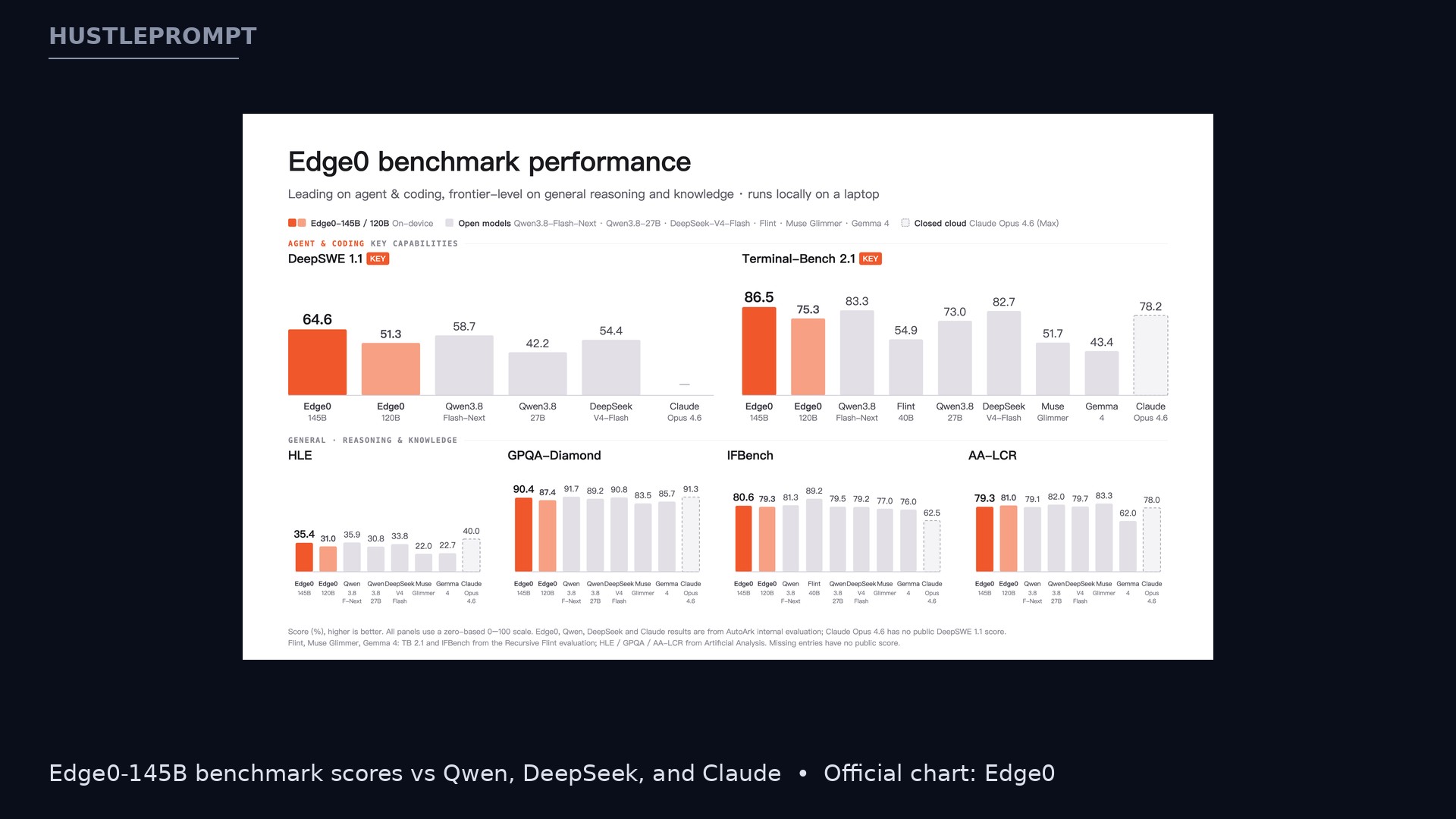
Edge0 says its 145B model is competitive with specific frontier cloud models on coding, reasoning, and instruction following. The scores below come from Edge0’s own internal evaluations — not from an independent lab — so treat them as the maker’s claims, not verified results:
Edge0-145B benchmark scores (Edge0 internal evaluations)
| Benchmark | Edge0-145B | Best rival in Edge0’s table |
|---|---|---|
| DeepSWE 1.1 (coding agents) | 64.6 | 58.7 — Qwen3.8-Flash-Next |
| Terminal-Bench 2.1 (terminal tasks) | 86.52 | 83.3 — Qwen3.8-Flash-Next |
| GPQA-Diamond (hard science) | 90.4 | 91.3 — Claude-Opus-4.6 (Max) |
| IFBench (instruction following) | 80.6 | 81.3 — Qwen3.8-Flash-Next |
| AA-LCR (long-context reasoning) | 79.3 | 82.0 — Qwen3.8-27B |
| Mean across six benchmarks | 72.8, with 29GB measured peak memory | 71.7 — Qwen3.8-Flash-Next, about 70GB estimated |
Source: Edge0’s official announcement, November 12, 2026. Rival memory figures are Edge0’s estimates for standard 4-bit deployment, not measured results. Claude is cloud-only and has no public DeepSWE score.
The honest read: on Edge0’s own numbers, the model beats its open-weight rivals on agent and coding work — 64.6 on DeepSWE 1.1 against 58.7 for Qwen3.8-Flash-Next and 54.4 for DeepSeek-V4-Flash — and sits close to Claude-Opus-4.6 on hard science questions. The GitHub repo passed 10,000 stars on launch day, according to launch coverage, which is a real signal that developers are actually downloading it. Independent verification is still missing, and the full evaluation setup and technical report are being released with the model, so the numbers above are a starting point, not a verdict.
What it can actually do: five demos, all local
Benchmarks are one thing. Edge0’s launch demos show the model carrying whole projects through to a finished result, on a laptop, with no cloud calls:
- A Tesla Roadster explainer video, in under an hour. The model handled research, scriptwriting, asset generation, and editing for a video explaining how the Roadster could fly. Edge0 says producing comparable work manually would have taken a director, scriptwriter, 3D modeler, editor, and physics expert a month — and an AI video workflow could previously cost hundreds of dollars in cloud fees.
- A Manhattan city scene in Blender, in under an hour. Built from text and reference images, with materials, lighting, and iterative fixes. Creating a scene like that manually typically costs about $12,000–$18,000 and takes at least a month; a leading cloud model would still incur more than $150 in token charges for the same job, according to Edge0.
- A playable game and a medieval city. The model planned a fantasy RPG capital from scratch in Blender — city walls, more than a thousand old-town homes, a plaza fountain, a Gothic twin-tower facade — and rendered a 20-second fly-through at game-trailer quality, inspecting and correcting its own work along a fixed camera path.
- Code that flies a real drone. From one instruction — “Write a drone program that navigates through obstacles and finds a red backpack” — Edge0-145B generated the flight-control and visual-recognition programs locally. The drone took off indoors, navigated a row of obstacle poles, and found the backpack. No human-written code, no cloud call.
- A PCB design, start to finish. The model designed a board for itself in KiCad, placed components, routed a two-layer board, imported it into Unreal Engine 5, and rendered an animation of fabrication and assembly. Work that previously needed a hardware engineer and a 3D designer passing tasks back and forth for days.
Watch it in action
Edge0’s own demo video shows the Roadster explainer the model produced locally — research, script, assets, and edit, with no cloud-model calls:
Watch: Edge0-145B produces a Tesla Roadster explainer video in under an hour, running entirely on a local laptop. Video: Edge0 (official channel).
How to profit from a free 145B model
A frontier-class model with a $0 token bill is a business model, not just a download. Here is how to turn it into income — with one license limit to respect first: the model card’s community license allows research, internal use, and commercial use of outputs, but not selling the model itself or running it as a commercial service without separate permission, according to launch coverage. So sell your work and your services, not the model:
- Sell local-AI setups to privacy-sensitive clients. Law firms, clinics, and finance teams cannot send client data to a cloud API. Install Edge0-145B on their hardware, configure it for their documents, and charge a setup fee plus maintenance. The pitch writes itself: their data never leaves the building.
- Run an offline coding service with zero token cost. Long agent jobs — dozens of rounds of planning, coding, debugging, and visual checks — are exactly where cloud token bills explode. Locally, those extra rounds cost nothing but electricity. Price per project, not per token, and keep the margin.
- Produce video, 3D, and game content at near-zero marginal cost. A Roadster-style explainer or a Blender city scene that used to cost hundreds in cloud fees or thousands from an art team now costs an hour of laptop time. Sell the finished assets on marketplaces or as a service to creators and indie studios.
- Teach local AI while the topic is hot. A short course or workshop — “run a 145B model on your laptop” — is a launch-week search magnet. The GitHub repo passing 10,000 stars on day one proves the demand is real.
- Bundle hardware guidance with the setup. Clients need a compatible machine: 29GB of memory minimum, ideally a 48GB laptop or an RTX 4090/5090 desktop. A tested hardware shortlist with affiliate links turns every setup into a second revenue stream.
- Build internal tools for small teams. A local agent that plans, codes, runs, and debugs — with screenshots to check its own work — is a junior developer that never sleeps. Productize it as a fixed-price “AI employee” install for agencies and e-commerce teams.
From prompt to finished project in 4 steps
How Edge0-145B works through a task locally
1. Plan it
One natural-language request starts the job. The model breaks down the requirements and plans the steps — on your machine, with your data staying local.
2. Build it
It writes code and calls tools to run it — Blender scenes, KiCad boards, drone flight programs — with only about 10B parameters active per step.
3. Check it
It takes screenshots, inspects renders, debugs errors, and repairs the code itself — dozens of rounds if needed, at zero token cost.
4. Ship it
The finished video, scene, game, or board is yours. No cloud bill, no upload of your work, and the result keeps working offline.
You need a compatible laptop with at least 29GB of memory — a 48GB machine or an RTX 4090/5090 desktop is the comfortable setup. Hardware and electricity still cost money; the model itself is free.
Frequently asked questions
What is Edge0-145B?
Edge0-145B is an open-source AI model with 145 billion parameters, released November 12, 2026, designed to run on personal computers. It offers coding, reasoning, and agent capabilities comparable to specific cloud models, according to Edge0, but operates locally with no cloud-model token fees.
Is Edge0-145B really free?
The weights are free to download from Hugging Face and the code is Apache 2.0 on GitHub. Local inference carries no cloud-model token or API fees — but hardware and electricity still cost money, and the model card’s community license does not allow selling the model or running it as a commercial service without separate permission.
What hardware do I need to run Edge0-145B?
A compatible laptop with at least 29GB of peak memory. Edge0 reports day-one support for macOS, Windows, and Linux, including Apple M-series chips and NVIDIA platforms such as RTX Spark, RTX 4090, and RTX 5090. A 48GB laptop is the comfortable setup Edge0 points to.
How fast is Edge0-145B on a laptop?
Edge0 reports 29GB peak memory, decoding above 80 tokens per second, prefill above 1,100 tokens per second, about 120W typical power, and a 128K–256K context window. These are Edge0’s own reported measurements, not independent tests.
How does Edge0-145B compare to cloud models?
On Edge0’s internal evaluations, it scores 64.6 on DeepSWE 1.1 and 86.52 on Terminal-Bench 2.1 — ahead of Qwen3.8-Flash-Next and DeepSeek-V4-Flash — and 90.4 on GPQA-Diamond, close to Claude-Opus-4.6 at 91.3. Its mean across six benchmarks is 72.8, versus 71.7 for Qwen3.8-Flash-Next. Independent verification is still pending.
Can Edge0-145B really build games and videos by itself?
Edge0’s launch demos show it producing a Tesla Roadster explainer video in under an hour, a Manhattan 3D scene in Blender, a playable game with a medieval city, a working drone program, and a PCB design — all locally. These are the maker’s demonstrations; your results will depend on your hardware and prompts.
What is the difference between Edge0-145B and Edge0-120B?
Both launched together on November 12, 2026, with the same inference framework. Edge0-145B is the larger model, scoring higher on most benchmarks (64.6 vs 53.6 on DeepSWE 1.1; 86.52 vs 81.3 on Terminal-Bench 2.1). Edge0-120B scores slightly higher on AA-LCR (81.0 vs 79.3). Both report 29GB peak memory.
Keep Reading
- Qwen Code 1.0: Open-Source Agent Runtime for Builders — Another free, open agent runtime for builders — this one from Qwen, with a very different license and setup.
- DeepSeek V4 Pro Lands on AWS SageMaker JumpStart — DeepSeek’s flagship goes one-click on AWS — the cloud route, with cloud pricing, for teams that do not want local hardware.
- Kimi K3.1 Pro Lands on Amazon Bedrock at $4 per Million — Kimi’s agent model on Bedrock at $4 per million tokens — compare that per-token math with Edge0’s $0 local inference.
Sources: Edge0 — Introducing Edge0-145B (official announcement, November 12, 2026); Edge0-145B weights on Hugging Face; Edge0 on GitHub. Benchmark figures are Edge0’s internal evaluations; rival memory figures are Edge0’s estimates. License terms as summarized in launch coverage of the model card.