
Five days ago, Qwen4-Max was a two-week test drive with no benchmarks, no parameter count, and no per-token price. This morning it is a real product. Alibaba launched Qwen4-Max out of preview on Monday, November 16, 2026, with a public pay-as-you-go API at $1.50 per million input tokens, a 2.4-trillion-parameter backbone, and a headline claim that matters more than any of those numbers: on Alibaba’s own evaluation, the average cost of an agent task fell 62%, from $4.43 to $1.67. The model that was a curiosity on November 11 is now the cheapest way to run a flagship-class agent — at least on Alibaba’s own math.
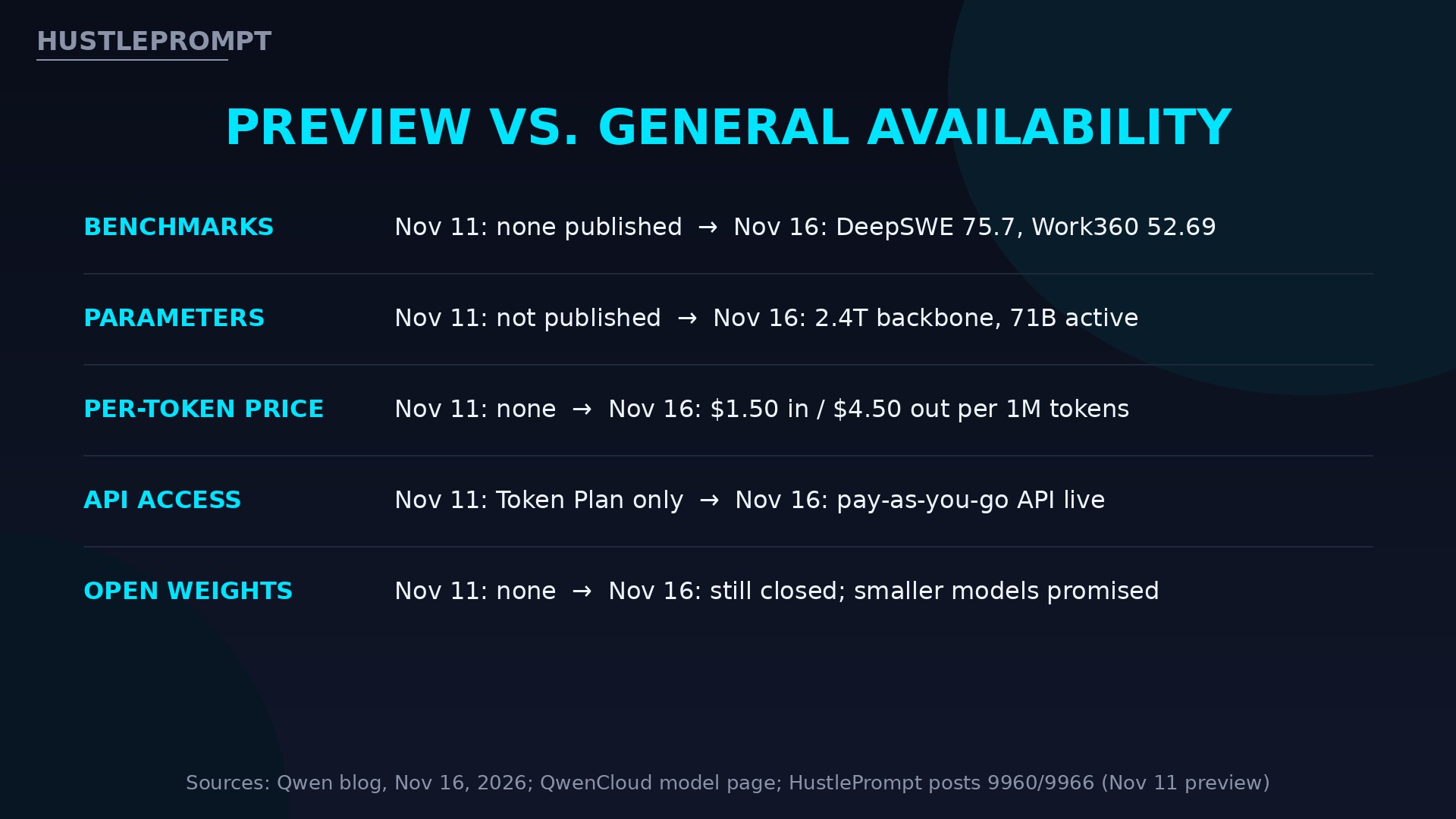
We covered the preview when it opened — the 14-day window, the 1-million-token context, and the $3 entry point — and we were explicit about what was missing: no benchmarks, no parameter count, no per-token price, no launch date, and no way to call it outside a subscription. The launch post, “Qwen4-Max: Your New Teammate Has Arrived”, fills in every one of those blanks. That is the story: not just a new model, but a model that finally has numbers attached to it.
What launched today
The Qwen team announced the launch at 02:01 UTC on November 16 with a short post: “Meet Qwen4-Max, your new AI teammate for work, creativity, and discovery!” The model ID is qwen4-max, and the API is live on QwenCloud — pay-as-you-go, not just the Token Plan subscription the preview required. It is also available in Qwen Studio, QwenWork, and Qoder, and Alibaba says it works with the protocols established by OpenAI and Anthropic, so existing agent tooling can point at it without a rewrite.
Three things changed at once. First, access: the preview ran only through Token Plan and retires on November 25. The launched model can be called from a standard API key. Second, pricing: the preview had no per-token price at all. The launch lists $1.50 per million input tokens and $4.50 per million output tokens, with implicit caching at $0.075 per million — about 25% below the previous flagship, Qwen3.8-Max, which lists at $2 and $6. Third, evidence: the preview shipped zero benchmarks. The launch ships a full scorecard, including a coding score that Alibaba says beats Claude Opus 5.5.
Watch: “Qwen4-Max is now available.” — the official Qwen launch clip, November 16, 2026. Video: Qwen (official YouTube channel).
The architecture in numbers
Qwen4-Max is built on a new Qwen4 architecture, a sparse mixture-of-experts design with a 2.4-trillion-parameter backbone. Only 71 billion of those parameters switch on for each token it processes, plus 328 billion N-gram Embedding parameters. Three changes do the heavy lifting: Gated DeltaNet layers plus Qwen Sparse Attention, which compress history into fixed-size states so a million-token context stays affordable; Gated Residual, four parallel residual branches with dynamic read and write gates; and N-gram Embedding, context-based lookups at the second layer that expand capacity with little extra compute.
Alibaba reports the training run itself went smoothly — no loss spikes across the 2.4-trillion-parameter run — and says the base model reached the lowest bits-per-byte of the five checkpoints it evaluated, roughly 5% to 13% lower than Qwen3.8-Max-Base while activating 25% fewer parameters. It has native vision, takes text, images, and video as input, and holds a 1-million-token context window. The QwenCloud model page lists a maximum input of 991,000 tokens and a maximum output of 393,000 tokens.
Qwen4-Max: the specs Alibaba published
| Spec | Qwen4-Max | Qwen3.8-Max (previous flagship) |
|---|---|---|
| Backbone parameters | 2.4 trillion | Not disclosed |
| Active per token | 71 billion | Not disclosed |
| Context window | 1,000,000 tokens | 1,000,000 tokens |
| Max output | 393,216 tokens | 128,000 tokens |
| Input price / 1M tokens | $1.50 | $2.00 |
| Output price / 1M tokens | $4.50 | $6.00 |
| Cached input / 1M tokens | $0.075 | ~$0.25 (70% higher) |
Sources: Qwen blog, “Qwen4-Max: Your New Teammate Has Arrived,” November 16, 2026; QwenCloud model page. Qwen3.8-Max prices are its published list rates.
The price cut is the story
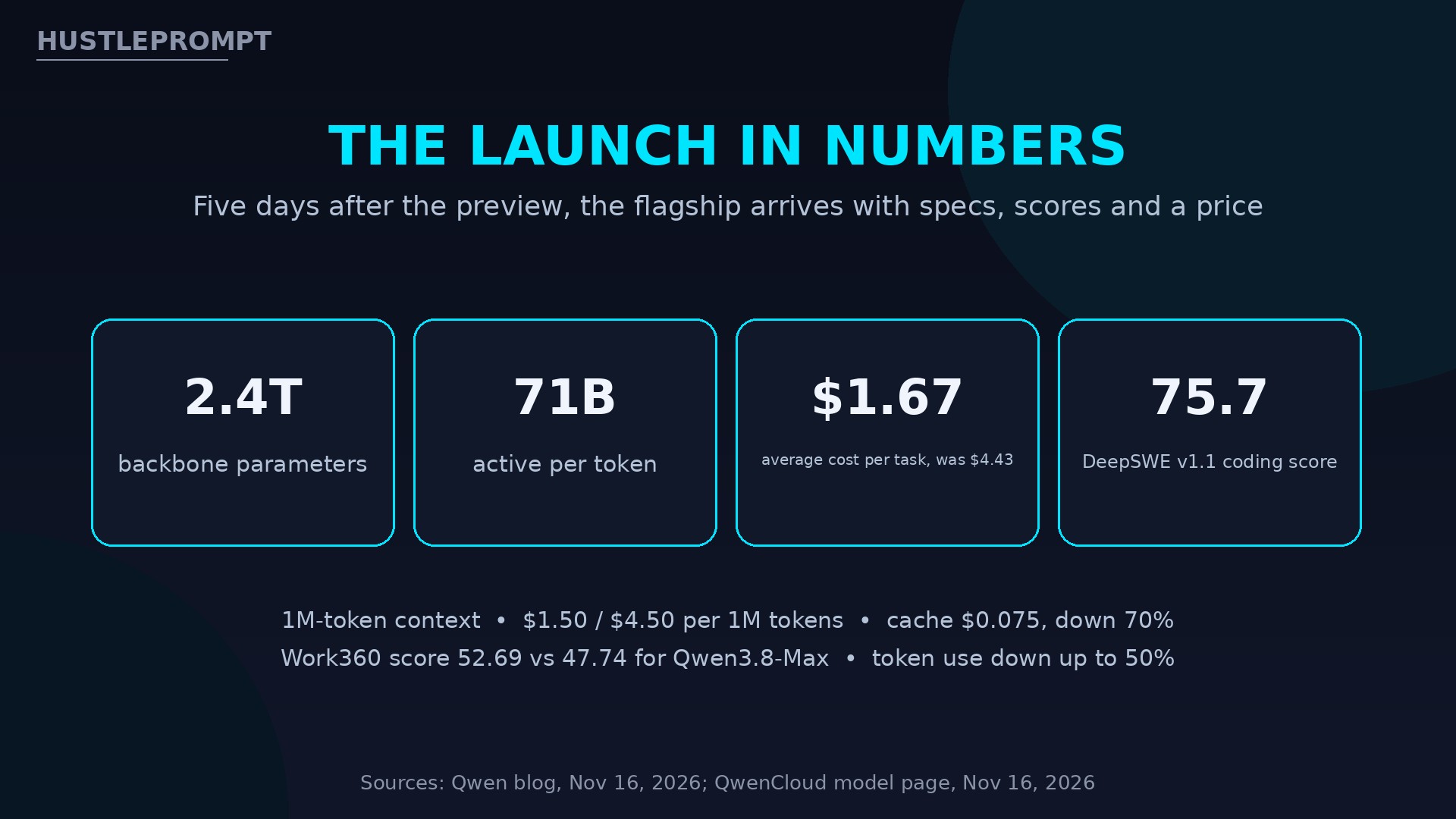
Benchmarks make headlines, but the cost numbers are the most concrete part of this launch — and the part that changes what it costs to run an agent in production. On Work360, Alibaba’s own framework for modeling complex professional work across 26 industries, 182 subdomains, and 721 fields, Qwen4-Max scored 52.69 against 47.74 for Qwen3.8-Max. The more important figure sits next to it: the average cost per task fell from $4.43 to $1.67, a 62% cut.
That cut comes from two directions at once. The model uses fewer tokens on the same work — about 24% less on Work360 at Xhigh effort and 35% less at High effort, and about 48% to 49% less on Terminal-Bench 4.0 — and the per-token prices are lower, with the biggest cut in cached-input pricing, down 70%. Token use is down by up to half, and the tokens themselves are cheaper. That combination is what produces the $4.43-to-$1.67 drop.
The coding numbers back up the positioning. Alibaba says Qwen4-Max scored 75.7 on DeepSWE v1.1, ahead of Claude Opus 5.5 and competitive with Moonshot’s Kimi K3.1 Pro, and debuted at sixth place on the CodeArena WebDev leaderboard with a preliminary score of about 1,750 points — the top Chinese model there. Two caveats belong here. Work360 is Qwen’s own benchmark, so the 62% is a claim about Alibaba’s own workload mix, not a universal price comparison. And the independent rankings are less generous than the company numbers. Treat the 62% as directional — then test it on your own workload.
The cost math, side by side
| Measure | Qwen3.8-Max | Qwen4-Max | Change |
|---|---|---|---|
| Work360 score | 47.74 | 52.69 | +10% |
| Average cost per task | $4.43 | $1.67 | -62% |
| Token use, Work360 (Xhigh) | Baseline | ~24% less | -24% |
| Token use, Terminal-Bench 4.0 | Baseline | 48-49% less | ~-48% |
| Input price / 1M tokens | $2.00 | $1.50 | -25% |
| Cached input / 1M tokens | ~$0.25 | $0.075 | -70% |
| DeepSWE v1.1 | Not reported | 75.7 | Beats Claude Opus 5.5* |
Sources: Qwen blog, November 16, 2026; QwenCloud model page. *Alibaba’s claim; independent verification is pending. Work360 is Qwen’s own benchmark.
What it can actually do
The launch is framed around a “24/7 AI teammate,” and the demos lean hard into long-running, multi-step work rather than chat. The model drives Blender for geometry, materials, lighting, and rendering, and builds playable games in Unity, Unreal Engine, and Godot from a single brief — including running the game and iterating on camera tracking, animation, and pacing from visual feedback.
The industry examples are specific enough to check:
- Manufacturing: in real production settings at SANF and Pacific Union, Qwen4-Max planned production lines, designed parts, and verified machining — cutting the manual effort to program a single workpiece from about 475 minutes to 24 minutes, roughly a 95% reduction.
- Finance: for investment research it invoked 90 MCP tools across market data and produced Excel workbooks and PowerPoint decks where charts map one-to-one to the underlying data.
- Law: for pre-IPO legal due diligence it sorted 198 inconsistently formatted working papers into 14 folders and produced an 86-page report of over 60,000 Chinese characters, with every conclusion backed by citations.
- Healthcare: for critical care it reviewed a six-day clinical course spanning dozens of lab reports and 1,433 medical images, and its four management recommendations matched the attending physician’s actual orders point by point.
Two science demos push the long-horizon claim furthest. In a continuous 48-hour run on Deep Principle’s Mira platform, Qwen4-Max surveyed approaches, screened 2.7 million candidate molecules, and directed an automated wet lab through four design–synthesis–testing loops to produce a physical sample of a novel coolant material for data-center chips. On DP Technology’s PharmMaster platform, it made 454 tool calls and ran 3,239 computational metric evaluations across 24 candidate molecules, ending with a candidate whose estimated binding affinity is about 3.6 times the patent-derived reference molecule. DP Technology endorsed the result and said it warrants further wet-lab validation — which is still pending.
There is also a product idea worth stealing. The launch introduces Live Delivery: instead of making users wait for a long task to finish, the agent ships a usable first version early and improves it through successive releases, with the user able to step in and redirect at any point. Qwen is open-sourcing the Qwen-Live-Delivery-Plugin so others can build on the pattern.
How to try Qwen4-Max today — four routes
qwen4-max on QwenCloud at $1.50 in / $4.50 out per million tokens, $0.075 cached. OpenAI- and Anthropic-compatible protocols.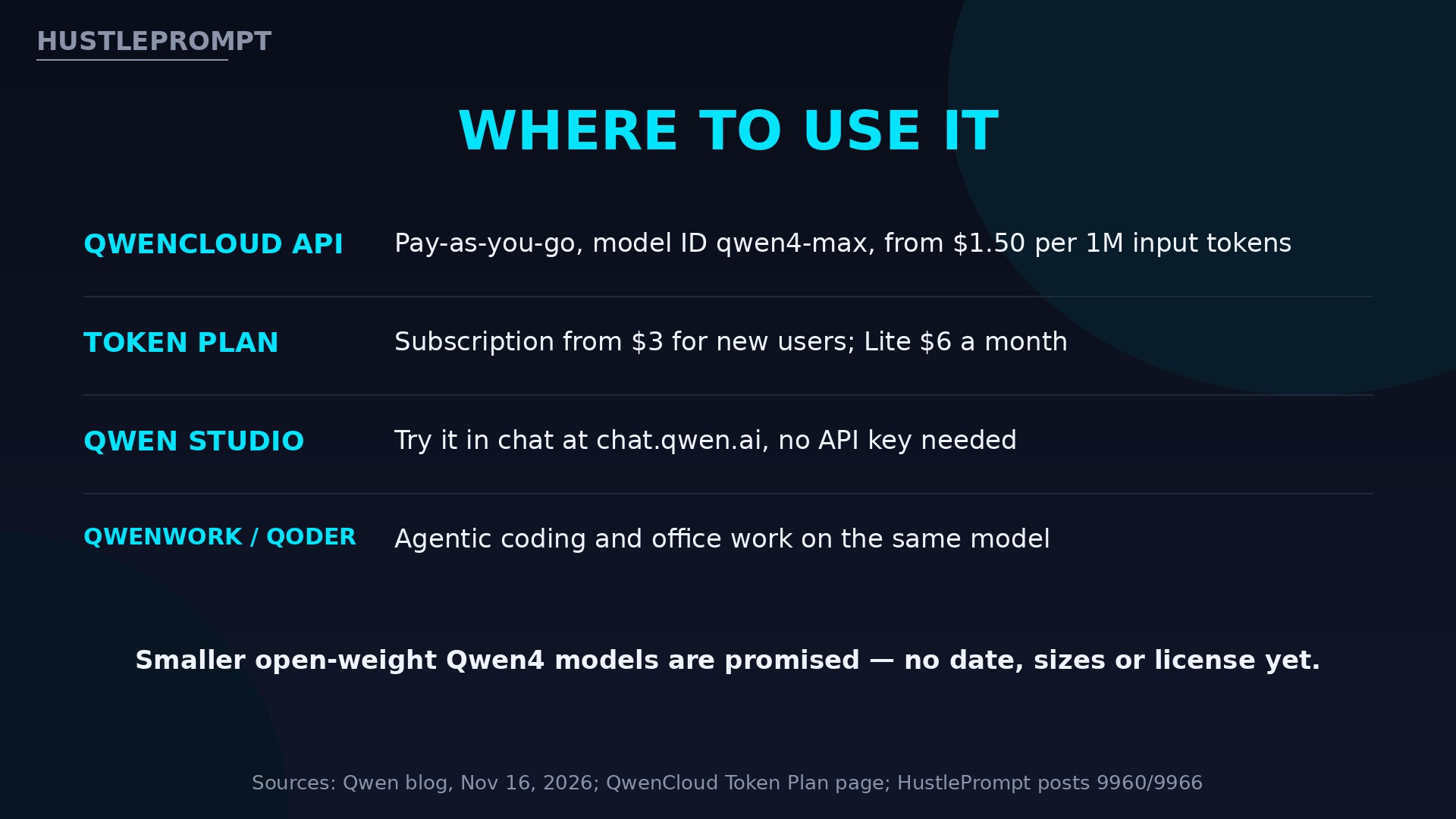
How to profit from the launch
The money angle here is not the model — it is the cost curve. If you run coding agents, the move is to re-price your stack. Swap one agent workflow from Qwen3.8-Max or Claude to Qwen4-Max, measure tokens per task and dollars per task over a week, and keep the cheaper one. At $1.50 per million input tokens with 48% less token use on agent benchmarks, the saving compounds on long-running jobs, which is exactly where agent bills hurt most.
If you sell AI services, the launch is a margin story. A 62% cut in average cost per task — if it holds on your workload — lets you either undercut competitors on fixed-price agent work or keep your price and widen your margin. Test it on one client workflow first, with the client’s data, before re-pricing anything. And if you build products on top of frontier models, watch the smaller Qwen4 models Alibaba says are coming to open source: a 27B-class model on this architecture, runnable on your own hardware, would be the one that changes the math for self-hosters. No date, sizes, or license have been announced yet.
The catches
Three things temper the launch. First, Qwen4-Max itself is not open source. The blog says smaller models in the family are “coming to open source” on the same lineage — Max is the hosted flagship, available through QwenCloud, QwenWork, Qoder, and Qwen Studio. If you wanted to self-host this one, that door is not open.
Second, the headline benchmarks are largely in-house. Work360 is Qwen’s own benchmark, and the cost-per-task figures come from that same evaluation. Third-party scores cited in the announcement come from leaderboards like LMArena and Artificial Analysis, but the launch leads with its own numbers. The 62% is a directional claim about Qwen’s own workload mix, and independent testing will take time to confirm or challenge it.
Third, the most spectacular demos are single showcases run with partner platforms. They demonstrate that a long-horizon agent loop can complete — a 48-hour run ending in a real coolant sample is a genuine engineering result — not that it will complete reliably on your problem. The drug candidate has expert endorsement but still awaits wet-lab validation. And the safety numbers, while improved, are modest in absolute terms: on Last Secure Code Bench, the function-level pass rate for both functionality and security rose from 22.0% to 31.8%, and code that is secure at all three granularities rose from 8% to 14.7%. Nearly doubling is real progress — and a reminder that most generated code still is not secure by default.
FAQ
What is Qwen4-Max?
Qwen4-Max is Alibaba’s new flagship AI model and the top tier of the Qwen4 family. It launched out of preview on November 16, 2026, with a 2.4-trillion-parameter backbone, 71 billion parameters active per token, native vision, and a 1-million-token context window. It is a hosted model, available through QwenCloud, Qwen Studio, QwenWork, and Qoder.
How much does Qwen4-Max cost?
On QwenCloud, pay-as-you-go pricing is $1.50 per million input tokens and $4.50 per million output tokens, with implicit caching at $0.075 per million — about 25% below the previous flagship, Qwen3.8-Max. The Token Plan subscription starts at $6 a month (Lite), with a $3 first-purchase offer for new users. Alibaba says the average cost per agent task on its Work360 evaluation fell from $4.43 to $1.67, a 62% cut.
Is Qwen4-Max open source?
No. Qwen4-Max is available only as a hosted service. Alibaba says smaller models in the Qwen4 family are coming to open source, but it has given no date, sizes, or license terms. The preview model, qwen4-max-preview, retires on November 25, 2026.
How good is Qwen4-Max at coding?
Alibaba says it scored 75.7 on DeepSWE v1.1, ahead of Claude Opus 5.5 and competitive with Kimi K3.1 Pro, and debuted sixth on the CodeArena WebDev leaderboard with a preliminary score of about 1,750 points. These are company-reported figures; independent verification is pending.
What is the difference between the preview and the launch?
The preview, which opened November 11, was Token Plan only, had no benchmarks, no parameter count, and no per-token price, and it retires November 25. The launch adds all four — DeepSWE 75.7, a 2.4T backbone, $1.50/$4.50 pricing — plus a live pay-as-you-go API under the model ID qwen4-max.
Where can I try Qwen4-Max?
The fastest way is Qwen Studio at chat.qwen.ai, where the model appears in the picker with no API key. For API use, call qwen4-max on QwenCloud, or use the Token Plan subscription. It also works inside QwenWork and Qoder, and Alibaba says it is compatible with OpenAI and Anthropic API protocols.
Should I switch my agent stack to Qwen4-Max?
Test before you switch. Run your own agent workload on Qwen4-Max and on your current model, and compare tokens used and dollars spent per task. The 62% figure comes from Alibaba’s own benchmark; your workload is the only test that matters. If it holds, the saving is largest on long-running agentic jobs, where token use was cut by up to half.
Sources
- Qwen: Qwen4-Max: Your New Teammate Has Arrived (November 16, 2026) — official launch post
- The Hindu BusinessLine (Bloomberg): Alibaba unveils new flagship AI model in riposte to US rivals (November 16, 2026)
- Dow Jones via TradingView: Alibaba Unveils AI Model With Stronger Performance at Lower Cost (November 16, 2026)
- DEV Community: Qwen4-Max Is Here — a careful read of the official announcement (November 16, 2026)
- The Indus Pulse: Qwen4-Max — 2.4 trillion parameter backbone, 1M token context (November 16, 2026)
- AI Letter: Alibaba unveils Qwen4-Max, cutting token use by up to 50% and average cost per task by 62% (November 16, 2026)