
Google’s custom AI chip may have just found its two biggest customers — and they are not Google. Top supply-chain analyst Ming-Chi Kuo posted on X in the early hours of Monday, November 16, 2026, that OpenAI and Anthropic will take about 26 million Google TPUs in 2028 and 2029, roughly 79% to 87% of everything Google ships in those two years. The claim is already moving markets and trending across AI circles. It is also, for now, one analyst’s estimate — not a number any of the three companies has confirmed. That distinction matters, and this article keeps it in front of every figure below.
A Google TPU, or Tensor Processing Unit, is the custom chip Google designs for AI work and sells through Google Cloud. For a decade it was mostly an internal tool that powered Search, ads and Gemini. Kuo’s post says that era is ending: the two labs building the models that compete with Gemini are now ordering Google’s chips at a scale that would make them Google’s main TPU customers. If even half of the 26 million arrives, the AI chip race stops being a one-company story.
What Kuo actually said
Kuo, an analyst at TF International who is closely watched for calls on Apple and Nvidia suppliers, published the update at 01:02 UTC on November 16, describing it as key takeaways from his latest industry survey. FourWeekMBA reproduced the post in full, and TradingView and Stocktwits covered it the same morning. His lead line:
“Strong new orders from OpenAI and Anthropic have extended Google TPU shipment visibility to 2029, ahead of Nvidia GPUs and other AI ASICs (mostly 4Q27–2Q28).”
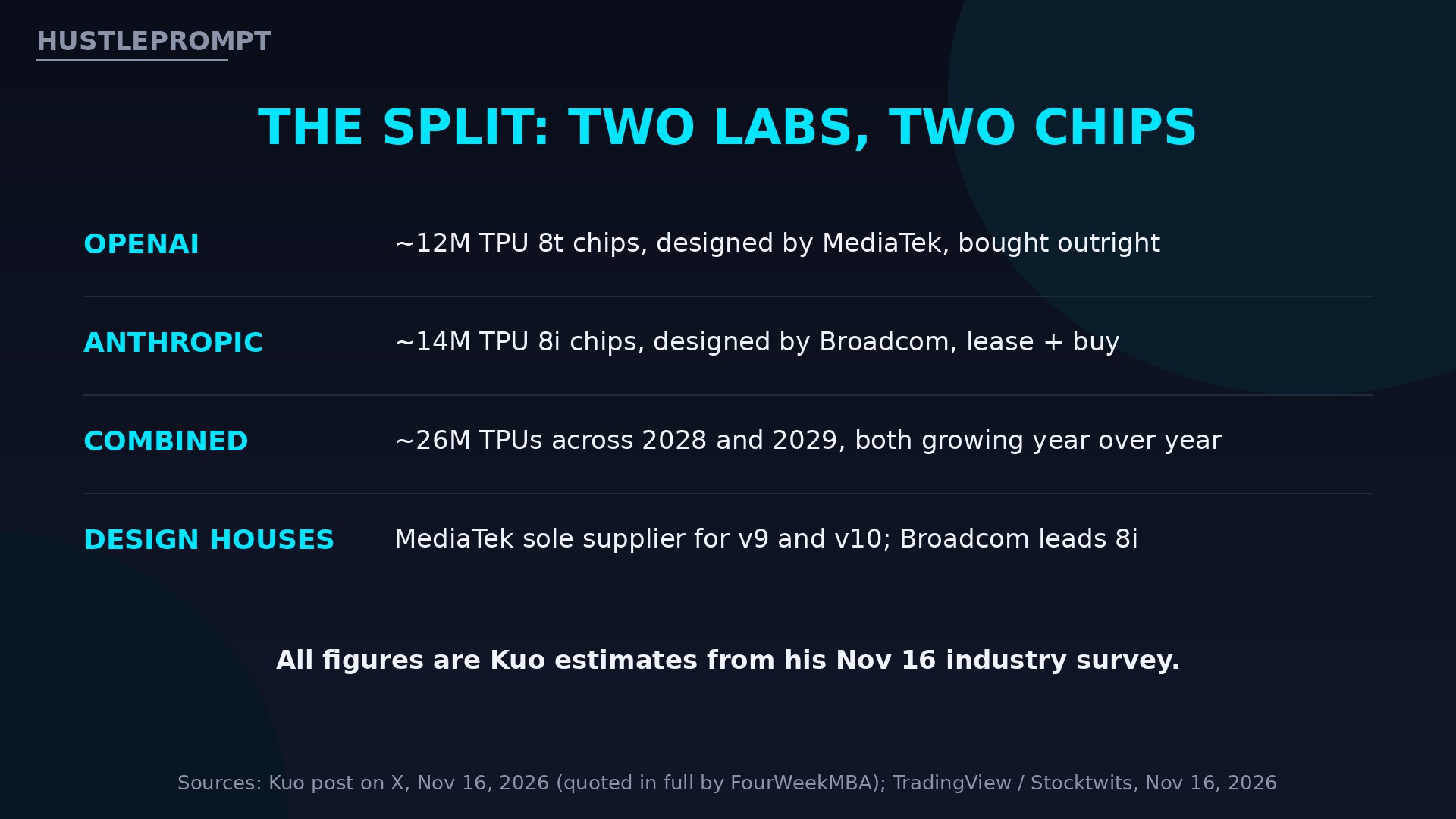
“Shipment visibility” is analyst language for how far ahead a supplier can see confirmed demand. Kuo’s point is that Google can now see TPU demand into 2029, while Nvidia GPUs and rival custom chips mostly have visibility only through late 2027 or mid-2028. The second half of the post is the part that made the rounds: the unit counts. OpenAI takes about 12 million TPU 8t chips, the training chip designed with MediaTek, and buys them outright. Anthropic takes about 14 million TPU 8i chips, the inference chip designed with Broadcom, through a mix of leasing and outright purchases. Both totals grow year over year.
Watch: “How Google’s 8th Generation TPUs Power the Agentic Era” — Google Cloud explains the TPU 8t and 8i chips at the center of Kuo’s estimates. Video: Google Cloud (official YouTube channel).
The split, in numbers
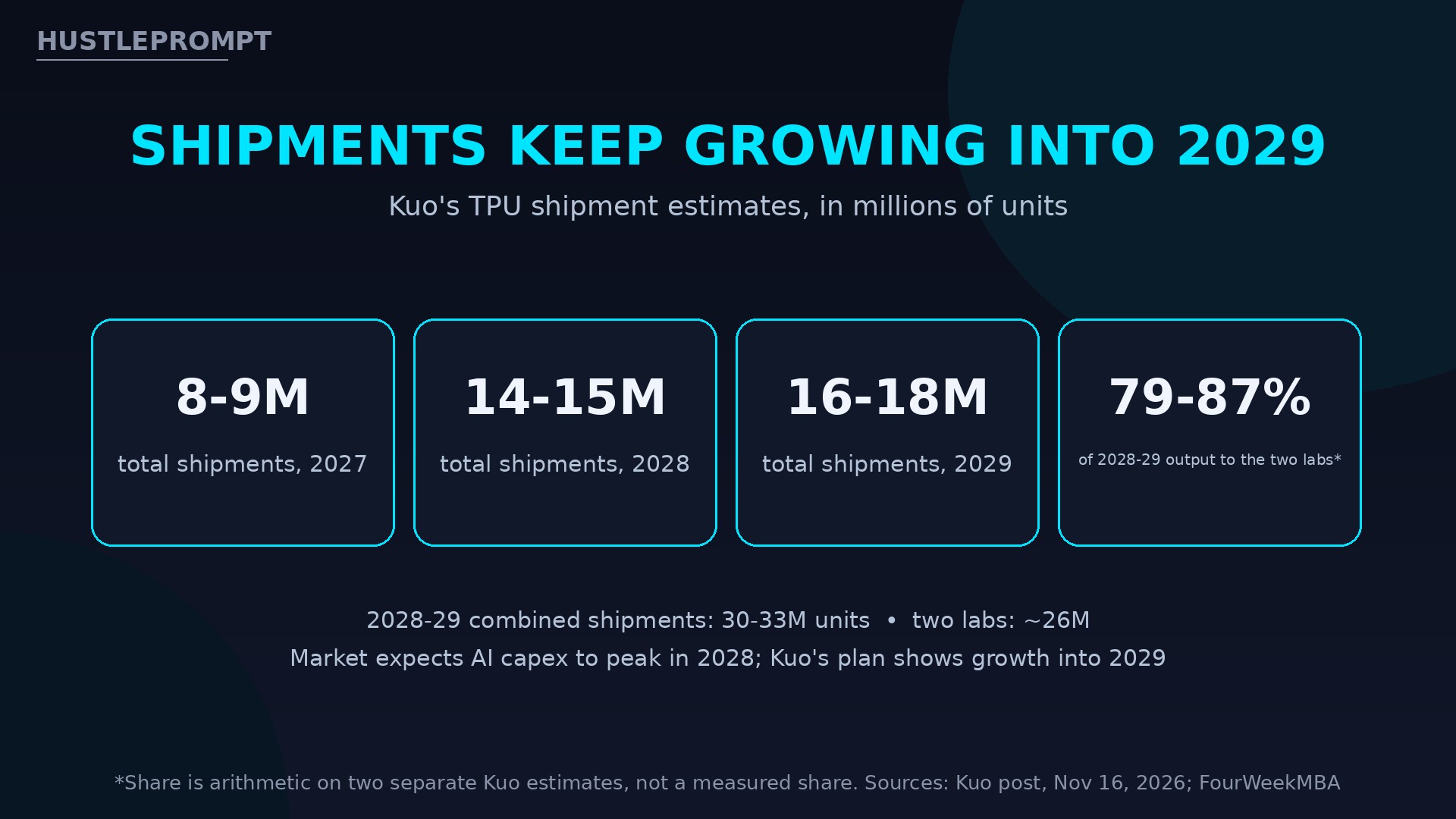
The split is the story. Anthropic takes the larger share in Kuo’s estimates, and the two labs pay in different ways — a difference that matches what Anthropic’s own IPO filing says about how it buys compute. Kuo also estimates total TPU shipments of 8 to 9 million units in 2027, 14 to 15 million in 2028, and 16 to 18 million in 2029. Set the two labs’ combined 26 million against the 30 to 33 million he expects Google to ship in 2028 and 2029, and they would take about 79% to 87% of output. That share is arithmetic built from two separate estimates, not a measured share reported by Google — and it is labeled that way everywhere it appears in this article.
The Kuo estimates: who takes what
| Item | Kuo estimate |
|---|---|
| OpenAI demand, 2028-29 | About 12 million TPU 8t chips, designed by MediaTek |
| Anthropic demand, 2028-29 | About 14 million TPU 8i chips, designed by Broadcom |
| Combined demand, 2028-29 | About 26 million chips |
| How OpenAI pays | Outright purchases |
| How Anthropic pays | Mix of leasing and outright purchases |
| Total TPU shipments, 2027 | 8 million to 9 million |
| Total TPU shipments, 2028 | 14 million to 15 million |
| Total TPU shipments, 2029 | 16 million to 18 million |
| Two labs’ share of 2028-29 output | About 79% to 87% (arithmetic on Kuo’s figures) |
Sources: Ming-Chi Kuo post on X, November 16, 2026, quoted in full by FourWeekMBA; TradingView / Stocktwits coverage, November 16, 2026. All figures are Kuo’s estimates from his industry survey, not disclosures by Google, OpenAI or Anthropic.
Why this would be a big deal
Three things make the numbers matter beyond the chip count. First, the direction of travel. Kuo says that from 2028, Google’s own computing buildout moves to the next generation, the v9, “so v8-series orders can be viewed as coming from OpenAI and Anthropic.” In other words, the current generation of Google’s chips would be built mostly for two outside labs, while Google itself moves on. That is a strange position for a company whose chips were designed for its own models — and a sign of how far Google has come in turning the TPU from an internal tool into a product it sells, leases and lets others resell.
Second, the timing. The market broadly expects AI capital spending to peak in 2028. Kuo’s plan shows TPU shipments still growing in 2029 — 16 to 18 million units, up from 14 to 15 million in 2028 — driven by direct orders from OpenAI and Anthropic. If he is right, the AI spending boom gets at least one more year of growth in Google’s corner of the market, and the “peak in 2028” story needs a rewrite.
Third, the Nvidia angle. Kuo wrote that uncertainty over Nvidia’s CEO succession “helps Google in discussing post-2028 long-term plans with customers.” Nvidia’s week has been brutal: Jensen Huang resigned, the board named CFO Colette Kress as interim chief, and Nvidia shares fell 12.8% in the week, their worst weekly performance since March 2025, according to the same TradingView report. We covered the boardroom fight in detail — Treasury Secretary Scott Bessent told Nvidia’s board to hire an outsider CEO — and Kuo’s read is that the chaos is handing Google an opening to pitch long-term TPU plans to customers who plan years ahead.
What is already on record
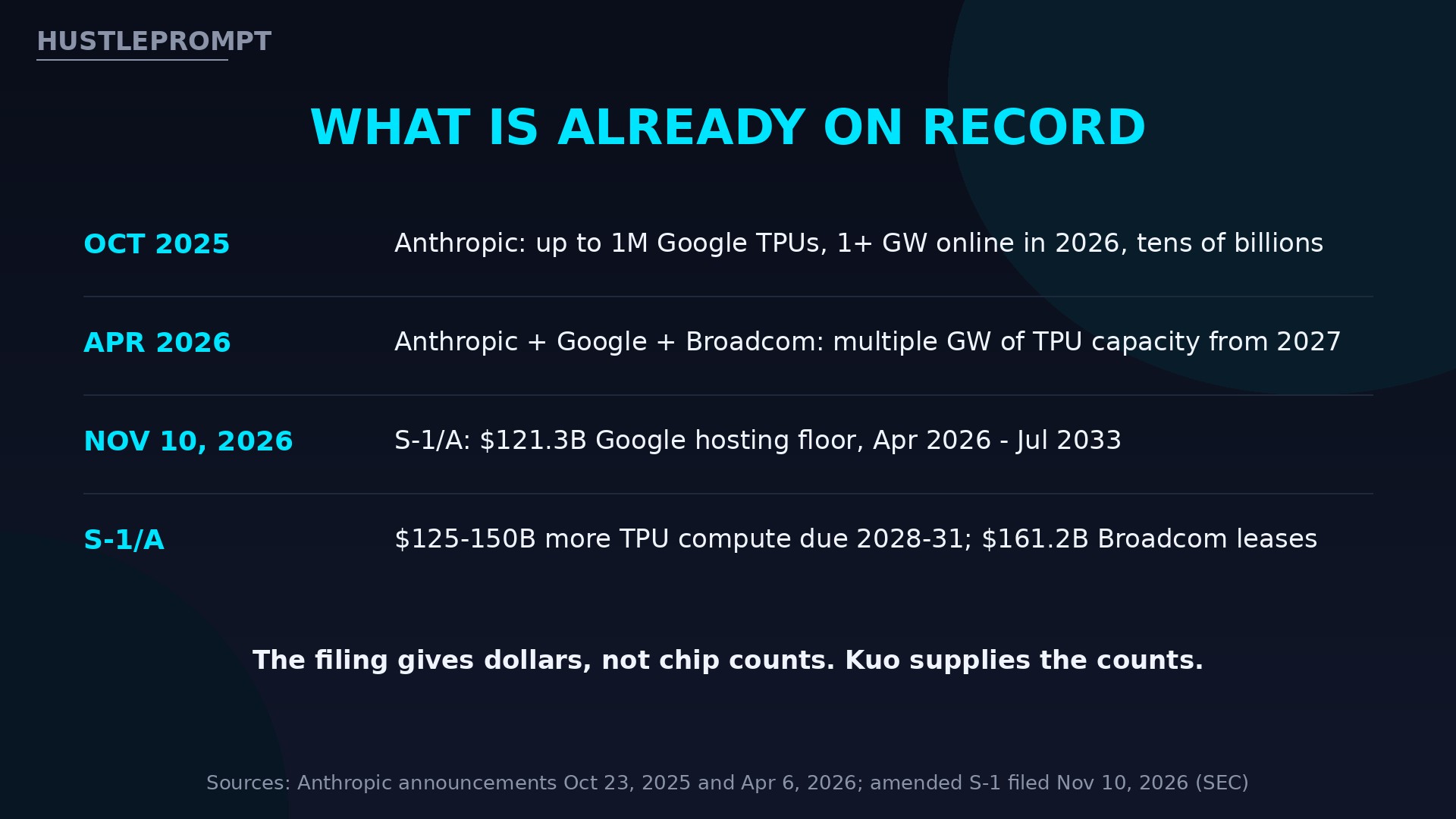
Kuo’s numbers sit on top of a record that is already large, and that record is in dollars and gigawatts more than in chip counts. On October 23, 2025, Anthropic announced it would expand its use of Google Cloud TPUs to up to one million chips, bringing well over a gigawatt of capacity online in 2026, in a deal the companies valued in the tens of billions of dollars. In April 2026, Anthropic, Google and Broadcom added an agreement for multiple gigawatts of TPU capacity from 2027; Broadcom’s filing at the time put that expansion at about 3.5 gigawatts.
The filing record has grown since then. Anthropic’s amended S-1, filed with the SEC on November 10, 2026, commits the lab to spend at least about $121.3 billion under its Google hosting agreement between April 2026 and July 2033, plus an estimated $125.0 billion to $150.0 billion for additional TPU compute expected to be delivered between 2028 and 2031. Separately, the filing lists five-year equipment leases with Broadcom whose rent comes to about $161.2 billion, excluding interest, for access to TPU-based compute. Add the Google floor and the Broadcom leases and Anthropic’s stated TPU-linked commitments already come to $282.5 billion — before the extra $125 to $150 billion. The filing gives dollars. It gives no 2028 or 2029 chip count that matches Kuo’s 14 million figure, and that gap should stay visible.
Anthropic’s TPU commitments, from its own filing
| Commitment | Amount | Period |
|---|---|---|
| Google hosting agreement floor | At least ~$121.3 billion | April 2026 – July 2033 |
| Additional TPU compute (estimate) | $125.0B – $150.0B | Delivery 2028 – 2031 |
| Broadcom equipment leases (rent) | ~$161.2 billion | Five-year leases |
| Google floor + Broadcom leases | ~$282.5 billion | Arithmetic on the filing |
| October 2025 deal | Up to 1M TPUs, 1+ GW, tens of billions | Online in 2026 |
Sources: Anthropic amended S-1 (Form S-1/A), filed with the SEC on November 10, 2026, as read by FourWeekMBA; Anthropic announcement of October 23, 2025; Anthropic, Google and Broadcom agreement of April 2026. Dollar figures are from the filing; the $282.5B total is our arithmetic.
For OpenAI, the record is thinner. The Information reported on October 27 that OpenAI plans to buy Google AI chips, and Bloomberg reported the next day that final terms were not yet known and that both companies declined to comment. OpenAI has rented Google AI chips since June 2025, according to RCR Wireless. A plan to buy, reported by others, is not the same as a confirmed order for 12 million chips. Kuo’s post is the first source to put a unit count of that size on the OpenAI side, and it remains his estimate.
The chips at the center of the claim
The hardware in Kuo’s post is Google’s eighth-generation TPU family, which Google expanded just last week. Google’s official announcement of November 9 added two systems, TPU 8tx for confidential inference and TPU 8i Max for massive context windows, to the TPU 8t and 8i introduced at Cloud Next in April — four TPU systems in a single year. Google says the 8t offers up to 2.7 times better training performance and the 8i offers 80% better inference price performance than the previous generation, and that TPUs are now “a rapidly growing business with nearly 100 customers — including frontier labs, trading firms, retailers, universities, and more.”
The specs behind the two chips Kuo assigns: TPU 8t supports pods of 9,600 chips and carries 216 GB of HBM3e memory per chip, while TPU 8i raises memory to 288 GB and adds 384 MB of SRAM on chip, according to RCR Wireless reporting. TPU 8i Max, the newest variant, combines two 8i chips on a single package for double the compute, double the SRAM and double the HBM bandwidth. Kuo also notes the road ahead: the v10 lineup has been overhauled to a design called Quillfish, with mass production expected in 2029 and MediaTek winning the design order, while the earlier Icefish design is now v11, due in 2030, and Merope may be canceled. From v9 onward, all new TPUs will use Intel’s EMIB-T advanced packaging — and because early v9 packaging capacity is limited, the v8 series should stay the bulk of shipments through 2029.
The winners if Kuo is right
Kuo named the suppliers who gain if the plan holds, and his post reads like a scorecard for three stocks. MediaTek is “clearly the biggest TPU winner of the next few years,” he wrote: it will be the sole design supplier for v9 and v10, accounting for about 45–50%, 50–55% and 55–60% of total TPU supply in 2027–2029, respectively, and the high-margin 8t series is a key profit source. Broadcom leads the 8i design, and Kuo says its gross margin on the 8i is even higher than the 8t’s — but its focus over the next few years will shift toward other custom chips and AI networking, with non-TPU revenue expected to pass TPU revenue as early as 2027. And Google itself gets a longer runway: a J.P. Morgan Asset Management chart in Michael Cembalest’s note of November 14 already gives Google TPUs 16% of frontier labs’ future compute agreements, and Alphabet reportedly holds about 9.9% of Anthropic, worth an estimated $126 billion to $139 billion, according to TradingView.
None of that is a buy recommendation — this article is not financial advice, and the unit counts are unconfirmed. But the shape of the trade is clear: if the two labs really do take 26 million TPUs, the money flows to Google Cloud, to MediaTek’s design business, and to Broadcom’s 8i work, while Nvidia competes for its two biggest potential customers on hardware Google designed.
How to read this story — four checks before you believe it
How to profit from the TPU shift
The money angle here is not the chip count — it is the cost curve underneath it. If the two biggest AI labs are buying Google’s custom silicon at this scale, inference gets cheaper for everyone who builds on it, and the companies that sell the silicon win a multi-year revenue stream. Three practical moves follow from that, none of which require believing Kuo’s exact numbers.
- If you invest: track the verification chain, not the headline. Google Cloud’s growth, MediaTek’s TPU revenue share and Broadcom’s AI networking orders are the numbers that will confirm or break this story over the next two earnings cycles. This is not financial advice — it is a watchlist. The 26 million is an estimate, and estimates move.
- If you build AI products: test TPU-backed endpoints now, while they are still the cheaper option. Google has been removing the barriers: it open-sourced TorchTPU last month so PyTorch code runs natively on TPUs, its TPU agent suite (in preview) plugs into Claude Code, Cursor and Google Antigravity, and Cloud Pathways is now generally available on Google Kubernetes Engine. If your agent workload runs on Nvidia GPUs today, a TPU benchmark costs an afternoon and could cut your inference bill.
- If you sell AI services: the shift is a margin story. Custom silicon at this scale means the cost of running frontier models keeps falling, and the firms that re-price first win the fixed-price agent work. Watch what your competitors charge for long-running agent jobs — if their prices fall, this is probably why.
The catches
Three things temper the story. First, the unit counts are one analyst’s estimates from his own industry survey. Anthropic’s filing states commitments in dollars, and in the filing text there is no 2028 or 2029 TPU unit count. Kuo’s demand figures and his shipment figures are separate estimates, so the 79% to 87% share is a comparison of two estimates, not a measured share. Second, supply is the constraint, not demand: Kuo’s own shipment ranges are “more reasonable” estimates given supply-chain limits, and v9 packaging capacity is limited enough that v8 has to carry the bulk of shipments through 2029. Third, the market still expects AI capital spending to peak in 2028 — Kuo’s plan is a bet against that consensus, and if the peak arrives on schedule, the 2029 growth he projects may not materialize. Until a company confirms a chip count, a contract term or a delivery schedule, the right way to hold this story is as a well-sourced rumor from an analyst with a record the market trades on — not as fact.
FAQ
What did Ming-Chi Kuo report on November 16, 2026?
TF International analyst Ming-Chi Kuo posted on X at 01:02 UTC that strong new orders from OpenAI and Anthropic have extended Google TPU shipment visibility to 2029. He estimated OpenAI will take about 12 million TPU 8t chips and Anthropic about 14 million TPU 8i chips across 2028 and 2029, with total TPU shipments of 8–9 million in 2027, 14–15 million in 2028 and 16–18 million in 2029.
Are the 26 million TPUs confirmed?
No. The 26 million is the sum of two Kuo estimates, and no company has confirmed the figure, the split or the payment mix. No delivery schedule, price or contract term for these 2028 and 2029 orders has been published by Google, OpenAI or Anthropic. Anthropic’s own S-1 filing gives dollar commitments, not chip counts. Treat the headline number as reported, not confirmed.
What is a Google TPU?
A TPU, or Tensor Processing Unit, is a custom AI chip Google designs for machine learning work. The eighth generation splits into two lines: TPU 8t for large-scale training and TPU 8i for real-time inference, plus the newer TPU 8tx for confidential computing and TPU 8i Max for massive context windows. Google sells TPU capacity through Google Cloud and is now letting customers deploy TPUs in their own data centers.
Why would OpenAI and Anthropic buy Google chips instead of Nvidia GPUs?
Cost, supply and leverage. Google’s TPUs are purpose-built for AI workloads and, according to Google, the 8t offers up to 2.7 times better training performance than the previous generation. Buying from Google also gives the labs a second supplier beside Nvidia, which matters while Nvidia’s leadership is in turmoil — Kuo explicitly says the succession uncertainty helps Google pitch post-2028 plans. OpenAI has rented Google chips since June 2025, and Anthropic already runs on up to one million of them.
Who makes money if Kuo is right?
MediaTek designs the 8t and, per Kuo, will be the sole design supplier for the v9 and v10 generations, with a rising share of total TPU supply. Broadcom designs the 8i and earns a higher gross margin on it than on the 8t, though its focus is shifting to non-TPU custom chips and AI networking. Google Cloud sells the capacity. Nvidia is the loser in this version of events, competing for its two biggest potential customers on hardware Google designed.
What does Anthropic’s IPO filing say about TPU spending?
Anthropic’s amended S-1, filed November 10, 2026, commits at least about $121.3 billion under its Google hosting agreement from April 2026 to July 2033, plus an estimated $125.0 to $150.0 billion for additional TPU compute expected between 2028 and 2031, and about $161.2 billion in rent on five-year Broadcom equipment leases. The filing states dollars, not chip counts — it does not confirm Kuo’s 14 million figure.
What should I watch next?
Four things: a statement from Google, OpenAI or Anthropic naming chip counts or contract terms; any future Anthropic filing that moves from dollars to units; MediaTek and Broadcom earnings for TPU revenue and margins; and Oracle’s TPU launch in 2027, the first time TPUs will be sold by a cloud outside Google. Any one of those would turn this from an analyst estimate into a confirmed fact.
Sources
- FourWeekMBA: Kuo: OpenAI, Anthropic to Buy or Lease 26M TPUs in 2028-29 (November 16, 2026) — full text of Kuo’s X post
- TradingView / Stocktwits: More Pain For NVDA? Top Supply Chain Analyst Says New OpenAI, Anthropic Chip Orders Boost Google’s TPU Outlook (November 16, 2026)
- Stocktwits: More Pain For NVDA? Top Supply Chain Analyst Says New OpenAI, Anthropic Chip Orders Boost Google’s TPU Outlook (November 16, 2026)
- Google: Introducing TPU 8tx and TPU 8i Max (November 9, 2026) — official announcement
- Dirty Static: OpenAI Anthropic Reportedly Order Millions Google TPUs (November 16, 2026) — careful read of the Kuo post and the filing record