
Tencent just made its flagship AI model affordable for everyday work. Hy4 flash, launched today, November 16, 2026, costs $0.07 per million input tokens — about 12 times less than the full Hy4 model — while keeping a 1-million-token context window and multimodal inputs. For anyone building AI tools, automating documents, or running agents at scale, the price cut changes the math on what is worth automating. And until November 30, it is free on WorkBuddy and half price on Tencent Cloud.
Tencent announced Hy4 flash as the most cost-effective model in its Hy family to date. The numbers come straight from Tencent’s own press release, published today, and from its Tencent Cloud TokenHub pricing page. This article sticks to those official figures — and labels Tencent’s own benchmark claims as Tencent’s, because no independent test of Hy4 flash exists yet.
What Hy4 flash is
Hy4 flash is a smaller, faster sibling of Hy4, the flagship model Tencent launched on November 4. It has 224 billion total parameters, including 64 billion Engram memory parameters, with only 12 billion active parameters per token. That sparse design is the whole point: fewer active parameters per token means cheaper, faster inference. The model accepts multimodal inputs — text and images — and handles a context of up to 1 million tokens (1,048,576), with a maximum input of 960,000 tokens and a maximum output of 64,000 tokens per call. Its API id is hy4-flash.
Under the hood, Tencent says Hy4 flash uses hybrid attention, LatentMoE and Engram architecture, with a KV cache just 1/24 the size of Hy3’s and 1/6 of Hy4’s. Combined with megakernel optimization, 4-bit quantization and its DFly technique, Tencent reports decoding speeds above 150 tokens per second. Reinforcement learning cuts the average end-to-end task output tokens by 50%, according to Tencent — fewer tokens out means a smaller bill for the same finished task.
The price: 12x cheaper than Hy4
The headline number is the price. On Tencent Cloud TokenHub in Singapore, Hy4 flash costs $0.070 per million input tokens, $0.281 per million output tokens and $0.003 per million cached input tokens. The mainland card is CNY 0.5 / CNY 2 / CNY 0.02. Compare that with the full Hy4 at $0.834 / $2.501 / $0.042, and the gap is stark: flash is about 12 times cheaper on input, 9 times cheaper on output and 14 times cheaper on cached input (15x on the CNY card). For workloads that re-read the same documents — RAG pipelines, document agents, repeated analysis — the cached-input price of $0.003 per million tokens is the number that matters most.
Hy4 flash vs Hy4 — official TokenHub pricing (per 1M tokens)
| Price per 1M tokens | Hy4 flash | Hy4 (full) | Flash is cheaper by |
|---|---|---|---|
| Input | $0.070 | $0.834 | ~12x |
| Output | $0.281 | $2.501 | ~9x |
| Cached input | $0.003 | $0.042 | ~14x |
| Mainland card (CNY) | CNY 0.5 / 2 / 0.02 | CNY 6 / 18 / 0.3 | 12x / 9x / 15x |
Sources: Tencent, “Tencent Launches Hy4 flash” press release, November 16, 2026; Tencent Cloud TokenHub pricing (Singapore card, USD; mainland card, CNY). Ratios computed from the listed prices. Promotions: free on WorkBuddy until November 30, 2026; 50% off standard pricing via TokenHub until November 30, 2026.

How smart is it? Tencent’s own numbers
Cheap only matters if the model is good enough. Tencent’s answer rests on WorkIndex, its internal benchmark built from typical WorkBuddy tasks — PowerPoint deck creation and editing, document editing, spreadsheet repair, audio and video processing, and visual understanding — across 8 evaluation sets. On that benchmark, Tencent says Hy4 flash delivers a per-task cost of just 1/13 that of Hy4 Preview, 1/20 that of Hy4, and 1/8 that of DeepSeek-V4.1-Flash-1017 (max effort tier, busy-hour pricing). Tencent also says Hy4 flash slightly outperforms the larger Hy4 Preview (770 billion total parameters, 49 billion active) in overall effectiveness.
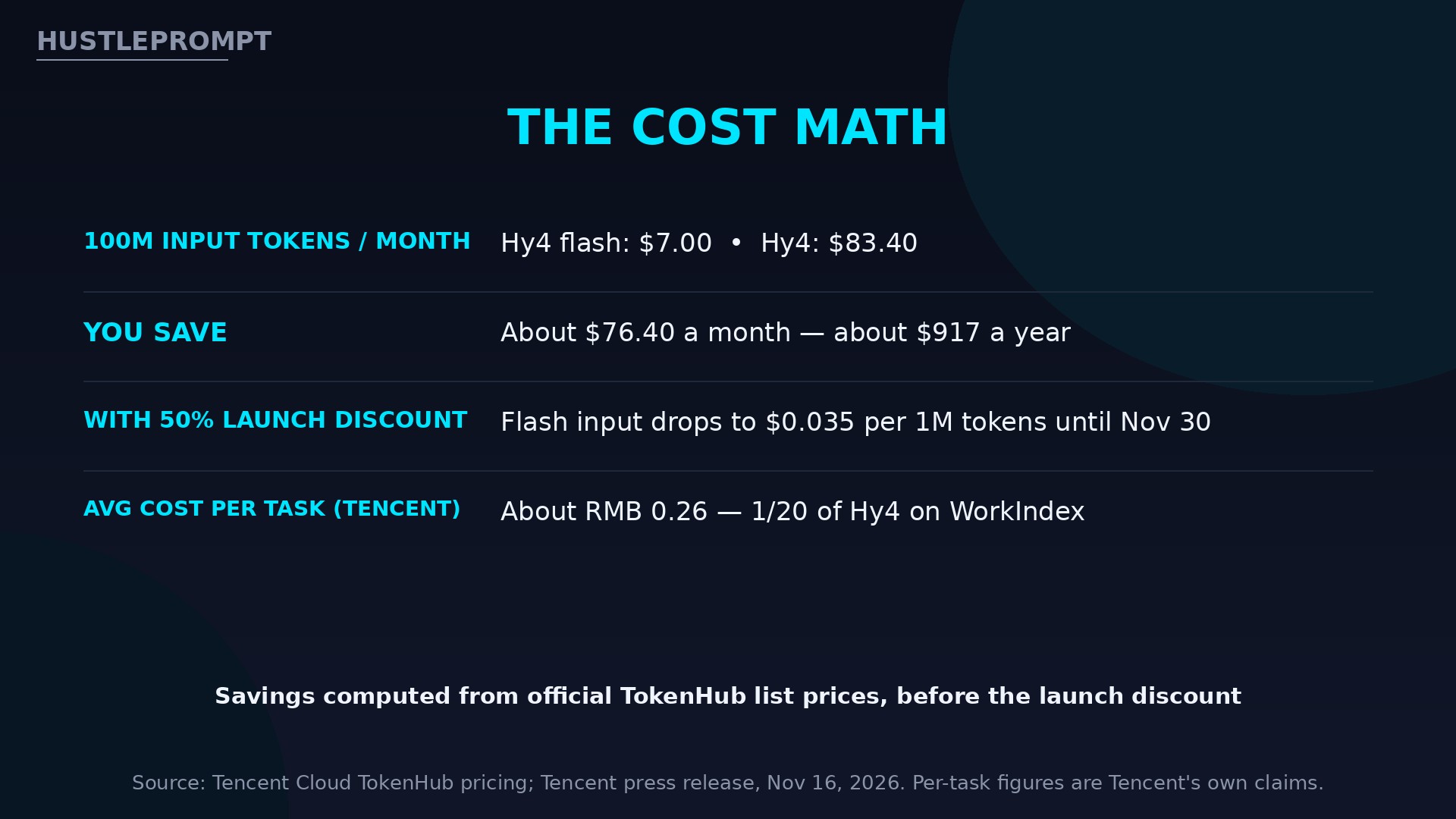
The second claim comes from a blind test: 85 internal Tencent WorkBuddy users across 259 tasks in 27 categories, where Hy4 flash achieved user satisfaction close to Claude Haiku 5.5, at roughly 1/18 the per-task cost and with the shortest task completion time of all models evaluated. Tencent puts the average cost per task at about RMB 0.26. These are Tencent’s own figures — no independent benchmark, model card or weights exist yet, so treat them as the vendor’s case, not a verdict. The honest signal is that Tencent is benchmarking on finished work tasks (decks, documents, spreadsheets) rather than abstract test scores, which is exactly how a buyer should judge a work model anyway.
Hy4 flash — the specs that matter
| Spec | Hy4 flash | Hy4 (full, Nov 4) |
|---|---|---|
| Total parameters | 224B (64B Engram) | 770B |
| Active parameters per token | 12B | 49B |
| Context window | Up to 1M tokens | Up to 1M tokens |
| Max input / output | 960,000 / 64,000 tokens | 960,000 / 64,000 tokens |
| Inputs | Multimodal | Multimodal (vision + computer use) |
| Decoding speed (Tencent) | Over 150 tokens/sec | — |
| KV cache vs Hy4 | 1/6 the size | — |
| API id | hy4-flash | hy4 |
Sources: Tencent, Hy4 flash press release, November 16, 2026; Tencent Cloud model list; Tencent, “Introducing Hy4,” November 4, 2026. Speed and cache figures are Tencent’s own claims. Context: Hy4 ranked 2nd among Chinese models on the Artificial Analysis Intelligence Index and 1st among open-source models on the Agent Arena leaderboard.

Where you can use it right now
Hy4 flash is live today across Tencent Cloud TokenHub, WorkBuddy, Yuanbao, WeCom, QQ, ima and Marvis, with OpenRouter integration coming soon. Tencent also plans to open-source Hy4 flash with frequent iterations, though it gave no date. That matters for builders: an open-weight flash tier would let small teams self-host a cheap, fast model instead of paying per token at all.
Two promotions run until November 30, 2026: free access on WorkBuddy, and 50% off standard pricing via TokenHub. At the promotional rate, input drops to an effective $0.035 per million tokens — a price point where heavy document and agent workloads become almost free to experiment with. Tencent recommends Hy4 flash for most everyday tasks, including deep research, document processing, PowerPoint deck generation, simple front-end displays and computer use, and points users to the more capable Hy4 only for complex work such as long-horizon software engineering.
Flash or full Hy4? Decide in 30 seconds
How to profit from Hy4 flash
A model this cheap is a margin opportunity, not just a curiosity. Four concrete moves follow from the official numbers — none of them is financial advice, and all of them depend on testing the model on your own workload first.
- Cut your existing AI bill first: if you already run document, deck or spreadsheet agents on a flagship model, swap the model id to
hy4-flashon TokenHub and compare output quality on your real tasks. At $0.07 input versus $0.834 for Hy4, every million input tokens saves $0.764. A workflow processing 100 million input tokens a month saves about $76 a month — about $917 a year at list prices — before the 50% launch discount. - Sell the automation, not the model: build a service around the tasks Tencent benchmarks — PowerPoint decks, document editing, spreadsheet repair — and price it per finished deliverable. With Tencent’s claimed average cost of about RMB 0.26 per task, the gap between your price and the model cost is your margin. Test the blind-test claim yourself: if satisfaction really is close to Claude Haiku 5.5 at 1/18 the cost, the arbitrage is real.
- Use the free window to build: free WorkBuddy access and 50% off TokenHub pricing both end November 30, 2026. That is two weeks to prototype agents, measure cost per task, and lock in a workflow before list prices return. Build the demo now, while the compute is nearly free.
- Watch the open-source release: Tencent plans to open-source Hy4 flash. If weights land, self-hosting removes the per-token bill entirely for high-volume users — and early expertise with the model becomes a sellable skill. Follow the Hy4 flash research page for the release date.
The catches
Three things temper the story. First, every performance number here is Tencent’s own. WorkIndex is an internal benchmark, the blind test used Tencent’s own WorkBuddy users, and there is no independent benchmark, model card or downloadable weight set to check the claims against. The 1/20 per-task cost versus Hy4 and the near-Haiku satisfaction are impressive — and unverified. Second, availability is still narrow: OpenRouter integration is “coming soon,” not live, and the open-source release has no date, so most builders outside Tencent’s ecosystem must go through TokenHub for now. Third, the promotions expire. Free WorkBuddy access and the 50% TokenHub discount both end November 30, 2026, so any business case built on those rates needs to work at the $0.07 list price too — which, at 12x cheaper than Hy4, it probably does. The right move is the boring one: run your own workload on the free tier this week, measure cost per finished task, and let your own numbers decide.
FAQ
What is Tencent Hy4 flash?
Hy4 flash is a smaller, cheaper tier of Tencent’s Hy4 model family, launched November 16, 2026. It has 224 billion total parameters (64 billion Engram memory parameters) with only 12 billion active per token, supports multimodal inputs, and handles up to 1 million tokens of context. Its API id is hy4-flash.
How much does Hy4 flash cost?
On Tencent Cloud TokenHub (Singapore card), $0.070 per million input tokens, $0.281 per million output tokens and $0.003 per million cached input tokens. The mainland card is CNY 0.5 / CNY 2 / CNY 0.02. That is about 12x cheaper on input, 9x on output and 14x on cached input than the full Hy4 at $0.834 / $2.501 / $0.042. Until November 30, 2026, it is free on WorkBuddy and 50% off on TokenHub.
Where can I use Hy4 flash today?
It is live now on Tencent Cloud TokenHub, WorkBuddy, Yuanbao, WeCom, QQ, ima and Marvis. OpenRouter integration is coming soon, according to Tencent. Tencent also plans to open-source Hy4 flash later, with no date announced.
How does Hy4 flash compare with Claude Haiku 5.5?
Tencent says that in a blind test with 85 internal WorkBuddy users across 259 tasks in 27 categories, Hy4 flash reached user satisfaction close to Claude Haiku 5.5 at roughly 1/18 the per-task cost, with the shortest task completion time. That is Tencent’s own claim — no independent test exists yet.
What is the context window of Hy4 flash?
Up to 1 million tokens (1,048,576), with a maximum input of 960,000 tokens and a maximum output of 64,000 tokens per call, according to the Tencent Cloud model list. The full Hy4 has the same 1M context.
When should I use Hy4 flash instead of Hy4?
Tencent recommends Hy4 flash for most everyday tasks — deep research, document processing, PowerPoint deck generation, simple front-end displays and computer use — and the full Hy4 for complex work such as long-horizon software engineering. If your workload re-reads the same documents, the $0.003 cached-input price makes flash the obvious default.
Will Hy4 flash be open source?
Tencent says it plans to open-source Hy4 flash with frequent iterations, but it gave no date. The full Hy4 was announced on November 4, 2026 as an open-source model, ranked 2nd among Chinese models on the Artificial Analysis Intelligence Index and 1st among open-source models on Agent Arena — with weights still to follow.
Sources
- Tencent: Tencent Launches Hy4 flash to Power High-Speed, Cost-Efficient AI Deployment for Everyday Workflows — press release, November 16, 2026 (pricing, specs, WorkIndex claims, availability, promotions, Hy4 context)
- Tencent Hy: Hy4 flash research page