
An open AI model just beat OpenAI’s best science model at its own game — and it costs 10 to 20 times less to run. Nemotron for Science, announced by NVIDIA on November 16, 2026, packages an open 120-billion-parameter model with a new chemistry dataset of nearly 50,000 questions and the recipes to post-train it into a lab agent. One partner, Lila Sciences, pushed the model to 61% accuracy on quantum-dot synthesis — past GPT-6 Astra’s 54% — at a tenth to a twentieth of the inference cost. The model, the data and the recipes are all available now, free, on Hugging Face. If you build AI tools for a living, this is the cheapest frontier-grade science agent ever put in public hands.
A science agent is an AI system that does more than answer questions: it reads papers, plans experiments, writes code and calls lab tools on its own. Until now, building one meant paying frontier-model API prices or training a model from scratch. NVIDIA’s move removes both costs. The package is built on Nemotron 3.5 Super VL, an open model with 120 billion total parameters and 12 billion active per token, a 1-million-token context window, and text, image and video inputs. Around it, NVIDIA added scientific evaluations, the LitmusBench v0.2 chemistry dataset and post-training recipes — the exact steps its partners used to get the results below.
What NVIDIA actually shipped
The announcement, made at the SC26 supercomputing conference in Chicago, has four parts. First, the model itself: Nemotron 3.5 Super VL, released on Hugging Face on October 15, 2026, and now optimized to run locally on a 128GB NVIDIA DGX Spark system — a desktop box, not a data center. Second, LitmusBench v0.2, a new open dataset with nearly 50,000 questions for training and evaluating language models on chemistry reasoning. It draws on molecular properties and experimental drug-discovery data, including how molecules dissolve and how the human body processes them. Third, scientific evaluations to measure a model before you trust it in a lab. Fourth, post-training recipes that show exactly how to adapt the model to a specialty such as chemistry or protein design.
Post-training is the step that turns a general model into a specialist. Researchers feed the model domain-specific data, then plug the result into agent workflows that read scientific information, generate code and call computational tools — including NVIDIA’s CUDA-X accelerated software for the heavy math. NVIDIA’s pitch is that the whole loop is now a recipe anyone can follow, not a research project.
The package at a glance
| Part | What it is | The number |
|---|---|---|
| Model | Nemotron 3.5 Super VL, open weights | 120B total / 12B active, 1M-token context |
| Dataset | LitmusBench v0.2, open chemistry questions | Nearly 50,000 questions |
| Recipes | Post-training steps for science tasks | Chemistry, protein design, experiments |
| Hardware | Runs locally on a DGX Spark | 128GB system |
| Availability | Model + dataset on Hugging Face | Available now, free |
Sources: NVIDIA press release, November 16, 2026 (SC26, Chicago); Nemotron 3.5 Super VL model card via Unite.AI. The model itself was released on Hugging Face on October 15, 2026; the science package, dataset and recipes are the new part.

The results NVIDIA reports
The release leads with four partner results, and they are the reason this story matters for anyone who sells AI work. All four come from post-training the same open model on domain data — the exact workflow NVIDIA just published. None of the four has been independently verified yet, and the release says so by attributing each one to the partner. Here is what NVIDIA reports:
Partner results from post-training Nemotron
| Partner | What they did | Result NVIDIA reports |
|---|---|---|
| Terray Therapeutics | Extract reactants, products and reaction conditions from scientific diagrams | About 76% of annotated reactions recovered on the RxnScribe test, beating previously published results on two benchmarks |
| Lila Sciences | Design lab protocols; post-train on quantum-dot synthesis with lab feedback | 61% accuracy vs 54% for GPT-6 Astra, at 10–20x lower inference cost |
| Therna | Agentic mRNA therapeutic design | Nearly doubled accuracy predicting protein-expression ranges over frontier models |
| KTH Royal Institute of Technology | Agent repairs broken GROMACS molecular dynamics setups | 81% of test cases fixed overnight on a single DGX Spark, every fix checked by GROMACS itself |
Source: NVIDIA press release, November 16, 2026. These are NVIDIA-reported partner results, not independent benchmarks. The Lila comparison is against GPT-6 Astra on quantum-dot synthesis accuracy; the 10–20x figure is inference cost, as NVIDIA reports it.
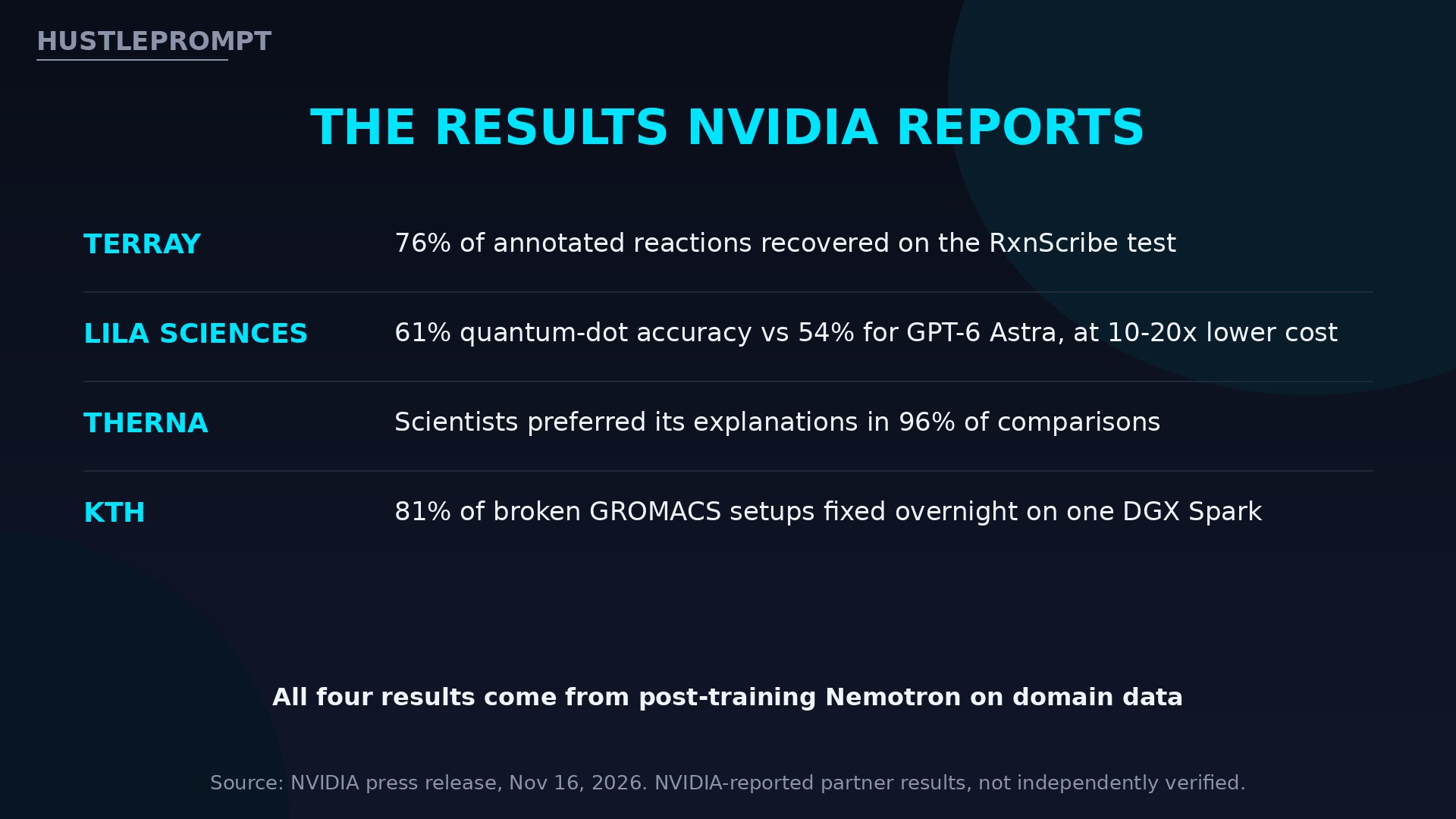
The Lila Sciences number deserves a second look. Lila first used Nemotron to design execution-ready lab protocols for its automated labs, matching what NVIDIA calls frontier-level performance without any additional fine-tuning. Then it post-trained with feedback from its own lab, and accuracy on making quantum dots — the nanoscale crystals used in screens and solar panels — nearly doubled to 61%. GPT-6 Astra, OpenAI’s science model, scored 54% on the same task. And Lila did it at 10 to 20 times lower inference cost. That is the whole story in one line: an open model, tuned on a lab’s own data, beating a frontier model for a fraction of the running cost.
Therna’s result points the same way for drug makers. It post-trained Nemotron for agentic mRNA therapeutic design and nearly doubled accuracy in predicting protein-expression ranges over frontier models. Scientists preferred the tuned model’s explanations over the base model’s in 96% of comparisons — a number that matters because a lab will not trust an agent it cannot follow. Terray’s 76% on the RxnScribe test turns published chemistry diagrams into structured data for synthesis planning, which is the unglamorous step every drug-discovery agent needs first.
Who is already using it
The release names national labs as well as startups. Argonne National Laboratory is integrating Nemotron into StructBioReasoner, a multi-agent system that designs and evaluates protein-based therapeutic candidates for cancer and other diseases. RIKEN, Japan’s national research institute, has made Nemotron available on its RIKYU AI supercomputing platform through its RiVault inference gateway. The Jülich Supercomputing Centre is integrating it into drug and scientific discovery agents. And KTH’s result — an agent that fixes broken molecular dynamics setups on its own, overnight, on a single desktop-class DGX Spark — is the one a small team can copy fastest.
“Accelerated computing is transforming how scientists tackle the world’s most complex challenges,” said Ian Buck, vice president of hyperscale and high-performance computing at NVIDIA. “Nemotron for Science gives researchers open models, scientific data and post-training recipes to build specialized agents that reason through scientific problems and use CUDA-X accelerated tools to turn ideas into discoveries.”

Watch: a science agent built on Nemotron in action — Edison Scientific’s Literature Agent compresses months of expert analysis into a day of compute. Video: NVIDIA Developer (official NVIDIA channel).
How to build your own science agent, in four steps
How to profit from it
The money here is not in the model — NVIDIA gave that away. It is in the workflow around it. Four concrete moves follow from the release, and each one copies something a named partner already did.
- Sell a tuned science agent to one lab. Pick a single workflow — reading chemistry papers into structured data, like Terray — and post-train Nemotron on that lab’s own documents. Charge for the setup and a monthly retainer. The model is free; your data work is the product.
- Offer a benchmark-and-tune service. Use LitmusBench v0.2 to measure a lab’s current model, then post-train Nemotron and show the before-and-after numbers. Lila’s 61%-vs-54% story is the sales slide; your client’s own numbers close the deal.
- Build the boring glue. KTH’s agent fixes broken simulation setups — unglamorous, billable, repeatable. Every research group has a version of this problem: broken configs, failed runs, messy data. An agent that fixes them overnight is an easy first sale.
- Run it locally and keep the margin. Because the model runs on a single DGX Spark, you can host a client’s agent on hardware they own, with no per-token API bill eating your margin. Price the service, not the tokens.
The catches
Three things temper the story. First, every result above is NVIDIA-reported, from NVIDIA’s own partners, on NVIDIA’s own benchmarks. No independent lab has reproduced the 61%-vs-54% comparison or the 76% RxnScribe score yet. Treat them as a demo of what post-training can do, not as settled science. Second, the model is open, but the work is not free: post-training needs domain data, GPU time and someone who understands the science. A bad dataset will tune a model into confident nonsense faster than a good one tunes it into an expert. Third, the timing is deliberate. NVIDIA reports third-quarter earnings on Tuesday, November 17 — the day after this launch — and the science package is a reminder, the night before, that NVIDIA sells the picks and shovels for every AI lab, not just the chips. That does not make the release less real. It makes the earnings call worth watching.
FAQ
What is NVIDIA Nemotron for Science?
It is a package NVIDIA announced on November 16, 2026, for building science agents: the open Nemotron 3.5 Super VL model, the LitmusBench v0.2 chemistry dataset with nearly 50,000 questions, scientific evaluations and post-training recipes. It targets chemistry, life sciences, protein design and materials science.
What is LitmusBench v0.2?
An open dataset of nearly 50,000 questions for training and evaluating language models on chemistry reasoning. It draws on molecular properties and experimental drug-discovery data, including solubility and how the human body processes molecules. It supports both evaluation and post-training.
How big is Nemotron 3.5 Super VL?
It has 120 billion total parameters with 12 billion active per token, a context window of up to 1 million tokens, and text, image and video inputs with text outputs. It was released on Hugging Face on October 15, 2026, and NVIDIA optimized it to run locally on a 128GB DGX Spark system.
Did Nemotron really beat GPT-6 Astra?
On one task, as NVIDIA reports it: Lila Sciences post-trained Nemotron on quantum-dot synthesis and reached 61% accuracy, against 54% for GPT-6 Astra, at 10 to 20 times lower inference cost. The result is NVIDIA-reported from a partner, not independently verified, and it covers quantum-dot synthesis specifically — not science in general.
Is Nemotron for Science free?
The model, the dataset and the recipes are open and available now on Hugging Face at no license cost. You still need hardware to run them — NVIDIA says a 128GB DGX Spark runs the model locally — and post-training needs your own data and compute time.
Who is using Nemotron for science already?
Argonne National Laboratory (StructBioReasoner for protein-based drug candidates), RIKEN (on the RIKYU supercomputer via RiVault), the Jülich Supercomputing Centre, KTH Royal Institute of Technology, and life-sciences companies Lila Sciences, Terray Therapeutics and Therna.
How can I make money with Nemotron for Science?
Sell the workflow, not the model: post-train Nemotron on one lab’s data for one task, benchmark it on LitmusBench v0.2, and charge for setup plus a retainer. The model is free and runs locally, so your margin comes from the data work and the agent integration — not from reselling tokens.
Sources
- NVIDIA press release, November 16, 2026: “NVIDIA Introduces Nemotron for Science” (full text via HPCWire / BigDATAwire) — LitmusBench v0.2, partner results, availability
- Unite.AI: “NVIDIA Launches Nemotron for Science and Open Chemistry Dataset” (November 16, 2026) — Nemotron 3.5 Super VL model card: 120B parameters, 12B active, 1M-token context, October 15 Hugging Face release
- Investing News: “NVIDIA Introduces Nemotron for Science to Accelerate Discoveries With Agents” (November 16, 2026) — full press release text, published 14:00 UTC
- Morningstar / Dow Jones: “Nvidia Launches AI Platform for Science Experiments” (November 16, 2026) — Lila Sciences, Terray Therapeutics and Hugging Face availability
Keep Reading
- NVIDIA Nemotron 3.5 Super VL: 120B Open AI Agent Model — the model behind today’s science package
- NVIDIA Nemotron 3.5 Transcribe Turns Audio Into Answers — the newest member of the Nemotron 3.5 family
- Open AI Models Just Beat GPT-6 at Finance Research — open models are beating frontier models on more than chemistry