
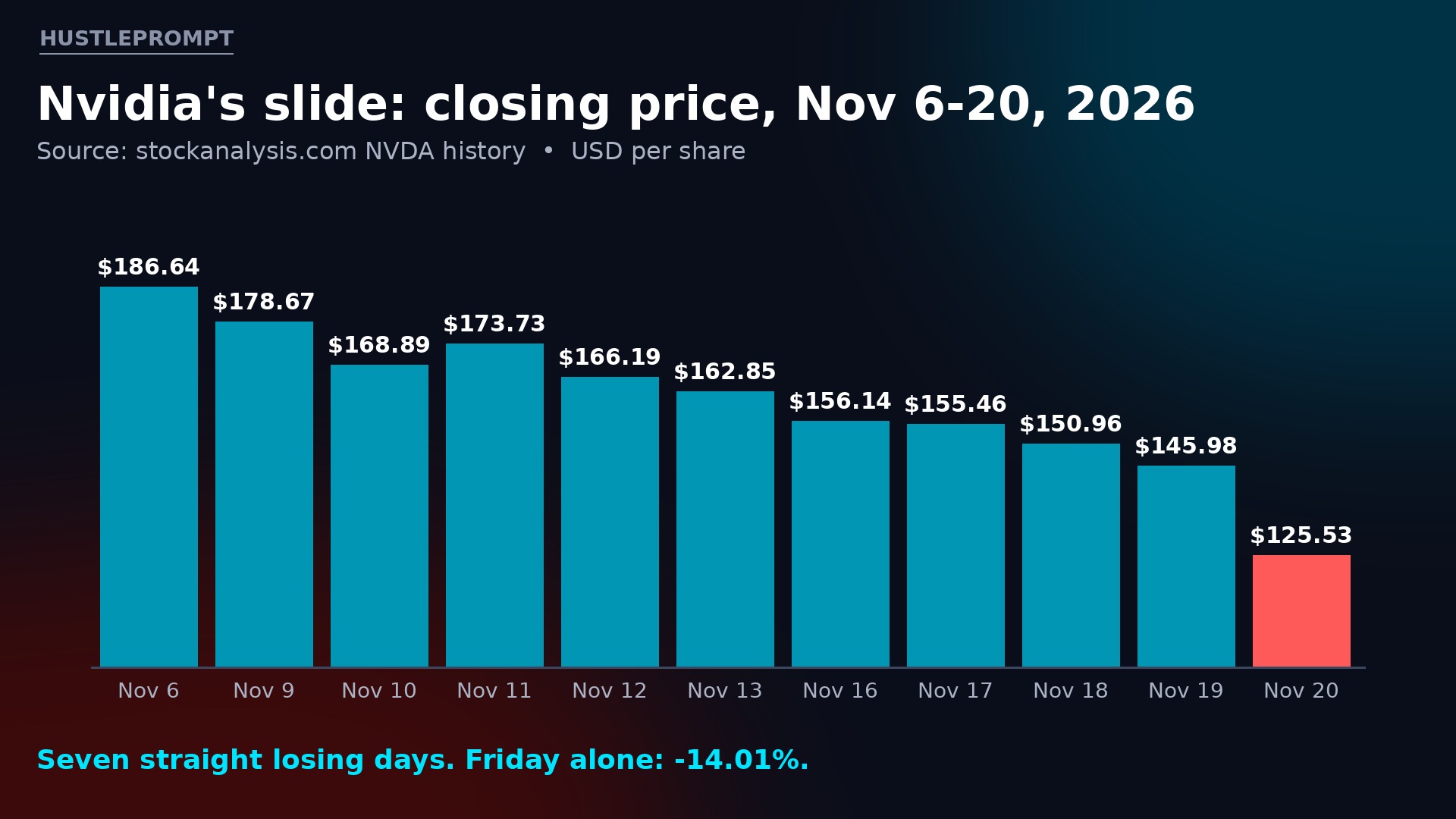
Nvidia stock just lost $485 billion in a single day. On Friday, November 20, 2026, shares of the AI chip giant fell 14.01% to close at $125.53, after Reuters reported that the US Securities and Exchange Commission is investigating potential accounting issues at the company.
It was the worst single-day percentage drop for Nvidia since January 2025. It was also the seventh straight losing day, and the seventh straight losing week — a stretch of weekly losses not seen since 2008.
The stock was already down about 7% before the Reuters report landed. Then the selling accelerated, volume exploded to 633.3 million shares, and the rout spread across the whole market. Here is what happened, what the probe is actually about, and what it means for your money.
What happened on Friday
Reuters reported on Friday afternoon that SEC enforcement staff are scrutinizing potential accounting issues at Nvidia, citing two people briefed on the matter. The Wall Street Journal had reported on Tuesday that the SEC was investigating the company, but could not pin down the focus of the inquiry.
Reuters could not determine when the SEC opened its inquiry, or exactly which accounting issues it is examining. The SEC declined to comment, and Nvidia did not immediately respond to requests for comment.
One thing to be clear about: an investigation is not a finding of wrongdoing. As Reuters put it, investigations are not evidence of wrongdoing, and many close without resulting in enforcement action. But markets do not wait for conclusions. Uncertainty alone was enough to send the stock to its lowest price since May 2025.
The evidence: Friday’s price action
Nvidia opened at $143.52, barely moved to a high of $143.73, then slid all day to a low of $124.50 before closing at $125.53. The table below is the full session, from stockanalysis.com NVDA history:
| Measure | Friday, Nov 20, 2026 |
|---|---|
| Previous close | $145.98 |
| Open / high / low | $143.52 / $143.73 / $124.50 |
| Close | $125.53 (-$20.45, -14.01%) |
| Volume | 633.3 million shares (vs a 3-month average of about 168 million) |
| After-hours | $130.03 (+3.58%) as of 7:59 PM EST — a partial bounce, not a recovery |
Volume ran at roughly 3.8 times the recent daily average. This was panic-level selling, not an orderly pullback.
The rout in numbers: $2.7 trillion gone
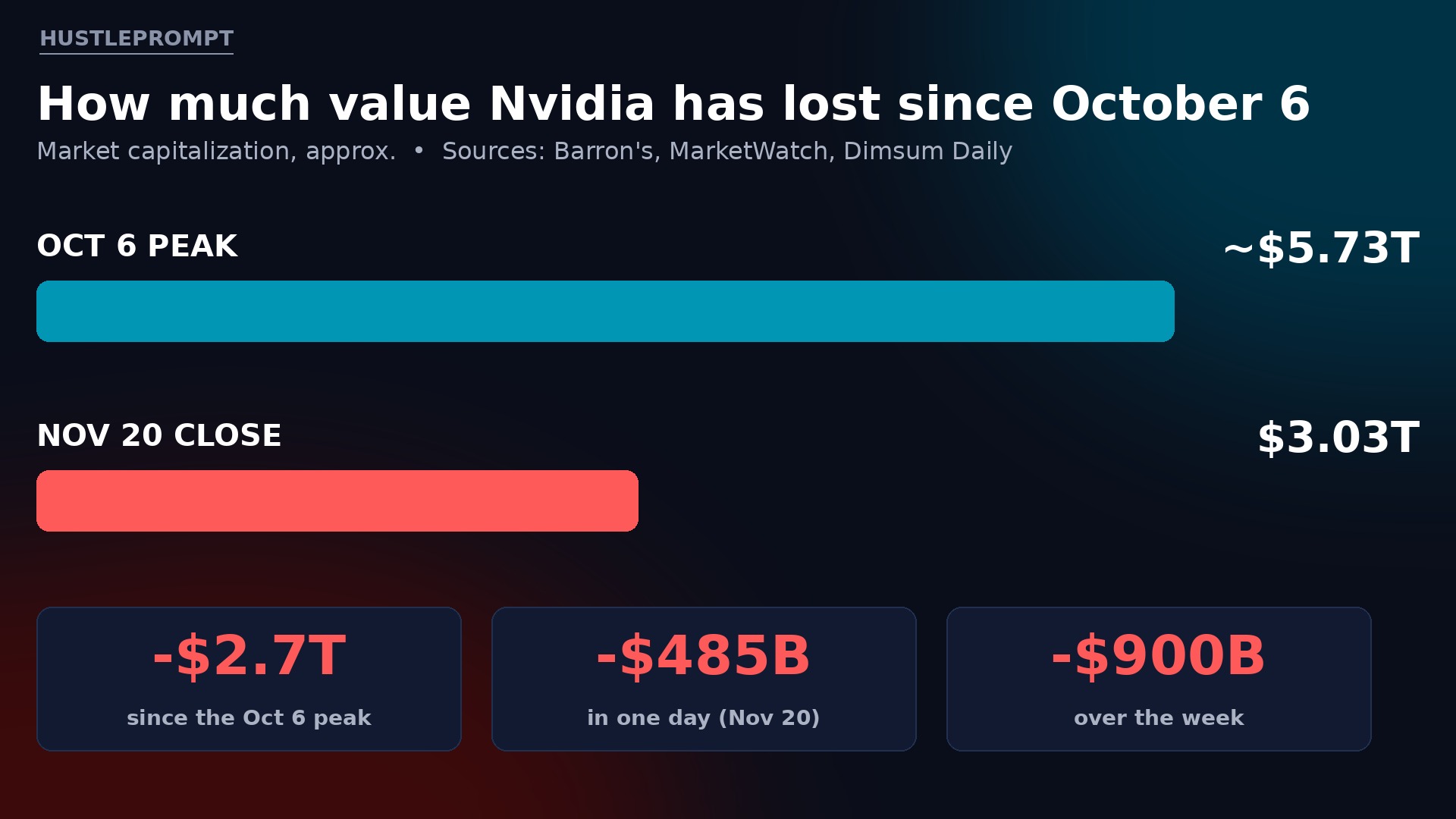
Friday was brutal. The six weeks before it were worse. Nvidia has now fallen more than 47% from its closing high of $239.24 on October 6, wiping out roughly $2.7 trillion in market value — about the value of Amazon, as the Wall Street Journal noted.
The company’s market capitalization now stands at about $3.03 trillion. That makes Nvidia the fourth-largest US company, behind Apple, Microsoft, and Alphabet, after falling below Alphabet for the first time since April 2024.
The evidence: the scale of the losses
- One day: about $485 billion in market value wiped out on Friday alone, per Dimsum Daily.
- One week: nearly $900 billion lost, the worst week since October 2008 — and the biggest one-week loss for any company on record.
- Seven sessions: roughly $1.16 trillion shed over the seven straight losing days, almost the entire market value of Anthropic ($1.18 trillion), per Dow Jones Market Data via MarketWatch.
- Since the peak: about $2.7 trillion gone since October 6, a decline of more than 47%.
“The stock’s weakness despite strong earnings shows how much it will take to restore confidence.” — David Miller, CIO at Catalyst Funds, to MarketWatch
That stings. Nvidia reported blockbuster third-quarter results on Tuesday — $115.8 billion in revenue and $2.68 per share — and raised its outlook. The stock still fell. Strong numbers are no longer enough when investors doubt the numbers themselves.
How a probe report became a $485 billion day
The chain reaction ran in four steps, and each one made the next one worse:
The Wall Street Journal reports an SEC civil probe into whether Nvidia’s investor disclosures were misleading. The focus is unknown.
Reuters reports the probe is examining potential accounting issues. The stock, already down about 7%, drops sharply.
AMD falls 13%, Micron about 14%, and the Nasdaq drops 5.28% as AI valuations are reassessed across the board.
Nvidia closes at $125.53, down 14.01%, with $3.03 trillion in market value left — fourth in the US.
What the SEC is reportedly looking at
The reported focus is accounting, and three items keep coming up in the reporting. First, the roughly $104 billion in 2025 revenue booked through Nvidia’s Singapore unit — about half of global revenue, according to the Financial Times — and a change in how the company reports revenue by geography that removed Singapore from its breakdown.
Second, accounts receivable stretching to 64 days of sales, the highest level since 2022, and a delayed Form 10-Q quarterly filing that is now due by December 4. Third, circular financing deals across the AI sector, in which chipmakers help customers fund purchases of their own chips — arrangements critics say make it harder to judge the quality of the revenue.
The probe sits alongside other investigations. The Justice and Commerce departments have been looking into whether Nvidia chips reached China in violation of export controls, with Singapore-based customer Megaspeed under scrutiny since 2024. California’s attorney general issued an investigative subpoena on Thursday.
There is also the leadership question. Co-founder and CEO Jensen Huang resigned recently, and interim CEO Colette Kress — who remains CFO — has said the company will be far more selective about AI financing deals. Treasury Secretary Scott Bessent has called on Nvidia’s board and outside counsel to answer within 10 days, and told CNBC on Friday that US policy permitting licensed H200 chip sales to China is unchanged.
The selloff spread beyond Nvidia
Friday was a market-wide rout, not a single-stock event. The Nasdaq Composite fell 5.28% and turned negative for the year, closing its worst week since March 2020 with a roughly 10% weekly drop. The S&P 500 fell 3.7%, dropping below 7,000. The Dow fell 1.93%, losing 949.73 points to close at 48,147.33.
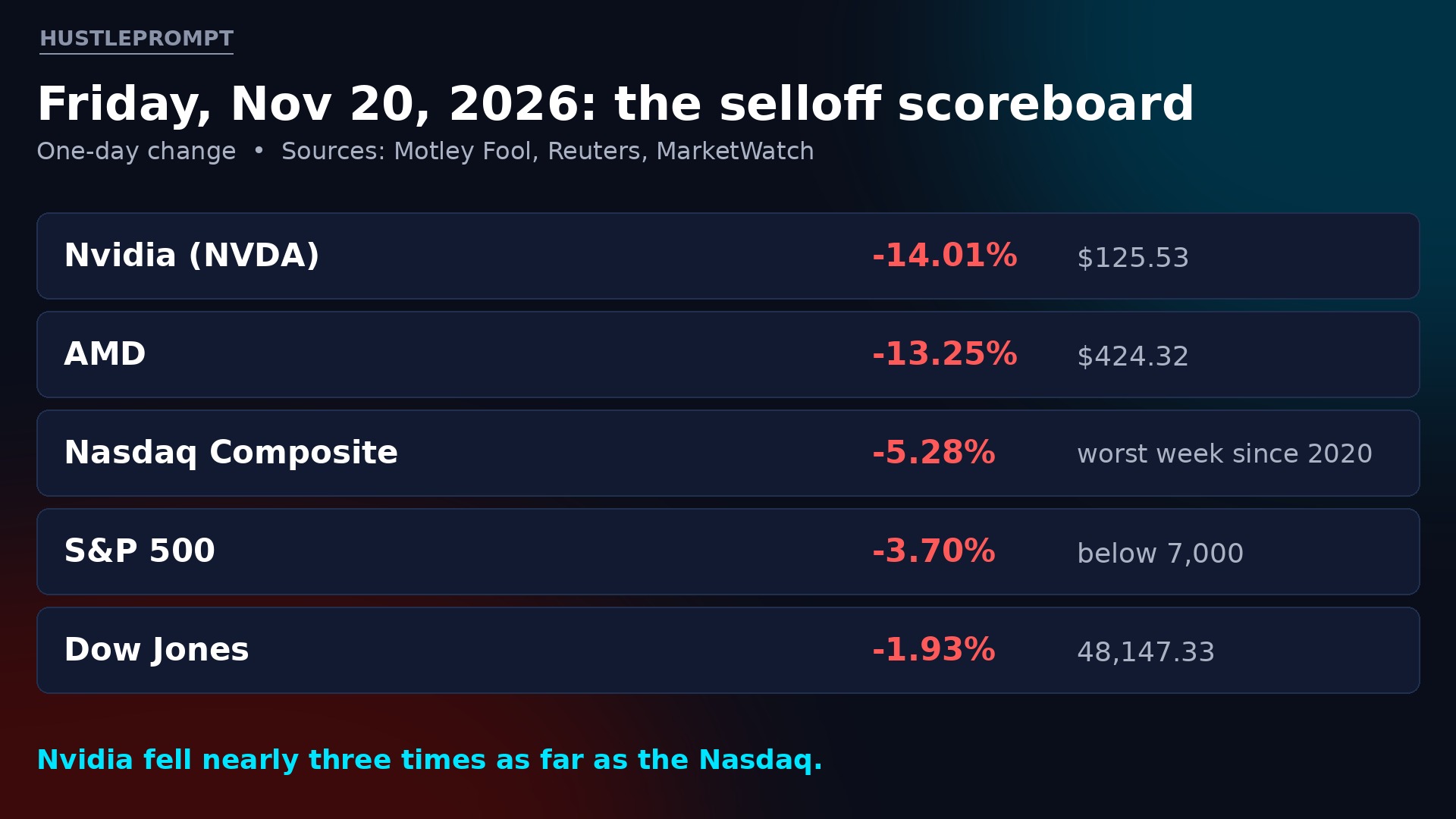
Across semiconductors, the damage was severe. AMD plunged 13.25% to $424.32. Broadcom fell 12.19% to $304.65. Micron dropped about 14% and Dell about 12%, as investors reassessed valuations across the whole AI hardware trade at once.
Wall Street analysts, for what it is worth, are more optimistic than the market. In the view of Barron’s, 71% of analysts covering Nvidia still rate it a Buy, and the average price target implies a 66% jump from Thursday’s close. That is opinion, not evidence — and it has been wrong for seven straight weeks.
What it means for your money
If you own Nvidia, Friday hurt. If you are thinking about buying the dip, nobody knows where the bottom is yet. Here is a concrete way to think about it:
- Separate the business from the stock. Nvidia just reported $115.8 billion in quarterly revenue. The business is still growing. The problem is trust in the numbers and the leadership, not demand for chips.
- Watch the December 4 deadline. The delayed 10-Q filing is the next hard date. A clean, complete filing would answer more questions than any analyst note.
- Watch for a company or SEC statement. So far, neither has said anything substantive about the probe. The first official word will move the stock more than any rumor.
- Do not catch a falling knife with money you need soon. Seven straight losing days and a 47% drawdown do not make a stock cheap by themselves. Size any position so a further 20% drop does not change your life.
- Check your exposure, not just your Nvidia shares. If you hold an S&P 500 or Nasdaq index fund, you already own Nvidia — and AMD, Broadcom, and Micron too. The selloff hit those funds as well.
- Decide your rule before Monday. Write down the price, news event, or filing that would make you buy, hold, or sell — and stick to it when the market opens.
This is not financial advice — just a framework while the facts come out. Friday proved one thing: a single report can erase half a trillion dollars in a day, and no earnings beat protects a stock when investors stop trusting the books.
Frequently asked questions
Why did Nvidia stock crash on Friday, November 20, 2026?
Nvidia fell 14.01% to $125.53 after Reuters reported that the SEC is investigating potential accounting issues at the company. The stock was already down about 7% before the report, amid a broader AI selloff and questions about the company’s leadership and disclosures.
What is the SEC investigating at Nvidia?
According to Reuters, citing two people briefed on the matter, SEC enforcement staff are scrutinizing potential accounting issues. The Wall Street Journal previously reported a civil probe into whether Nvidia’s investor disclosures were misleading. The exact issues under examination have not been disclosed, and neither the SEC nor Nvidia has commented substantively.
Has Nvidia been charged with anything?
No. An investigation is not a finding of wrongdoing, and many SEC investigations close without enforcement action. No charges have been announced.
How much has Nvidia stock fallen from its peak?
More than 47% from its October 6 closing high of $239.24, wiping out roughly $2.7 trillion in market value. The stock is down about 23% for the week and has fallen for seven straight days and seven straight weeks.
How did the rest of the market do on Friday?
The Nasdaq fell 5.28%, the S&P 500 fell 3.7%, and the Dow fell 1.93%. AMD dropped 13.25%, Broadcom 12.19%, Micron about 14%, and Dell about 12%.
Did Nvidia bounce back after hours?
Partly. The stock rose 3.58% after hours to $130.03 as of 7:59 PM EST on Friday. That is a bounce from a very low close, not a recovery — the stock is still down more than 47% from its peak.
What should investors watch next?
Three things: the delayed Form 10-Q filing due by December 4, any statement from Nvidia or the SEC about the probe, and Jensen Huang’s scheduled appearance before Congress on December 1. The answers Treasury Secretary Scott Bessent demanded within 10 days are also on the clock.