
Only 2.8% — that is what the median full-service restaurant kept of every sales dollar before taxes in 2024, according to the National Restaurant Association’s survey of more than 900 operators. That gap is the business: selling AI menu engineering services to restaurants — an AI-assisted analysis of their menu that prices every dish by food cost, profit per plate, and sales volume, then tells the owner what to reprice, promote, or drop. This is analysis and pricing, not menu copywriting (post 9333 covers the words on the menu), and not staff scheduling (post 11037). You sell numbers, not adjectives.
Disclaimer: general business information, not legal advice. Use written agreements and the client’s own tools. Prices are illustrative, never promises of income.
What the service is, exactly
You take a restaurant’s menu, its sales report, and its recipe costs, and you return a ranked plan: which dishes earn money, which ones only look busy, and what to change first. The method is menu engineering, a 1982 framework that sorts every dish by popularity and profit per plate. AI does the arithmetic across the whole menu in minutes; you check the numbers and turn them into decisions the owner can act on.
- Plate costing: ingredient cost per dish, from recipes and current prices.
- Contribution margin: menu price minus plate cost, per dish.
- Popularity: units sold per dish, from the sales report.
- The matrix: every dish sorted into Stars, Puzzles, Plowhorses, or Dogs.
- The action plan: reprice, promote, shrink, or drop — one move per dish.
- The re-check: the same analysis every quarter.
High profit, high sales. Protect.
High profit, low sales. Move up and push.
Low profit, high sales. Reprice.
Low profit, low sales. Test, then drop.
The evidence: restaurant margins leave no room for guesswork
The National Restaurant Association’s 2025 Operations Data Abstract, built from data on more than 900 restaurants, found the median full-service restaurant kept 2.8% of sales as income before taxes in 2024, and the median limited-service restaurant kept 4.0%. Its 2026 State of the Industry report found 42% of operators said their restaurant was not profitable in 2025.
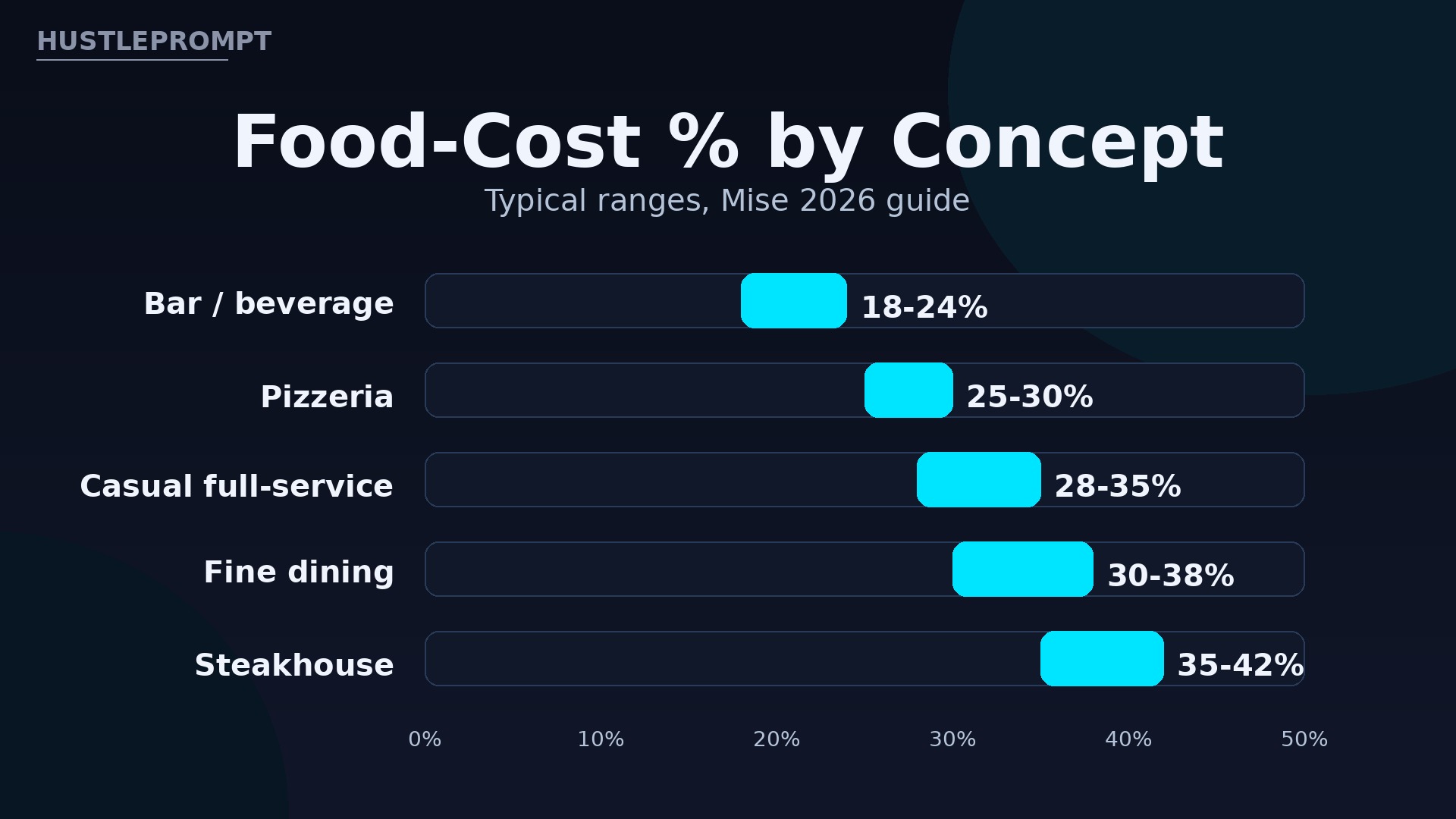
Food cost is the lever you can actually move. Most restaurants aim for a food cost of 28% to 35% of food sales. Prime cost — food plus labor — should stay below 60% to 65% of sales for a full-service restaurant. Five points above target on $40,000 of monthly food sales is $2,000 a month leaking out of the kitchen.
| Concept | Typical food cost % | Source |
|---|---|---|
| Pizzeria | 25–30% | Mise |
| Casual full-service | 28–35% | 7shifts |
| Fine dining | 30–38% | Mise |
| Steakhouse | 35–42% | Mise |
| Bar (beverage cost) | 18–24% | Mise |
Your costs: what the tools charge
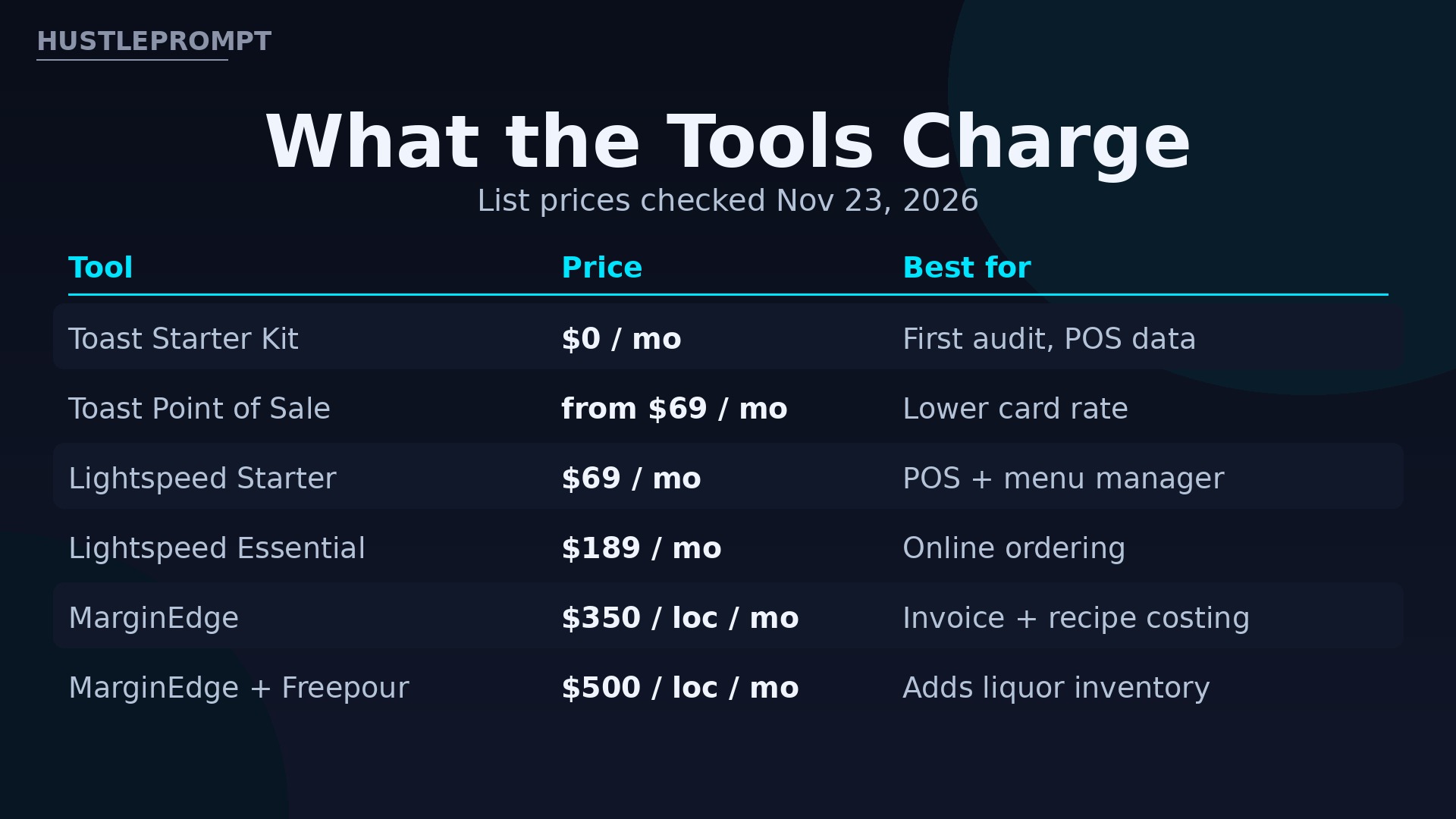
| Tool | Price (checked Nov 23, 2026) | What you get |
|---|---|---|
| Toast POS Starter Kit | $0/mo software, 3.09% + 15¢ per card sale | POS, reporting |
| Toast POS Point of Sale | From $69/mo, 2.49% + 15¢ per card sale | POS plus lower processing rate |
| Lightspeed Restaurant Starter | $69/mo | POS, menu manager, reporting |
| Lightspeed Restaurant Essential | $189/mo | Adds online ordering, inventory |
| MarginEdge | $350 per location/mo | Invoices, recipe costing, daily food cost |
| MarginEdge + Freepour | $500 per location/mo | Adds liquor inventory |
Start with the client’s own point-of-sale data and a spreadsheet — that costs you nothing. MarginEdge at $350 a month per location is a client purchase, not yours: recommend it only when invoice volume justifies it. Toast’s xtraCHEF add-on covers recipe costing from invoices, but Toast publishes no price for it, so get a quote.
How it works: the menu audit you sell
A menu audit has four parts. First, the data pull: 30 to 90 days of item sales, plus recipes and supplier invoices. Second, the plate cost of every dish, priced from current invoices. Third, the matrix: each dish plotted by popularity and contribution margin, using the 70% rule and the menu’s average contribution as the lines. Fourth, the plan: one action per dish, with the new price noted.
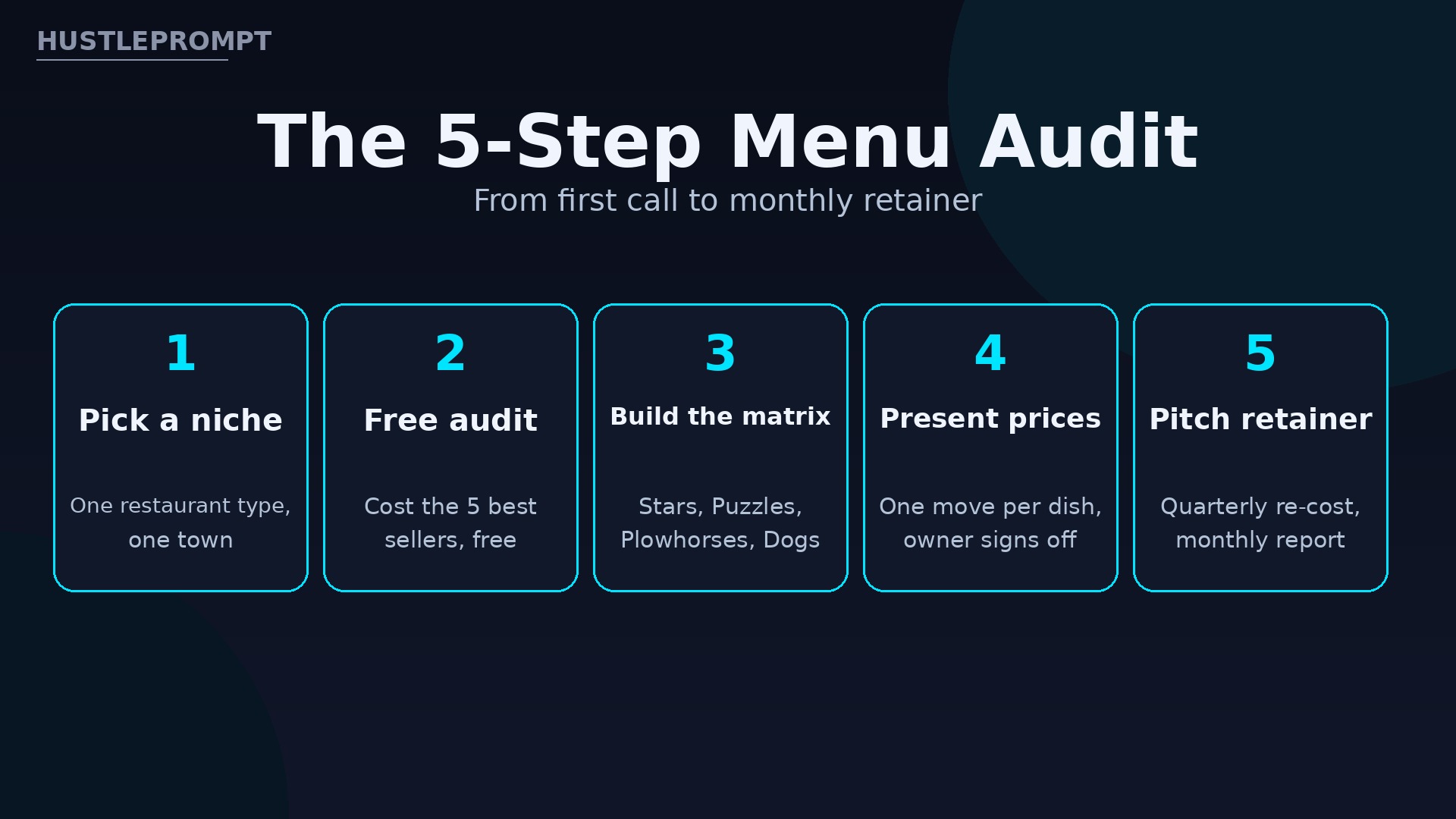
Step 1: pick one restaurant type and one town
Do not start with “menu help for all restaurants.” Pick one pair: independent casual restaurants with 30 to 60 seats in your town, or pizza shops with delivery in the next county. List 30 targets, and note which ones still price by gut feel or have not changed a price in a year.
Step 2: run a free five-dish audit
Offer a free audit of the owner’s five best sellers. Cost each plate from the recipe and the latest invoice, then show the margin per dish. A burger at $14 with a $4.20 plate cost keeps $9.80 per sale at a 30% food cost. A salmon plate at $26 with a $12.50 cost keeps $13.50 but sells 40 times a week, while the burger sells 300. Show them which dish pays the rent.
Step 3: build the matrix in the client’s own data
Build the analysis in the client’s own point-of-sale export and a spreadsheet they own, never in yours. For each dish, record units sold, menu price, plate cost, and contribution margin. Draw the two lines: popularity at 70% of an equal share, and margin at the menu’s average contribution. Sort every dish into its quadrant, then write one action per dish.
Step 4: present the price changes with the math attached
Present the plan dish by dish, with the math on the page. A plowhorse selling 200 times a week gains $300 a week — $15,600 a year — from a $1.50 price increase. Recommend small moves: 50 cents to $1.50 on plowhorses, no change on stars. Give each dog one test — a new description or a better menu spot — with a removal date if nothing changes. The owner signs off on every price.
Step 5: pitch the quarterly retainer with their own numbers
After the first audit, show the before-and-after: food cost percentage, the three worst dishes fixed, and the dollars the changes are worth per month. Then pitch the retainer. Your best line is arithmetic: “Your food cost fell from 36% to 32% on $40,000 of monthly sales. That is $1,600 a month back — for a $600 monthly fee.” Their own numbers close the sale.
What to charge
No official price list exists — these are illustrative ranges.
| Package | Illustrative price | What it includes |
|---|---|---|
| Five-dish audit | Free | Plate costs for 5 best sellers |
| Full menu audit | $600 to $1,200 one-time | Full matrix, price plan, sign-off |
| Quarterly menu retainer | $400 to $900 a month | Re-costing, re-pricing, monthly report |
Scale it: 8 restaurants at $600 a month is $4,800 a month, or $57,600 a year, plus 4 audits at $900 — $61,200 a year part-time.
The mistakes that kill this business
- Stale invoices. Supplier prices move weekly, so re-cost every quarter.
- Cutting a dog the regulars love. Check who orders it first.
- Raising star prices. Stars pay the bills.
- Guessing plate costs. Weigh portions.
- Working in your own account. The client must own the data.
- One audit, then silence. Menus drift; the retainer is the business.
Frequently Asked Questions
What are AI menu engineering services?
A done-for-you service that analyzes a restaurant’s menu with AI: plate costs, margins, and sales volume for every dish, sorted into Stars, Puzzles, Plowhorses, and Dogs, with a price plan for each one.
How is menu engineering different from menu copywriting?
Copywriting changes the words; menu engineering changes the prices and the lineup. Copy sells the dish, engineering decides whether it earns its place.
What data do I need from the restaurant?
Three things: 30 to 90 days of item sales, recipes with portion sizes, and recent supplier invoices. Without real invoices, plate costs are guesses.
How much can I charge for AI menu engineering services?
Illustrative: $600 to $1,200 for a full menu audit, $400 to $900 a month per restaurant on retainer.
Do I need the restaurant to buy new software?
Usually not at first: the point-of-sale export and a spreadsheet do the first audit. MarginEdge at $350 a month per location comes later, when invoice volume justifies it.
How often should a menu be re-analyzed?
Every quarter, or whenever a key supplier raises prices. Toast’s guide says to revisit the matrix every quarter or after any major menu change.
Keep Reading
- Sell AI Restaurant Menu Copy Services: A Freelancer Guide.
- Sell AI Staff Scheduling to Restaurants and Retail.
- Sell AI Loyalty Program Services to Cafes and Salons.
Sources: NRA 2025 Operations Data Abstract (via Economy Insights) — economyinsights.com; Toast menu engineering matrix — pos.toasttab.com; 7shifts restaurant metrics — 7shifts.com; Mise food cost guide — mise.ws; Toast POS pricing — pos.toasttab.com; Lightspeed pricing — posusa.com; MarginEdge pricing — chronicle.fi; plowhorse example — restaurantbottomline.com. Checked Nov 23, 2026.