
More than 100 customers, including a quarter of the Fortune 100, helped design the system that now lets you run frontier Claude models without handing your prompts to anyone. AWS has made the Bedrock Trusted Access API generally available, and the first two programs on it, Anthropic’s Enterprise Frontier Safeguards (EFS) and Enterprise Data Controls (EDC), are in public preview.
For a freelancer or small agency, that is worth money. Until now, the most capable Claude models meant accepting that prompts and responses could be retained for safety review. Now they can live in your own S3 bucket, under your own key, with no human at AWS or Anthropic ever reading them.
What the Bedrock Trusted Access API actually does
The API is one front door for model-provider safety programs: your team can discover the programs available to your account, check eligibility, and enroll the same way every time.
A status check returns one of two answers: eligible means you can enroll right away, and requestable means you need approval first, with the response explaining how to ask. Enrollment is a separate step, where you accept the program’s terms at account, organization, or project scope. You can opt out at any time.
Every step is an API call, so IAM and service control policies decide who can enroll. EFS and EDC are the first offerings, covering Claude Fable, Claude Mythos, and Claude Opus 5.5 and Sonnet 5.5 through the Cyber Verification Program.
EFS vs. EDC: where your Claude data lives
Both programs share the same automated safety monitoring; the difference is custody. With EFS, retained prompts and responses go into an S3 bucket in your own account, encrypted with your KMS key. With EDC, retained data sits in Amazon-managed storage with AWS-managed keys, so there is nothing to set up.
Under both, Anthropic does not retain your prompts or completions, and under EFS, Bedrock keeps no copy either. Only automated monitoring inside AWS reads the retained data, hunting for misuse across many requests, and it is never used for training.
One detail decides many deals: with EDC, cases are not delivered during the public preview, so if a client contract requires you to review every flag, EFS is the only option today.
| Route | Data retention | Where it lives | Encryption key | Who reviews flags |
|---|---|---|---|---|
| Default (aws_review) | Up to 30 days | Amazon-managed storage | AWS-managed | Review within AWS |
| Zero data retention | None, through at least June 30, 2027 | Not retained | Not applicable | Not applicable |
| EFS (public preview) | Your lifecycle rules apply, 30 days minimum | Your S3 bucket | Your KMS key | Your team |
| EDC (public preview) | Up to 30 days, then deleted | Amazon-managed storage | AWS-managed | Your team (cases not delivered in preview) |
What EFS and EDC cost: $0, plus your own storage
AWS and Anthropic do not charge for EFS or EDC, and neither changes model pricing, behavior, or rate limits. You pay only for the infrastructure: standard S3 and KMS charges for your bucket and key.
One extra charge can appear: review runs in US East (N. Virginia) and Europe (Ireland), so a bucket elsewhere pays S3 transfer when review reads it. Keep the bucket in a review Region and that charge disappears. EDC has no bucket or key, so there is nothing extra to pay.
| Cost item | EFS | EDC |
|---|---|---|
| Program fee (AWS and Anthropic) | $0 | $0 |
| Model pricing change | None | None |
| Rate limits or model behavior change | None | None |
| S3 storage and KMS key | Standard charges, your account | Not applicable |
| S3 transfer for review reads | Only if bucket is outside the review Regions | Not applicable |
The only bill is a few dollars a month of S3 and KMS usage, itemized in your own AWS bill.
How the data flows: your bucket, your key, your review
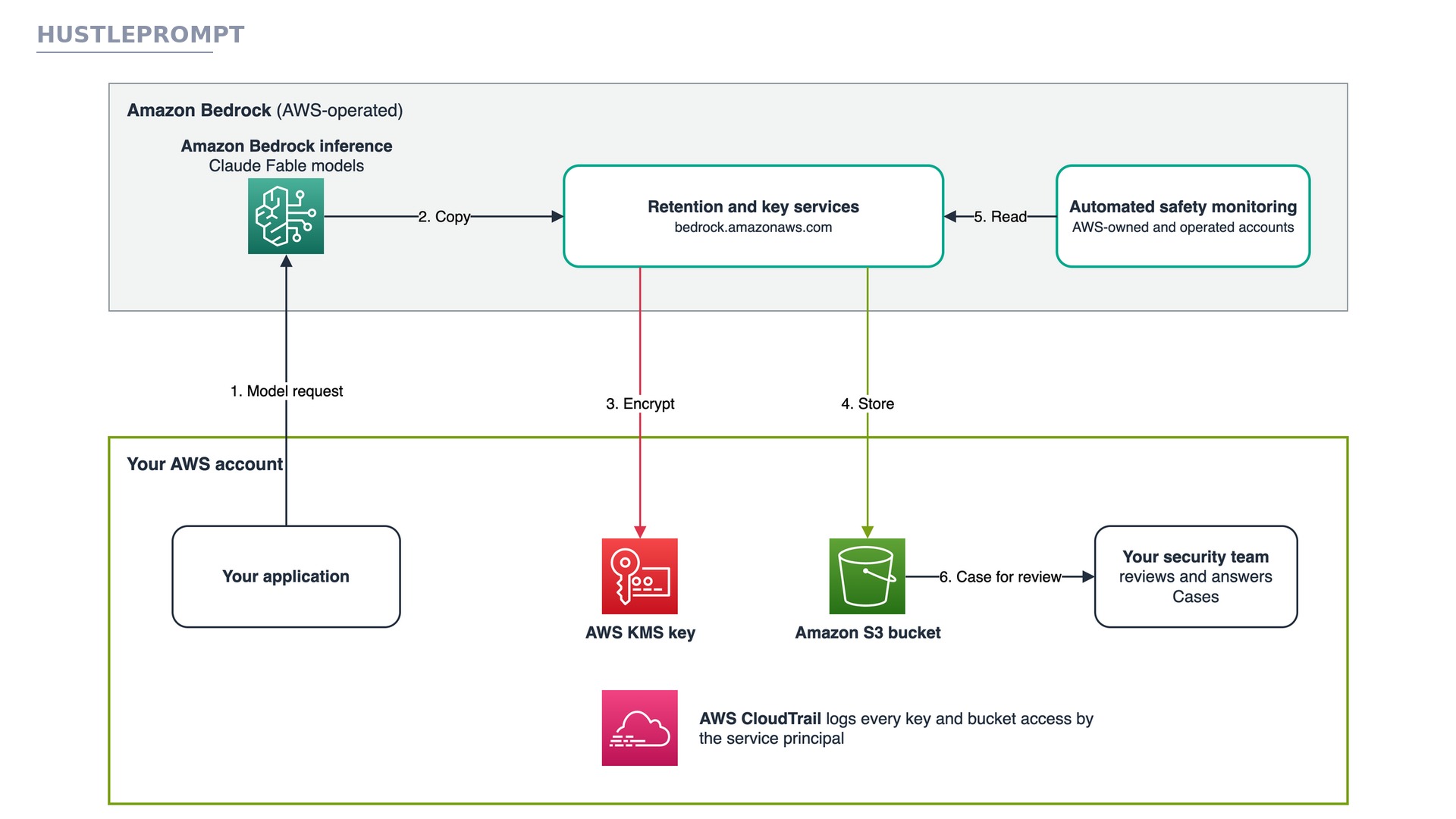
When your app calls a covered model, Bedrock runs the request exactly as for any Bedrock model, then writes the prompt and response to your bucket, encrypted with your key, usually within minutes, retrying for up to 72 hours on failure.
Automated monitoring in AWS-owned accounts scans for misuse across requests and opens a Safety Case in your bucket when it finds a potential risk. Transcripts land under transcripts/, cases under review-cases/, and your answers go to review-responses/.
How a prompt travels under EFS
- Your app calls Claude on Bedrock. Inference works exactly as before.
- Bedrock encrypts the prompt and response with your KMS key.
- Bedrock stores them in your S3 bucket, usually within minutes.
- Automated monitoring in AWS scans the data for cross-request misuse.
- A Safety Case lands in your bucket if a potential risk is found.
- Your team answers within 7 days: violation or no_violation.
No human at AWS or Anthropic reads the retained data, and it is never used for training. Every key and bucket access shows up in your own CloudTrail logs.
How to profit: turn compliance into a service
For a freelancer or agency, EFS is a service you can sell: many small businesses want Claude for client work but cannot use it because clients or insurers forbid sending data into a provider’s retention system.
- Offer a “private Claude” setup. Configure a client’s Bedrock project with EFS, their own S3 bucket, and their own KMS key — for a fixed fee.
- Sell the Safety Case desk. Offer a monthly retainer to watch the bucket, triage cases, and file each answer. The first valid response is final, so this is skilled work.
- Write the client-facing page. A one-page data-handling note tells your client’s customers where prompts live and who holds the key.
- Start with EDC where it fits. Where clients need no customer-held storage, EDC needs no bucket, so you can bill from day one.
- Use a test account first. AWS says to send test traffic only, with no regulated data in the preview.

The catches: a 7-day clock and a 24-hour cutoff
Control comes with a clock: your team must answer each Safety Case within 7 calendar days, stating violation or no_violation. Miss the window and the case closes as window_ended — not a clearance — and repeated failures can lead to suspension. In certain cases, Bedrock may stop serving requests before the 7 days end.
The second obligation is the key and bucket: if Bedrock cannot use them for 24 hours, it stops serving the covered models for that scope and Region, as it does if you delete retained content early or loosen the required bucket settings. Bedrock fails closed by design, so name a case-queue owner and check the bucket daily.

Who should enroll now, and who should wait
Enroll now if you already run Claude Fable or Mythos models for clients who ask where data goes. The preview targets customers already on EFS zero data retention, and joining turns ZDR off for the accounts you add, so start with a test account.
Wait if nobody on your team can own a 7-day review queue, or no client demands customer-held storage. Zero data retention runs through at least June 30, 2027. Learning this flow now is the cheapest way to be ready for the next provider’s program.
Video: AWS’s overview of Claude on Amazon Bedrock, from the official Amazon Web Services channel — a general introduction, not a video about this launch, which has no official launch video yet.
Frequently asked questions
What is the Bedrock Trusted Access API?
It is a generally available API on Amazon Bedrock that gives you one place to discover, request, and enroll in model-provider trusted access programs, starting with Anthropic’s Enterprise Frontier Safeguards and Enterprise Data Controls.
What is the difference between EFS and EDC?
Both use the same automated safety monitoring and leave review with your team. With EFS, retained data lives in your own S3 bucket, encrypted with your KMS key. With EDC, retained data sits in Amazon-managed storage with AWS-managed keys, so there is nothing to set up.
Does Anthropic keep my prompts under EFS or EDC?
No. Anthropic does not retain your prompts or completions under either program, and under EFS, Amazon Bedrock keeps no copy either. No human at AWS or Anthropic reads the retained data, and it is never used for training.
How much do EFS and EDC cost?
AWS and Anthropic do not charge for EFS or EDC, and they do not change model pricing, behavior, or rate limits. With EFS you pay only standard S3 and KMS charges for your own bucket and key.
How long do I have to answer a Safety Case?
Seven calendar days from the case arriving in your bucket. Your first valid response, violation or no_violation, is final. Missing the window can stop Bedrock serving your requests, and repeated failures can lead to account suspension.
Which Claude models are covered?
Claude Fable and Claude Mythos models, plus Claude Opus 5.5 and Sonnet 5.5 when used through the Cyber Verification Program. The AWS documentation lists Fable 5, 5.1, and 5.2 and Mythos 5, 5.1, and 5.2.
What happens if Bedrock loses access to my key or bucket?
Bedrock stops serving the covered models 24 hours after it loses access to your key or bucket. The same happens if you delete retained content early or loosen the required bucket settings.
Keep Reading
- Claude Ship: AI Now Reviews, Fixes and Approves Code
- Best AI Tools for Freelancers (by Task) in 2026
- 2M Fake Secrets Prove Your AI Prompts Are Leaking
Sources
- AWS Machine Learning Blog: Introducing the Amazon Bedrock Trusted Access API with Anthropic’s Enterprise Frontier Safeguards and Enterprise Data Controls
- AWS Documentation: Enterprise Frontier Safeguards and Enterprise Data Controls on Amazon Bedrock (public preview)
- Anthropic: Developing Enterprise Frontier Safeguards with our customers