
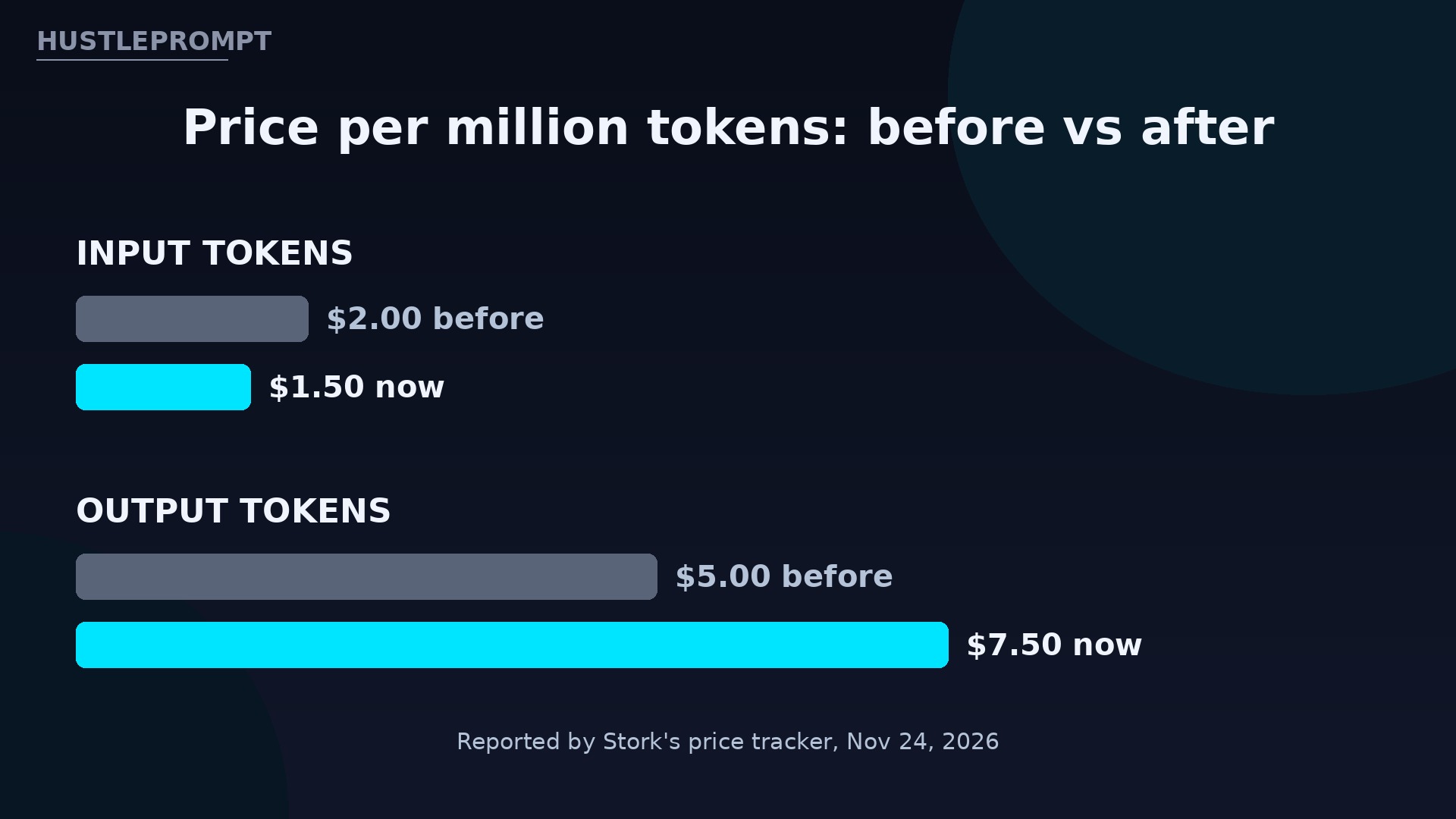
Long-form AI generation just got a lot more expensive. On November 24, 2026, Stork’s price tracker recorded a sharp change in the Magistral Medium price: output tokens jumped 50%, from $5.00 to $7.50 per million, while input tokens fell 25%, from $2.00 to $1.50. If your app writes articles or generates code, your next invoice will show it.
Reasoning models are output-hungry by design. Magistral Medium thinks before it answers, and every word of that thinking — plus the final answer — is billed as output. The model now charges a premium for exactly the tokens you use most.
One catch: Mistral has not published the new rates on its official pricing page. This article reports the change as tracked by Stork and corroborated by two other trackers — plus seven ways to cut the bill.
What changed: the new Magistral Medium price
Stork’s LLM price catalog, which checks first-party list prices daily, logged the move on November 24, 2026: input fell from $2.00 to $1.50 per million tokens, a 25% cut, while output rose from $5.00 to $7.50, a 50% increase. The model affected is Magistral Medium (latest), the alias for Mistral’s enterprise reasoning model.
Two independent trackers agree. TokenBarometer, drawing on models.dev data, recorded the identical change on the same date, and LiteLLM lists Magistral Medium at $1.50 in and $7.50 out, with cached input at $0.15, checked November 23, 2026.
What we could not verify is an official confirmation. Mistral’s API pricing page, read on November 25, lists Mistral Large 4, Mistral Small 4, Codestral, and the Ministral 3 family — but Magistral Medium does not appear on the current rate card at all, and we found no announcement on Mistral’s blog or changelog. Treat the new rates as reported, and check your own La Plateforme invoice before you reprice for customers.
| Rate per million tokens | Before | Now (reported) | Change |
|---|---|---|---|
| Input | $2.00 | $1.50 | -25% |
| Output | $5.00 | $7.50 | +50% |
| Cached input | — | $0.15 | — |
| Blended (3:1 input to output) | $2.75 | $3.00 | +9.1% |
Before/after figures: Stork price tracker, November 24, 2026; cached input: LiteLLM, checked November 23, 2026. Blended rate is our own calculation from the reported prices.
What Magistral Medium is — and why output costs so much
Magistral is Mistral’s first reasoning model, launched in June 2025 in two versions: Magistral Small, a 24-billion-parameter open-weight model, and Magistral Medium, the more powerful enterprise version sold through Le Chat and the API.
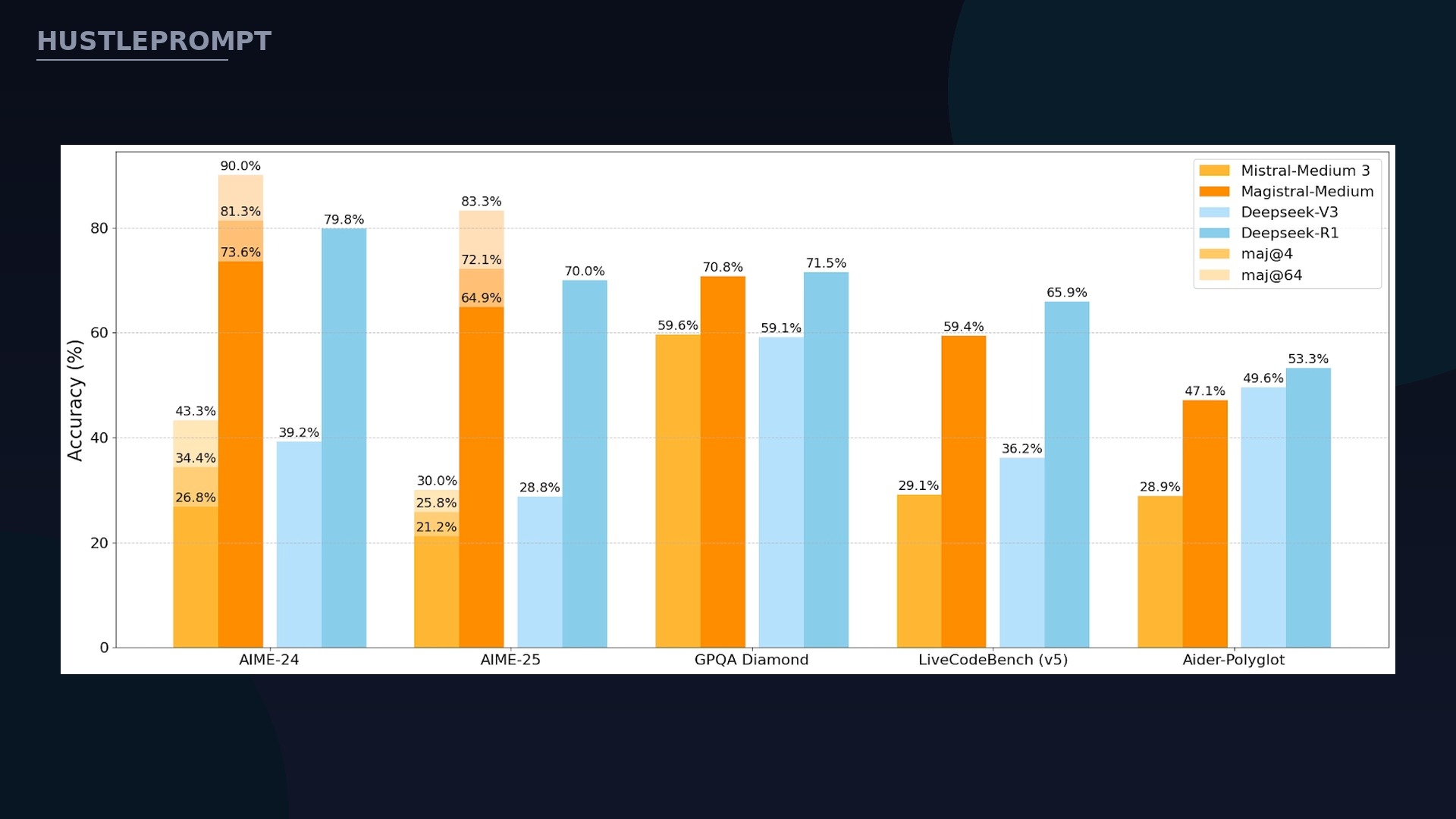
It is built for problems that need step-by-step thinking: math, code, legal research, and multi-step planning. Mistral reports that Magistral Medium scored 73.6% on the AIME 2024 math exam, rising to 90% with majority voting across 64 attempts, and that its Flash Answers mode in Le Chat runs up to 10 times faster than most competitors.
That thinking is exactly why the output hike stings: a reasoning model bills you for the chain of thought, not just the answer. Long, careful reasoning means long, expensive outputs — and at a reported $7.50 per million, every extra paragraph of thinking costs half as much again.
The benchmark chart below, published by Mistral with the launch, shows where it stands: it leads on the AIME-24 and AIME-25 reasoning tests, where its premium is hardest to replace.
What the hike costs in real workloads
Percentages hide the real damage. The table below translates the reported rates into monthly bills, using our own calculations plus TokenBarometer’s published workload estimates.
| Monthly workload | Tokens | Before | Now | Change |
|---|---|---|---|---|
| Content generation | 1M in / 5M out | $27.00 | $39.00 | +44% |
| Long-form writing (1,000 articles) | 2M in / 8M out | $44.00 | $63.00 | +43% |
| Chat assistant | TokenBarometer preset | $32.00 | $39.00 | +22% |
| Coding agent | TokenBarometer preset | $21.50 | $18.00 | -16% |
| Classification | 10M in / 1M out | $25.00 | $22.50 | -10% |
Content generation, long-form writing, and classification rows are our own calculations from the reported rates. Chat assistant and coding agent rows are TokenBarometer’s published estimates, November 24, 2026.
The pattern is clear: output-heavy work pays 40% or more, while input-heavy work gets cheaper. Your bill moves with your input-to-output ratio, not the headline 50%.
Who gets hit hardest — and who actually saves money
Three kinds of builders take the biggest hit: content platforms that generate full articles, code agents that write and rewrite large files, and chat products with long replies. If output is more than half your token volume, expect a bill increase of 25% or more.
Three kinds of workloads come out ahead: classification, data extraction, and retrieval-augmented chat send long prompts and receive short answers, so the 25% input cut outweighs the output hike and the bill falls.
Should you keep using Magistral Medium?
Step 1 — Measure
Check your last invoice: what share of your tokens is output?
Step 2 — Output over 50%?
Your bill rises. Apply the cost cuts below or switch models for easy tasks.
Step 3 — Input over 75%?
Your bill falls. Stay put and enjoy the 25% input discount.
How to cut your Magistral Medium bill
You do not have to accept the new rate as-is. Seven levers cut the bill, starting with discounts Mistral itself publishes.
- Batch what can wait. Mistral’s own pricing page says batch processing cuts the price by 50%. Nightly reports, bulk content, and dataset labeling can run through the Batch API — at the reported rates, that turns $7.50 output into $3.75.
- Cache repeated prompts. Cached input costs $0.15 per million, according to LiteLLM, and Mistral says caching cuts input costs by up to 90%. Cache the system prompts, examples, and long documents you send on every call instead of re-sending them.
- Shorten the thinking. Reasoning effort is configurable on Magistral models. Use low effort for simple tasks and reserve high effort for the problems that need it — every skipped reasoning token is one you do not buy.
- Cap output length. Set a max token limit per request and ask for concise formats: bullet summaries instead of essays, diffs instead of full files. A hard cap makes costs predictable.
- Route simple calls to a cheaper model. Mistral’s own rate card lists Mistral Large 4 at $0.70 in and $2.10 out, and Mistral Small 4 at $0.15 and $0.60. Use them for classification, routing, and short replies.
- Split the pipeline. Let a cheap model draft, extract, and summarize, and call Magistral Medium only for the final reasoning step.
- Reprice your product. If you resell generation — articles, reports, code — rebuild your unit costs on the $7.50 output rate now. A 43% cost increase on long-form output swallows most margins if you bill per article at old prices.
Cheaper options on Mistral’s own rate card
If the new rate does not fit, Mistral’s official pricing page offers cheaper in-house options. The table below uses only rates from mistral.ai/pricing/api, read November 25, 2026.
| Model | Input / 1M | Output / 1M | Best for |
|---|---|---|---|
| Mistral Large 4 | $0.70 | $2.10 | General work, coding, agents |
| Mistral Small 4 | $0.15 | $0.60 | High-volume chat, extraction |
| Codestral | $0.30 | $0.90 | Code completion |
| Ministral 3 (8B) | $0.15 | $0.15 | Classification, routing |
Source: Mistral AI API pricing page (mistral.ai/pricing/api), read November 25, 2026. EU regional inference adds 10%.
Note the oddity: the reported Magistral Medium output rate of $7.50 is more than triple Mistral Large 4’s $2.10, even though Large carries the flagship name. At these rates, Magistral Medium only earns its premium when its reasoning quality decides between a right answer and a wrong one.
Watch: Magistral Medium in action
Mistral’s official video below shows Magistral Medium working through a coding task, with its thinking visible step by step. It is from the model’s June 2025 launch — it demonstrates the model, not the November price change.

Video: “Magistral Medium — Coding abilities” by Mistral. It shows the model’s reasoning, not the price change.
Frequently asked questions
What is the new Magistral Medium price?
According to Stork’s price tracker, Magistral Medium (latest) now costs $1.50 per million input tokens and $7.50 per million output tokens, changed on November 24, 2026. The rates are reported, not yet confirmed on Mistral’s official pricing page.
Why did output get more expensive while input got cheaper?
Reasoning models burn most of their compute on generation, not on reading prompts. Stork’s analysis is that Mistral is passing the real cost of generation on to builders, while cutting input prices for workloads that mostly read and classify.
How much will my bill change?
It depends on your input-to-output ratio. At a 3:1 mix, the blended rate rises about 9%, from $2.75 to $3.00 per million tokens. Output-heavy workloads such as long-form writing rise 40% or more, while input-heavy workloads such as classification fall about 10%.
Is Magistral Medium still worth $7.50 per million output tokens?
For hard reasoning — math, complex code, multi-step planning — its AIME 2024 score of 73.6% (90% with majority voting) is the reason to pay. For routine chat, extraction, or short replies, cheaper Mistral models do the same job for far less.
How can I cut the cost?
Use the Batch API for non-urgent work (50% off, per Mistral), cache repeated prompts (cached input from $0.15 per million), lower the reasoning effort on easy tasks, cap output length, and route simple calls to Mistral Small 4 or Mistral Large 4.
Where can I verify the new prices?
Check your own usage in La Plateforme, Mistral’s developer console, and watch Mistral’s official pricing page. The change is also recorded by Stork’s price tracker, TokenBarometer, and LiteLLM’s model pricing page.
Keep Reading
- Mistral AI: Europe’s Best Models and How to Use Them Free
- Mistral Vibe Desktop Brings Parallel Agents to Mac, Windows
- Pixtral Large 2502 Joins OpenRouter at $2 Per Million Tokens
Sources
- Stork AI Daily — Mistral hiked Magistral Medium prices (November 24, 2026)
- TokenBarometer — Magistral Medium mixed price change, November 24, 2026
- LiteLLM — Magistral Medium API pricing
- Mistral AI — API pricing (official rate card)
- Mistral AI — Pricing (plans, batch and caching discounts)
- Mistral AI — Announcing Magistral, the first reasoning model by Mistral AI (June 10, 2025)
- Mistral Docs — Mistral Medium 3.5 model card