
Ternary Bonsai 2.5 is a 27-billion-parameter coding model that fits in 5.9 GB. PrismML announced the upgrade on November 24, 2026: the same class of model that normally needs 53.8 GB of memory now runs from a file smaller than a movie download. Free under Apache 2.0, on hardware you already own.
Coding agents are hungry: they read whole repositories, call tools, run tests, iterate for hours. Until now, running one locally meant renting a big GPU or paying a frontier API by the token. Bonsai 2.5 closes most of that gap.
What Bonsai 2.5 actually is
Bonsai 2.5 is built on Qwen 3.8 27B and compressed with ternary weights: every weight is stored as minus one, zero, or plus one instead of a 16-bit number. Groups of 128 weights share one precise scale value, which keeps the model accurate: 1.76 bits per weight, a 5.93 GB file, roughly 9 times less memory than the 53.8 GB full-precision model.
The upgrade targets agentic work — long jobs of reading code, editing it, running tests, fixing what breaks. Small errors compound across tool calls, so PrismML focused on keeping the agent on track.
| Benchmark | Bonsai 2.5 | Bonsai 2 | Full Qwen 3.8 |
|---|---|---|---|
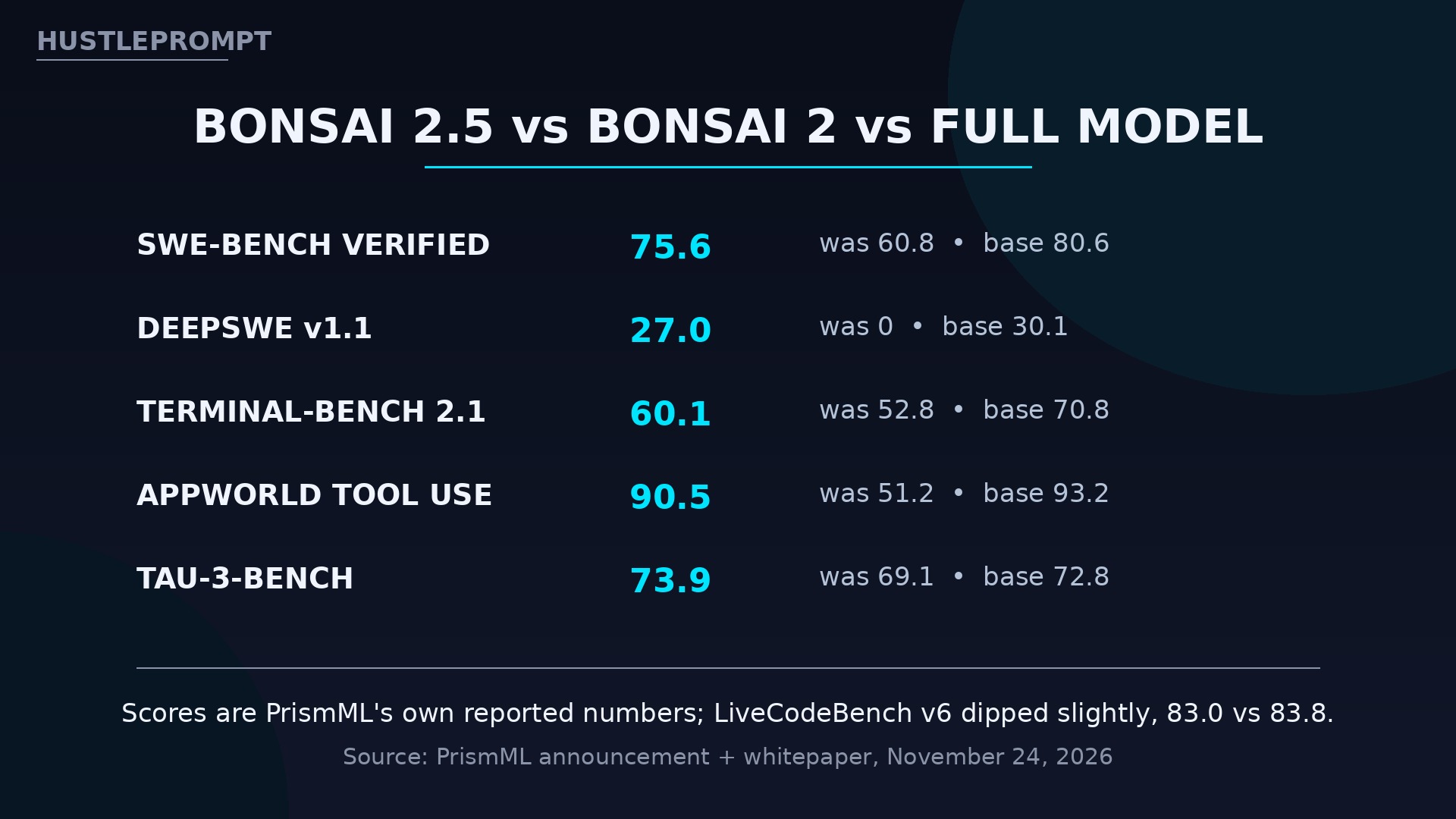
| SWE-bench Verified | 75.6 | 60.8 | 80.6 |
| DeepSWE v1.1 | 27.0 | 0 | 30.1 |
| Terminal-Bench 2.1 | 60.1 | 52.8 | 70.8 |
| AppWorld | 90.5 | 51.2 | 93.2 |
| τ³-Bench | 73.9 | 69.1 | 72.8 |
| LiveCodeBench v6 | 83.0 | 83.8 | 87.6 |
Bonsai 2.5 sits far closer to the full model than its predecessor, and beats the base model outright on τ³-Bench. The one exception is LiveCodeBench v6, down slightly from 83.8 to 83.0. PrismML reports the numbers itself; no independent lab has reproduced them yet — treat them as vendor claims.
The jump that matters: agents that finish the job
Across three agentic coding benchmarks — SWE-bench Verified, DeepSWE, Terminal-Bench — Bonsai 2.5 averages 54.2, up from 37.9. Across two tool-calling benchmarks, AppWorld and τ³-Bench, it averages 82.2, up from 60.2. DeepSWE, which measures long multi-step software work, went from 0 to 27.0.
Why stamina beats raw score
“Getting a capable model onto a device is only part of the challenge. It also has to remain effective through all the decisions involved in completing a real complex task. That is where we focused our work with Bonsai 2.5.”
— Babak Hassibi, Founder and CEO of PrismML, November 24, 2026
A coding agent that forgets the plan halfway through a refactor is worse than no agent. Bonsai 2.5’s pitch is stamina across a long task, not raw intelligence.
What it costs to run — and what it saves
The download is free; the running cost is your own electricity. A heavy agentic session on a frontier coding API can burn dollars in tokens per task. For a freelancer or small team running agents all day, the difference between a per-token bill and a one-time download is the business case.
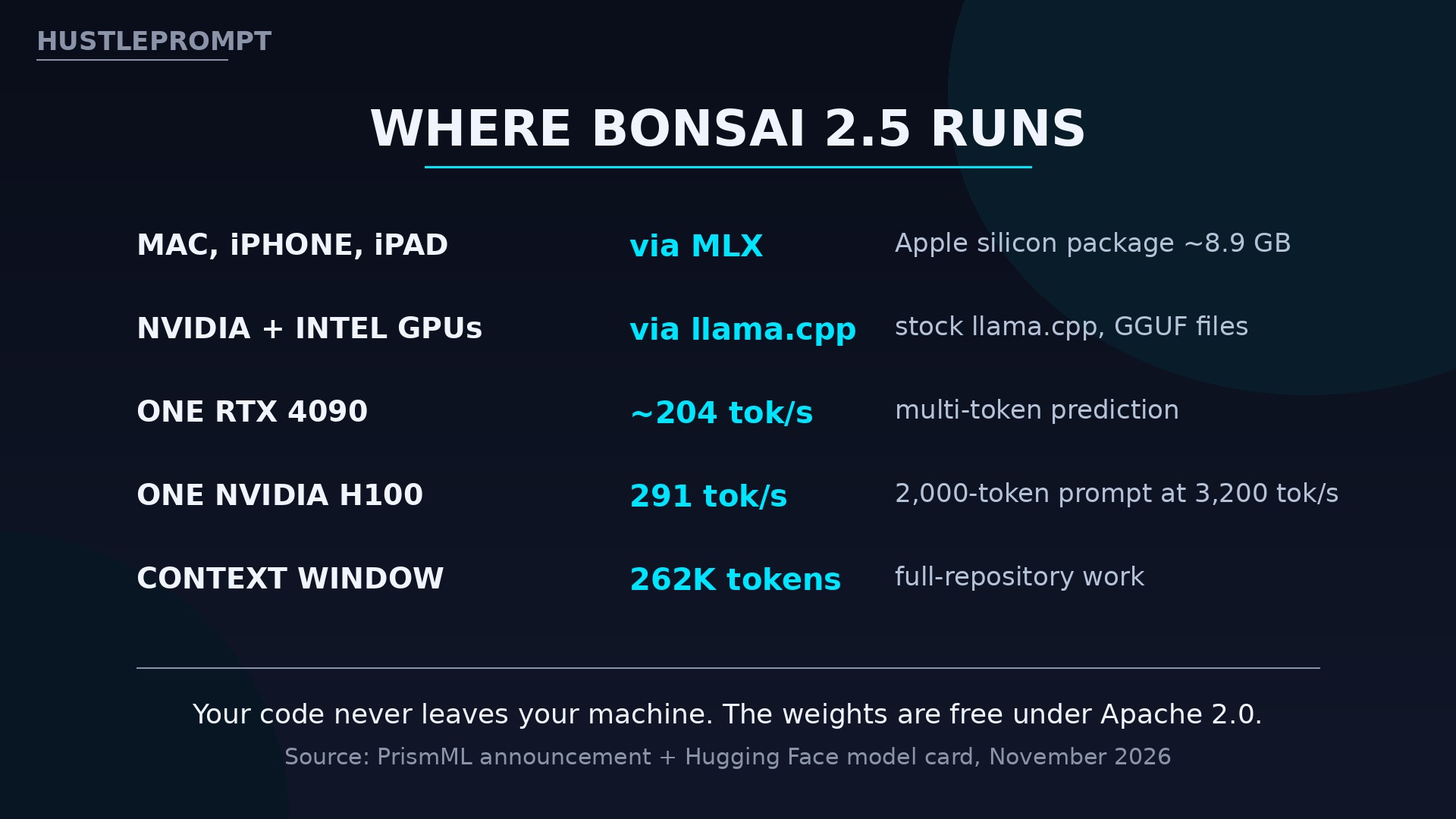
- Mac, iPhone, iPad: via MLX (Apple silicon package ~8.9 GB).
- NVIDIA and Intel GPUs: via llama.cpp (GGUF files).
- One RTX 4090: about 204 tokens per second (multi-token prediction).
- One NVIDIA H100: 291 tokens per second; a 2,000-token prompt at 3,200 tokens per second.
- Context window: 262,000 tokens for full-repository work.
Privacy is the second saving: the model runs on your device, so a private codebase never leaves your machine — important under NDA and for anyone who cannot send code to a third-party API.
How to run it this afternoon
How to profit from it
- Sell local coding help: repository cleanup, test-writing, or bug fixes with a free model behind them — no API bill eats the margin.
- Sell privacy-first automation: clients who cannot use cloud AI pay for agents on their own hardware.
- Build products on it: embed the model in an app under Apache 2.0.
- Cut your own costs: replace paid API calls for routine coding with the local model; keep frontier APIs for the hardest 10%.
The honest caveats
Bonsai 2.5 is not a frontier model: on most benchmarks it still trails the full 27B model it was compressed from, and frontier models by more. The 75.6 SWE-bench Verified score is a vendor claim until an independent lab reproduces it. It also needs real hardware for good speed — a phone runs it, but an RTX 4090 or an Apple silicon Mac is where it feels fast. Download it for local agent work, not as a replacement for the best cloud models.
Details: the PrismML announcement, the PR Newswire release, the Hugging Face model card.
Frequently asked questions
What is Ternary Bonsai 2.5?
PrismML’s compressed 27B coding model, based on Qwen 3.8 27B, announced November 24, 2026, free under Apache 2.0.
How small is it really?
5.9 GB, about 9 times smaller than the 53.8 GB full-precision model, at 1.76 bits per weight instead of 16.
How good is it at coding?
PrismML reports 75.6 on SWE-bench Verified, up from 60.8 and close to the full model’s 80.6; its agentic coding average is 54.2, up from 37.9. Vendor-reported.
What hardware do I need?
Mac, iPhone, or iPad via MLX; NVIDIA or Intel GPUs via llama.cpp. One RTX 4090 runs about 204 tokens per second, one H100 291.
Is it really free?
Yes — free under Apache 2.0 from Hugging Face, no subscription, no cloud account.
Can I use it commercially?
Yes, Apache 2.0 allows commercial use, including embedding it in products. Check the model card for the full terms.