
OpenAI’s Astra just helped two amateur astronomers flag 49 possible exoplanets — using public NASA data, no telescope, no astronomy degree. OpenAI published the story on November 24, 2026; the two searches show what AI research agents can now do in the hands of anyone with a laptop.
One search covered about 100,000 stars, the other about 19 million. Professional astronomers are now checking the leads, and two signals were independently re-found by a SETI Institute astronomer. None is a confirmed planet yet — but that is not the point. The point is who can now do this work.
The two searches
| Who | Tool | Stars searched | Result |
|---|---|---|---|
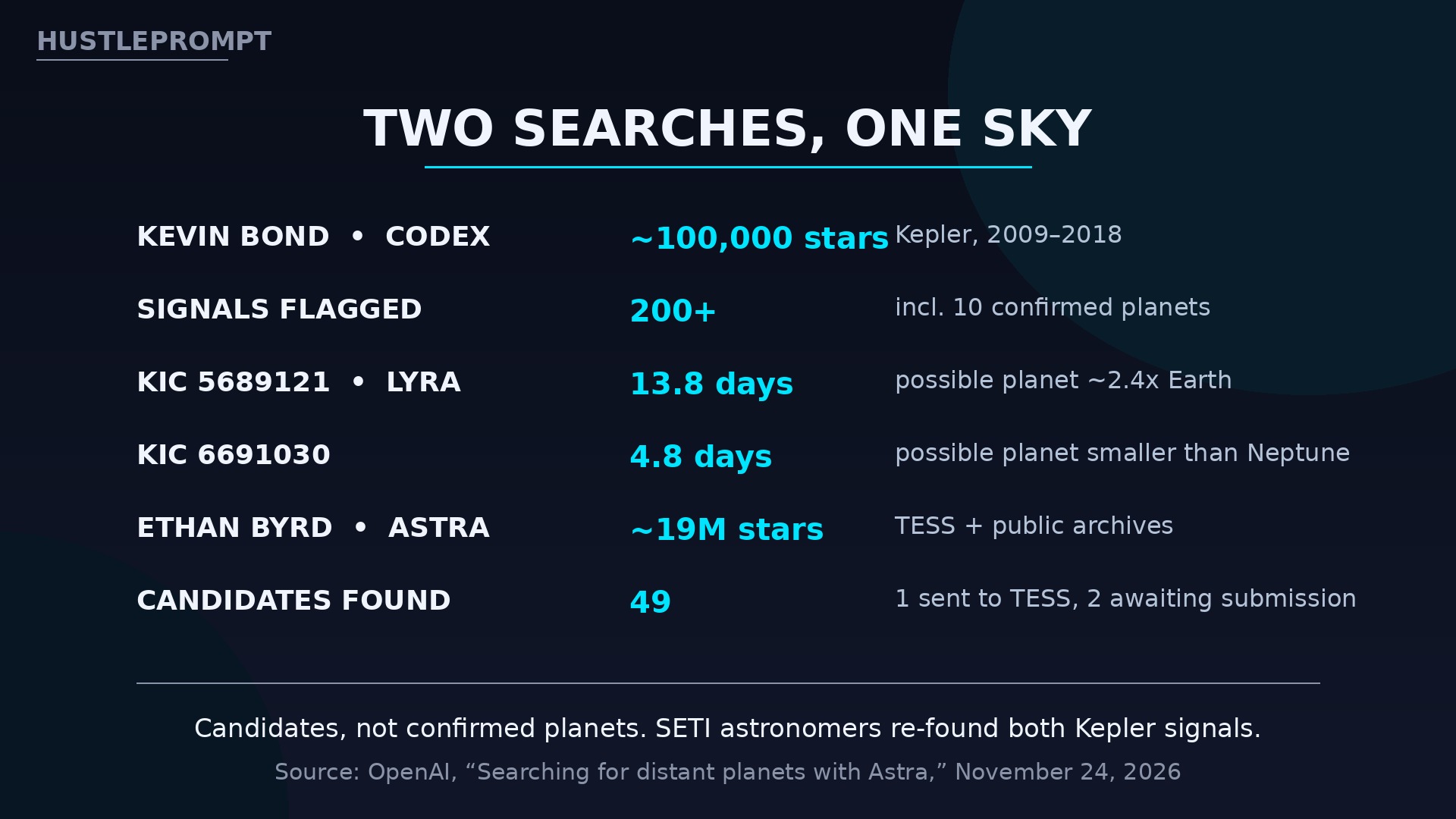
| Kevin Bond, OpenAI engineer | Codex | ~100,000 (Kepler, 2009–2018) | 200+ signals, including 10 confirmed planets |
| Ethan Byrd, founder of Primitive | Astra | ~19 million (TESS + public archives) | 49 candidates; 1 sent to TESS researchers |
Bond used Codex to compare published detection methods, combine them into a search program, and test whether changes improved it. One AI agent scanned the light curves — graphs of a star’s brightness over time — while a second ran closer checks. Byrd tried several models before choosing Astra, then asked it to review published methods, build the software, and run initial checks.
The two stars to watch
Two signals stood out in Bond’s search. KIC 5689121, a relatively cool star about half the size of our sun in Lyra, dims every 13.8 days; if a planet is causing the dip, the light it blocks suggests a world about 2.4 times Earth’s diameter. KIC 6691030, a faint star in the northern sky, dims every 4.8 days — consistent with a planet smaller than Neptune. A SETI astronomer ran an independent search and found both signals.
Independent confirmation matters
“Kevin’s work shows how citizen scientists, equipped with AI, can help astronomers explore the Kepler Bonus Catalog — a vast collection of stars beyond Kepler’s original targets. His pipeline has surfaced promising candidates in data traditional searches may have missed. Our initial checks are encouraging, and follow-up observations will tell us more.”
— Vishal Gajjar, associate director for international SETI programs, SETI Institute, November 24, 2026
Byrd’s 49 candidates are earlier in the pipeline: one is with researchers on NASA’s TESS mission, two more await submission, and his search is still running.
How a planet hunt works
What it means for your money
The money angle is not planets — it is the pattern. A research agent that reads published methods, writes code, searches millions of records, and hands you a shortlist is a product. The same pipeline works on legal records, market data, scientific papers, and customer data. The people who learn to aim these agents at valuable questions will sell the answers.
- Research-as-a-service: run deep literature and data searches for clients who cannot.
- Citizen science is free to join: NASA’s Exoplanet Watch, the AAVSO program, and the Unistellar network all take volunteers.
- Skills that pay: building agent pipelines — one to search, one to check — is the exact pattern Bond used, and it transfers to any field.
- Low cost of entry: the data is public, and the tools are AI subscriptions many people already pay for.
How to try it yourself
You can contribute without owning a telescope: NASA’s Exoplanet Watch lets you request data and learn to plot a light curve, and its broader citizen science programs offer other ways in. If you do have a telescope, Exoplanet Watch walks you through collecting transit data, the AAVSO program shows you how to measure a dip and share it, and Unistellar coordinates volunteers worldwide to watch the same star.
The honest caveats
These are candidates, not confirmed planets. Two stars passing in front of each other can mimic a transit, and even a temperature change aboard a telescope can make a star appear to dim. Confirming a planet takes statistics, repeat observations, and sometimes radial velocity measurements — months or years. One disclosure matters: Bond works at OpenAI, the company telling the story. The SETI Institute’s independent check is what makes the Kepler signals worth watching.
Read OpenAI’s full account in Searching for distant planets with Astra, and explore NASA’s citizen science programs to join the hunt.
Frequently asked questions
Did amateurs really find new planets?
Not confirmed planets — yet. Two amateurs flagged 49 candidates and 200+ signals in public NASA data; professionals are checking them, and a SETI astronomer independently re-found two Kepler signals.
What is Astra?
Astra is OpenAI’s research agent. It helped design the searches, review published methods, and build the software. Codex is OpenAI’s coding agent, which Kevin Bond used on the Kepler data.
What is the transit method?
A planet passing in front of its star blocks a tiny amount of light. On a graph of the star’s brightness over time — a light curve — that shows up as a dip; if it repeats at regular intervals, it may be a planet.
How were the signals checked?
A SETI Institute astronomer independently re-found both Kepler signals. One of Byrd’s TESS candidates is with NASA researchers; two more await submission.
Can I hunt for exoplanets too?
Yes — NASA’s Exoplanet Watch, the AAVSO program, and the Unistellar network all welcome volunteers, and the telescope data is public.
How long until confirmation?
Months or years: candidates need repeat observations, statistical checks, and sometimes radial velocity measurements before anyone can call them planets.