
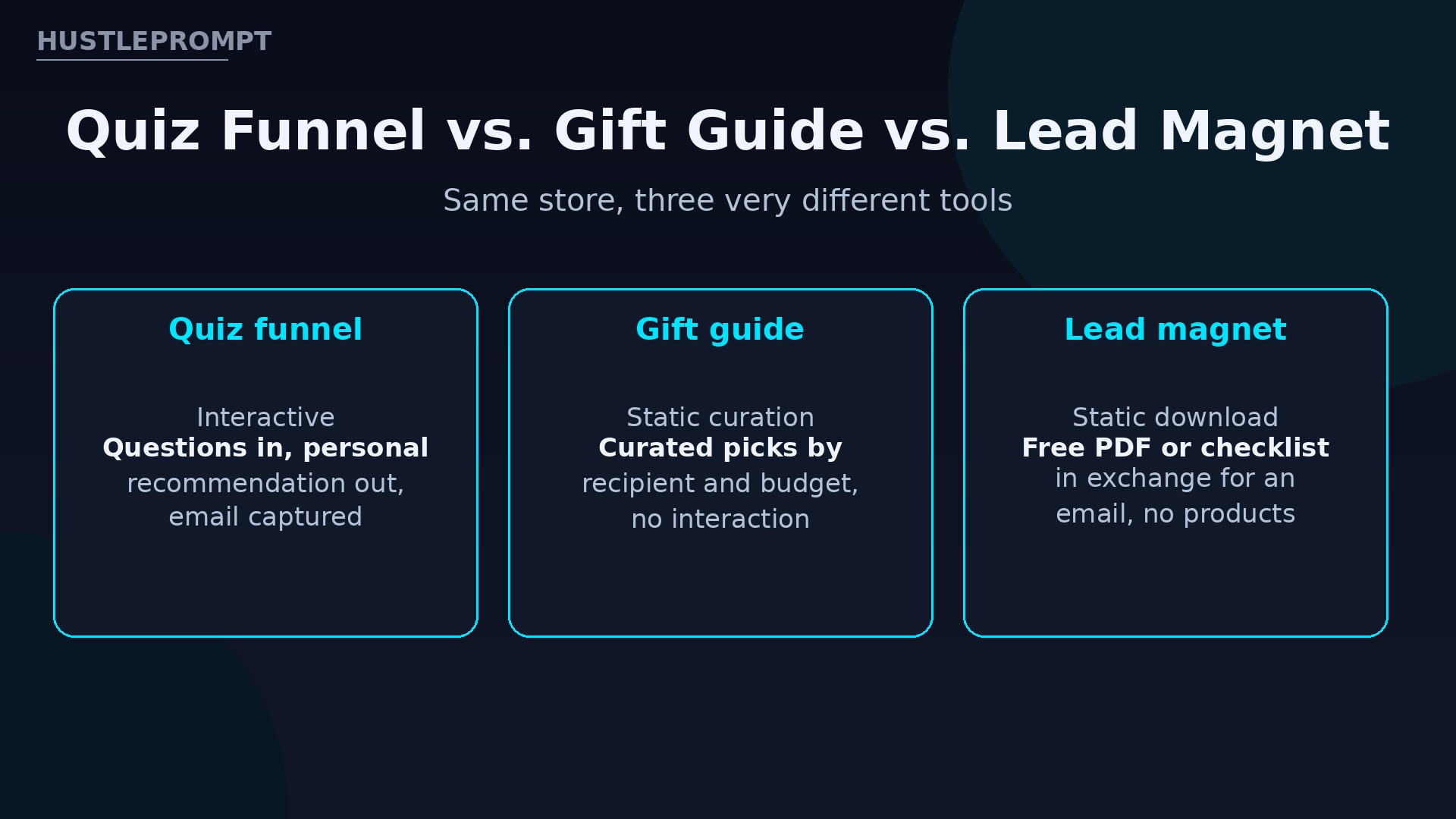
Most online stores convert under 3% of visitors. But 15% of shoppers who finish an AI quiz funnel place an order. That gap is the service: a product-finder quiz that asks five to eight questions, recommends the right products, captures the email, and follows up with segmented offers. Here is how to sell it to e-commerce stores. A quiz funnel is not a gift guide (post 11577), static curated content, or a lead magnet (post 9177), a static download. It is interactive: questions in, a personal recommendation out, email captured before the result.
Disclaimer: general business information, not legal advice. Use written agreements and the client’s own tools. Prices are illustrative, not promises of income.
What the service is, exactly
You build one product-finder quiz for a store for one fixed fee. A shopper answers questions about needs, budget, and taste — “find my skincare routine,” “find the perfect gift” — and the quiz recommends one to three products from the store’s catalog. AI drafts the questions and logic; you map every answer to real products and check results by hand before launch.
- The quiz: 7 to 8 questions, built in RevenueHunt or Octane AI, on the store’s site.
- The results page: one to three matched products, with a reason each fits.
- The email capture: the shopper’s email before results, synced to Klaviyo.
- The follow-up flows: three emails — results, reminder, discount nudge.
- The launch pack: homepage block, popup, menu link.
- The report: starts, completions, opt-ins, orders after 30 days.
7 to 8 questions on needs.
AI matches answers to products.
Required, before results.
Answers become segments.
Results, reminder, discount.
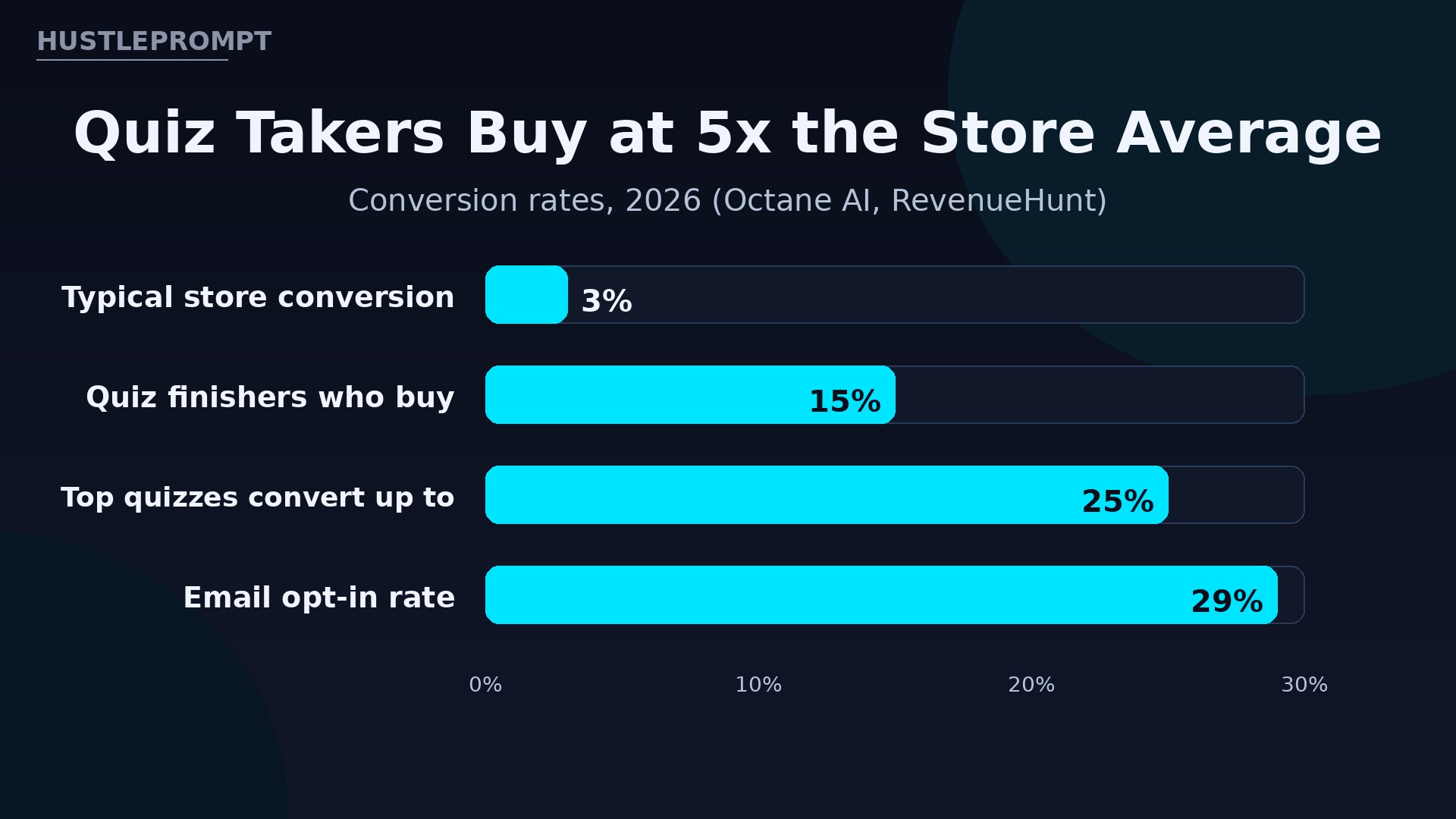
The evidence: quiz takers buy at five times the store average
Octane AI’s 2026 quiz playbook, built on live quizzes across 5,000+ Shopify brands, puts it plainly. Most stores convert under 3% of visitors — yet 15% of shoppers who finish a quiz place an order. That is five times the store average, and quiz takers spend more: up to a 62% lift in average order value. The quiz also captures shoppers who do not buy yet, at a 29% average email opt-in rate.
| Figure | Result | Source |
|---|---|---|
| Quiz finishers who buy | 15% | Octane AI |
| Order value lift, quiz takers | Up to 62% | Octane AI |
| Email opt-in rate | 29% | Octane AI |
| Store conversion rate | Under 3% | Octane AI |
| Quiz conversion range | 10% to 25%+ | RevenueHunt |
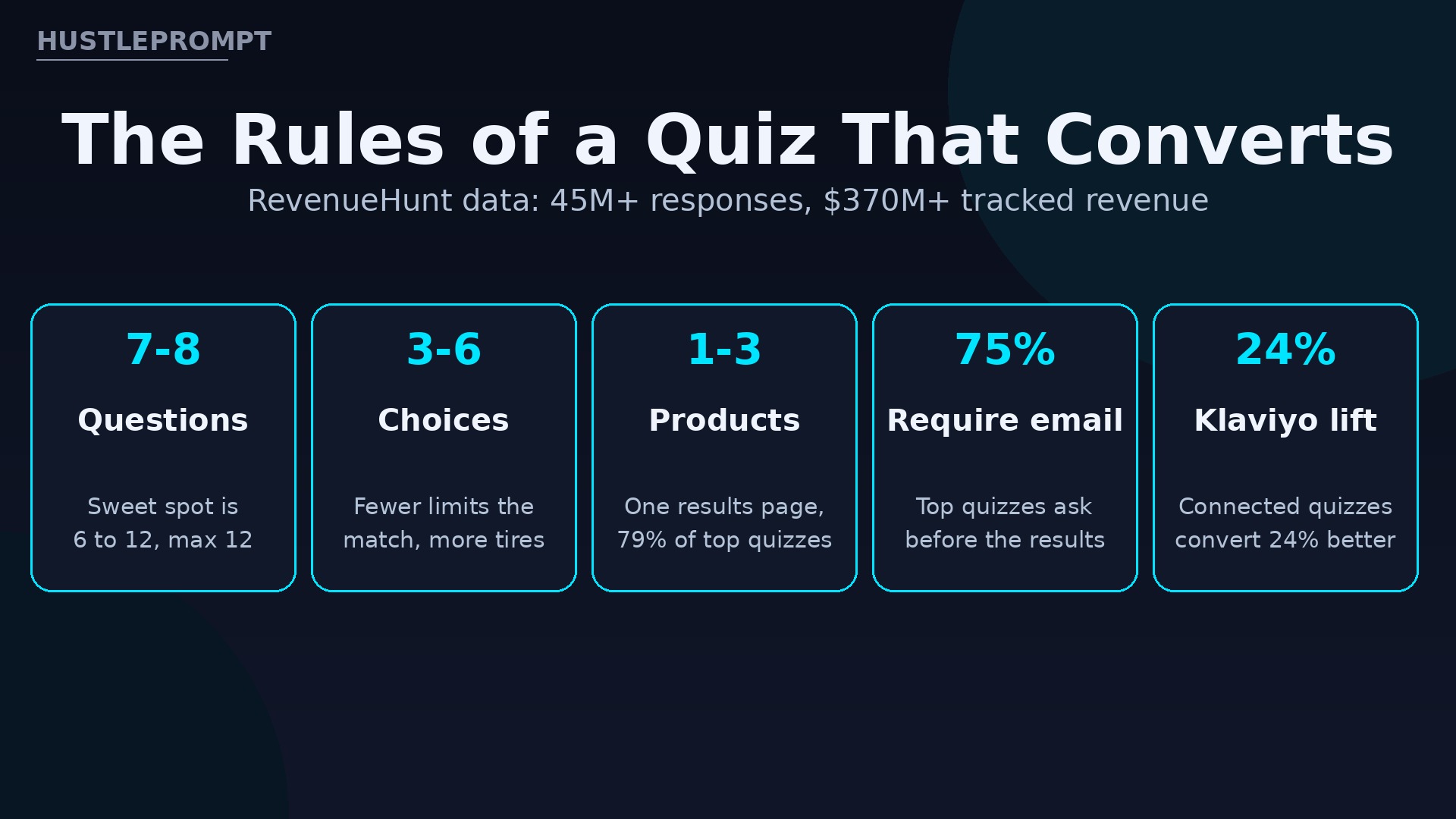
RevenueHunt’s checklist draws on 45 million-plus quiz responses and $370 million-plus in tracked revenue across 20,000+ brands, and reports its best quizzes convert at 10% to 25% and above. The follow-up compounds it: quizzes connected to Klaviyo convert 24% better and generate 66% more orders on average.
The timing is Black Friday: NRF counts 182.7 million consumers planning to shop over Thanksgiving weekend, and a gift-finder quiz turns that browsing into a purchase — “find the perfect gift for Dad” beats a grid of 200 products. A quiz launched today has a month of gift buying ahead.
Your costs: what the tools charge
| Tool | Price (Nov 27, 2026) | What you get |
|---|---|---|
| RevenueHunt Free | $0/mo | 100 responses/mo, unlimited quizzes |
| RevenueHunt Basic | $39/mo | 500 responses/mo, Klaviyo sync |
| Octane AI Basic | $50/mo | 400 credits, up to 2 quizzes |
| Typeform Basic | $39/mo | 100 responses/mo, logic |
| Klaviyo Free | $0/mo | 250 profiles, 500 emails/mo |
| Klaviyo Email | $20/mo | 500 profiles, 5,000 emails/mo |
Start free: RevenueHunt’s free plan covers 100 quiz responses a month, with unlimited quizzes and AI help included. The client pays for their own quiz and email plans — RevenueHunt Basic at $39 a month and Klaviyo Email at $20. Your only cost is Typeform Basic at $39 a month for non-Shopify clients.
How it works: the quiz funnel you sell
Here is how to sell it.
Step 1: pick one niche and twenty stores
Pick one pair: skincare brands on Shopify, or supplement stores. Audit 20 targets: do they have a quiz? Most have a search bar and a category grid, and nothing that asks the shopper what they need. A store with 200 products and no “find your” tool is a warm lead.
Step 2: build the quiz map before you build the quiz
Write the quiz on paper first: 7 to 8 questions, 3 to 6 choices each, every choice mapped to a product. RevenueHunt calls mapping the most important step — and the one most often skipped. Unmapped answers produce generic results that do not convert. Then build it in RevenueHunt or Octane AI’s Phoenix, and test every path yourself.
Step 3: sell it with a one-question demo
Skip the slide deck. Build a free demo — “find your skincare routine” with the store’s real products — and send it with the numbers: 15% of finishers buy, up to 62% higher order value. Your best line: “Your shoppers already know what they want. Your store just isn’t asking.”
Step 4: launch on Black Friday and wire up the follow-up
Publish the quiz in two places — a homepage block and a popup — and make the email question required: 75% of RevenueHunt’s top-converting quizzes that collect email make it required, and it does not hurt completion. Then connect Klaviyo and write three follow-up emails — results, reminder, discount nudge — within the first week.
Step 5: report results and sell the year-round version
After 30 days, send a one-page report: starts, completions, emails, and orders. Then pitch the follow-up: a second quiz for a different need — a gift finder, a routine builder — then a monthly retainer to test questions and refresh products. The first quiz is a one-time fee; the funnel that keeps improving becomes the retainer.
What to charge
No official price list exists — these are illustrative ranges.
| Package | Illustrative price | What it includes |
|---|---|---|
| Demo quiz | Free | One quiz with the store’s real products |
| Quiz funnel | $800 to $1,500 one-time | Quiz, results page, email capture |
| Quiz + follow-up | $1,500 to $2,500 one-time | Everything above + 3-email flow |
| Monthly retainer | $800 to $1,200 a month | Testing, new quizzes, flow upkeep |
Scale it: 5 stores at $1,200 is $6,000 for the season, and 2 on a $900-a-month retainer add $21,600 a year. Bill the quiz and email tools to the client: $39 plus $20 a month, their asset.
The mistakes that kill this business
- More than 12 questions. Completion drops past 12; start with 7 to 8.
- Unmapped answers. Every choice must point to a product, or results are generic.
- Recommending too many products. One to three matches maximum; 79% of top quizzes use one results page.
- Asking for the email after the results. Capture it before, and make it required.
- No follow-up emails. The quiz captures the lead; the flow closes it.
- Working in your own account. The client must own the quiz and the email list.
Frequently Asked Questions
What is an AI quiz funnel?
A done-for-you service that builds an interactive product-finder quiz for a store. A shopper answers questions, AI recommends one to three products from the catalog, and the quiz captures their email before showing results — then segmented emails follow up.
How is a quiz funnel different from a gift guide or a lead magnet?
A gift guide (post 11577) is static curated content, and a lead magnet (post 9177) is a static download. A quiz funnel is interactive: the shopper’s own answers decide the recommendation, and every answer becomes data to segment on.
How many questions should a product quiz have?
Seven to eight, with three to six choices each. RevenueHunt puts the sweet spot at 6 to 12 questions, and completion drops sharply past 12. Every question should change the recommendation — if it does not, cut it.
Which tools do I need to build AI quiz funnels?
RevenueHunt for Shopify — free to 100 responses a month, Basic at $39 — or Octane AI Basic at $50 for bigger brands. Typeform Basic at $39 covers non-Shopify stores, and Klaviyo runs follow-up emails.
Should the email question be required?
Yes. Among RevenueHunt’s top-converting quizzes that collect email, 75% make it required, and it does not hurt completion. Shoppers who reach that step will trade their address for a personal recommendation.
How much can I charge for AI quiz funnels?
Illustrative: $800 to $1,500 for one quiz funnel, $1,500 to $2,500 with the three-email follow-up flow, and $800 to $1,200 a month on retainer.
Keep Reading
- Sell AI Gift Guides to E-Commerce Stores.
- Sell AI Lead Magnet Services to Coaches.
- Sell AI Pinterest Marketing Packs to E-commerce Brands.
Sources: Octane AI playbook and pricing — octaneai.com; RevenueHunt checklist and pricing — docs.revenuehunt.com; Typeform pricing — typeform.com; NRF holiday data — nrf.com; Klaviyo pricing — klaviyo.com. Checked Nov 27, 2026.