
A 1% price increase lifts operating profit by 8.7%, assuming volume holds — that is McKinsey’s finding, and it is the whole pitch for AI dynamic pricing. Most small stores set prices once and forget them; competitors change theirs three times a day. Cyber Monday lands on November 30, and stores are setting holiday prices this weekend. This service reprices a store’s own catalog: AI rules, markdown timing, and margin guardrails inside owner-approved limits. It is not competitor price monitoring (post 10101), which watches rivals’ prices, nor a tool review like the Arbitrica price agent (post 11617). This is a done-for-you service you sell to stores.
Disclaimer: general business information, not legal advice. Use written agreements and the client’s tools. Prices are illustrative, never promises of income.
What the service is, exactly
You run a store’s prices for a fixed fee: rules that move each price with demand, stock, and competitors, with a floor no price can fall below. The owner approves the limits once; the system applies them daily. AI suggests the new prices; you set the rules, the guardrails, and the markdown calendar.
- The catalog audit: every product’s cost, price, and margin, so no rule ever sells at a loss.
- The repricing rules: rules such as “5% below the cheapest competitor, never below cost plus 20%.”
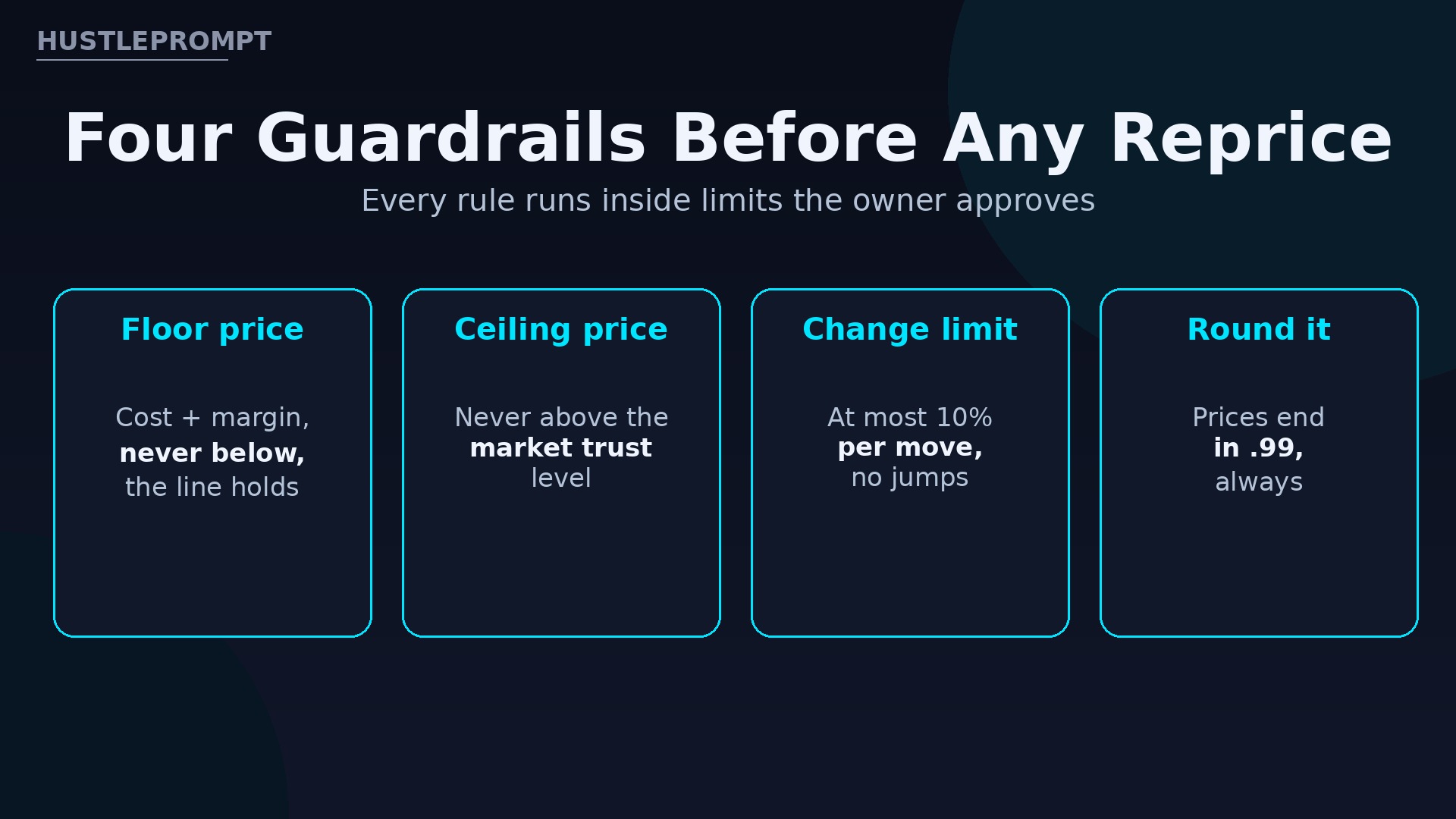
- The margin guardrails: a floor, a ceiling, and a maximum change per move.
- The markdown calendar: when each seasonal line gets cut, by how much, and what happens to unsold stock.
- Daily monitoring: competitor moves, stock-outs, and rule breaks, checked every morning.
- The report: revenue, margin, and units sold vs. the week before launch.
Cost, price, margin per SKU.
Position, competitors, markup.
Floor, ceiling, change limit.
Rules run daily; you watch the log.
Weekly numbers, rules adjusted.
The evidence: price is the biggest profit lever
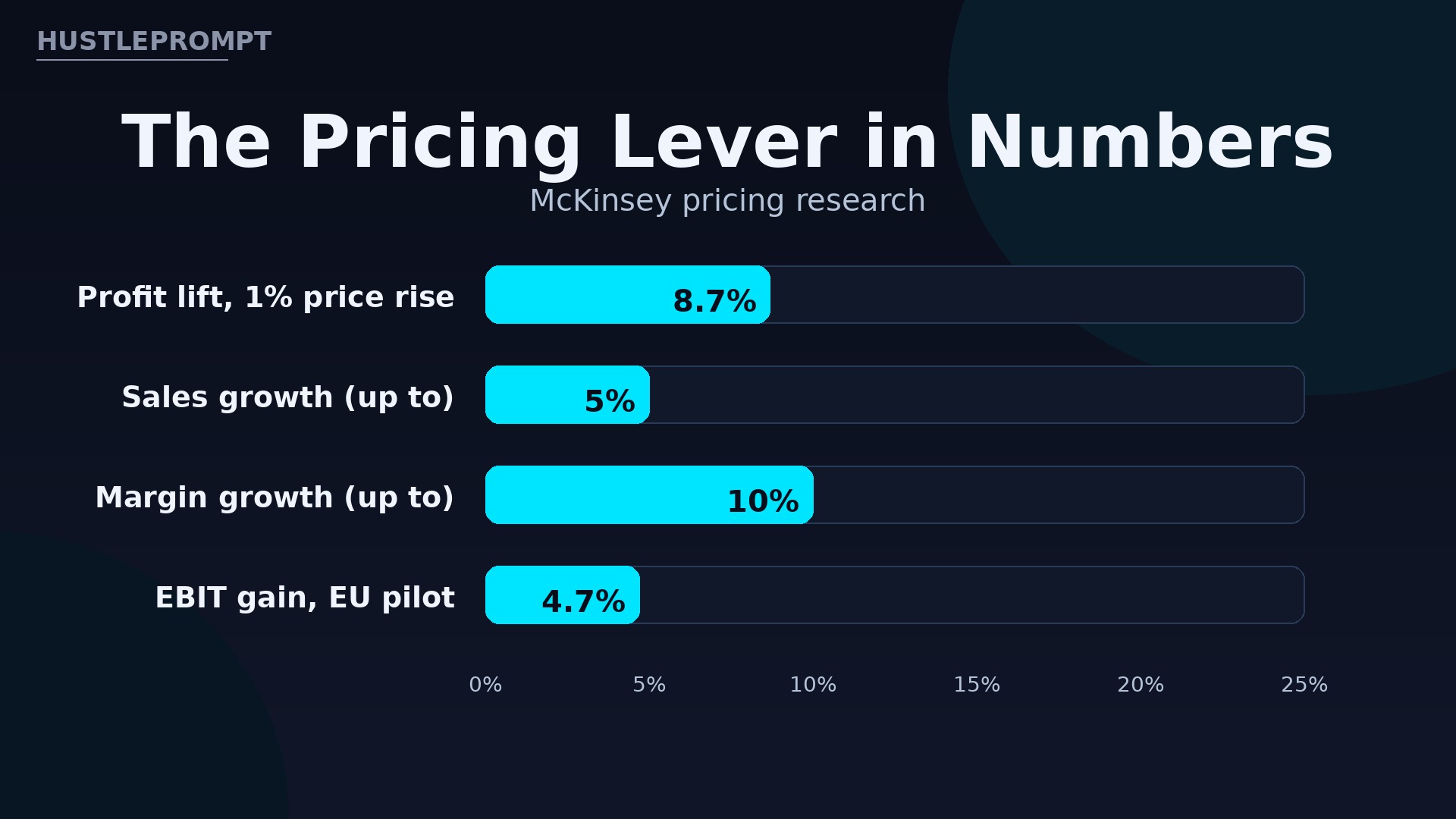
McKinsey’s pricing research makes the case: a 1% price increase lifts operating profit 8.7% for a typical large company, assuming no volume loss. The same research estimates up to 30% of companies’ yearly pricing decisions fail to deliver the best price. Stores leave money on the table with every static price tag.
| Figure | Value | Source |
|---|---|---|
| Profit lift from a 1% price rise | 8.7% (no volume loss) | McKinsey |
| Pricing decisions missing the best price | Up to 30% | McKinsey |
| Sales growth, dynamic pricing | 2–5% | McKinsey |
| Margin growth, dynamic pricing | 5–10% | McKinsey |
| European pilot: EBIT gain | 4.7% in pilot categories | McKinsey |
Vendor results run higher — present them as vendor claims, never as promises. Prisync’s help center says its users see, on average, 21% more revenue and 7% better profit margins. Competera’s Foxtrot case study, a six-week test vs. a control group, reports revenue up 13.6% and profit margin up 51.5%. Prisync’s Protein Package case reports 200% growth on 1,000 products vs. 239 competitors.
Use McKinsey’s 2–5% sales and 5–10% margin band as the planning number, and vendor cases as the ceiling. A store doing $40,000 a month that gains 2% in sales adds $800 a month — our calculation from McKinsey’s band. That honest math sells the service — it pays for itself several times over.
Your costs: what the tools charge
| Tool | Price (Nov 28, 2026) | What you get |
|---|---|---|
| Prisync Professional | $99/mo | 100 products, 3 updates a day |
| Prisync Premium | $199/mo | 1,000 products, Dynamic Pricing Engine |
| Prisync Platinum | $399/mo | 5,000 products, price history |
| Prisync Shopify app | $49/mo | 100 products, auto repricing |
| Competera | Quote-based | Enterprise pricing |
| ChatGPT Plus | $20/mo | Rule drafts and reports |
Prisync Premium at $199 a month is the working tier — the first plan with the Dynamic Pricing Engine, covering 1,000 products. The Shopify app’s Professional tier at $49 a month is the cheap pilot for a small store. Competera publishes no prices — enterprise pitches only. The client pays for their own Prisync account. Your cost is ChatGPT Plus at $20 a month, reused across every client.
How it works: the dynamic pricing service you sell
Here is how you sell it.
Step 1: pick one niche and twenty stores
Pick one niche: apparel brands on Shopify, or home goods stores. Audit 20 targets: 100+ products, visible competitors selling the same items, prices frozen for months. A store with 300 SKUs untouched since summer is a warm lead. Skip stores under 50 products.
Step 2: build the pricing kit
Build it once for a demo store: a cost sheet, three SmartPrice rules, and guardrails per group. Draft the rules in ChatGPT, then set them in Prisync: “match the lowest competitor” for traffic drivers, “5% below cheapest, never below cost plus 20%” for mid-range lines, “hold price” for exclusives. Test on ten products first.
Step 3: sell it with a free price audit
Skip the slide deck. Audit ten products free: cheapest competitor, today’s margin, and the rule’s price. Send it with the numbers: a 1% price rise can lift operating profit 8.7%; McKinsey puts dynamic pricing gains at 2–5% in sales, 5–10% in margin. Your best line: “Your prices have not moved since summer. Your competitors’ have — three times a day.”
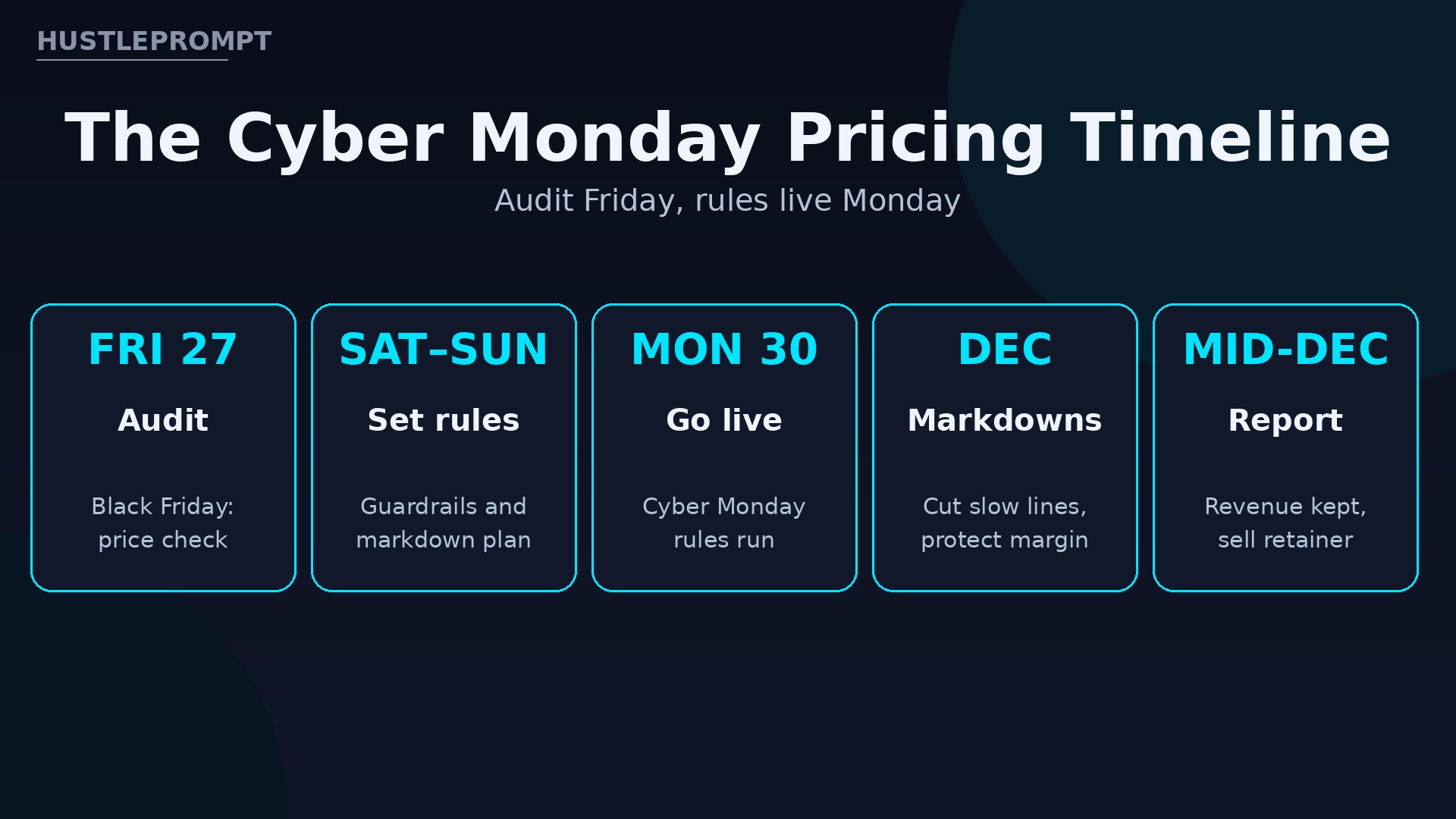
Step 4: launch before Cyber Monday and watch daily
Install Prisync in the client’s own account, linked to their Shopify store. Set the Cyber Monday rules live November 29, the day before the sale, with the markdown calendar for the week after. Check the change log each morning: what moved, what hit a floor, what forced it. Pause any rule that cuts a bestseller’s price twice in one week.
Step 5: report results and sell the year-round version
In mid-December, send a one-page report: revenue, margin, and units vs. the week before launch, with the three biggest wins named. Then pitch the follow-up: a monthly retainer to run the rules, time markdowns, and tune guardrails. The holiday setup is a one-time fee; the year-round version is how it becomes a retainer.
What to charge
No official price list exists — these are illustrative ranges.
| Package | Illustrative price | What it includes |
|---|---|---|
| Free price audit | Free | 10 products, rule preview |
| Pricing setup | $900 to $1,800 one-time | Audit, rules, guardrails, calendar |
| Setup + holiday management | $1,800 to $3,000 one-time | Above, plus daily monitoring |
| Monthly retainer | $800 to $1,500 a month | Rules, markdowns, weekly reports |
Scale it: 5 stores at $1,400 is $7,000 a season; 2 retainers at $1,000 a month add $24,000 a year. Bill Prisync to the client: $199 a month on Premium.
The mistakes that kill this business
- Repricing without a floor. A rule with no minimum price can sell at a loss overnight.
- Changing prices hourly. Shoppers notice — McKinsey warns against prices that alienate customers.
- Copying the cheapest competitor. The cheapest price is not the most profitable one.
- Discounting bestsellers. Items that sell anyway should hold their price.
- No markdown plan. Cutting everything 30% at once burns margin for nothing.
- Working in your own account. The client must own the account and the price data.
Frequently Asked Questions
What is AI dynamic pricing?
A done-for-you service that sets repricing rules for a store’s own catalog — competitor-aware changes, markdown timing, margin guardrails — with AI suggesting prices and a human setting limits.
How is dynamic pricing different from competitor price monitoring?
Competitor price monitoring (post 10101) watches rivals’ prices and reports them. Dynamic pricing acts on that data, changing the store’s own prices automatically inside approved guardrails.
Which tools do I need to reprice a store?
Prisync Premium at $199 a month for 1,000 products is the working tier, the first plan with the Dynamic Pricing Engine. The Shopify app’s Professional tier at $49 a month covers small pilots. ChatGPT Plus drafts rules and reports.
When should dynamic pricing launch?
The rules go live November 29, 2026, the day before Cyber Monday on November 30. Set the markdown calendar the same week and report in mid-December.
How much can I charge for AI dynamic pricing?
Illustrative: $900–$1,800 for setup, $1,800–$3,000 with holiday management, $800–$1,500 a month on retainer.
Will repricing anger customers?
It can if prices jump daily or spike without reason — McKinsey warns against prices that insult the customer. Keep changes small, cap them at 10% per move, round prices to .99, and never reprice weekly staples.
Keep Reading
- Sell AI Competitor Price Monitoring Services to Online Sellers.
- Sell AI Quiz Funnels to E-Commerce Stores.
- Sell AI Holiday Sale Campaigns to E-Commerce Stores.
Sources: McKinsey dynamic pricing — mckinsey.com; McKinsey, “Using big data to make better pricing decisions” — mckinsey.com; Prisync help center — helpcenter.prisync.com; Prisync for retailers — prisync.com; Competera Foxtrot case — competera.ai; Prisync pricing — competitors.io; ChatGPT Plus — help.openai.com. Checked Nov 28, 2026.