
Shoppers check their order tracking 2.8 times per order — Gen Z checks 4.1 times — per Pitney Bowes. That is the market for AI delivery tracking notifications: a branded tracking page, proactive delay alerts, and delivery-date promises, sold as a done-for-you service. Route optimization (post 11042) plans driver routes; this is shopper-facing tracking for online stores. Upsell emails (post 11362) sell more after delivery; tracking answers “where is my order” mid-delivery.
Disclaimer: general business information, not legal advice. Use written agreements and the client’s own tools. Prices are illustrative, never promises of income.
What the service is, exactly
You build and run a store’s delivery communication for one fixed fee: the branded tracking page and the messages that keep shoppers informed. Shoppers check the order on the store’s own page, get a text or email at every key moment, and hear about a delay before they ask. AI drafts the messages; you set the rules and test every alert before it goes live.
- The branded tracking page: an order status page on the store’s own domain, with its logo and colors.
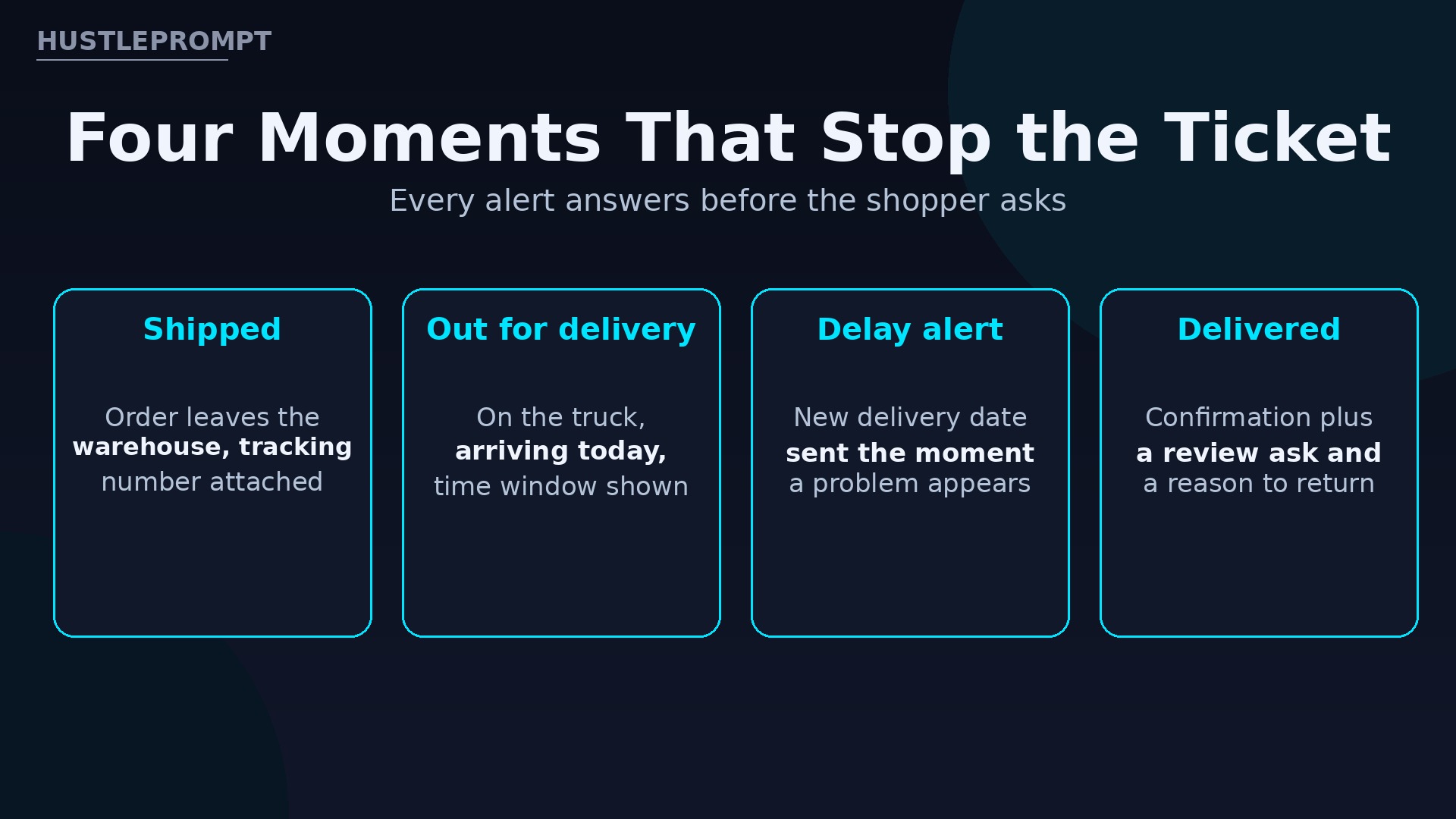
- Proactive notifications: email and SMS alerts for shipped, in transit, out for delivery, delivered.
- Delay alerts: a revised date sent the moment a carrier reports a problem.
- Delivery-date promises: an accurate date at checkout and on the page.
- The “where is my order” deflection: a self-service lookup that answers without a ticket.
- The report: tracking visits, opens, tickets deflected, repeat purchases.
Number pulled in.
Email and SMS, page link.
New date triggered.
Revised date sent early.
Confirmation and review ask.
The evidence: shoppers keep asking, and silence costs money
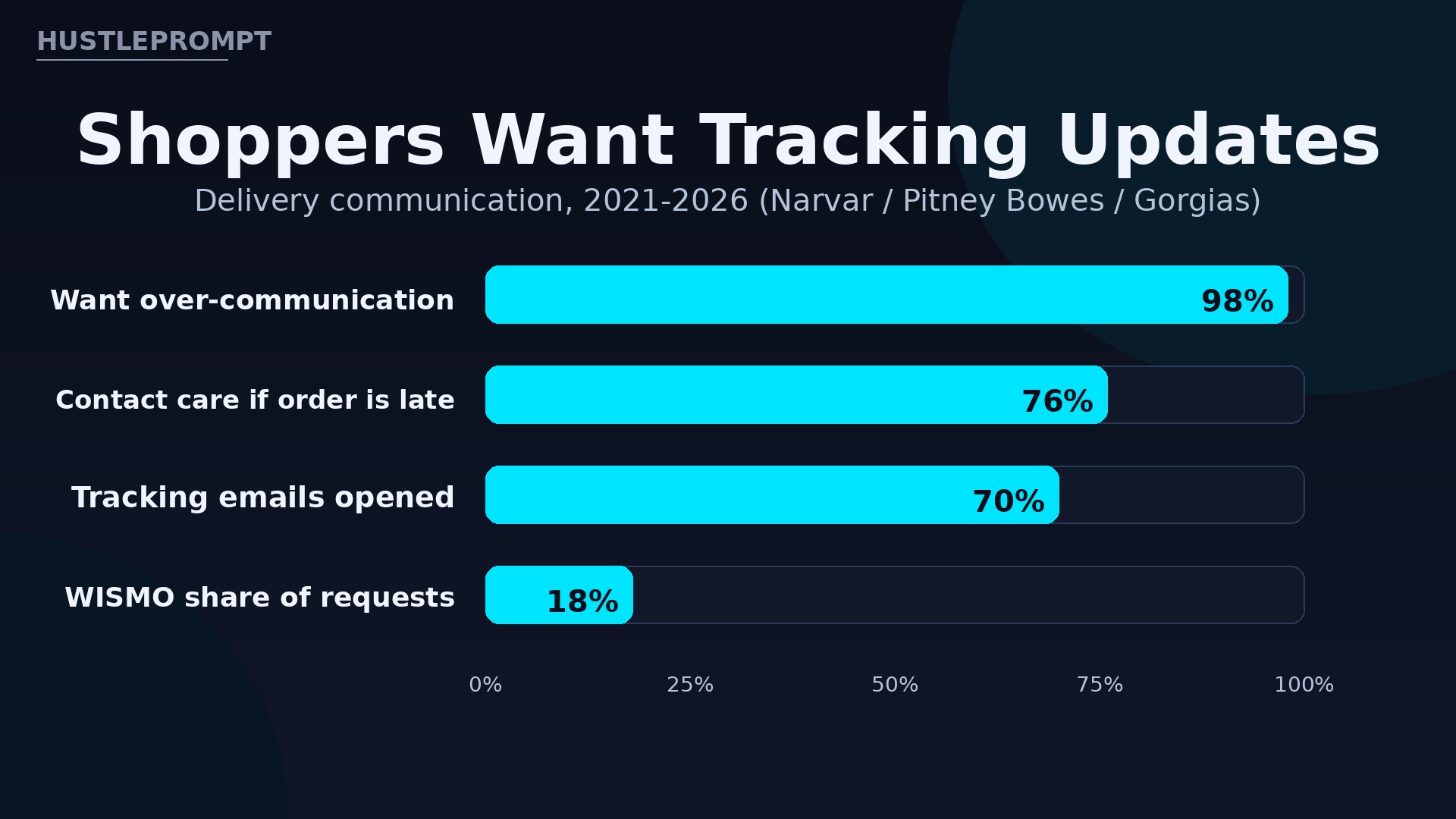
“Where is my order” is the most common question in e-commerce support. Gorgias data puts WISMO at 18% of incoming support requests, and Gartner puts the median assisted contact at $13.50, against $1.84 for self-service. A store doing 1,000 orders a month fields roughly 300 tickets, so about 54 are WISMO, costing around $729 a month. Deflect half and it saves about $365 a month — our calculation.
| Figure | Value | Source |
|---|---|---|
| Checks per order | 2.8 (Gen Z: 4.1) | Pitney Bowes BOXpoll |
| WISMO share of requests | 18% | Gorgias |
| Assisted cost | $13.50 | Gartner |
| Self-service cost | $1.84 | Gartner |
| Contact care if late | 76% | Pitney Bowes BOXpoll |
Silence turns a late parcel into a ticket: 76% of shoppers will contact care when an order misses its promised date — and that share falls by half when the retailer updates the estimate, per Pitney Bowes. Narvar reports 98% want over-communication during delivery, tracking emails open at around 70%, and shoppers view branded pages 3.2 times per order. Tell them early and most never write in.
A major U.S. department store cut tracking-related calls by 30% within two months of Narvar branded pages, with 9% of visitors clicking back and 2–3% buying something else. An outdoor gear brand saw a 13% click-through rate, and repeat purchases within 90 days rose 9% year over year. Single-retailer case studies, not averages — but they show what a store owner is buying.
Your costs: what the tools charge
| Tool | Price (Nov 28, 2026) | What you get |
|---|---|---|
| AfterShip Tracking Essentials | $49/mo | Up to 1,000 shipments/mo |
| AfterShip Tracking Premium | $99/mo | AI delivery dates, custom domain |
| Malomo Lite | $49/mo | 1,000 shipments, Klaviyo flows |
| ChatGPT Plus | $20/mo | Message drafts, reports |
AfterShip Essentials at $49 a month covers a small store’s pilot. Malomo Lite at $49 a month fits Shopify brands on Klaviyo. The client pays for their own tracking app; your cost is ChatGPT Plus at $20 a month.
The holiday clock: ship-by dates sell the service now
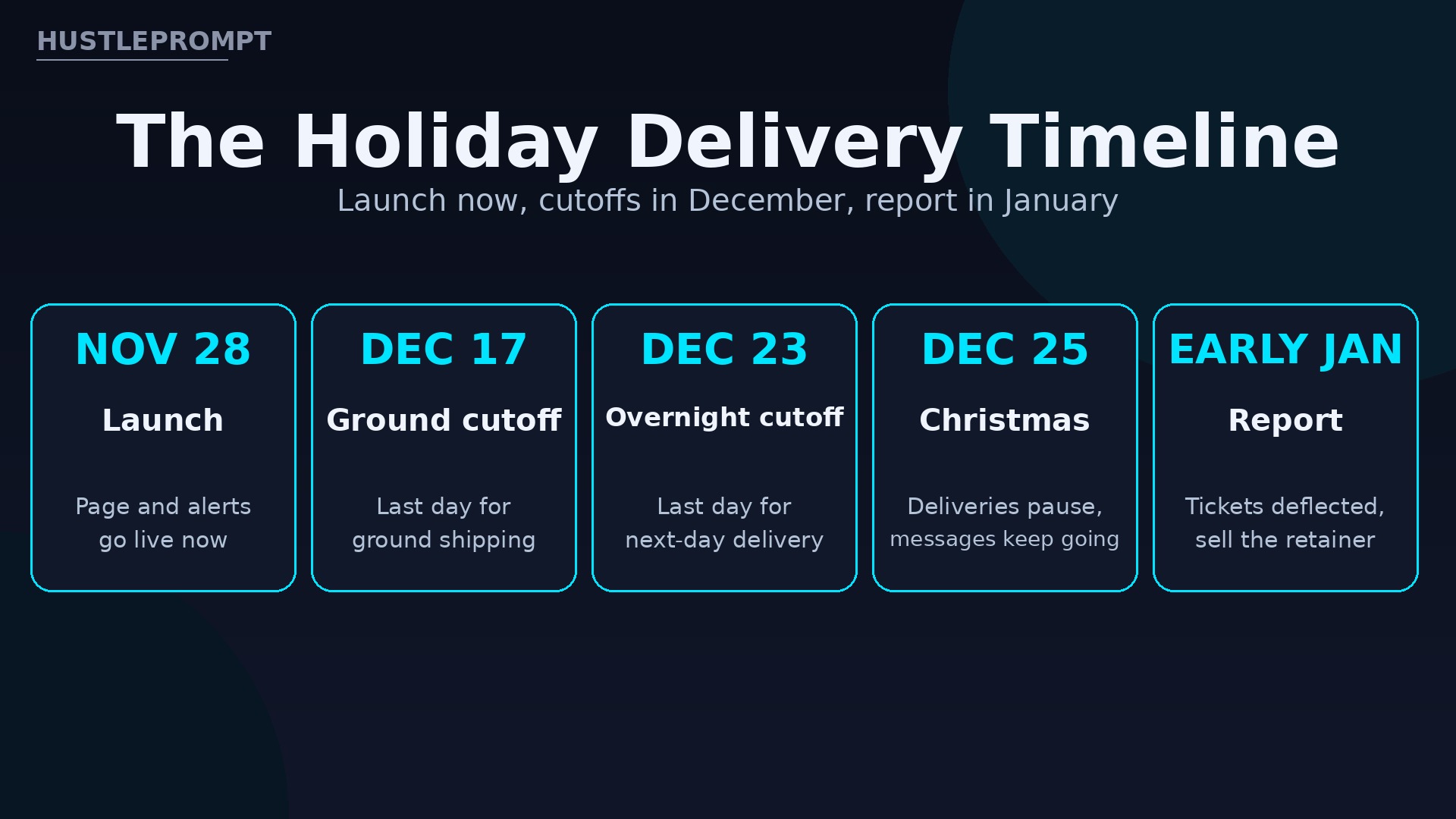
Carriers publish hard cutoffs for Christmas delivery. Ground must go out by December 17; overnight by December 23. After those dates, the only honest message is a revised date — exactly what your delay alerts send. Put the cutoffs in your pitch.
| Service | Last ship day | Delivers by |
|---|---|---|
| USPS Ground | Dec 17 | Dec 25 |
| USPS Priority | Dec 18 | Dec 25 |
| USPS Express | Dec 19 | Dec 25 |
| UPS 2nd Day | Dec 22 | Dec 24 |
| UPS Next Day | Dec 23 | Dec 24 |
How it works: the tracking service you sell
Step 1: pick a niche and twenty stores
Pick one niche: apparel brands on Shopify, or beauty stores. Audit 20 targets: does the shipping email link to the carrier’s page, or to the store’s own page? A store whose customers land on UPS.com hands away 2.8 visits per order. One doing 500 orders a month with carrier links and no delay alerts is a warm lead.
Step 2: build the tracking kit
Build the service once for a demo store: a branded tracking page, five notification templates, and a delay-alert rule. Draft the messages in ChatGPT — shipped, out for delivery, delayed with a new date, delivered — then set them up in AfterShip. Test with three real tracking numbers, including one delayed parcel, before you show anyone.
Step 3: sell it with a one-page sample
Skip the slide deck. Build one free sample: the store’s branded tracking page with a live order on it. Send it with the numbers: 18% of support requests are “where is my order,” each costing $13.50 to answer by hand. Best line: “Your customers check tracking 2.8 times per order. Right now those visits belong to the carrier.”
Step 4: launch before the peak and watch the exceptions
Install the tracking page in the client’s own AfterShip or Malomo account and link it from order emails, the account page, and the footer. Set the delay-alert rule before the December 17 ground cutoff. Watch the exception queue daily: every delayed parcel needs a revised date before the shopper writes in.
Step 5: report results and sell the year-round version
In early January, send a one-page report: tracking visits, notification opens, WISMO tickets before and after, repeat purchases from the tracking page. Then pitch the follow-up: a monthly retainer that runs the notifications and tunes the delay rules. The holiday setup is a one-time fee; the year-round version is the retainer.
What to charge
| Package | Illustrative price | What it includes |
|---|---|---|
| Sample page | Free | Branded page, live order |
| Tracking setup | $700 to $1,200 one-time | Page, notifications, delay rules |
| Setup + peak watch | $1,200 to $2,000 one-time | Above + daily exception watch |
| Monthly retainer | $500 to $900 a month | Notifications run, rules tuned |
Scale it: 6 stores at $950 is $5,700 for the season, and 2 on a $700-a-month retainer add $16,800 a year. Bill the app to the client.
The mistakes that kill this business
- Linking to the carrier. Every carrier link hands away 2.8 visits per order.
- Notifying only on delivery. The delay alert is the message that stops the ticket.
- Promising a date you cannot keep. An accurate date beats a fast one; update it the moment it slips.
- Launching after the peak. The page must be live before the December 17 cutoff.
- Working in your own account. The client must own the page and its shipment data.
Frequently Asked Questions
What is a delivery tracking notification service?
A done-for-you service that sets up a store’s branded tracking page and proactive email and SMS alerts — shipped, out for delivery, delay, delivered — with AI drafting the messages.
How is it different from route optimization or upsell emails?
Route optimization (post 11042) plans driver routes. Upsell emails (post 11362) sell more after delivery. Delivery tracking answers “where is my order” while the parcel is moving.
When should tracking launch?
Before the holiday peak — live before the December 17 ground cutoff, so the busiest weeks run on the new system.
Which tools do I need?
AfterShip Tracking Essentials at $49 a month — or Malomo Lite at $49 a month for Shopify brands on Klaviyo. ChatGPT Plus drafts the messages.
How much can I charge?
Illustrative: $700 to $1,200 for a one-time setup, $1,200 to $2,000 with peak monitoring, and $500 to $900 a month on retainer.
Do tracking pages bring shoppers back?
In Narvar’s case studies, yes: a department store saw 9% of tracking-page visitors click back to its site, and an outdoor gear brand saw 13%. Single-retailer results, not guarantees.
Keep Reading
- Sell AI Returns Automation to E-Commerce Stores.
- Sell AI Post-Purchase Upsell Emails to E-commerce Stores.
- Sell AI Back-in-Stock Alerts to E-Commerce Stores.
Sources: BOXpoll and Gorgias/Gartner figures — clickpost.ai; Narvar dept. store — corp.narvar.com; Narvar outdoor — corp.narvar.com; Narvar comms — corp.narvar.com; AfterShip — aftership.com; Malomo — gomalomo.com; Deadlines — goshippo.com; ChatGPT Plus — help.openai.com. Checked Nov 28, 2026.