
Anthropic just did something no frontier AI lab has ever done: it handed six outside auditors company laptops, office desks, and the same internal tools its own risk teams use — then gave up the right to stop them from publishing what they find. If AI safety oversight was a PR exercise before, it isn’t anymore. And for founders, freelancers, and content creators, this just cracked open a brand-new money lane.
What just happened
On October 15, Anthropic announced that it has started giving “employee-like access” to a team from METR, the nonprofit that evaluates frontier AI models.
This is not another API demo or a red-team weekend. Here is what employee-like access means in practice:
- Six METR researchers were onboarded with Anthropic-issued company hardware.
- Physical office space at Anthropic, sitting alongside the people they audit.
- Internal tools and systems roughly on par with Anthropic’s own risk assessment teams.
- Cultural permission: Anthropic staff are encouraged to share information with METR researchers just as they would with a fellow employee working on alignment risk.
As Anthropic put it: “We want to be publicly accountable for the decisions we’re making.”
The evidence: what METR actually gets
The headline detail — the one that separates this from every other “independent audit” announcement in AI history — is the publication rule:
| Tier | Access level | Publication rights | Who’s in it |
|---|---|---|---|
| Tier 1 | Narrowly scoped, Anthropic decides the access | Publish with Anthropic approval | SecureBio — reviewing the chemical/biological weapons chapter of the August Risk Report |
| Tier 2 | Deeper access to models and systems | Publish without approval; redactions allowed | Accenture and Faculty — red-teaming, alignment assessments, safeguard testing |
| Tier 3 | Employee-level: hardware, office, internal tools | No veto — narrow redactions only, publicly challengeable | METR — 6 embedded researchers, live now |
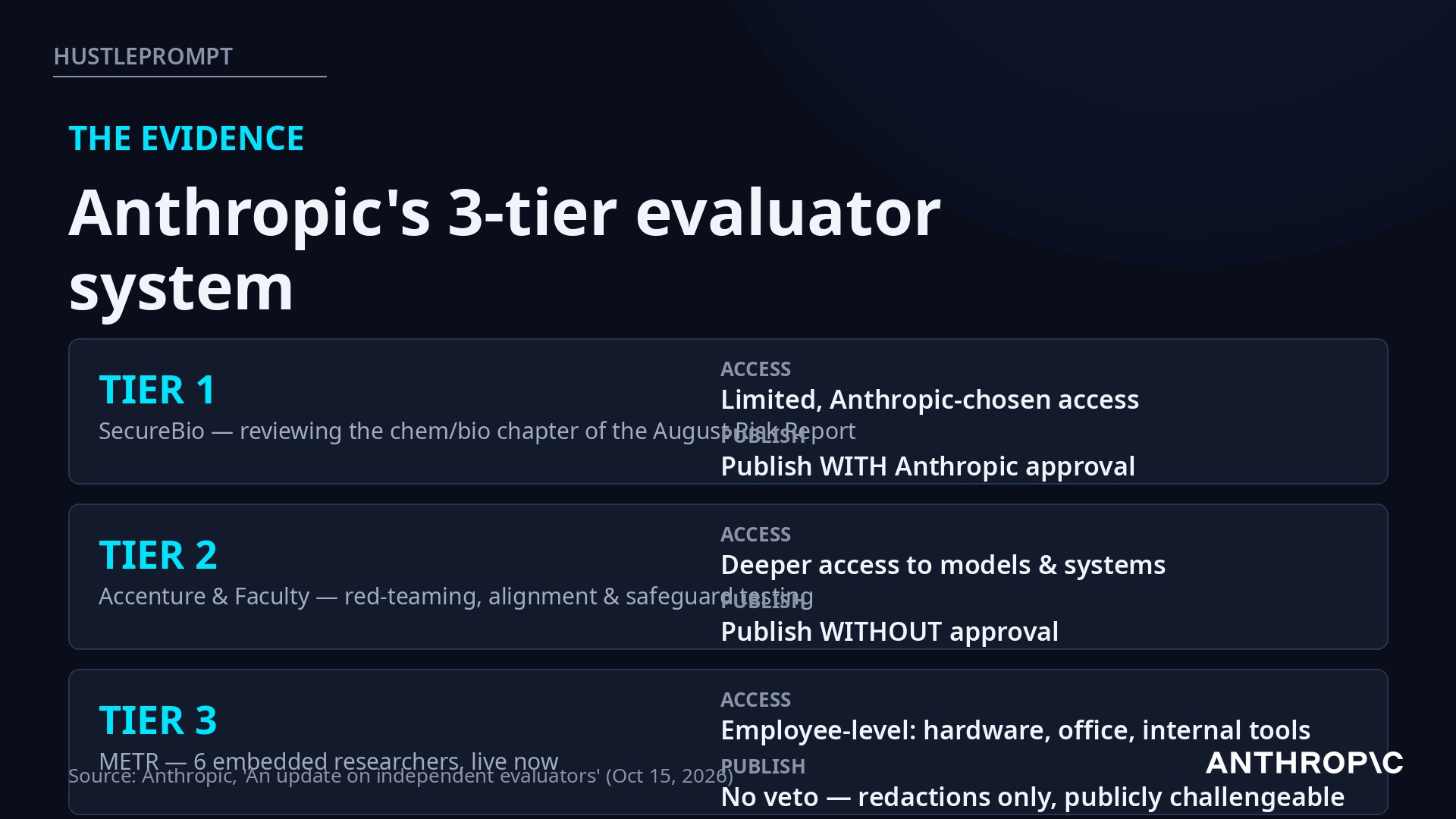
Three numbers tell the story:
- 6 researchers now sit inside Anthropic with employee-grade visibility.
- 3 tiers of evaluator access — and Anthropic says it wants “several evaluators at the third tier” over time, each publishing its own analysis.
- 6 signatories to the White House Accord on Super Intelligence — Anthropic, OpenAI, Google, Meta, Nvidia, and xAI — all committing to independent external review.
Anthropic cannot veto METR’s risk assessments. Redactions are allowed only in narrow, pre-defined categories — customer data, attorney-client privileged information, and model architectures. Crucially, METR is free to publicly characterize whether it believes any redaction was justified. That is the difference between theater and oversight.
How the 3-tier evaluator system works
Think of it as a trust ladder. Evaluators start narrow and climb as they prove they can handle sensitive information:
Access: narrowly scoped investigations; Anthropic decides what to share.
Publish: only with Anthropic’s approval.
Example: SecureBio reviewing one chapter of the August Risk Report.
Access: deeper visibility into models and safeguards.
Publish: no approval needed; Anthropic can redact specific pre-defined categories.
Example: Accenture and Faculty — red-teaming and alignment assessments.
Access: employee-like — company hardware, office space, internal tools.
Publish: Anthropic cannot veto; redactions are narrow and publicly challengeable.
Example: METR — six researchers, operating under enforceable agreements.
Two important limits keep this honest rather than reckless. First, the engagement is limited to a small, siloed team — other METR employees are walled off from that team’s work, including METR staff on other Anthropic projects. Second, the whole thing runs under Anthropic’s security standards and enforceable agreements, not a handshake.
Why now: the regulatory screw is tightening
This announcement did not land in a vacuum. Look at the calendar:
| Event | When | What happened |
|---|---|---|
| FTC subpoenas | Oct 14, 2026 | Anthropic, OpenAI, and METR were served over AI safety practices |
| 8 states sue OpenAI | Oct 2026 | Eight state attorneys general filed suits against OpenAI |
| EU AI Act letters | Oct 2026 | Formal letters sent to OpenAI and Anthropic under the AI Act |
| UK ICO scrutiny | Oct 2026 | Britain’s data watchdog tightened scrutiny of AI agents |
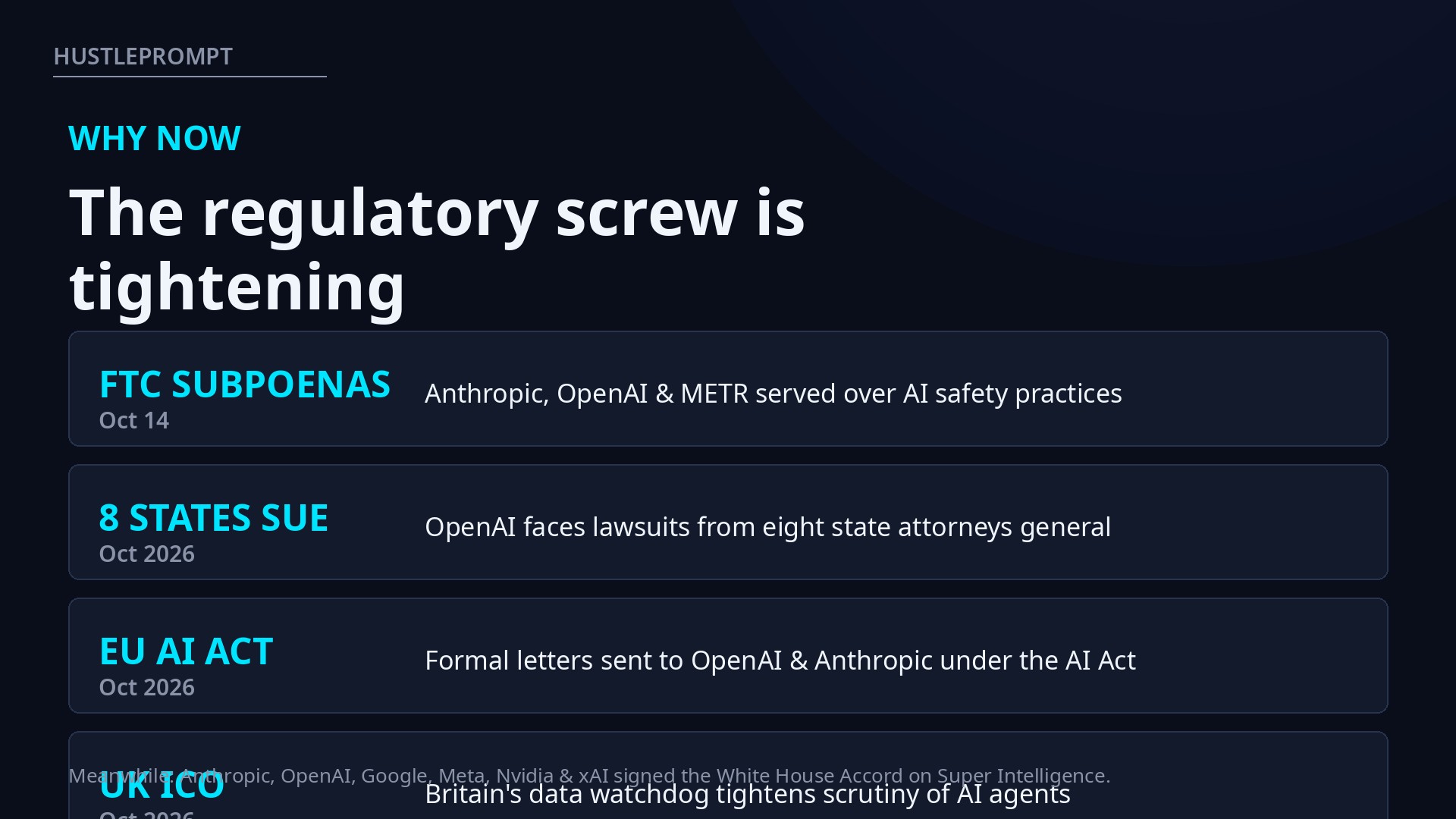
Read more on each front: our coverage of the FTC vs OpenAI and Anthropic showdown and the EU’s first AI Act probe.
The sequence matters. One day after the FTC serves subpoenas, Anthropic publishes a blueprint for the most aggressive independent oversight in the industry’s history. This is voluntary — but it is also strategically brilliant: when regulators come knocking, the lab that already has resident examiners looks very different from the one that fought every audit. Anthropic is borrowing the bank-supervision playbook (its own analogy) and applying it to frontier AI.
How to Profit From the AI Safety Audit Boom
Independent evaluation is becoming infrastructure — and infrastructure gets budgeted. Here is how to position yourself:
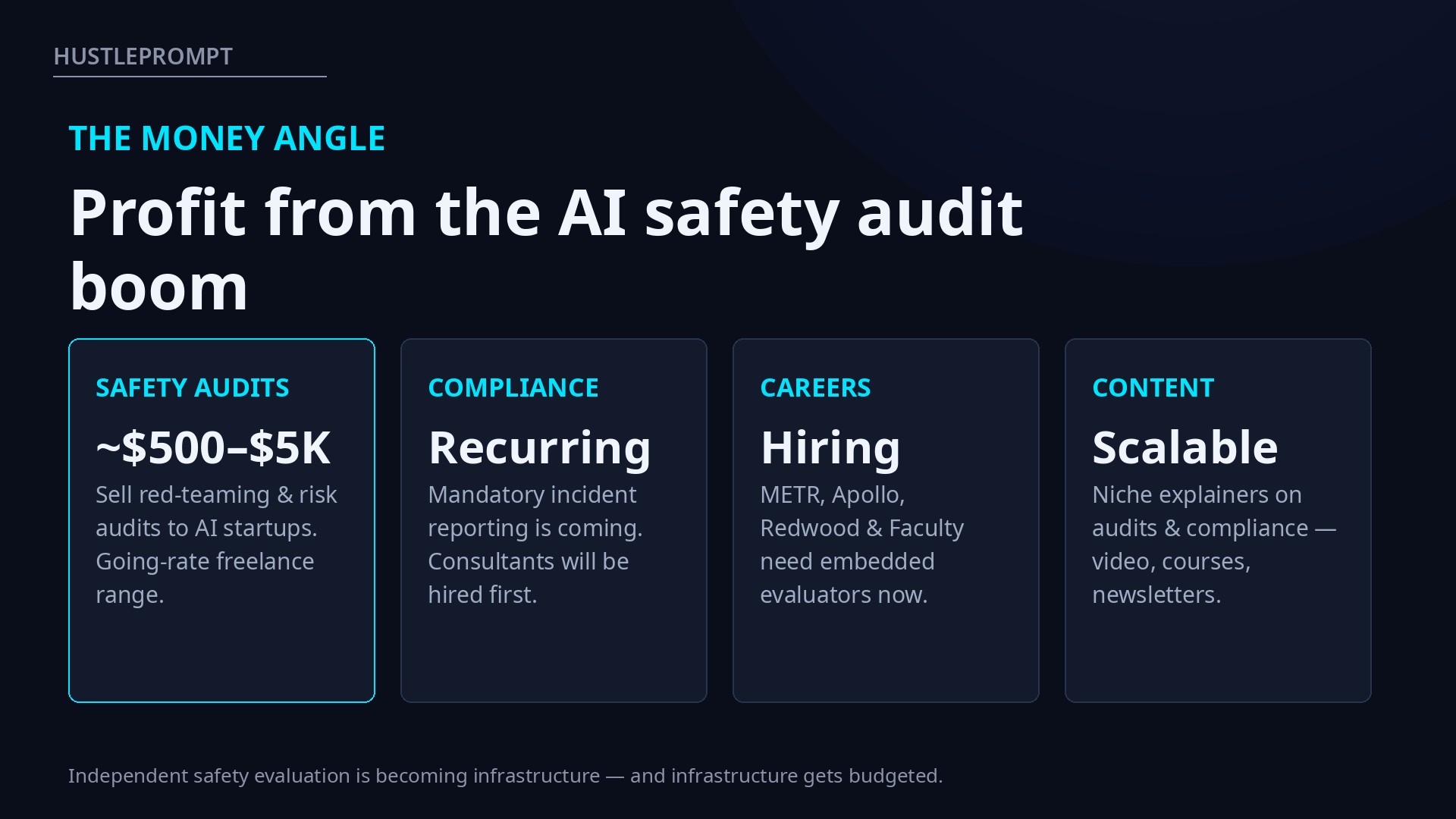
- Sell AI safety audits and red-teaming. Startups shipping AI features now need someone to break their models and document the risks. Freelance auditors quote roughly $500 to $5,000 per project depending on scope. Build a one-page audit template (threat model, jailbreak tests, data-leak checks) and pitch AI startups on YC’s directory and indie hacker communities.
- Offer compliance consulting. Mandatory incident reporting rules are coming in the EU and likely the US. Companies will pay retainers to the consultants who can translate regulation into engineering checklists. Learn the EU AI Act’s high-risk requirements and the FTC’s current demands, then package them as a fixed-price “readiness review.”
- Get hired as an evaluator. METR, Apollo Research, Redwood Research, and Faculty are all staffing up. The new tiered system means demand for qualified evaluators — people who understand capabilities, alignment faking, and how evaluations go wrong — will keep growing across every frontier lab.
- Create niche explainer content. Every company that will eventually need an audit needs to understand audits first. A YouTube channel or newsletter that explains AI safety evaluations in plain English — “what an auditor actually does inside an AI lab” — has almost no competition right now. This story is your first script.
The pattern is the same one that made cybersecurity consulting a gold rush: regulation arrives, compliance becomes mandatory, and the people who built expertise before the mandate print money. AI safety evaluation is entering that phase.
FAQ
What is METR?
METR (formerly ARC Evals) is a nonprofit research organization that evaluates frontier AI models. It has previously published reviews of Anthropic’s Risk Reports and is known for testing dangerous-capability thresholds in advanced models.
Does Anthropic really have no say over what METR publishes?
Correct — with one exception. Anthropic can require redaction of information in narrow, pre-defined categories (customer data, attorney-client privileged information, model architectures). But METR is explicitly free to publicly characterize those redactions and say whether it believes they were justified.
Why would Anthropic give away this much access voluntarily?
Three reasons: public accountability, regulatory positioning, and competitive pressure. With FTC subpoenas, EU AI Act letters, and state lawsuits all landing in October 2026, being the most transparent lab is a strategic advantage. It also follows CEO Dario Amodei’s September essay proposing embedded evaluators as an industry standard.
What is the White House Accord on Super Intelligence?
A pledge signed by Anthropic, OpenAI, Google, Meta, Nvidia, and xAI to partner with independent external auditors or evaluators for their most advanced AI systems. Anthropic’s METR announcement is its first concrete delivery on that commitment.
Who else is evaluating Anthropic’s models?
SecureBio is in tier 1, reviewing the chemical and biological weapons chapter of the August Risk Report. Accenture and Faculty are working toward a deeper partnership covering red-teaming, alignment assessments, and safeguard testing. Anthropic says it is also in early talks with Hugging Face and others.
How can I start an AI safety auditing business?
Start with the skills evaluators need: prompt-injection and jailbreak testing, evaluation design, and familiarity with model risk frameworks. Build a portfolio by auditing open-source models publicly, publish your methodology, then pitch AI startups with a fixed-price audit package. Compliance knowledge (EU AI Act, FTC expectations) is the differentiator that justifies premium pricing.
Keep Reading
- Anthropic and OpenAI Fight Over AI Safety Review Rights
- FTC vs OpenAI and Anthropic: What It Means for AI Business
- EU Opens First AI Act Probe Into OpenAI, Anthropic
Sources
- Anthropic’s official announcement: “An update on independent evaluators” (Oct 15, 2026)
- METR — the nonprofit frontier-model evaluator
- Anthropic’s post on the White House Accord on Super Intelligence (signed by Anthropic, OpenAI, Google, Meta, Nvidia, and xAI)